Delhi is facing a critical health crisis. The pollution rate is alarming. It is believed to be off the charts. Some call the city a ‘gas chamber‘. Experts suggest evacuating the city. But is this a viable option for the millions who live here/
The causes are many from burning crop residue in neighbouring states to industrial emissions to cars and construction dust.
This happens every year and every year panic sets in and short term measures are taken. But then winds blow and take the dust away. The problem is forgotten till it hits again a year later. Memory is short.
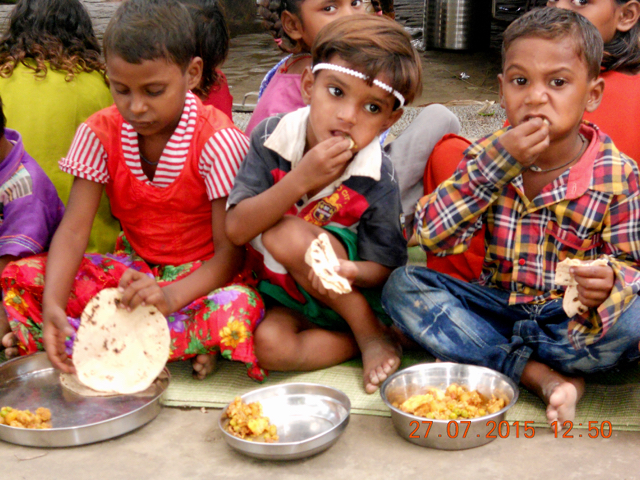
We are in the midst of a crisis and witnessing the short term measures: schools are closed for three days, trucks have been stopped from plying and people have been told to stay indoors. Closing schools may be an option for children from better homes, they can sit in their room with air purifiers, but what about children from slums who live close to polluting factories and whose homes are dark and insalubrious and so small that you can barely stand. Such children have no option but play outside in the haze and dust. Where else can they go.
With schools closed, many of the younger children will miss their midday meal something they look forward to! But notwithstanding this, it is certain that slum children will breathe in more toxic air while schools are closed. But does any one care?
And come to think of it, do we really care about the environment or do we too only react in times of crises by blaming the government and demanding remedial measures.
The sad reality is that when there is no crises each one of us is a big polluter. How many of us will take public transport? Far from that, in rich Delhi people of a same family got to the same wedding in different cars! How many of us do not use plastic, segregate garbage, do not litter, save water and so on. Not any is any. So are we not all at least a little responsible for the mess we are in?
Is it not time that we take action and commit to play our part in saving the environment.
Came across an interesting article on the need of sex education in India. Sex education is a highly controversial topic as for some it is seen as offensive to Indian values, and concerns that it might lead to risky sexual behaviour and promiscuity. What its detractors do not understand is that it is quite the opposite. UNESCO defines sexuality education as one that “provides opportunities to… build decision-making, communication and risk reduction skills about many aspects of sexuality…. encompasses the full range of information, skills and values to enable young people to exercise their sexual and reproductive rights and to make decisions about their health and sexuality”.
Wonder why those who oppose it do not see the situation on the ground with rape, teenage pregnancies and sexual abuse on the rise in a alarming manner.
Adolescents need to be taught age appropriate sexual behaviour or else they will be unable to reign in the raging hormones. If not in homes, then the only alternative is in schools. Some feel erroneously that if there is sexual education everyone will only talk of sex. But that is not true. Sexual education is about knowing your body and its changes, about understanding consent, about learning to interact with the opposite sex.
One cannot be prudish about this.
A very pertinent spoof was made on what would sex education look like in our patriarchal society.
It is so true. We are even afraid of mouthing words like sex!
At project why we have regular workshops on adolescent issues. We feel these are an intrinsic part of growing u in today’s world where teenagers and even tweens have access to unrestricted internet via the smart phone. Teaching age appropriate behaviour is an absolute must. Gender equality has to be taught albeit in our patriarchal society.
Sex education has several benefits:
1. It can help students understand that attraction to the opposite sex is a biological phenomenon.
2. It can do away with the taboo and stigma surrounding sex.
3. It can educate children on health issues related to sex and lower the rates of teenage pregnancy.
4. It can prevent gender and sex related injuries and violence.
5. It can enhance the psychological, sexual and reproductive health of students.
But the Government is even weary of using the word ‘sex’ in any programme on adolescent issues. Some feel it is against vedic values, and a top cop even said it would increase the number of rapes.
Sex education is taken seriously in many countries.
In Holland ‘Lentekriebels’, a government subsidised programme for children aged between four and twelve, is carried out every year. Under this programme, children are taught about relationships, sexuality, the act of cuddling, friendship and also about new born babies.
In Denmark children are made aware of what sex is in a very simple and clinical way. They even have picture books for little children to understand the process of having safe sex. The process is explained factually through cartoon-like graphics.
Comprehensive Sexuality Education (CSE)is much more than sex education: It covers the physical, biological, psychological and social aspects of a person’s being and sexuality. It covers issues like bodily changes and differences, and relationships with other youngsters, teachers, and society at large, to discussing important social issues like bullying, abuse, infections, and breakups. And yes, it also provides information about sex along with the importance of consent and safety, all in age and stage appropriate terms.
Efforts are being made by the Government but civil society has to back it up. 2017, the Ministry of Health and Family Welfare launched the Saathiya resource kit for young people. It is a progressive approach and covers six important adolexent issue: nutrition, sexual and reproductive health, non-communicable diseases, substance misuse, injuries and violence (including gender based violence) and mental health. However it relies on peer educators and an app and thus cannot reach every adolescent.
CSE is essential to help a child navigate through puberty to adulthood, more so in a country where questions are met with silence or raised eyebrows.
A recent report from theInternational Food Policy Research Institute states that “India is ranked 100th out of 119 countries”. The indicators used are : undernourishment, child mortality, child wasting and child stunting.
The statistics of 5000 children under 5, dying of malnutrition related issues remains unchanged. I have lost count of the number of times I have written about this. 5000 children a day, that is almost 4 children every minute. It is a statistic that should shock us but sadly it does not. We have become inured I guess, or is it that it is not our children who die @4/minute.
Last week a 11 year old died of hunger! Some administrative glitch The blame game is on. Soon politicians will jump in the fray but the bottom line is that a child died because she had no food. Her family was stripped of their ration card and the little they were entitled to.
I once again revisit all that I have written about malnutrition. I cannot but recall the words of Mahatma Gandhi: “Recall the face of the poorest and the weakest man whom you may have seen, and ask yourself if the step you contemplate is going to be of any use to him. Will he gain anything by it? Will it restore him to a control over his own life and destiny? In other words, will it lead to Swaraj for the hungry and spiritually starving millions?”. Does anyone remember them today?
The Bill introduced in Parliament few years ago with the mission to ensure no one goes hungry seems to have fizzled out. Schemes to help the poor are multiple and seem to add that feel good quotient but do nothing on the ground. The spectre of malnutrition looms large. And statistics remain the same: 43.5% of children are underweight; 50% of children’s death are attributed to malnutrition, 46 per cent of all children below the age of three are too small for their age, 47 per cent are underweight and at least 16 per cent are wasted; anaemia affects 74 per cent of children under the age of three, more than 90 per cent of adolescent girls and 50 per cent of women.
What do we do? Continue wasting food?
Peek into your garbage bin and ask yourself how many of the things you have thrown are still edible. Look a the your plate at the next party, wedding you go and see if it is empty before you put it down. Next time you are asked by your pandit to offer milk to the goods, ask yourself if that very God would not feel more propitiated if you offered it to a child?
Will we ever light a candle for these 5000 children we lose every day?
When will the horror of malnutrition move us out of our apathy.
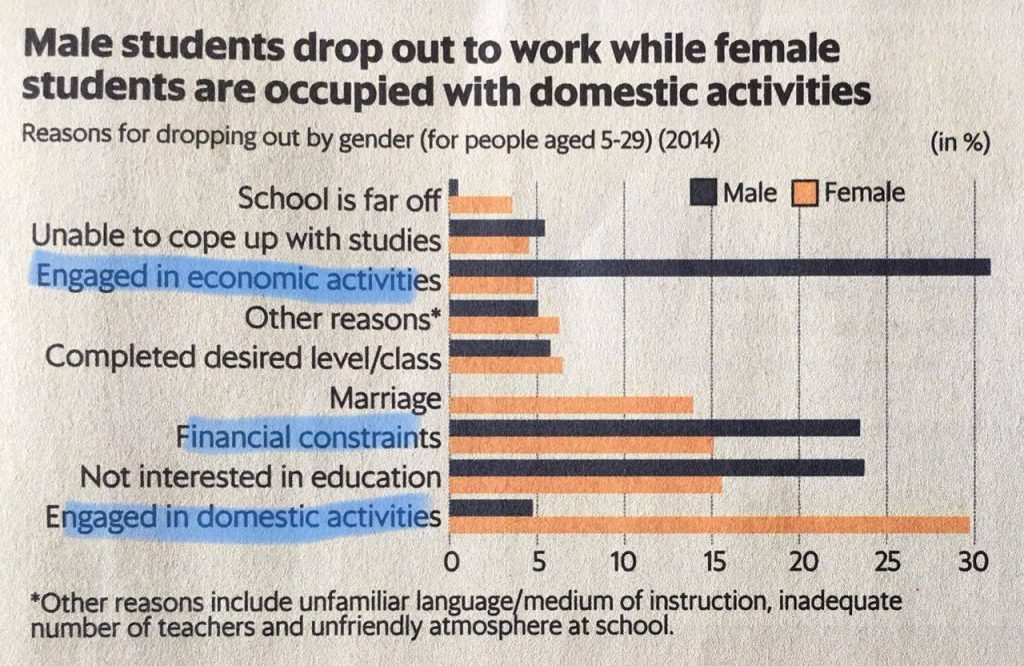
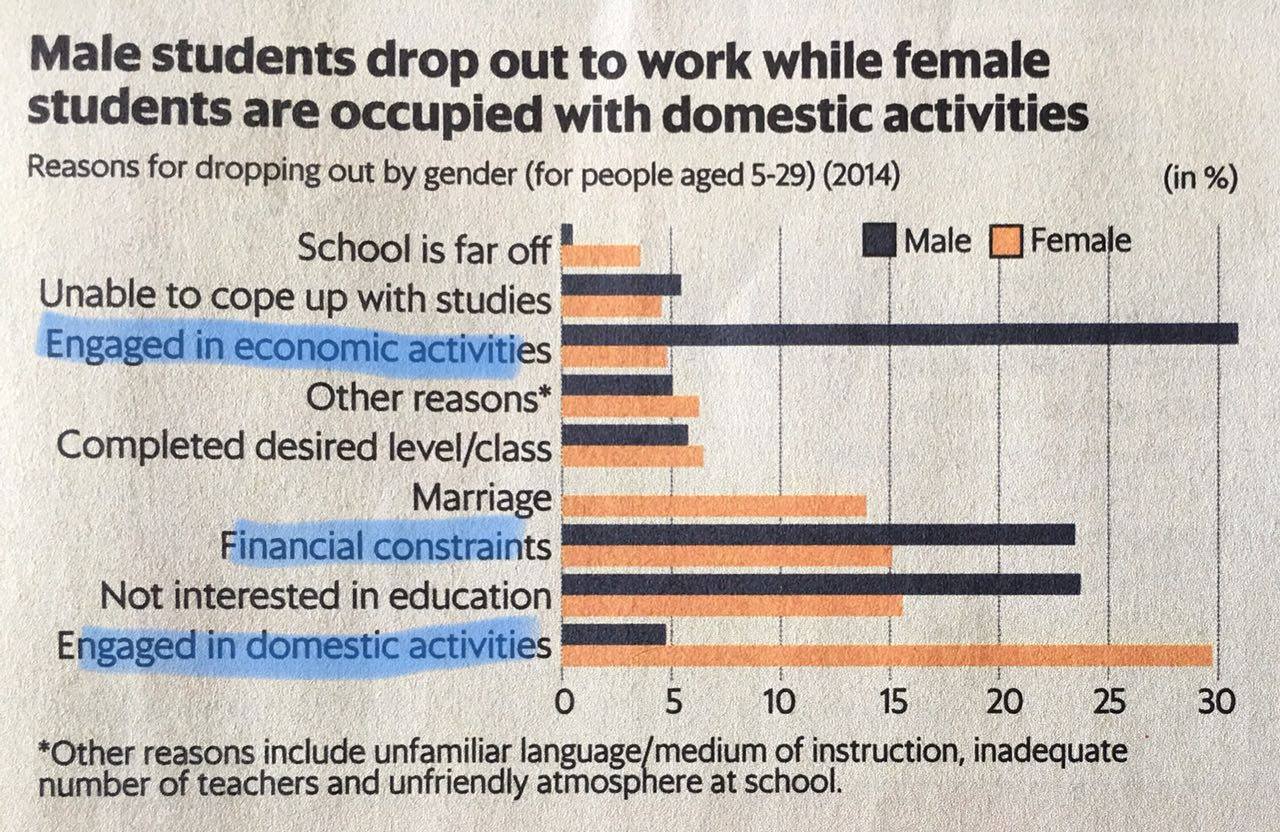
This graph appeared in a recent newspaper. It makes for interesting reading as to the situation of school drop outs in India. For us at Project Why, its is of prime importance as our primary mission has been to contain school drop outs something we have done quite successfully over the past decade and a half. The other facet of our work has been our relentless effort to mainstream as many children as possible. We must have pushed back hundreds of children to school.
Our work continues.
However seeing statistics like these makes us weary and a tad sad. What held true in 2000 still occurs 14 years later. Nothing seems to change for one end of the spectrum while on the other we witness proliferation of new swanky schools. The school business only thrives for some, the others remain in the dark.
Girls drop out for the same reasons year after year and we can almost say generation after generation: distance of school from home, marriage, engaged in domestic activities, financial constraints, lack of interest etc. Some of these reasons are akin to those we face as we often have to persuade families to allow their girls to study.
Boys too drop out for the same reasons as those mentioned: to help the family finances or simply by lack of interest. One needs to remember that children from poorer backgrounds rarely get marks allowing them to pursue higher studies in affordable institutions. Joining the work force is often their only option.
Containing school drop outs remains a challenge even after 17 years of our existence. At times it seems like a Sisyphean task! But as I always held when faced with the daunting task ahead, even one drop out contained is worth every effort put in.
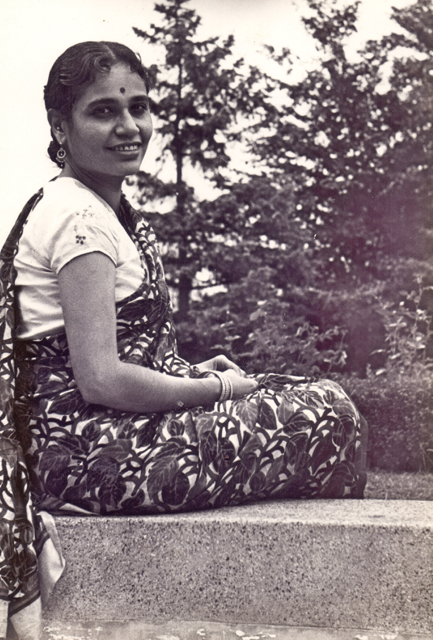
Kamala Goburdhun née Sinha 15 October 1917 – 13 June 1990
It is Kamala’s centenary today. It will be celebrated in the centre that is named after her and where two of her most cherished ideals are pursued: education and women’s empowerment. It will be a low key affair, a far cry from the loud and impressive centenary celebration of her better half a few years ago. A tribute to who she was: discrete while being strong, opting for the behind the scenes role as that is where she could truly colour the whole show.
She left this world 27 years ago but has never failed to guide me in every thing I have done, just as she did when she was alive. I feel her presence around me with every breath I take.
I am often asked why I decided to set up Project Why. There are many reasons, but one is undoubtedly the lessons learnt at Kamala’s knee. These were cameos of her life that she shared candidly leaving them to seep through my heart slowly, knowing that they would reach their destination one day. The destination was Project Why.
Kamala’s education was nothing short of a saga worthy of being brought to life in a TV soap! Kamala was the eldest child of a freedom fighter and in many ways his favourite. When the first girls school opened the town she lived in, she was rearing to join. Her father indulged her thinking that a few years of schooling would be a good thing. He never knew he had opened the floodgates.
Kamala had two formidable allies in her quest for education: her mom and her paternal grand mom both women way beyond their times. To ‘tame’ the freedom fighter they would use his own weapon: hunger strikes! So when Kamala wanted to study beyond primary school and the father was reluctant out came the big guns: Kamala went on a hunger strike! The two ladies would stand with forlorn faces just as the father sat down to eat and needless to say, he would relent. Sometimes it took more than a day but Kamala was fed at night by her two supporters. Hence she studied all the way to her matriculation. I guess my grandfather thought it would stop there as there were no institutions for higher studies in her city. But he did not know his women. Up came another hunger strike, this time a little longer, but permission was given to go to BHU in Varanasi to do her BA. Then would come an MA and LLB but by that time her father had surrendered totally.
Kamala also convinced her father that she would not marry unless India became independent. She did not want to give birth to a slave child. Life as a old maid was a better option.
So what would this tiny feisty educated young woman do? The unthinkable! Women’s equality is something she believed in fiercely and she knew that was her calling. She wanted to do something meaningful. After long discussions with her freedom fighter father she decided to work for the British so that she could ensure that war widows of WW II got their pensions, a pension that was often usurped by some male member of the family. This meant that she would have to leave her home and live alone in Delhi. Kamala drove a truck into the remotest villages of Uttar Pradesh and ensured that the young widows got their due. While in the village Kamala would talk to the women on several issues life hygiene, child marriage and girl’s education. All this when women her age were already mothers of many.
Kamala knew how to make a difference. She had the courage to stand for what she felt was right and never shirked from walking the road less travelled.
In a recent heated debate on women safety, a spirited woman anchor told a politician that she and for that matter all women, were not anyone’s daughters or sisters or wives. She wanted to be considered simply as a citizen enjoying the same constitutional rights!
A recent article entitled: There’s more to women than being betis and biwis, seconds that statement. Recently two young diplomats, who also happen to be women, were feted for their spirited defence of India at the UN. For the author and for man of us women, these remarks reek of patriarchy. We are sick of hearing politicians spout ‘our daughters’, or ‘just like our daughters’ when any issue concerning women is discussed be it safety or even rape.
Different rules are set up in universities for the so called daughters as it seems that they ‘need’ to be protected! Patriarchy seems to follow women no matter what they do or how high they reach. The sickening ‘in spite of being a woman’ is galling.
As long as this attitude remains, nothing is going to really change.
Women want to be considered as equal partners and so if the roads are safe for men, they should be for women too. We do not want to be talked down too or clubbed as the weaker sex.We want to be treated and recognised as professionals minus the ‘even though they are women”.
Nobel Laureate Kailash Satyarthi’s launched a ‘Bharat Yatra’ against child abuse on Monday with the words: “Each time when a child is raped, our conscience, innocence is raped. I am not going to tolerate this. I am going to change this.”
The sad reality is that a child is raped with regularity in this land of ours. Children are raped within he safety of their homes or school. Just last week a 5 year old was murdered in a prestigious school in India’s capital city. In another horrific incident a minor was gang raped by the school owner and a teacher for months. The incident came to light after a botched up abortion organised by the perps. She is critical.
Nothing has changed in spite of public outrage following the Nirbhaya gang rape. Children are still being raped with impunity. Some cases make the headlines. But others remain cloaked in silence, a silence often linked to misplaced family honour. Rapes remain in the closet. It is time they were brought out in the open.
Madhumita Pandey is a student in criminology. For her doctoral thesis she interviewed over 100 rapists. This was prompted by the question she and each one of us ask ourselves: “Why do these men do what they do?” and then goes on to ask: “what prompts these men? What are the circumstances which produce men like this?” This is something we all want to know. Madhumita set out to find out from the horse’s mouth.
It is easy to call all such rapists ‘monsters’! To bung them in a category that has nothing to do with us. To think of them as some aliens from another planet. Anything else makes us uncomfortable. But that is not the reality. The reality is that they come from within our society. How can one forget that 90% of child sexual and other abuse is committed by people within the family or extended family.
When she interviewed the rapists in jail she realised that most of them are ordinary men, with little education, often school drop outs and what they did was related to the way they were brought up. Boys are given false ideas about their gender and most if not all the women they interact with are submissive. Consent is not part of their lexicon. Gender equality is an aberration.
Let us pause a little and look around us and ponder on the day-to-day reality of children growing up in what is undoubtedly a patriarchal society. Children are brought up in an environment where boys and girls are looked at up differently. If one is king, the other is more a slave! In school sex education has been obliterated as such topics corrupt the young and offend traditional values. All conversation about anything related to ‘sex’ is taboo. Never minds if hormones rage or if the young access the mine of information now available at the swipe of hand on the ubiquitous smart pone.
Rape should it occur, is quickly brushed aside with a boys will be boys, or he had too much to drink, or why was she out at night, or the ever present family honour. One cannot begin to imagine how many cases of child sexual abuse are brushed under the carpet to guard family honour.
So what needs to be done. First accept that the real cause lies within our society and that it needs to be addressed head on. Sex education has to come back on school curricula asap! Young children have to be taught to say NO! They have to be taught ‘good’ touch and ‘bad‘ touch and have to be heard. It is imperative to give children a voice. And it is imperative to respect that voice. Even a sex worker has the right to say NO!
A child needs to have an adult it trusts and can go to in case of need. If not someone in the family, then a teacher or care giver. A loud NO the first time any such dastardly incident occurs is all it needs to stop any further abuse.
Perhaps it is too late to change the well ingrained mindset of adults. Let us at least strive to make the next generation aware of gender equality and consent.
I recently stumbled upon an article entitled: India’s education system is broken beyond fixing; we need to reimagine it entirely. It caught my attention as this is something close to my heart. The author refers to education as being a ‘terror outfit!’. It kills an average of 20 teenagers everyday due to academic pressure. For her the indian education system is nothing short of calamitous.
She retraces the origin of the education as we know it today and quotes an interesting excerpt of a TED talk that sums it all: “The schooling system as it is today goes back to 400 years of an empire’s colonisation and this empire needed three kinds of people: Soldiers to protect their land interest, clerks to run their offices and, after the industrial revolution, assembly line workers to make things. So for 400 years we produced millions and millions of people like them and what are the properties of those people? They should be able to understand instructions, follow them and most importantly, they should not ask questions and they should not be creative. Imagine if an assembly line worker started being creative! o produce millions of such people, what the empire basically needed was a system that kind of worked like a factory. You take raw materials, subject all of them to exactly the same processes and conditions and finally test them. The finished products that clear the test are ready to be sold and the remaining products are simply passed off as defects. The empire managed to build such a system and a very efficient one that: The schooling system.
And we have been nurturing this system for four centuries. This system is obsolete and cannot be fixed. It has to be re-imagined. In tomorrow’s world where AI will reign and robots proliferate, such products will be jobless. In India the number is staggering: 600 million in a scenario where 68% of the jobs will be sacrificed at the alter of automation.
Who will bell the cat, or will anyone bell the cat. Without sounding alarmist, it is imperative someone look at this in time.
The question remains as to whether we can ‘fix’ the system as we know it. First and foremost ne can of course try and ensure that the system as we know it works as in many ways it does not. Over the years the rot has set in and a system that once worked is now hijacked by the absurd race for marks. Maybe that is the first thing that should be addressed as it is also the cause of the many suicides we see. A couple of decades ago 60% was considered to be top of the scale. Today it is close to failure. I felt extremely disturbed when I heard a topper question why she did not get 100% in a particular subject as she has mugged the entire book by heart.
That is what we have let our education become: the art of rote learning. A child has to give up everything to mug books by heart. Our education system has hijacked everything that is the prerogative of a child: playing, singing, dancing, running, laughing, giggling, day-dreaming, having fun, being creative and above all being a person. It is time all this was reinstated.
Learning by rote is useless. Once you have regurgitated what you learnt at the given exam, you forget it all. Learning is about understanding, interpreting, reacting, giving your opinion and it is possible but is needs commitment and motivation from the teachers. I remember the question I had to answer way back in the sixties at my History exam for my Baccalauréat. It was an oral exam without any choice. The syllabus was World History from 1914 to present days. The question I got was the following: Had the Allies lost the war, what in your opinion would have been the economic situation today! There was no correct answer, you simply has to analyse what you hd learnt and give your opinion and defend it. Rote learning in this case would have got you nowhere.
This happened over half a century ago and I still remember the question and my answer. That is because we were made to comprehend what we were taught. Maybe the first step to take is to teach our children to understand what they are being taught. That would challenge every child’s independent thinking.
School curricula are being reviewed the world over. Finland seems to have got it right. Please watch this Michael Moore’s film!
I send my child to school because I believe my child will be safe.
This is undoubtedly what most parents feel when the wave goodbye to their child at the gate of the school or the school bus stand. But all changed on the fateful day when a little seven year old was brutally killed within the walls of his school. The case remains unsolved and gets murkier by the day as a cover up game is on!
The terrible crime sends chills down one’s spine. Imagine a little boy who saunters happily to school in the morning, needs to visit the loo and is brutally killed, his throat slashed. His fault? Trust. Trust that in his school he is safe. A culprit had been ‘identified’. Is he the real culprit. The sexual assault angle has been negated by the autopsy. A fact finding committee has come out with glaring lapses in security measures. The Government has stepped in and may take over the school for a period of time. The case has been taken over by the country’s leading Intelligence organisation. But all this can never bring back the little victim to life.
Today as we sit and wonder why this happened and where did we go wrong, many things come to mind. As we look back on the recent history of education in free India, what stares us in the face is its commercialisation. Education is now a business. and in business it is not the child that is the centre of attention, but the money that can be made. The equation is skewed and unless its is redressed, the likelihood of another child being hurt is very real.
The question is: how does one balance the two, or rather can one balance the two.
I have always held that education should be equitable and free for every child born in this land. Thus education should be imparted in state run neighbourhood schools where children of all walks of life should share school benches. Isn’t education meant to be an even playing field.
Sadly this is not what seems to be the chosen option. Education is a business and no matter how many checks and balances one comes up with, one has to remember that market forces dictate businesses.
Memory is short. Soon this terrible crime will be forgotten. Things will go back to what they were.
Will it take another child’s life to bring us to our senses. Let us not forget that one child dying in one child too many.
This post should have gone up a long time ago! All in perfection as it is said. Our website crashed and for almost a month we were ‘under construction’! But we are back now.
A few weeks ago we bid farewell to our dearest Carla: friend, mentor, fund raiser extraordinaire and above all the rock we needed to lean on. She came to us at a time when we needed her most and held our hands ever so gently throughout the makeover that was crucial to our existence.
The organic, from the heart, slightly topsy turvy organisation I had steered for a decade and a half had to be given a new image to meet the requirements of the world it had to now step in. It was the world of strategic plans, assessments, reports and projections in time – words we barely comprehended – and we were lost. Till date Project WHY had functioned in reverse mode: first the why that needed an answer and then the resources to meet it. In the new scenario essential for sustainability, we needed to first plan and then raise the money. Daunting to say the least. But thanks to Carla’s extreme patience and caring approach the transition was painless. The reason was that her heart beat for Project WHY and hence she never lost sight of its spirit.
We came close to losing her as the initial days were a bit choppy. We could not understand why she wanted to organise things. Mercifully the penny dropped in time and that was the beginning of the most beautiful relationship.
Through many meetings and workshops Carla introduced us to the demands of the outside world and slowly but surely we completed our makeover. I hope she is proud of what we achieved. She also was a star fund raiser who came to the rescue every time we were in need devising new ways of garnering support. Being a mean photographer she participated in the creation of a beautiful coffee table book on Delhi, the proceeds of which were donated to us. But that is not where it ended, she also commandeered the support of her family making Malte her lovely son one of the youngest donors we have as he set out to collect money with his Scout Cubs and come and paint our Okhla school. We were extremely touched when Peter her husband decided to forego his birthday presents and ask his friends to donate to his wife’s favourite charity.
Favourite charity! How lovely these words sound. And to return the compliment can we say that Carla was our favourite: friend, supporter, mentor and so much more.
We will miss her. We will miss her kind heart and her loving ways. We will miss her wise counsel. We will miss her presence.
I know she will be back! But till that day she lives in our hearts forever.
Two Angels landed in my life without any warning and changed my life forever. The first was Manu. Manu was the kind of being you pass on the street and never look at. To many he would be just a beggar who seemed deranged and bedraggled. He roamed a street I passed regularly. I often wondered what could have got him there, but it was a fleeting thought that disappeared in a trice. But one fateful day the heart rendering cry he let out as he was being riled by someone pierced my heart and soul in a way that I cannot describe in words. It was like a deafening cry for help targeted at me and demanding to be heard. I did hear it. The rest is history, something I have written about time and again. Manu was a mirror to my soul, the reason that really made me take the less travelled road. His mission as I see it was to show me the way at a time when I was somewhat confused and did not know which way to go.
All I knew at that instant was that I had to help him. How to help a beggar who roams the streets is not written in any book, you just have to find your way. And in finding my way, a larger plan enfolded called Project Why! I made myself a promise that no one knew till maybe much later. Manu would one day have a warm bed, a set of friends; would share a meal around a table, and would watch TV to his heart’s content.
To many it would have sounded ludicrous but to me it became a life and death decision. At that moment the ‘how’ and ‘when’ were of no consequence. As time passed we moved a step at a time towards a dream that rested in the recesses of my mind.
Project Why grew by leaps and bounds. Every day was better than the previous specially for Manu. He was bathed, fed and had his own bed in the veranda of what was our office. And when we launched our class for special kids, he was Roll no 1! So to some perhaps it could seem that the game was over, never mind the dining table or the TV. Not not for me. The small challenges and big ones we managed to overcome gave me the audacity to start dreaming big, too big. Was it hubris? I do not know. Maybe. The idea emerged in my mind when we began thinking about long term sustainability. While on the ground the ideas were mundane – chocolates, earthen lamps, candles, paper bags and even pongamia oil soaps – my mind was busy conjuring what came to be know as Planet Why! In its first iteration that was in my head it was to be a place where Manu and his mates could grow old and die with dignity. I imagined a green building, with terracotta bricks and old style floors, with arches and little windows that would let the breeze in. It would be Manu’s home, and workplace as he was able enough to learn gardening. And the strange things is that many believed in this dream. We bought the land, drew the architectural plans and set out looking for funds.
But then on a cold January Day in 2011, my dreams did not fit with those of the Gods of Lesser beings.
They decided Manu had completed his mission and he breathed his last leaving me lost and rudderless. There would be no Planet Why for Manu.
The best I was able do was craft a small residential unit where Manu and a bunch of special and regular kids lived together. Yes there was a dining table, there was a TV, there was a refrigerator and cold water and special treats. Often it was Manu who decided the menu and of course we never ran out of biscuits, Manu’s all time favourite. Manu died quietly after having had his tea and biscuits. The Angel who sustained and protected me for more than a decade flew away leaving me with one unanswered question: did I fulfil the silent promise I had made to myself.
When I feel a little lost ,all I have to do is look at his smiling face that sits on my wall frozen in time and remember that the only way to honour his memory is to continue my journey.
After the death of her parents, Anouradha Bakshi felt lost and without direction. Then she met Manu, a homeless man whose trust and friendship gave her back a reason to live—and inspired the creation of Project Why.
I would keep the excerpt fairly simple. The article itself is deeply emotional, so the excerpt should create curiosity without trying to tell the whole story.
Editorial table
Original Title: Manu New Title:The Boy Who Gave Me Back My Life Rating:10/10 Status:Ready after edit Notes: The origin story of Project Why, told through the extraordinary relationship between Anouradha and Manu. A deeply personal and emotionally powerful piece about grief, love, human dignity and the way one life can change another. Manu is revealed not simply as the inspiration for Project Why, but as the person who gave Anouradha a reason to live and a path forward. The essay is both the emotional and historical foundation of the Project Why archive. Cornerstone?:Yes — essential cornerstone
I would give this one a 10/10, rather than 9.5. Not because it is technically perfect, but because its importance to the Project Why story is unmatched.
You now have seven cornerstone pieces. And this one is the foundation stone—the story from which the others, in a sense, grew.
Yes. I’ve got the main Utpal piece. And I can already see the shape of it.
Before we rewrite, I want to make one important editorial decision: the story should begin with the boiling pot, but it must not remain a story about a terrible accident. The accident is the doorway. The real story is:
A child whom the world had almost given up on survived—and then became someone who helps other children find their own confidence and creativity.
That is much more powerful.
The current piece has four distinct movements:
The accident and the fight for survival
The loss of his mother and Project Why becoming his family
The child growing into a talented, generous young man
The adult finding his own path in film and media
I would also keep the final quote about having spent one-third of his life in pain. It is a very powerful way of reminding the reader what he overcame.
I suggest we start with the opening only. I would rewrite it like this:
In March 2003, the day after Holi, we heard that the little boy who had recently moved into the neighbourhood had fallen into a pot of boiling water.
We barely knew him. His family had moved to Giri Nagar only a few days earlier. We felt sorry for the baby and, as people often do, went on with our lives.
A few days later, we heard that he had not died after all. He had been sent home from hospital.
When we saw him, we were shocked.
He was a tiny bundle wrapped in bandages, with a bewildered look in his little eyes. The hospital had sent him back, telling his mother that he would not survive.
We thought otherwise.
With the help of Sophie, a young nurse from Belgium, and Rani, we fought for him day and night.
And six weeks later, Utpal smiled.
We knew then that we had won.
I think “We knew then that we had won” is a wonderful opening section. It gives the story a clear emotional beat.
Have a look at this first section and tell me when you’ve put it into your document. Then we’ll move to what happened after he survived, which is where the story becomes even more complex.
extra
Yes—please paste the extra snippets as well. I’ll read them alongside the main Utpal piece before we continue rewriting. They may give us the missing details, especially about his personality, his relationship with the children, and the later stages of his life.
I am just back suitcase shopping. Not for me though! I do not travel. Come Monday Utpal will board a train and leave for Mumbai to fulfil his dream of working in the movies. The stage is set for him as Mrinal and Abhigyan wait for the shooting of their next serial. My mind goes back to 2006 when I had gone suitcase shopping for him as he was going to boarding school. He was 4. We bought a little red bag and filled it not just with the things on the list given to us by the school, but also with a plethora of dreams yet to be revealed and fulfilled. Today one of these comes true. Over the past years as he moved from class to class we packed many suitcases for him never forgetting to tuck in the yet unfulfilled dreams. If his going to school the first time was a rite of passage for the two of us, today as he moves into the adult world is yet another one we both have to go through. I remember when he left for school the first time, I wept like a baby, a mix of feelings gushing through my mind, and my heart being ripped wide open. Was I doing the right thing in sending such a tiny tot to a big boarding school. The mind jumped in to quell the heart: it was for his good; education was what would make the dreams come true. The primary years ended and we moved to secondary school, then the final examination and results. School days were over. Then came college in another city a few hundred kilometres from here. His BA in hand, Utpal came to Delhi for his internship and then secured a job in a digital media start up. But that was not in the dream box. I was happy having him at home, seeing him every day. It was comforting but as I said not part of the dream. I was quite happy the way things were but not the God of small things to whom all dreams were entrusted. He had to make them come true. So the universe conspired to make things happen and they did at lightning speed: a phone call or two and before we knew it Utpal had a job offer and even a place to stay for the initial days. It was time to go. The last few days have been busy shopping, packing, cooking special treats. No one is saying anything. Each quietly counting the days till the suitcases are ready to move and our little Utpal with them. The coming days will be hard. Keeping a brave face is hard. The half packed suitcase in the room stares at me and I feel my throat constrict and my eyes well up.And I am not the only one. Though no one says anything. There are so many things I want to say but can’t. I find myself patting his cheek or giving him a furtive hug and walking away. I know I have to let him go as that is the only way he will be able to find his wings and fly and let him go I will as there is no other option. I know that when it is time to leave the house, I will send him off with a smile and the right words but I also know that when the car is gone and one has stopped waving goodbye, I will break down and weep. But suitcases with dreams have a destiny to fulfil. I will simply pray everyday to the God of small things to take care of my darling child and walk with him always. “All God’s angels come to us disguised” said James Russell Lowell. Utpal a.k.a Popples, and Outpal to all his friends is a force to reckon with, and a great lesson in survival. From a young age, he suffered third degree burns, double pneumonia, acute hepatitis A, and he never gave up. Utpal and his family moved into the tiny hovel adjacent to the Project WHY office, Giri Nagar in February 2003. In March 2003, the day after Holi, the ‘little boy next door’ had fallen in a boiling pot. The tiny boy sustained third-degree burns. The hospital gave up hope for the child’s survival when the discharge slip read – “Chances of survival – Nil” Project WHY, along with the help of Sophie, a volunteer nurse from Paris assisted in nursing Utpal back to health. In time Utpals scars healed, and the frightening reality of his existence emerged – alcoholic parents, violence, abuse and no clear plan ahead. His family was completely dysfunctional and not a healthy environment for a child to grow. Utpal negotiated both worlds the best he could. In 2003, Utpal started attending Project WHY in the day time and at night stayed with his parents. If the days were safe as both mother and son were under Project WHY’s care, conversely the nights were unpredictable – with nothing to eat at home and the possibility of ending up at the police station. He was an endearing child and wise beyond his years. Should anyone want to visit his home he would run ahead on his chubby legs to hide the alcohol bottles consumed by his mother at night, saying: “Mama was naughty.” As Utpal’s mother’s alcoholism became unsafe for the child. Project WHY stepped up and sent the mother to rehab for women and Utpal in boarding school. At that time Utpal was just 4 years old. The separation was hard for Utpal, but as he accompanied Project WHY resource person to the rehab centre; he bid farewell to his mom with a smile as he knew he is safe but above all his mom is safe. The intermittent years were not easy. Utpal learned to integrate into his new life at the Boarding school but would still come to his family on holidays, where the situation continued to worsen. Another incident compelled Project WHY to step in again – that of securing his legal guardianship, as it was feared that the family might take him out from boarding school and vanish. Project WHY’s founder, Anouradha Bakshi was made his legal guardian. As the years rolled by, Utpal taught us many things but most of all the meaning of dignified acceptance in the wake of any adversity: from excruciating pain that third degree burns bring, to the abject humiliation you suffer when those you love the most let you down. Looking back, Utpal was an ideal candidate for begging at a red light. Drunk parents, a nicely scalded body and yet an incredibly beautiful personality. With a little help from a network of friends who held on to the dream, of a better life for Utpal with Project WHY, made it possible for Utpal to survive and slowly transform his life. Each day goes by with making small memories which is captured in the little book called “dear Popples. with love Maam’ji” which will stand in for all the memories that Utpal may need as he grows into a man. Today, Utpal is 15 years of age and attends grade X at the boarding school. He is making up for all the lost years and the wise little chap of yesteryear has given way to a delightful adolescent with all flaws that come with the teen-age. He has made friends with his scars that had made him the butt of a lot of bullying and riling. He’s now a natty lean young lad, a mean skater, who teaches skating to smaller children in his school, plays tennis and football. He’s extremely fond of ‘engineering’: he takes apart a multitude of objects and rebuilds them when he’s at his guardian’s home for the holidays. He loves music and dancing like any other 15-year-old waiting for his dreams to unfold.
Ah—this extra material is extremely useful. In fact, it changes the shape of the article quite substantially.
The original piece tells us what happened to Utpal. These additional passages show us who Utpal was.
And there are some beautiful details here that we absolutely should preserve:
the little red suitcase;
the dreams packed into it;
the four-year-old hiding the alcohol bottles and saying, “Mama was naughty”;
his mother going to rehabilitation;
the pain of sending him to boarding school;
the later suitcase taking him to Mumbai to pursue his dream;
and the idea that the same child who once needed to be carried into a new life eventually had to be let go so he could fly.
That gives us a much stronger structure.
I think the article should probably open with the little red suitcase, rather than the accident.
Something like:
I was suitcase shopping recently.
Not for myself. I do not travel much.
This suitcase was for Utpal.
And as I stood looking at it, my mind went back to another suitcase—a little red one I bought for him nearly two decades ago.
Utpal was four years old then, and he was leaving for boarding school.
We filled that little red suitcase with everything on the list given to us by the school. But we also packed something else: a whole collection of dreams waiting to be discovered and fulfilled.
Over the years, as Utpal moved from one stage of his life to the next, we packed many more suitcases.
And we never forgot to tuck in the dreams that were still waiting for their turn.
Today, another suitcase is ready.
And this time, Utpal is not leaving for school.
He is leaving to begin his adult life and pursue his dream of working in films.
The little boy who once needed us to help him find his way is now ready to find his own.
I think this is much more emotionally sophisticated than beginning with the accident. Then we can go back in time:
But before we talk about the young man leaving for Mumbai, we need to go back to the little boy who almost did not survive.
That one line tells us more about the little boy and the terrible situation he was living in than a whole paragraph of explanation.
The other sentence I especially want to preserve, in some form, is:
“I know I have to let him go as that is the only way he will be able to find his wings and fly.”
That is the emotional heart of the whole story.
So I suggest we do not yet rewrite the accident section. First, put this new opening into your document. Then we can move from the suitcase back to March 2003 and build the story chronologically from there.
Agrees, so can, I’m a little confused, so can you give me the entire beginning from the beginning? Thanks.
Of course. And you’re right to ask for the whole beginning—when we are working with several versions, it is very easy to lose track of which paragraph comes where.
Here is the complete opening section, from the suitcase through to the accident and Utpal’s survival. You can paste this as one continuous section:
I w
In March 2003, the day after Holi, we heard that the little boy who had recently moved into the neighbourhood had fallen into a pot of boiling water.
We barely knew him. His family had moved to Giri Nagar only a few days earlier. We felt sorry for the baby and, as people often do, went on with our lives.
A few days later, we heard that he had not died after all. He had been sent home from hospital.
When we saw him, we were shocked.
He was a tiny bundle wrapped in bandages, with a bewildered look in his little eyes. The hospital had sent him back, telling his mother that he would not survive.
We thought otherwise.
With the help of Sophie, a young nurse from Belgium, and Rani, we fought for him day and night.
And six weeks later, Utpal smiled.
We knew then that we had won.
I think this is now a very strong opening because it gives the reader the destination first, then takes them back to the beginning.
And the little red suitcase becomes a wonderful recurring image throughout the article.
The next section should deal with what happened after Utpal survived: his home life, his mother’s alcoholism, the dangerous environment, and the decision to send him to boarding school. That is a difficult section, and we should handle it with care and dignity.
now next
Yes. Now we move into the difficult part: Utpal survives, but survival is only the beginning.
I would write the next section like this:
Utpal was a survivor.
But surviving the burns was only the beginning of his story.
His home life was far from safe. His mother struggled with alcoholism and mental illness, and the family environment was deeply dysfunctional. During the day, Utpal was safe with us. At night, however, life could become unpredictable.
There were nights when there was nothing to eat at home. There were times when his mother ended up at the police station. And there were moments when a little boy had to deal with situations no child should ever have to face.
Utpal, however, seemed to understand far more than a child of his age should have.
If someone wanted to visit his home, he would run ahead on his chubby little legs and hide the bottles of alcohol his mother had been drinking.
“Mama was naughty,” he would say.
The words were innocent.
The reality was anything but.
We tried to help his mother. We eventually arranged for her to go to a rehabilitation centre, while Utpal went to boarding school.
He was just four years old.
The separation was difficult for both of them. But when Utpal accompanied one of our resource persons to the rehabilitation centre to say goodbye to his mother, he smiled.
ok
This section takes us naturally from physical survival to the much harder question of how a child survives a chaotic childhood.
The next section will be the boarding school and the loss of his mother, followed by the moment when you became his legal guardian. That is where the relationship between you and Utpal becomes even more central.
ok
Good. We’ll continue from there.
The next section should cover the years that followed: Utpal adapting to boarding school, the continuing uncertainty around his family, and the moment you became his legal guardian.
The years that followed were not always easy.
Utpal slowly learned to adapt to his new life at boarding school. During the holidays, he would return to us, but the situation at home continued to deteriorate.
Eventually, we became afraid that his family might take him out of school and disappear with him. We could not allow that to happen.
So we stepped in once again.
I became Utpal’s legal guardian.
By then, he had already been through more than most adults could bear. The burns had left scars on his body. The chaos at home had left other scars, less visible but no less real.
And yet, somehow, Utpal kept moving forward.
As the years passed, he taught us many things. Perhaps the most important was the meaning of dignified acceptance in the face of adversity.
He had endured excruciating physical pain. He had lived with the humiliation of being let down by the people he loved most. And yet he never allowed any of it to define him.
Looking back, Utpal could so easily have become one of the many children begging at a traffic light.
Instead, a network of people chose to hold on to a different dream for him.
The dream was simple: that this little boy should be given the chance to live a different life.
And slowly, with a little help, he began to build one.
This gives us a strong transition from the difficult years into the Utpal who begins to emerge.
Next, we move into the lovely section about his personality—his scars, skating, dancing, football, taking things apart, and becoming the lively young man he was. That will bring some light and energy into the story before we return to the suitcase and his departure.
ok
Good. Now we let the story breathe a little. We move from everything Utpal survived to the person he became.
And then, slowly, the little boy began to grow into himself.
By the time Utpal was fifteen, he had made peace with the scars that had once made him the target of bullying and teasing. He was now a lean, stylish young man, a terrific skater who taught skating to younger children at his school.
He played tennis and football. He loved music and dancing. And he had a particular fascination with engineering—or what he called engineering.
Whenever he came home for the holidays, he would take apart all manner of objects and then try to put them back together again.
Sometimes they worked.
Sometimes they did not.
But Utpal was always willing to try.
The wise little boy of earlier years had become a delightful teenager, complete with all the imperfections and mischief that come with being fifteen.
He was also deeply generous.
During his holidays, he would return to the Khader centre, his first home, and teach the children to dance and draw. He had a way of reaching straight into their hearts.
To them, he was Utpal Bhaiya.
And Utpal Bhaiya was very special.
I’ve kept this section lighter and warmer deliberately. We need the reader to fall in love with Utpal as a person before we take him into the next stage of his life.
Next comes the transition into adulthood—his studies, his interest in media and film, and eventually the moment when the dream of working in movies begins to become real.
ok
Then let’s finish it.
But suitcases packed with dreams have a destiny to fulfil.
I knew that when the time came, I would send him off with a smile and the right words.
I also knew that when the car disappeared and I stopped waving goodbye, I would probably break down and cry.
And I did.
But that is what we do for the children we love.
We hold them close.
We nurture them.
And then, when the time comes, we let them go.
I will pray every day to the God of small things to take care of my darling child and walk with him always.
“All God’s angels come to us disguised,” wrote James Russell Lowell.
Utpal—Popples to me, and Outpal to his friends—is a force to be reckoned with.
He has survived third-degree burns, double pneumonia and acute hepatitis A. He has survived pain, loss and circumstances that could easily have broken him.
But he never gave up.
And now, finally, the little boy who once needed others to carry him towards his future is ready to walk there himself.
His suitcase is packed.
His dreams are waiting.
And it is time to let him fly.
I think “His suitcase is packed. His dreams are waiting. And it is time to let him fly.” is a very strong ending.
Now, once you have put this in place, we should read the entire article from beginning to end. That is important because we may discover a few repeated ideas or places where the transitions can be tightened. Then we can choose the final title, excerpt, rating, and table notes.
ok
Perfect. Once you’ve assembled the full article, we can do one complete read-through. That final pass is where we check the overall rhythm and emotional arc, rather than just individual paragraphs.
The story now has a beautiful structure:
The suitcase → the accident → survival → the difficult childhood → boarding school → growing up → finding his dream → the second suitcase → letting go.
That circular structure is doing a lot of work for us. When you’re ready, paste the complete article, and we’ll read it as one story.
I was suitcase shopping recently. Not for myself. I do not travel much. This suitcase was for Utpal. And as I stood looking at it, my mind went back to another suitcase—a little red one I bought for him nearly two decades ago. Utpal was four years old then, and he was leaving for boarding school. We filled that little red suitcase with everything on the list given to us by the school. But we also packed something else: a whole collection of dreams waiting to be discovered and fulfilled. Over the years, as Utpal moved from one stage of his life to the next, we packed many more suitcases. And we never forgot to tuck in the dreams that were still waiting for their turn. Today, another suitcase is ready. And this time, Utpal is not leaving for school. He is leaving to begin his adult life and pursue his dream of working in films. The little boy who once needed us to help him find his way is now ready to find his own. But before we talk about the young man leaving for Mumbai, we need to go back to the little boy who almost did not survive. His home life was far from safe. His mother struggled with alcoholism and mental illness, and the family environment was deeply dysfunctional. During the day, Utpal was safe with us. At night, however, life could become unpredictable. There were nights when there was nothing to eat at home. There were times when his mother ended up at the police station. And there were moments when a little boy had to deal with situations no child should ever have to face. Utpal, however, seemed to understand far more than a child of his age should have. If someone wanted to visit his home, he would run ahead on his chubby little legs and hide the bottles of alcohol his mother had been drinking. “Mama was naughty,” he would say. The words were innocent. The reality was anything but. We tried to help his mother. We eventually arranged for her to go to a rehabilitation centre, while Utpal went to boarding school. He was just four years old. The separation was difficult for both of them. But when Utpal accompanied one of our resource persons to the rehabilitation centre to say goodbye to his mother, he smiled. He knew he was safe. And, more importantly, he knew that his mother was safe too. That little boy had already begun to show us something that would remain one of his defining qualities throughout his life: an extraordinary ability to endure, to accept what life placed before him, and somehow to keep moving forward. The years that followed were not always easy. Utpal slowly learned to adapt to his new life at boarding school. During the holidays, he would return to us, but the situation at home continued to deteriorate. Eventually, we became afraid that his family might take him out of school and disappear with him. We could not allow that to happen. So we stepped in once again. I became Utpal’s legal guardian. By then, he had already been through more than most adults could bear. The burns had left scars on his body. The chaos at home had left other scars, less visible but no less real. And yet, somehow, Utpal kept moving forward. As the years passed, he taught us many things. Perhaps the most important was the meaning of dignified acceptance in the face of adversity. He had endured excruciating physical pain. He had lived with the humiliation of being let down by the people he loved most. And yet he never allowed any of it to define him. Looking back, Utpal could so easily have become one of the many children begging at a traffic light. Instead, a network of people chose to hold on to a different dream for him. The dream was simple: that this little boy should be given the chance to live a different life. And slowly, with a little help, he began to build one. And then, slowly, the little boy began to grow into himself. By the time Utpal was fifteen, he had made peace with the scars that had once made him the target of bullying and teasing. He was now a lean, stylish young man, a terrific skater who taught skating to younger children at his school. He played tennis and football. He loved music and dancing. And he had a particular fascination with engineering—or what he called engineering. Whenever he came home for the holidays, he would take apart all manner of objects and then try to put them back together again. Sometimes they worked. Sometimes they did not. But Utpal was always willing to try. The wise little boy of earlier years had become a delightful teenager, complete with all the imperfections and mischief that come with being fifteen. He was also deeply generous. During his holidays, he would return to the Khader centre, his first home, and teach the children to dance and draw. He had a way of reaching straight into their hearts. To them, he was Utpal Bhaiya. And Utpal Bhaiya was very special. After school, Utpal went on to study Mass Communication and Journalism. But his real education was happening elsewhere too. He had always been drawn to art, music, dance and storytelling. Now he began to find his way into the world of film and digital media. Between 2021 and 2023, he worked on small projects, gradually gaining experience and opening doors to collaborations with brands and music projects. He filmed and edited using nothing more than his phone. Those early projects brought him his first income and, more importantly, gave him the confidence to begin creating content of his own. He went on to work as a sub-editor at Ritam Digital and later as an assistant director on the film Janani, Ek AI Ki Kahaniin Mumbai. For a while, he returned to Delhi and worked with a digital marketing start-up. But that was not really the dream. The dream was still waiting. And then, suddenly, the opportunity came. The last few days before his departure were busy. There was shopping to do, things to pack and special meals to cook. The suitcase slowly filled up. No one said very much. We were all quietly counting the days until it was ready and our Utpal was ready to leave with it. I had been through this before. When Utpal first left for boarding school, he was only four years old. I remember weeping like a baby. My heart was screaming at me: Was I doing the right thing? Was I really sending such a tiny child away? My mind tried to reassure me. It was for his good. My mind tried to reassure me. It was for his good. Education would help make his dreams possible. Now, all these years later, I found myself facing another departure. The little boy who had once left for boarding school was now a young man leaving to pursue his dream. And once again, I had to let him go. The half-packed suitcase sat in the room, silently staring at me. I could feel my throat constrict and my eyes fill with tears. I was not the only one. No one said much. There were so many things I wanted to say, but could not. Instead, I found myself patting his cheek, giving him a furtive hug and walking away. I knew I had to let him go. That was the only way he could find his wings and fly. And so I would let him go. There was no other option But suitcases packed with dreams have a destiny to fulfil. I knew that when the time came, I would send him off with a smile and the right words. I also knew that when the car disappeared and I stopped waving goodbye, I would probably break down and cry. And I did. But that is what we do for the children we love. We hold them close. We nurture them. And then, when the time comes, we let them go. I will pray every day to the God of small things to take care of my darling child and walk with him always. “All God’s angels come to us disguised,” wrote James Russell Lowell. Utpal—Popples to me, and Outpal to his friends—is a force to be reckoned with. He has survived third-degree burns, double pneumonia and acute hepatitis A. He has survived pain, loss and circumstances that could easily have broken him. And now, finally, the little boy who once needed others to carry him towards his future is ready to walk there himself. His suitcase is packed. His dreams are waiting. And it is time to let him fly I was suitcase shopping recently. Not for myself. I do not travel much. This suitcase was for Utpal. And as I stood looking at it, my mind went back to another suitcase—a little red one I bought for him nearly two decades ago. Utpal was four years old then, and he was leaving for boarding school. We filled that little red suitcase with everything on the list given to us by the school. But we also packed something else: a whole collection of dreams waiting to be discovered and fulfilled. Over the years, as Utpal moved from one stage of his life to the next, we packed many more suitcases. And we never forgot to tuck in the dreams that were still waiting for their turn. Today, another suitcase is ready. And this time, Utpal is not leaving for school. He is leaving to begin his adult life and pursue his dream of working in films. The little boy who once needed us to help him find his way is now ready to find his own. But before we talk about the young man leaving for Mumbai, we need to go back to the little boy who almost did not survive. His home life was far from safe. His mother struggled with alcoholism and mental illness, and the family environment was deeply dysfunctional. During the day, Utpal was safe with us. At night, however, life could become unpredictable. There were nights when there was nothing to eat at home. There were times when his mother ended up at the police station. And there were moments when a little boy had to deal with situations no child should ever have to face. Utpal, however, seemed to understand far more than a child of his age should have. If someone wanted to visit his home, he would run ahead on his chubby little legs and hide the bottles of alcohol his mother had been drinking. “Mama was naughty,” he would say. The words were innocent. The reality was anything but. We tried to help his mother. We eventually arranged for her to go to a rehabilitation centre, while Utpal went to boarding school. He was just four years old. The separation was difficult for both of them. But when Utpal accompanied one of our resource persons to the rehabilitation centre to say goodbye to his mother, he smiled. He knew he was safe. And, more importantly, he knew that his mother was safe too. That little boy had already begun to show us something that would remain one of his defining qualities throughout his life: an extraordinary ability to endure, to accept what life placed before him, and somehow to keep moving forward. The years that followed were not always easy. Utpal slowly learned to adapt to his new life at boarding school. During the holidays, he would return to us, but the situation at home continued to deteriorate. Eventually, we became afraid that his family might take him out of school and disappear with him. We could not allow that to happen. So we stepped in once again. I became Utpal’s legal guardian. By then, he had already been through more than most adults could bear. The burns had left scars on his body. The chaos at home had left other scars, less visible but no less real. And yet, somehow, Utpal kept moving forward. As the years passed, he taught us many things. Perhaps the most important was the meaning of dignified acceptance in the face of adversity. He had endured excruciating physical pain. He had lived with the humiliation of being let down by the people he loved most. And yet he never allowed any of it to define him. Looking back, Utpal could so easily have become one of the many children begging at a traffic light. Instead, a network of people chose to hold on to a different dream for him. The dream was simple: that this little boy should be given the chance to live a different life. And slowly, with a little help, he began to build one. And then, slowly, the little boy began to grow into himself. By the time Utpal was fifteen, he had made peace with the scars that had once made him the target of bullying and teasing. He was now a lean, stylish young man, a terrific skater who taught skating to younger children at his school. He played tennis and football. He loved music and dancing. And he had a particular fascination with engineering—or what he called engineering. Whenever he came home for the holidays, he would take apart all manner of objects and then try to put them back together again. Sometimes they worked. Sometimes they did not. But Utpal was always willing to try. The wise little boy of earlier years had become a delightful teenager, complete with all the imperfections and mischief that come with being fifteen. He was also deeply generous. During his holidays, he would return to the Khader centre, his first home, and teach the children to dance and draw. He had a way of reaching straight into their hearts. To them, he was Utpal Bhaiya. And Utpal Bhaiya was very special. After school, Utpal went on to study Mass Communication and Journalism. But his real education was happening elsewhere too. He had always been drawn to art, music, dance and storytelling. Now he began to find his way into the world of film and digital media. Between 2021 and 2023, he worked on small projects, gradually gaining experience and opening doors to collaborations with brands and music projects. He filmed and edited using nothing more than his phone. Those early projects brought him his first income and, more importantly, gave him the confidence to begin creating content of his own. He went on to work as a sub-editor at Ritam Digital and later as an assistant director on the film Janani, Ek AI Ki Kahaniin Mumbai. For a while, he returned to Delhi and worked with a digital marketing start-up. But that was not really the dream. The dream was still waiting. And then, suddenly, the opportunity came. The last few days before his departure were busy. There was shopping to do, things to pack and special meals to cook. The suitcase slowly filled up. No one said very much. We were all quietly counting the days until it was ready and our Utpal was ready to leave with it. I had been through this before. When Utpal first left for boarding school, he was only four years old. I remember weeping like a baby. My heart was screaming at me: Was I doing the right thing? Was I really sending such a tiny child away? My mind tried to reassure me. It was for his good. My mind tried to reassure me. It was for his good. Education would help make his dreams possible. Now, all these years later, I found myself facing another departure. The little boy who had once left for boarding school was now a young man leaving to pursue his dream. And once again, I had to let him go. The half-packed suitcase sat in the room, silently staring at me. I could feel my throat constrict and my eyes fill with tears. I was not the only one. No one said much. There were so many things I wanted to say, but could not. Instead, I found myself patting his cheek, giving him a furtive hug and walking away. I knew I had to let him go. That was the only way he could find his wings and fly. And so I would let him go. There was no other option But suitcases packed with dreams have a destiny to fulfil. I knew that when the time came, I would send him off with a smile and the right words. I also knew that when the car disappeared and I stopped waving goodbye, I would probably break down and cry. And I did. But that is what we do for the children we love. We hold them close. We nurture them. And then, when the time comes, we let them go. I will pray every day to the God of small things to take care of my darling child and walk with him always. “All God’s angels come to us disguised,” wrote James Russell Lowell. Utpal—Popples to me, and Outpal to his friends—is a force to be reckoned with. He has survived third-degree burns, double pneumonia and acute hepatitis A. He has survived pain, loss and circumstances that could easily have broken him. And now, finally, the little boy who once needed others to carry him towards his future is ready to walk there himself. His suitcase is packed. His dreams are waiting. And it is time to let him fly
Yes. I’ve read through the complete version, and the good news is: the structure works beautifully. The suitcase is a very strong central image, and the ending now circles back to the beginning perfectly.
There are just a few things to correct before we do the final polish:
The entire article has been pasted twice. Delete the second copy completely.
The actual accident paragraph is missing from the version you pasted. After:
But before we talk about the young man leaving for Mumbai, we need to go back to the little boy who almost did not survive.
we need to insert the section about the boiling pot, the hospital saying he would not survive, Sophie and Rani helping, and Utpal smiling six weeks later.
The repeated lines:
My mind tried to reassure me. It was for his good.
appear twice. Keep them only once.
“Janani, Ek AI Ki Kahaniin Mumbai” needs correcting to:
Janani, Ek AI Ki Kahani in Mumbai.
“There was no other option” needs a full stop.
Once you delete the duplicate and put the accident section back in, don’t make any other changes yet. Then we will do one final read-through for rhythm and repetition. I think we are very close to a finished piece here.
can you resend the whole text
Of course. Here is the complete, clean version in one place, with the duplicated text removed, the accident section restored, and the small errors corrected.
I was suitcase shopping recently.
Not for myself. I do not travel much.
This suitcase was for Utpal.
And as I stood looking at it, my mind went back to another suitcase—a little red one I bought for him nearly two decades ago.
Utpal was four years old then, and he was leaving for boarding school.
We filled that little red suitcase with everything on the list given to us by the school. But we also packed something else: a whole collection of dreams waiting to be discovered and fulfilled.
Over the years, as Utpal moved from one stage of his life to the next, we packed many more suitcases.
And we never forgot to tuck in the dreams that were still waiting for their turn.
Today, another suitcase is ready.
And this time, Utpal is not leaving for school.
He is leaving to begin his adult life and pursue his dream of working in films.
The little boy who once needed us to help him find his way is now ready to find his own.
But before we talk about the young man leaving for Mumbai, we need to go back to the little boy who almost did not survive.
In March 2003, the day after Holi, we heard that the little boy who had recently moved into the neighbourhood had fallen into a pot of boiling water.
We barely knew him. His family had moved to Giri Nagar only a few days earlier. We felt sorry for the baby and, as people often do, went on with our lives.
A few days later, we heard that he had not died after all. He had been sent home from hospital.
When we saw him, we were shocked.
He was a tiny bundle wrapped in bandages, with a bewildered look in his little eyes. The hospital had sent him back, telling his mother that he would not survive.
We thought otherwise.
With the help of Sophie, a young nurse from Belgium, and Rani, we fought for him day and night.
And six weeks later, Utpal smiled.
We knew then that we had won.
Utpal was a survivor.
But surviving the burns was only the beginning of his story.
His home life was far from safe. His mother struggled with alcoholism and mental illness, and the family environment was deeply dysfunctional. During the day, Utpal was safe with us. At night, however, life could become unpredictable.
There were nights when there was nothing to eat at home. There were times when his mother ended up at the police station. And there were moments when a little boy had to deal with situations no child should ever have to face.
Utpal, however, seemed to understand far more than a child of his age should have.
If someone wanted to visit his home, he would run ahead on his chubby little legs and hide the bottles of alcohol his mother had been drinking.
“Mama was naughty,” he would say.
The words were innocent.
The reality was anything but.
We tried to help his mother. We eventually arranged for her to go to a rehabilitation centre, while Utpal went to boarding school.
He was just four years old.
The separation was difficult for both of them. But when Utpal accompanied one of our resource persons to the rehabilitation centre to say goodbye to his mother, he smiled.
He knew he was safe.
And, more importantly, he knew that his mother was safe too.
That little boy had already begun to show us something that would remain one of his defining qualities throughout his life: an extraordinary ability to endure, to accept what life placed before him, and somehow to keep moving forward.
The years that followed were not always easy.
Utpal slowly learned to adapt to his new life at boarding school. During the holidays, he would return to us, but the situation at home continued to deteriorate.
Eventually, we became afraid that his family might take him out of school and disappear with him. We could not allow that to happen.
So we stepped in once again.
I became Utpal’s legal guardian.
By then, he had already been through more than most adults could bear. The burns had left scars on his body. The chaos at home had left other scars, less visible but no less real.
And yet, somehow, Utpal kept moving forward.
As the years passed, he taught us many things. Perhaps the most important was the meaning of dignified acceptance in the face of adversity.
He had endured excruciating physical pain. He had lived with the humiliation of being let down by the people he loved most. And yet he never allowed any of it to define him.
Looking back, Utpal could so easily have become one of the many children begging at a traffic light.
Instead, a network of people chose to hold on to a different dream for him.
The dream was simple: that this little boy should be given the chance to live a different life.
And slowly, with a little help, he began to build one.
And then, slowly, the little boy began to grow into himself.
By the time Utpal was fifteen, he had made peace with the scars that had once made him the target of bullying and teasing. He was now a lean, stylish young man, a terrific skater who taught skating to younger children at his school.
He played tennis and football. He loved music and dancing. And he had a particular fascination with engineering—or what he called engineering.
Whenever he came home for the holidays, he would take apart all manner of objects and then try to put them back together again.
Sometimes they worked.
Sometimes they did not.
But Utpal was always willing to try.
The wise little boy of earlier years had become a delightful teenager, complete with all the imperfections and mischief that come with being fifteen.
He was also deeply generous.
During his holidays, he would return to the Khader centre, his first home, and teach the children to dance and draw. He had a way of reaching straight into their hearts.
To them, he was Utpal Bhaiya.
And Utpal Bhaiya was very special.
After school, Utpal went on to study Mass Communication and Journalism.
But his real education was happening elsewhere too.
He had always been drawn to art, music, dance and storytelling. Now he began to find his way into the world of film and digital media.
Between 2021 and 2023, he worked on small projects, gradually gaining experience and opening doors to collaborations with brands and music projects. He filmed and edited using nothing more than his phone.
Those early projects brought him his first income and, more importantly, gave him the confidence to begin creating content of his own.
He went on to work as a sub-editor at Ritam Digital and later as an assistant director on the film Janani, Ek AI Ki Kahani in Mumbai.
For a while, he returned to Delhi and worked with a digital marketing start-up.
But that was not really the dream.
The dream was still waiting.
And then, suddenly, the opportunity came.
The last few days before his departure were busy.
There was shopping to do, things to pack and special meals to cook. The suitcase slowly filled up.
No one said very much.
We were all quietly counting the days until it was ready and our Utpal was ready to leave with it.
I had been through this before.
When Utpal first left for boarding school, he was only four years old. I remember weeping like a baby. My heart was screaming at me: Was I doing the right thing? Was I really sending such a tiny child away?
My mind tried to reassure me.
It was for his good.
Education would help make his dreams possible.
Now, all these years later, I found myself facing another departure.
The little boy who had once left for boarding school was now a young man leaving to pursue his dream.
And once again, I had to let him go.
The half-packed suitcase sat in the room, silently staring at me. I could feel my throat constrict and my eyes fill with tears.
I was not the only one.
No one said much. There were so many things I wanted to say, but could not. Instead, I found myself patting his cheek, giving him a furtive hug and walking away.
I knew I had to let him go.
That was the only way he could find his wings and fly.
And so I would let him go.
There was no other option.
But suitcases packed with dreams have a destiny to fulfil.
I knew that when the time came, I would send him off with a smile and the right words.
I also knew that when the car disappeared and I stopped waving goodbye, I would probably break down and cry.
And I did.
But that is what we do for the children we love.
We hold them close.
We nurture them.
And then, when the time comes, we let them go.
I will pray every day to the God of small things to take care of my darling child and walk with him always.
“All God’s angels come to us disguised,” wrote James Russell Lowell.
Utpal—Popples to me, and Outpal to his friends—is a force to be reckoned with.
He has survived third-degree burns, double pneumonia and acute hepatitis A. He has survived pain, loss and circumstances that could easily have broken him.
But he never gave up.
And now, finally, the little boy who once needed others to carry him towards his future is ready to walk there himself.
Like all else at Project Why the boarding school project began as an answer to a deafening why. In the summer of 2006 Utpal found he was without a home as his mother had to be admitted in a rehab urgently and the ‘father’ stole all he could from their minute home and vanished. Utpal needed a safe house and the answer was a good boarding school. He joined school at the tender age of 4.
Four years later a potential donor wanted to give some children a better chance in life and requested us to select 4 children who could also be sent to the same school. Vicky, Babli, Nikhil and Aditya were the chosen ones and after spending a year in a residential facility we ran in order to groom them for the school, they joined Utpal.
It needs be said that the dream of having children from the poorest of homes rub shoulders with children from more privileged ones was a dream dear to us and this was a God sent opportunity. Many detractors felt that such deprived children should not be sent to better schools, as if these were hallowed ground, but we were confident that these children would prove that if given a chance, they would shine and do us proud.
Later they were joined by Meher, Manisha and Yash.
Nikhil left the programme after class VI.
They are incredible kids and are doing extremely well both in academics and extra curricular activities
The first batch will graduate in 2019 and we wait with bated breath for that day to dawn.
SPONSORING HEART SURGERIES FOR THOSE MOST IN NEED>
True Project Why is first and foremost an education support programme but when seeing with your heart is its watchword then it takes no time to widen your horizons. Answering every Why that comes our way has been our endeavour and what can be a more deafening why than the cry of a helpless parent in search of support to repair her child’s broken heart. And when you help repair one, it did not take long for others to follow!
Sanjay’s story starts with a camp of the Lohars
of Maharana Pratap, which has a longstanding relationship with Project WHY. The Lohars (ironsmiths) are a nomadic Indian tribe from Rajasthan (Chittorgarh), known to repair arms and shoe horses. One of their camps, containing 30 families, was located close to Project WHY Govindpuri centre. The sight of the Lohar children running and playing amongst the traffic light caught the attention of Project WHY. In 2005, The Project WHY Lohar Centre began, offered a crèche and primary school support for the children. Though the Lohar Centre no longer exists, Project WHY continues to employ people from this community.
Sanjay Padiyar, was one of seven children in the Padiyar family residing in the Lohars camp. Like his forefathers, Sanjay seemed destined to become a blacksmith. However, it soon became apparent that Sanjay’s dreams were much bigger. Having joined Project WHY classes, he finished his schooling. Through the recommendation of his sister, Project WHY employed Sanjay as a resource person. Sanjay was a primary teacher, and took the responsibility to teach at Project WHY for five years. His gentle ways and boundless patience made him a great favorite with the children. Despite his progress, he still took showers on the roadside, convinced that people like him could not transform their lives.
A French filmmaker, Camille Ponsin, visiting Project WHY in 2009, and maked a documentary on Sanjay’s life – Bollywood boulevard: From the Slums to
the Spotlights (AndanaFilms). Sanjay revealed his true dream on camera. “I want to be on the stage of the world. A model,
a Bollywood star”. It was not to be films, but that documentary led Sanjay Padiyar to the fashion ramp. In 2010, Sanjay walked the ramp for a top designer, Narinder Kumar, at the Lakme Fashion Week. In June 2011, Sanjay walked for Agnès B at her Paris Show, and has become a “poster child of rags to riches”.
Sanjay is living his dream and the showers on the street side seem like a distant memory. He continues to model, and has also now opened his own gym. He has become a beacon of hope to his community who hope to follow in his footsteps and achieve their dreams.
Anita’s relationship with Project WHY started in 2002 when she was a young girl studying in Class 3. Her father comes from Bihar and moved to Delhi in the late 80s to look for education. Due however to financial problems, he was forced to start working in the nearby factory at an early age and settled in the Giri Nagar area.
In 2004, with Anita in Class 6, her father, the family’s sole earner, was told that there was no work in the factory and told to take a two month ‘break.’ Whilst her mother had previously devoted her life to running the house, she was forced to begin running a stitching and embroidery service from home. In an effort not to make her family suffer, Anita’s mother combined this income with her life savings to support their lifestyle.
Anita is a glowing example of the opportunities that Project WHY can create. She attended
the centre in Giri Nagar untill Class 12,
and recorded consistent scores of 75-80% throughout her school career. As one of our brightest students, she secured admission to the prestigious Delhi University to do her B-Com in 2012.
Anita returned to us after graduating, wishing to provide the same opportunities to similarly underprivileged children. Her parents were supportive, indeed they knew she was safe with us and did not want her working anywhere else. As one of our oldest and most successful students, we were happy to take her on as a primary teacher. She then went on to teach some of our brightest secondary students in 2012.
In 2015, she came to us with the news that she would have to leave the job, as her parents had found a boy in the village and wished for her to get married. We had no choice but to accept this. Yet, four months later, Anita returned and asked to resume her old post, which we were happy to give her. The boy’s family had demanded a large amount of money as ‘dowry,’ claiming her to be dark in skin and apparently not sufficiently pretty. Yet Anita, as a product of Project Why, had learned to speak for her rights. She knows her self-worth, beauty and value to society and refused to get married under these conditions. She therefore spoke to the family herself to reject the boy and the forced marriage.
Dowry or Dahej is the payment in cash or/and kind by the bride’s family to the bridegroom’ s family along with the giving away of the bride (called Kanyadaan) in Indian marriage. It runs across all class and caste. Although Dowry was legally prohibited in 1961, it continues to be highly institutionalized and prevalent. The groom often demands a dowry consisting of a large sum of money, vehicle, house, furniture, and electronics. The dowry system puts great financial burden on the bride’s family
At Project WHY, we pride ourselves in discussing prevalent social issues such as caste, dowry, violence against women and sexual abuse. We believe that we have made our resource persons fully aware of their rights and responsibilities. Anita, at that moment, stood up for her rights and refused to get married on those terms and conditions. “I am as good as any girl on this planet,” she voiced.
Today, Anita is back teaching and continues
to value education above all else. Together with her mother, she is funding her brother’s B-Tech from IP University, at a cost of INR 60,000 per year, striving to give him the same opportunities in life that she had. Concurrent to her work as a Secondary teacher, Anita is now pursuing her M-Com. She wants to apply for a government job, from which she feels she can have an impact on an even wider scale. Yet always thankful of her roots, she will never stop supporting Project WHY, both through donation and through education.
Under the Right to Education (RTE) Act, passed in 2009, a free and compulsory education is guaranteed for all children aged between six and fourteen. The most recent figures for primary school enrolment in India stand at a seemingly impressive 98 per cent.
But going to school is a very different thing from receiving a quality education. Those monitoring progress on the sustainable development goal of achieving universal primary education have observed that Indian schooling, albeit ubiquitous, is simply not to standards.
At government schools, pupils face numerous challenges. Overcrowded classrooms, absent teachers, lack of toilets and unsanitary conditions are common complaints, and can eventually lead to parents deciding that the education system is simply not worth it. Moreover, given the economic conditions of many parents and the need for someone to help out around the house, there is not enough value placed on a girl’s education. Whilst girls attend primary school in roughly equal numbers to boys, the gap widens as they get older and more are forced to drop out to help with work at home or to get married.
One such story is that of Geeta, who came to Project WHY in 2008. She was studying at the time in Class 5 at the local government school. Her family is from Bihar and very poor. They came to Delhi looking for a better life and live on rent in Khader. Thankfully, her parents were quickly put in touch with us and enrolled Geeta, her sister, and her two brothers into our primary programme.
After a year of her studying at Project WHY, Geeta’s father became very sick and the doctor recommended surgery. He was the sole earner of the family but, with little employment protection law in India, he was deemed unfit to work and lost his job. The family soon found themselves unable to pay the rent or buy groceries. During one of our classes, Geeta shared her family’s situation with her resource person, who came to realise that the family were on the verge of eviction. It was decided that Project WHY would assist by raising money amongst the staff to temporarily pay her rent, in order to avoid her family living on the streets that month.
Geeta’s father, still recovering, was incredibly appreciative, and came to Project WHY personally to thank all of the teachers. We found ourselves touched by their situation and decided that a permanent solution was required. Through our community connections, we were able to find a cleaning job for Geeta’s mother in order that the family could make ends meet. Our staff, who had grown attached to the struggling family, continued to check on them every week. We encouraged them, in spite of their difficulties at home, to allow Geeta and her siblings to continue studying, which they agreed to do.
As Geeta’s father began to recover, a vacancy arose at the Project WHY Khader Centre for a security guard. As a sincere and upstanding member of the community, we offered this job to him and the family’s economic condition slowly started to improve.
Geeta, with uninterrupted education and support, secured 85% in her Class 10 exam in spite of her family’s difficulties. She was admitted for her desired science classes in Class 11, but at this point her parents went through an acrimonious divorce. With neither parent willing to pay the tuition fees, Project WHY again stepped in to fund these studies. We provided counselling to the parents and tried to maintain a healthy environment for Geeta.
Now in Class 12 and preparing to go to university, Geeta is appreciative of everything that Project WHY has done for her, saying, “if it were not for Project WHY, nobody would have helped us and our condition would have become worse”. She looks after her parents, who continue to work, and manages the household budget for herself and her siblings. She says that she will always be grateful to our staff and that “my studies have not suffered and through Project WHY’s guidance I hope to fulfil my dreams and become a doctor.”
Born to a poor family in Bihar, Gyanti Devi never had the opportunity to learn as a child. Soon after her marriage, her husband, who is severely handicapped, required treatment. This meant moving her life and her two children to Delhi in 2006, where they lived on rent in the village of Madanpur Khader. The area houses mostly migrant families and has a high dropout rate from government schools as well as issues of safety and nutrition.
Gyanti Devi’s case was brought to our attention by a friend of the Project, Sunita, at the beginning of 2014. With her husband unable to work due to his handicaps, Gyanti Devi needed income for her family but, with no skill whatsoever, was unable to find a job.
At Project WHY, we felt that our sewing or beautician classes could give Gyanti Devi the opportunity to start a career. However, we soon realised that, being entirely illiterate, she would need more than just vocational skills. Dharmender, the manager of our Khader centre, proposed that she spend the mornings learning to stitch with the vocational group, but also attend literacy lessons with the children for 40 minutes in the afternoon. She agreed to this and became one of our most motivated and diligent students, slowly building up her literacy skills with the children whilst also finding solace in her knitting.
Now, Gyanti Devi is a proud graduate of the Project WHY system and able to read, write and sew with ease. She has started a small business within her village stitching other people’s clothes, with which she is able to provide income to her family. She is also able to read the local newspaper and understand what is going on in the world. She points to an increased sense of freedom and opportunity with the skills that she now has. Previously afraid to take the bus alone, she notes that “I can now make my household budget and also can read the bus signboard.”
Armed with a new sense of financial responsibility, Gyanti Devi has spent the last three years building a new house for the family. She would get up early in the morning and take the interstate bus from Delhi to Palwal (Haryana) by herself, returning late at night. There, she would bargain and purchase the construction materials required. She kept detailed records of all labour payments in a notebook and is proud of her achievements. “I have successfully built my home for my family. So, I can say today that what every man can do, I can also do”.
Project WHY believes that every person should be able to change his or her life, and it provided the support for Gyanti Devi to do this and achieve her dream. She has created a better future for her children and she hopes that the skills she has learnt will allow her family to prosper for generations.