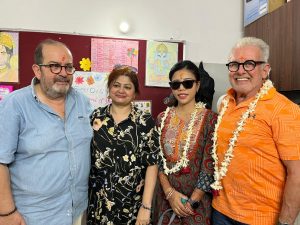
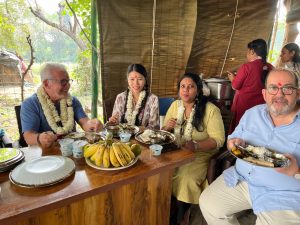
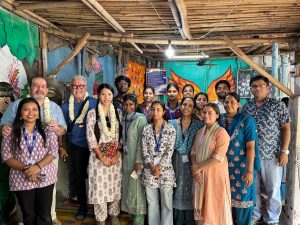
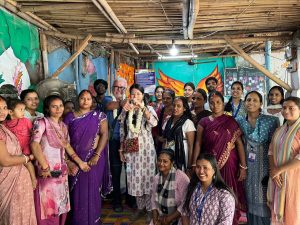
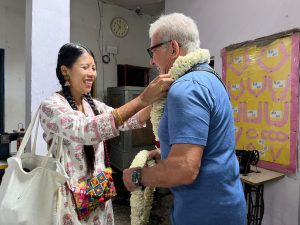
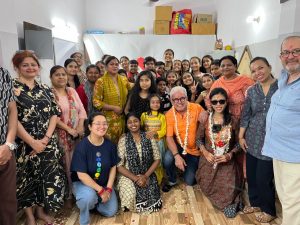
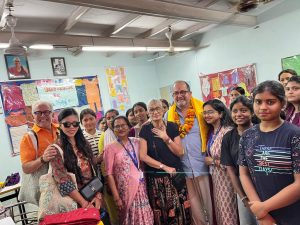
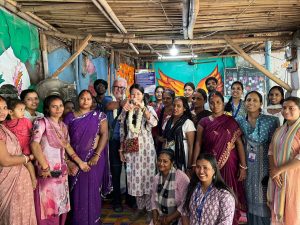
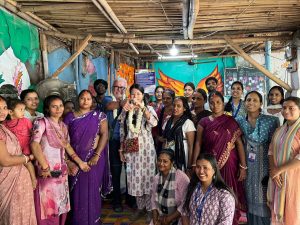
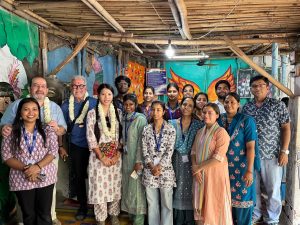
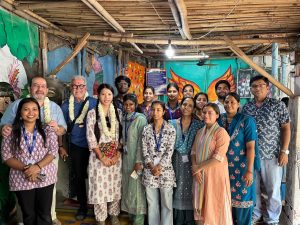
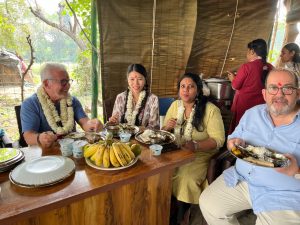
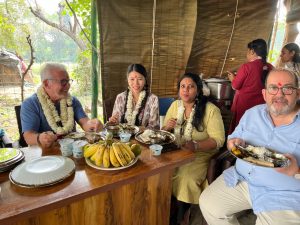
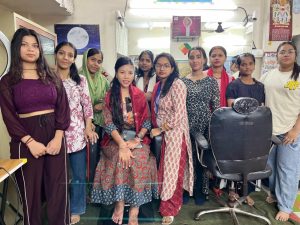
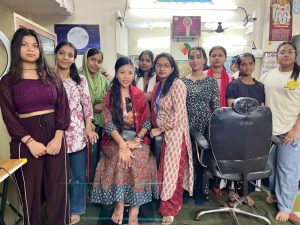
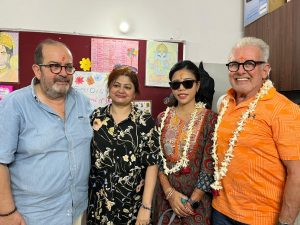
A few days back Xavier informed us about the visit of Serge an old friend of Project Why with his new bride Saranya. We decided to do something special for them. It was to be a surprise.
Serge carries India in his heart and his bride has never visited India. It was decided to welcome them at every centre with traditional Indian marriage customs. There was the exchange of garlands, the bride entering the ‘house’. after kicking a pot of rice, games newly weds play when the pride first comes, traditional wedding songs, wearing of toe rings and more.
Each centre did a fabulous job and the newly weds enjoyed every moment;

I came across this beautiful article recently. What caught my eye was the title:”When joy becomes simple, life becomes extraordinary“. I read it and was drawn to every word as it resonated with everything I have gone through. If you have time, read it.
It took me a long time trying to find an image to illustrate this post. I waded through the hundreds of pictures I had and fell on this one. This is my darling Popples bathing in a five star swimming pool for the first time. A simple joy indeed but at that moment life for the tiny soul was nothing short of extraordinary.
It was time to take a walk down memory lane. True I am a daughter, wife, mother, grandmother and my life has had its share of ups and downs but did it ever feel extraordinary. The answer is NO!
What has made it extraordinary is the last 25 years of Project replete with simple joys: the trusting smile of a child, the sticky sweet put into my mouth by a child who has just passed her exams, the pride of children who have come to share their exceptional result, the loud GOOD MORNING MA’AM of the little creche kids as I pass by their class, Manu feeding me with his grubby hands, Utpal taking his first step, my special needs kids dancing with abandon, the child who has had a heart surgery walking back to class, and I can go on and on. And all these are the simple joys that have made my life extraordinary.
On a more personal note I also understood why I became a recluse in my golden years. The author ends with these words The deepest journey of life is always inward, towards the unmasked self, waiting quietly within. Now I understand that your one and only lifetime long best friend is YOU. I did not become a recluse; I just found my best friend.
I came across a short clip about what the future will look like as AI moves in at a speed we cannot imagine. It covers many industries where jobs as we know now will disappear. To survive you will need to adapt and work with AI
This is what it says about education: AI tutors that adapt to each student personalised learning at scale, traditional classroom models that become obsolete . Teachers who survive will be facilitators and mentors not lecturers. The one who cannot adapt replaced by algorithms that teach better, faster and cheaper. This is not a prediction. It is happening. The question is whether we will be ready when they do.
And happen it will sooner than you think. A recent article proves just that. The journalist decided to feed class X both. basic and advanced maths question paper, having 15 pages each to ChatGPT. The AI assistant solved both in less than a minute. And that is not all and I quote “What stood out was not just the speed, but the structure of the answers. ChatGPT solved every section in detail, writing step-by-step solutions with proper headings, clear working, and neatly presented final answers, closely resembling how a student would attempt the paper in an exam.
So what awaits us? Sridhar Vembu, the creator of Zoho says that Ai automation may not kill jobs but bankrupt the middle class if the government does not act fast and deepen economic quality. He says: If robots take your job, don’t panic – just be ready to cook, care, sing or farm! Human only professions will rise. The remaining things humans do may get paid well — as an example, taking care of children, home cooked meals, nursing sick people, priests that minister to people, people who take care of soil health, water health, crop health and cattle health (we used to call them farmers), forest restoration specialists, local live performing musicians and so on may get paid much more,” he writes. For Vembu, the future isn’t about machines replacing humans — it’s about whether governments can adapt fast enough to ensure no one is left behind.
I am no tech person or economist but I see the writing on the wall. I also am aware that I have the future of over 1000 children in my hands. So in spite of resistance from my staff who are weary to change and adopt new ways I know that it is imperative to introduce gentle change today.
So what are the jobs that AI. will. not replace:
Jobs safest from AI are those requiring high empathy, complex human connection, physical adaptability in unpredictable environments, or strategic leadership.
Healthcare & Empathy Roles: Nurses, therapists, counselors, and home health aides are secure because they require emotional intelligence, trust, and physical, bedside care that AI cannot replicate.
Skilled Trades: Plumbers, electricians, and technicians are safe because their work is highly physical, requires adaptation to unpredictable environments, and often involves complex, non-repetitive problem-solving.
Strategic & Creative Leadership: Managers, leaders, and strategic planners are needed to navigate complex human situations, build trust, handle ethical dilemmas, and motivate teams.
Specialized Human Services: Social workers and lawyers (especially in courtroom settings) are secure because their roles require navigating complex, non-black-and-white situations and legal liability, respectively.
High-Touch Services: Personal trainers, hairdressers, and specialized repair technicians remain safe due to the need for personal connection and physical skill.
Why These Jobs are Safe: AI excels at pattern recognition and data processing but struggles with unstructured, real-world physical environments and genuine emotional connection. Jobs that combine high physical skill with empathy are the most resilient against automation.
But there is a dilemma we need to face. Parents across the board still dream of their children being doctors, engineers, chartered accountants, software engineers, in short al the jobs that have been top of the range till now. I know that by the time our children, particularly those in the primary section enter the job market, it would be totally transformed and that the time to steer them in the right direction is NOW!
But how do you tell a parent with huge dreams for their progeny that it will be better for their children do be a plumber or a hairdresser, more so in a country where dignity of labour is not prevalent. That is a huge challenge but unless we find a solution and ADAPT we will fail in our mission.
Now the reality. India is a young country and we will have 12 million young people entering the job market annually. You can do the math. While AI poses risks of displacing routine, low-level service and manufacturing jobs, it will create new, high-demand opportunities in specialized tech sectors. Key growth sectors will include green energy, healthcare, and space technology. So that is where we need to. focus.
Some sectors require specialised training and skills. But sector like health care will see a massive demand for professionals due to an aging population, with growth in assisted living, nursing, and specialized care.
To remain competitive, the workforce will need to move beyond basic technical knowledge to focus on:
Adaptability and problem-solving.
Advanced technical expertise (AI, robotics, data science).
Human-centric skills that cannot be easily automated.
Some may think it is speculation and. I agree none of us is a crystal ball gazer, but unless we see the writing on the wall what we are teaching our children today will be quite useless.
At Project Why we have always strived to remain ahead of times. Our challenge is to be judicious and work out a solution that will benefit all.
The first step is to explain this reality to our team and work out the best plan together.
In my almost three decades journey with Project Why there have been many moments that have made me proud be it a child who has passed an exam or a heart surgery that was successful and everything in between. But today my heart is swelling with pride, my throat is choking and my eyes are moist because Aman one of our alumni made a donation of ten thousand rupees to Project Why!
Aman’s story is nothing short of a miracle. He was a student of our Khader centre and we soon discovered that he was very good at Art and had a dream: that of becoming an Artist. Initially the family was not supportive and pushed him to join the commerce stream but his heart was not in it. We managed to convince his family to allow to pursue Art and helped him enrol in the Delhi school of Art. A kind soul supported and mentored him and he passed his BA. He then wanted to join a masters programme and Lady Luck smiled again and he got a seat in the Delhi school of Art!
He struggled for a while and finally got a job as an Art Director in a budding company and decided to donate ten thousand rupees to Project Why!
Over the years while studying and after he spent Saturdays at the Project teaching Art to the children and took on the task of mentoring the students who were in need.
The reason why I feel so proud today is that when I created Project Why I wanted to give wings to the dreams of my children and give them the opportunity to dream big. Aman did that! But there was another desire, one that I barely expressed. It was to see our alumni come back and remain part of Project Why. Aman did more than that he became a donor. Even I hadn’t dared dream of that.
Aman is a wonderful child – yes to me he will always remain a child, my child – gentle kind and always smiling. I wish that every single dream he has comes true and as some of you know I believe in miracles and know that it will happen. He is a blessed child.
Twice everyday a haunting melody is heard from the street below.. It is the flute and toy vendor who peddles his ware in our rather upmarket colony. Street vendors still ply across the city though much less than some decades ago. The flute vendor in our street has a cycle where his flutes and toys are displayed as you can see in the picture above. There are so many things that he cannot ride his cycle but has to push it the whole day.
The tune he plays is soul stirring. I often wonder how many flutes he sells in a day and actually who buys flutes in this day and age.
Before I started Project Why and crossed the invisible line that exists between us and them, street vendors were anonymous and invisible, their lives a far cry from mine. It is only when I began my work in the slums and came across daily wage workers be they selling vegetables or flutes, that I came to know about their lives and their struggle. I remember, in the very early days of Project Why, wondering why the woman next door sat woefully every evening staring at the road. When I enquired about this, I was told that her husband was a vegetable vendor and she waited for him to come back and give her money to purchase what was needed for the family’s dinner. Depending on what he gave, the family would eat a good meal or a frugal one.
Whenever I hear my flute vendor’s tune, I wonder whether his family would eat or not. How many flutes or poor quality plastic toys do you sell in. a colony like ours where people would go to Hamley’s to purchase toys, It’s a matter of prestige. And with the total disappearance of servant quarters where families could be lodged together and there maybe some child needing a cheap toy. But today the erstwhile servant quarters have been spruced up transformed into rentable spaces. All about money, honey! When I rebuilt my house I insisted to the horror of my contractor that I wanted servants quarters to be a space where I could live too. Sadly in today’s day and age servant quarters in all upcoming builders flats are either so tiny that they barely fit a bed for one, or some flimsy structure in the parking lot replete with toxic fumes and scant privacy.
One forgets that those who work for us within our homes or sell vegetables at your doorstep are persons just like us with dreams and hope for a better life for their children. As I am now aware of their struggle, these vendors who for long time remained invisible have become part of my life and yes I buy the occasional flute or toy.
I still am the little 3 year old whose granny organised a bear dance for her but who only saw the man in a threadbare coat asking for something warm. Even then I did not give up and wailed till the man was founded given a coat.
People write off such souls not realising that they make our life easier each and everyday.
So next time, if you hear a haunting tune on a flute, stop and acknowledge that the person exists.
India recently hosted the India AI Impact Summit! Anchored in the principles of People, Planet, and Progress, it envisions a future where AI advances humanity, fosters inclusive growth, and safeguards our shared planet. AI is here to stay! Some go as far as saying that it will take over the world by 2050. But we are not there yet. However we have to accept the indubitable fact that AI has transformed the job scenario. And to succeed children will have to be taught a whole new set of skills that are a far cry from what we are teaching them today.
Before I go further, I will just like share my own experience with AI. A few weeks back I did not know much about AI. I decided to take a short online course. After the course I tiptoed into this new world and lo and behold was left gobsmacked at the amazing power of this tool. Each day was a new discovery as I ventured into ChatGPT, Claude, Gemini and more. Jobs like mine – translator/interpreter – have already vanished. Write a text and any of the AI assistants will translate it in seconds to another language. You can have a conversation with these assistants and they can be quite witty! You want to write a report, a proposal anything and AI will do it for you. It performs, analyses, and generates complex content. The catch is to use the correct prompts. That is what needs to be mastered. I can see how you can get drawn into this world.
In an article entitled Ten 21st-century skills every student needs, the World Economic Forum states: The gap between the skills people learn and the skills people need is becoming more obvious, as traditional learning falls short of equipping students with the knowledge they need to thrive. Today’s job candidates must be able to collaborate, communicate and solve problems – skills developed mainly through social and emotional learning (SEL). Combined with traditional skills, this social and emotional proficiency will equip students to succeed in the evolving digital economy.
So the new skills needed are : Learning and innovation skills: critical thinking and problem solving, communications and collaboration, creativity and innovation. Digital literacy skills: information literacy, media literacy, Information and communication technologies (ICT) literacy Career and life skills: flexibility and adaptability, initiative and self-direction, social and cross-cultural interaction, productivity and accountability.
At present children are stuck in the traditional curriculum created by the British with the aim of making obedient pen pushers. The new skills are the exact opposite as they want people to think out of the box. As I have often said, children do not have the time to wait for policies to be changed. By the time new policies are put in place a whole set of children would be out of school and propelled into the work world armed with useless skills.
We at Project Why cannot let this happen. It is time to act.
Now you cannot navigate the AI universe without two basic skills: computer knowledge and a command of English. So the first step we have taken is to have computer and English classes from class one itself! The children are loving it. A little girl shared very proudly that she now knew how to start and shut a computer. Her eyes lit up when she told me that. Give a few years and she will master both.
The bigger challenge was to work out way of incorporating these new set of skills into the present curriculum. How do you weave skills like critical thinking or creativity into the subjects being taught. My incredible team has worked out a way to do so from class I itself. We are at present training and getting the teaches onboard as they are the main stakeholders. Then we run a pilot and come April 1, we go all guns blazing.
We intend to handhold the little ones till class V but then we want to steer the children towards self learning and independent studies so that by class IX children can study independently. We also want to accustom the children to digital learning and make them comfortable with this approach. Thanks to the Adish and Asha Jain Foundation we have a state-of-the-art recording studio where we have already recorded lessons for classes IX and X and plan to do it for all classes. We want our children to be comfortable with taking online classes as that would enable them to increase their skill sets.
This may sound ambitious but needs to be done if we want our children to be ready for the ever-changing work scenario. There will be resistance I know from both teachers and kids as I am pulling them out of their comfort zone and throwing in the deep end of the pool. But them at Project Why we have never shied away from a challenge.
We are at crossroads but I know that we will overcome. Wish us luck!