by Anuradha Bakshi | Jan 2, 2008 | Uncategorized
This morning S dropped by at the women centre to discuss our road map for planet why. It was not a matter of convincing ourselves, or anyone else for that matter, of the validity of the project. It even makes good business sense were it viewed solely as a business proposition. Actually it has to be so, as we need the profits to continue the work we began 8 years ago and graduate from the status of perpetual albeit high-tech beggars to that of people capable of fulfilling our dreams ourselves.
I have often talked about planet why and shared my vision trying to view it from all possible angles: be it the sustainability factor or the humane one. I have pitched it within the confines of social enterprise as well as that of what is now known as volontourism! Which ever way one looked at it, it always seemed to make sense.
As Anatole France said: To accomplish great things, we must not only act, but also dream; not only plan, but also believe. I guess one needs to turn the quote a little as dreamed and believe we have, now it is time to act!
I remember the days when I found it infra-dig to speak of money. I shudder to think of all that was owed to me that I never sought back. Then came pwhy and with it many little dreams that needed to be fulfilled; dreams entrusted to me by the God of Lesser Beings. And the only way to accomplish this daunting yet edifying task was to quickly give up what one considered demeaning and learn to beg. I must admit I learnt quickly and that is how we could achieve all that we have.
Today as we set out to translate another dream into reality I find myself faced with the necessity of taking a quantum leap in my new found profession as what we need today is a staggering figure with a string of zeros I cannot even formulate. And yet the dumbfounding figure pales in the wake of what it would actually yield: smiles on faces that had forgotten to smile, hope in hearts where there was only despair, shelter to those who live in constant fear and above all a tomorrow for those whose today has died.
Actually it is something was one has been doing till now but the target was small as it was just a matter of being able to carry on one day at time, one month at a time and so on for nearing nine years now! But this hand to mouth existence can only be temporary just as we are. What we seek now is secure all the tomorrows and moor them firmly so that little boys little Utpal can sleep in peace. That is what planet why is all about.
I know that there are people across the planet who know how to see with their hearts. I did find so many of them and they are the ones who made pwhy the vibrant reality it is is. I need now to just like the Little prince of St Exupery to set out on new travels and find the right ones. Past experience has shown that they are not easy to come by but dreams are never easy to fulfill and one does comes across businessmen too busy to look at you. But one has to persevere till the end and view the humongous figure as an aggregate of many smaller ones as my dear friend M put it.
I also know that simple humane stories of children will not suffice this time. So we do have our set of learned men furiously making plans with all the needed columns and projections to reassure the kind hearted persons who will be willing to invest in our dream to prove to them that it is worthy of their trust.
Nothing happens unless first we dream. (Carl Sandburg)
by Anuradha Bakshi | Jan 1, 2008 | Uncategorized
Pwhy has its own special way of celebrating special occasions; one may even call it brand project why and 1 January 2008 once again reflected this.
It was a bitterly cold crisp morning as we set out bright and early ready to make the best of this first day of the new year which promised to be a busy one. The Mitchells a retired couple from the UK were to come by at 9 am. They had come all the way to volunteer at pwhy and they wanted to help us build or repair something. It was to be the broken floor of our Okhla centre. They had already purchased all the material and were waiting for us!
The morning was spent breaking the old floor and beginning work in earnest with the help of the older children and the teachers.
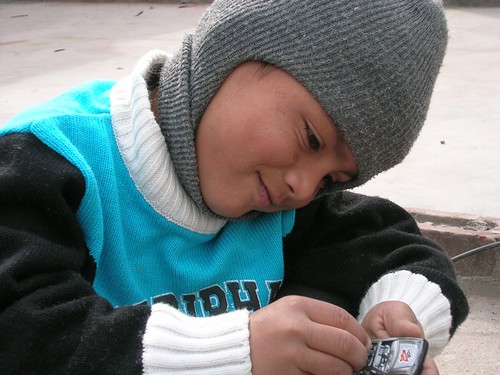
I had decided to make this day special and to play truant and do something totally out of sync and become a kid myself. It was to be a treat for Utpal and Kiran: a movie in a multiplex, a meal at fast food joint and a quick foray into a candy store. We did it all and i did enjoy hanuman returns a true delight in more ways than one! Wish they made more such movies!
While I enjoyed my escapade, the rest of the gang decided to mark the day by organising an impromptu party with the few kids that had brae the cold to come to pwhy. So party time it was for the junior secondary and the special kids – our own tare zameen par – ! They danced with gay abandon forgetting all differences and then enjoyed hot samosas, discovering each other and forging new bonds!
the excitement was palpable as you can see in these pictures:
Now you understand what brand project why is: a melting pot of different worlds where the only common denominator is love!
Happy New Year
by Anuradha Bakshi | Dec 31, 2007 | Uncategorized
 If I ever saw an angel, it was in your eyes. You’ve touched my life like an angel… Thanks for being there for me!
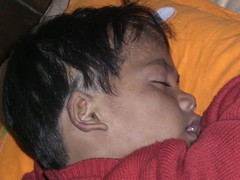
Four years back a little angel dropped into my existence. True that he was scalded and scorched and did not look very pretty but his incredible eyes were truly seraphic and in spite of the searing pain they held a message of love, hope and faith. I somehow knew he was blessed.
That day Utpal walked into my existence and life was never the same again. Miracles started coming our way and problems seemed to vanish as fast as they came. Project why grew in leaps and bounds at an astounding pace that left us all puzzled and stunned. Angels appeared from nowhere and nothing seemed impossible.
As I sit in the very first hours of this New Year crafting seemingly impossible dreams I can feel his presence and know that these dreams will come true. What I seek today is a way to make all the little dreams that the God of Lesser being has left in my custody come true and even if what we seek has a staggering number of figures, they pale in the wake of what they would actually yield: smiles on faces that had forgotten to smile, hope in hearts where there was only despair, shelter to those who live in constant fear and above all a tomorrow for those whose today has died.
Planet why has to become a reality and I know that a little angel is at work to make it happen.
Utpal is also a little boy just like others and today as a special treat he goes to see Hanuman returns with his pal Kiran and his ageing Maam’ji before he returns to his boarding school.
by Anuradha Bakshi | Dec 29, 2007 | Uncategorized
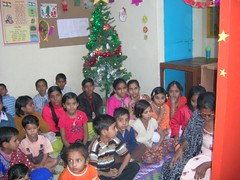
 Xmas was celebrated in earnest at the women centre. There was a tree, streamers, stars and bells, pictures of Santa drawn by the kids and much merriment. There was home baked Xmas cake and presents for all.
Sophie who had planned the party made a little speech explaining what Xmas was and how it was celebrated y children in our country. I was designated to translate and began by asking the kids whether they knew what Xmas was. Most of the children at the women centre belong to poor Muslim families and rarely go beyond the streets of Madanpur Khader where shops are not decorated for Xmas and do not sell Xmas ware and hence the answer to my query was a barely audible no accompanied y a vigorous shaking of the head!
Links had to be made so I asked about Eid and then Diwali and everyone nodded and smiled and went on to say that Xmas was just like those days for people who went to church instead of temples and mosques, all homes of God. When I asked what kids ate on Eid and Diwali, pat came the answer: ladoos and sewaiyan, so cake it was for Xmas and the link was made. Xmas became something familiar and comprehensible: it was simply a matter of replacing cakes with ladoos or sewaiyan!
by Anuradha Bakshi | Dec 28, 2007 | Uncategorized
 In many schools across our city where English is taught children are often heard singing the following prayer:
Thank you for the world so sweet,
Thank you for the food we eat.
Thank you for the birds that sing,
Thank you God for everything.
Strangely this prayer transcends all religion and faith, all social and economic barriers. Schools in remote corners of the city which boast of a sign board stating English medium have their children reciting these verse often led by a teacher who can barely articulate the words. I must confess that in our creche it is also sung with great fervour even if it sometimes difficult to differentiate the words!
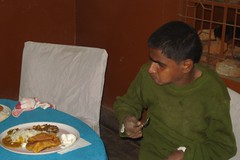
I have heard it over and over again as I walk up or down the stairs of our centre but it was only yesterday evening when I was looking at the pictures of our Xmas party that the familiar tunes came to my mind as I saw the snapshot of Manu eating his meal sitting at a table and using a spoon!
My mind flashed back to the summer of 2000 when I had first seen Manu and to the words I had first written about him: Manu, a young physically and mentally challenged young man lived on the street, neglected, dirty and soiled. People would feed him but like you feed an animal. Children threw stones at him. His family abused him in all conceivable ways. No one touched him, when things became too much he would let out the most heart wrenching cries.
In many ways those cries seeded what was to become project why as we all know it now. And as I looked at the photograph of Manu sitting at a table with his friends and teachers enjoying his meal I whispered the little prayer as it conveyed what I truly felt…
Yes God thank you for everything…
by Anuradha Bakshi | Dec 24, 2007 | Uncategorized
It was party time at project why and everyone was busy sprucing up their dancing shoes and rehearsing the latest moves. Even little Komal who has just learnt to stand did not want to be left out!
This year we were truly privileged as we had not one but two parties. One at the women centre organised by our wonderful volunteer Sophie, and the other a gift of our very special supporter young Dhaniya who has always given us this special moment.
For the women centre it was their first party ever and everyone was a little nervous, a tad tense as they spent a whole week in preparation: shopping, planning, more shopping, trimming the tree, wrapping gifts. Children were busy making decorations that were then hung all over the centre. Finally the 25th dawned and the excitement was palpable. Everyone turned up ahead of time, even the guests! The party was a huge success as the sound of carols filled the space infusing it with the true spirit of Xmas and it did not really matter if most of the kids had never heard of this festival, they all knew it was special and blessed. After tucking in cake and hot samosas the children left clutching their little packs with huge smiles on their faces and a song on their heart.
I urge you to look at these pictures so that you too can share the magic of this moment
The next day we had our project why annual bash one that is now almost tradition thanks to a lovely little girl who lives in another land but who has always given this very special treat to her pwhy friends. When the first such party was planned we asked the children what they would like to have: pat came the answer a DJ and a coffee machine. So there was a DJ and a coffee machine and the children had a ball! Rinky and Saheeda who cannot hear danced with gay abandon and little Komal all of 18 months old put p a mean performance that could match any item girl! Kids enjoyed a nice meal and then it was time to leave.
My thoughts went to our host of the night, a little girl who lives in another land but who each year gives a bunch of children of a lesser God a moment of pure unadulterated joy. I hope that one day she too will be here with us sharing this incredible experience.
Share some moments with us