by Anuradha Bakshi | May 29, 2008 | Uncategorized
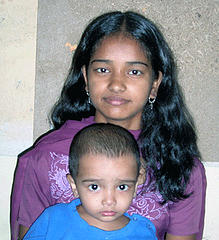
 This is a picture of Neha and Aditya taken almost three years back in happier times. Since a lot of water has flowed under the bridge. In those times questions were simple and solutions easy. Even mummy learnt to smile as she picked up the pieces of her broken life and wove them bravely into a new one.
Barely a few back just was working and had gladly accepted that Aditya become part of our foster care programme as she knew that this would give him a better future. Everything seemed almost picture perfect as we sat content in what we thought was a befitting conclusion of a journey started many months ago. We had conveniently forgotten about the big picture being busy putting final touches one the tiny one we could see.
Neha had been complaining of back aches, one that even compelled to take a break from the gruelling hours she put in at the beauty parlour where we worked. We advised her to se a doctor and take some rest. Nothing could have prepared us for what was to ensue.
One morning Neha came by asking for help as she had been asked to have an MRI and did not have the money to so. In spite of her smile, we could see the pain and knew that something was wrong. When the results came we were shocked. Neha had advanced tuberculosis of the spine and many of her vertebrae had collapsed. The diagnosis was confirmed by a bone specialist. it was a miracle that Neha was still walking. She needed immediate immobilisation and even then the prognosis was terrible: risk of paralysis, permanent damage to the back and poor chances of recovery, septicemia from the risk of any of her abscesses bursting .
She was advised complete bed rest for at least 3 months as any movement could entail paraplegia. Neha has no one; even her mother has walked away from her life. Her only family is 5 year old Aditya. She needs to get back on her feet; anything short of that is a death knell.
As I write these words she lies in terrible pain in a room at our foster care. In a few days she will be moved to a room on the ground floor of the dame building. A day time nurse will look after her and at night a distant relative will take care of her. Neha weighs a paltry 32 kilos. The ordeal that awaits her is terrible and she knows it.
I have often prayed for miracles but am at a loss as I do not know what to pray for. Even the best case scenario is short of what Neha needs. A deformed back or life in a wheel chair is no life at all for this young single mom. What we need is a real miracle, the kind that is not fabricated by us humans but one that only He can make true.
A miracle for a little boy who plays and learns unaware of the reality that may become his!
So help me God!
by Anuradha Bakshi | May 29, 2008 | Uncategorized
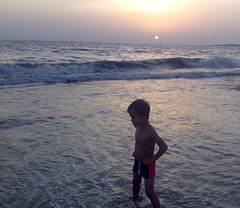
 One day Popples you will meet mrOcean. Many of your friends live close to it and many have promised that they will take you there one day…
These words were written almost 2 years ago and are now there for all to read as in dear popples. I must confess a little sheepishly that I had then hoped that I would be the one to make the introductions. But that was not part of the larger picture. Mr P met mrOcean last week when he was in Mumbai spending a few days with his new. friends: Abhigyan, Mrinal and Vedika. I wonder what went into his little mind when he saw so much water. I guess we will never know. All I know is that they will be tucked away in his little mind to be recalled at the right moment, when he is in need of reassuring himself.
Utpal has had an ace holiday in Mumbai. One replete with memories of things he never knew existed: a flat on the 22md floor, a shower cubicle, swimming in a pool with goggles, the feel of a real family with a father, mother and grandparents, a train ride over. And to crown a trip in a plane, like the ones he sees flying over his school every day. And of course the huge helicopter balloon he had to give up to enter the plane and that the misses terribly.
I know he was a handful to his impeccable and kind hosts but what a holiday it was. The kind he could not have ever conjured even in his wildest dreams. Here are some stolen moments:
by Anuradha Bakshi | May 27, 2008 | Uncategorized
I would have never believed that one day I would be seeking help to fund the surgery of a man! Most of the hearts we have fixed are those of children, barring Nutan who was a mom and her children’s life depended of her survival. She was taken care of and is now back in her village.
Rekha was a young spirited girl when she got married to Basant a kind hearted man. Life was going on well. A few months later she suffered a terrible fever. She survived but the drugs given to her were too strong and led to her losing her sight and hearing. For some months the family took her to a bigger town and yet another. But to no avail. Everyone told them that her eye sight was gone forever though perhaps something could be done for her hearing.
Basant’s family then tried to convince him to send her back and find another bride. But this man was made of another mettle. He stood his ground and told them that she was his wife for the better or the worse and that he would stand by her till the end. The young couple set home and in years to come three children were born. Basant tended to Rekha with affection and tenderness. He looked after her and helped her in all chores, even those considered infradig by his peers. Whenever he could he use to try and seek specialists and even took her to Bangalore in the hope of restoring her sight. Their meagre savings dwindled fast.
A few months back he had brought her to the All India Institute of Medical Sciences as he had been told of a possible next procedure that may restore her sight. One morning he got up with excruciating pain in the chest. he was diagnosed with a heart condition and was told that he may need open heart surgery. An angioplasty was performed and a stent was inserted in the hope that things would settle. But things did not work out and the pain came back. He needed open heart surgery.
The cost was prohibitive: 100 000 rs!
I would have never thought that I would be the one appealing for help for basant. there are many reasons for this. One is that he is the sole support of Rekha and her three children. Were anything to happen to him, she would suffer a fate worse than the darknes she lives in and her children’s future would be jeopardized. But that is not the only basis for my appeal. There is a much deeper one.
Basant is the kind of man one does not see in India, particularly in Bihar where he hails from. No man stands up for his wife, more so a blind one. And to do so with compassion, love and tenderness is unwonted. Were anything to happen to him, Rekha would be derided and shunned as a harbinger of bad times. There is much more at stake than just a life.
I hope we will find the support we need.
by Anuradha Bakshi | May 27, 2008 | Uncategorized
 The project why journey has been astounding in more ways than one. At every step, miracles big and small have dotted its path with regularity making one believe that the big picture theory really exists.
When we began the foster care programme, there was a huge debate about how to select the handful of kids that would launch the programme: social profile, performance, home situation.. The options were many. Finally four children were selected. Aditya and Babli being two of them. At that time none of us was aware of the real reason.
A few days back Aditya’s young mother came by our office. We could see the pain written on her face in spite of the smile she bravely put on. We had known that she had left her job as she had been complaining of back ache but nothing prepared us for what was to come. She wanted help to get the expensive CT scan her doctor had asked for. The scan was done and to our utmost dismay she was diagnosed with advanced Pott’s disease or what is knows as bone TB. Many of her vertebrae had collapsed and huge abscesses dotted her spine. The prognosis was not good: she could suffer paraplegia and septicemia.
Aditya’s mom had no support system as after her husband’s death she cut off her links with her own family. She had decided to bring up her child alone and after training as a beautician was working in a parlour earning enough to survive. Two months of sick leave had depleted her of her meagre savings. And to crown it all, her landlord had asked her to vacate the tiny room that was her home.
Aditya’s mom is at the foster care for a few nights. We will take her to hospital and start her treatment. Will she be saved is another part of the big picture cannot see. We will do our best and hope that things go well. We do not even want to think about what could have happened had things not fallen in place. We only know Aditya is safe and his mom in good hands.
When we invested in Babli’s tiny heart, we thought that like in all other cases she would thrive and grow after her surgery and fulfill all the dreams that she had conjured in her head. The script went awry many times and each time, we intervened in the best manner possible, or so we thought. On the way, we did wonder why, unlike other children, Babli was not growing, but felt that it was due to poor nutrition and care.
When we were about to launch our foster care programme, someone suggested Babli as one of the inmates. In spite of her advanced age, we all agreed that it would be a great idea, as the child was intelligent and would benefit from such a programme. A few days after her joining our housemother shared her concern about Babli’s constant bed wetting. Yesterday she was taken to the doctor and diagnosed with hypo parathyroid, a rare condition stunts growth and depletes the body of its calcium retention of the body. It can be treated and reversed with proper life long medication. Babli is now having all tests and investigations required and should soon be on the way to recovery and to leading a normal life.
When we selected Babli and Aditya we were totally unaware of the real reasons that had guided these two children our way. Today we know…
Wondrous are His ways…
by Anuradha Bakshi | May 26, 2008 | Uncategorized
 A few days back we got the visit of the representative of a very up market page 3 organisation. This organisation funds various NGOs by organising high profile fund raising events. As we sat chatting in our new foster care building, the lady told me about a new venture of theirs whereby they are sponsoring school fees in up market schools for a handful of very underprivileged children. Actually what she was trying to convey indirectly was her disapproval of the amounts we were spending on the foster care residential programme.
While we were chatting, our children sat quietly finishing their lunch.
I tried to the best of my ability and with as much fervour and passion I could muster to explain to her that a child from a deprived or dysfunctional poor background would never be able to fit and be accepted in an up market English medium school. He or she would feel lost and would not be able to keep up what is required of him or her. Moreover ‘home’ or what goes by the name would not be able to provide him or her the support needed.
My mind went back to a blog where I had shared my feelings about the reactions of people to our foster care programme when it was being launched. Today it is in its third month and though there have been many teething problems, we have never felt that our decision was wrong.
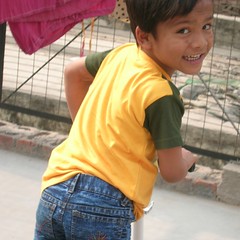
I would not have written this post were it not for a totally unrelated incident. Utpal is in Mumbai spending a few days with Abhigyan and his family. The first few emails were positive ones and then came one where I could feel that Popples was being difficult: tantrums and demands bordering bad behaviour. I must confess that at first I was upset and went into denial and then apologetic mode as any doting parent would. Much later when the heat and embarrassment of the moment has passed, I realised that it had been naive on my part to expect that Utpal would behave like a perfect child in an environment totally new to him. That he accepted to stay in an unknown home without batting an eyelid and with comfort and ease, is in itself huge. He is only 6 and he has had a lot to deal with in the 2000 odd days of his life.
But that does not condone bad behaviour one would we tempted to say, or does it… The urge to balance out his misfortune is not easy to put it in Abhigyan’s words. I cannot but agree. But let us take our thoughts a step further. Till date Utpal was never seen, let alone spent time in what you and I call a family: a papa, a mummy, siblings, maybe grandparents. He has never known a structured home. The only structure he has experienced is that of a boarding school. He has no role models, no examples to emulate, no mentor to walk him through such moments. He survives by instinct and the closest he has been to a home is probably mine, where he knows he gets what he wants courtesy his ever indulging Maam’ji!
We, and here I talk about all those who think they are a cut above the rest being engaged in doing some form of social work or the other and who would like to believe that lives can be transformed by doling out the needed amount of money to pay fees, books and more of the same, have to take a moment to pause and think. If that were so, how easy it would be alter destinies. But the reality is quite different. Education is not just imparted in schools however good they are. Nurturing and building lives start in homes and with parents or guardians. It takes time, patience and above all the will to truly want to do so.
When the idea of what is today our foster care programme was first mooted by a potential donor as part of what we call planet why, these are the words he chose to use: A residential foster care programme for a maximum of 20 bright children where children from deprived backgrounds will be given an enabling and nurturing environment to be able to excel in education and access to employment possibilities. The children ( a maximum of 20) will be kept at planet why for an incubating period of 4 to 5 years and then be sent to boarding school. Emphasis will be on creating an environment close to those found in educated homes, with stress on English and building self-confidence. At that point of time I must admit I was not in a great bargaining position but the immediate reaction that many of us had was that this was far too ambitious if not impossible and that the way it was spelt out reeked of social engineering.
However the die had been cast and even though the initiator of the idea backtracked at a later stage we were left holding the proverbial baby and there was no retracting. The only battle I had won was to begin with a trial with a maximum of 4 to 6 kids. The task was daunting albeit exciting and just the possibility of being able to perhaps change a handful of lives could not be set aside. However one must stress that right from the word go, we knew intuitively and logically that if this was to succeed, we had to keep the kids in residential care at least for part of the week.
Education as I have said time and again is not just imparting the 3 Rs; it goes much further and has to cover life skills. Something that tends to be forgotten. I recall with a smile one of the brainstorming sessions we had early this year about where the foster kids would spend their summer holidays. Our erstwhile donor had suggested that they be sent to homes like yours and mine and wondered if there would people who would accept them. A no comments on this one barring from saying that this person lives outside India and is not aware of the reality that surrounds us.
We will find a solution for Popples, and our fostercare kids are learning to unlearn before they begin learning again.
Life goes on as always.
To quote john Donne: “All mankind is of one author, and is one volume; when one man dies, one chapter is not torn out of the book, but translated into a better language; and every chapter must be so translated…As therefore the bell that rings to a sermon, calls not upon the preacher only, but upon the congregation to come: so this bell calls us all: but how much more me, who am brought so near the door by this sickness….No man is an island, entire of itself…any man’s death diminishes me, because I am involved in mankind; and therefore never send to know for whom the bell tolls; it tolls for thee.”

by Anuradha Bakshi | May 23, 2008 | Uncategorized
 The class XII results are out and once again all the pwhy kids have cleared the dreaded Boards! This is now the nth time in a row! There was a time when I remember spending a sleepless night before result day and pacing up and down till I was given the news. In those days results were not on line and one had to wait for the teacher to come back from the school where they were posted.
This year Naresh our secondary teacher just came to the office with his list of roll numbers and a few taps on the keyboard and we knew that all the kids had once again passed. No sleepless night, no angst. Just a feel of deja vu!
Naresh sat with paper and pencil computing the marks to get the percentages, a number essential to chart out the future. Gone were the days that a simple pass was enough for jubilation. Now it all depended on that extra half percent that could make all the difference. As I watched his serious face bent upon his sheet of paper I realised that all this could not have been possible without him. It is Naresh who has almost single handed, year after year, with rare dedication bordering on obsession ensured that pwhy kids have cleared their Boards!
The words of the title song from the movie To Sir with Love came to my mind: But how do you thank someone, who has taken you from crayons to perfume?It isn’t easy, but I’ll try. Every year we congratulate the kids, eat the sweets proffered and organise an outing. But this year kudos need to go where they are due: to sir, with love!
In the winter of 2001, when a deriding remark from a school Principal about the impossibility of a bunch of class X students to clear their Boards had led me to throw the gauntlet and accept the challenge of ensuring their success. That year we simply had a small spoken English class and helped a few primary kids with their studies on an ad-hoc basis. The bunch of boys were students of the spoken English class and the reason for my trip to the school was to find out why one of them had been beaten without apparent reason.
The next day the boys came, huge smiles on their faces and hope in their eyes. We had no classroom, no teacher, no funds. But what we had was the determination to win the challenge. At that time Naresh had just finished his college and was looking for work. I had hear that he use to give tuition to school kids. I asked him if he would help us and he accepted. Classes were held the pavement in front of our single class room, in the biting cold at 7.30 am with many cups of tea! That was how our senior secondary section began.
Naresh is a born teacher and teaches with compassion and unseen commitment. For him it is matter of pride to see his students do well even if that means extra classes early morning or late evenings and even on Sundays. He handles his section almost single handed as no teacher ever meets his expectations. And his students are infused with the same passion, as they often come well before time and wait for him with eagerness. Naresh has turned many failures into toppers and is always there for his students as a teacher, mentor and above all a friend. That is what teachers should be.
So today it is to Naresh that I say: hats off or chapeau bas!