by Anuradha Bakshi | Jun 10, 2008 | Uncategorized
 The spiralling and sky rocketing price of petrol in the past few weeks has finally, or so one hopes, brought to fore the need to pause and think about the necessity to change our ways. Till now the pleas of environmentalists fell on deaf years. At best we nodded agreement to all that was said/written/seen while we fans or ACs ran in empty rooms in our own homes.
Words life carbon footprint and emissions made good erudite conversation points, the news of glaciers melting brought the right expression of concern, but nothing got translated into action. It was always felt that others were responsible for all the horrors that befell our planet, our contribution to its slow destruction being oh so negligible: what difference could we make.
Even we at pwhy stand guilty of this as we let our awareness and environment programmes wither away. Somehow it found no takers, or perhaps were we not committed enough. Our only true contribution I guess is our use of green fuelled vehicles , a decision taken I must confess not for environmental reasons but practical and humane ones: the three wheelers have better access in slum areas and are owned by parents. I guess one has also time and again made the politically correct noise but how far have the words been translated into action. Not far at all I must admit. True we have solar energy at our women centre but here again it was a gift from a friend.
Our forays into saving the environment have been too far and few. It is so easy to slip back into comfort zones.
The recent petrol hike has shaken everyone out of ts torpor as it now hits where it hurts most: our pockets. Even the powers that be are talking about reducing carbon footprint: cancelling foreign jaunts and looking at alternative means of transport is the latest mantra being chanted in political circles. Recently a foreign visitor wondered whether the metro when it is completed would change things; his question was simple: would people like you and me adopt it as an alternative means of transport leaving our cars behind. Sadly the answer is in the negative. While we are willing to take metros and tubes on our foreign holidays, I wonder how many of us will take the metro to work or to visit a relative on a weekend. One can here again quote Don Ritter “Trying to save ecosystems has more to do with changing egosystems.” It is all a matter of egosystems and unless we change those nothing will really change.
People are finally seeing their dreams come true: the new Bentley or gleaming bike have just come their way so how can you ask them to park them and take a walk and a metro ride. It would be anathema. Will the new petrol price make a difference? I wonder.
Every price hike is finally taken in one’s stride. Smokers still smoke, and Bentleys and Mercedes still drive around. So one wonders what will truly shake us out of our inertia ad compel us to change? I again wonder.
The recent rains are once again a proof of our blinkered view of life. We urban animals and city dwellers are celebrating the cool clime totally oblivious to the fact that this freak weather may delay the monsoons and hence affect the crops.
Are the times really changing….
by Anuradha Bakshi | Jun 8, 2008 | Uncategorized
 Once upon a time, not so long ago, an afternoon at the cinema was a treat almost anyone could afford. For less than a hundred rupees two persons could see an afternoon flick and even eat a greasy burger or share a fizzy drink. Cinema was for the masses. Halls were huge and catered to large numbers. The number of movies produced were in accordance with the need of such large audiences. Box office was defined by the number of viewers as well as the number of times one saw the same film. Catching a first day first show was almost a ritual. Cinema was for everyone. It was one of the platform where the two Indias met on almost level field.
Was it too good to be true or did the Gods get jealous? Or was it once again the lure of what lay beyond seven seas or just market forces at play? Who knows. But came the day when the playing ground was redefined and the first multiplex appeared. A new invisible wall was surreptitiously erected. Suddenly what was once open to all, became inaccessible to some. A simple movie ticket was out of reach.
I have never been a movie goer and was quite unaware of the change. Slowly many of the cinema halls that dotted our area started closing for renovation, a renovation that rung the death knell of an era. Yesterday I decided to give a treat to Utpal, Kiran, Chanda and Radhey. The idea was to send them all to the movies, or rather should I say to the multiplex. Two adults and two children. I did not quite know how much money to give them. I handed them 1000 Rs thinking that they would also be able to buy themselves some lunch. I was horrified to learn that almost 800 rs were spent on the tickets alone and the remaining 200 barely got one cold drink and a bag of pop corn. You see in today’s new environment only branded eateries can operate in the swank halls. Gone are the days when you could grab your greasy burger or patty. And of course UtpalKiran being above 5 were treated as adults! And multiplexes have only one rate, even if you are placed in the front row. A great leveller but sadly in the wrong side of the spectrum.
Movies, at least in big cities, are no more for the poor. What was once entertainment for the masses and provided a few hours of much needed escape to many, was now the preserve of a few. You could not more plan a Sunday afternoon family outing. It would cost you a month’s wages. This is today’s reality. The times are indeed changing…

by Anuradha Bakshi | Jun 7, 2008 | Uncategorized
 The picture you see may, at first glance, seem innocuous and anodyne. A bunch of smiling young ones chaperoned by an also smiling older one. True that they seem to come from different lands but in today’s shrinking world this is no big deal!
This is what it looks like and no offence to anyone thinking just that. However this snapshot tells an incredible tale. It begins with the meeting of four young persons belonging to different worlds. Janaki is a pwhy alumni, and one we are terribly proud of. She came to us some years back, a spirited bright girl with an insatiable desire to learn. Not only was she a keen student but also one that never shied of anything that came her way. Meeting new people from unknown worlds, participating in any activity proposed, spending more time than necessary at pwhy in the hope of acquiring that little bit more. She completed her class XII last year by obtaining a 11th position in the whole of Delhi. Today she is in college doing not one but two courses.
Willy, Gordon and Lilly are but a few year older than Janaki. They come from the land that conjures success in measures larger than life. When Willy was just about Janaki’s age, an age when kids have glitzy dreams and boundless aspirations, he came to India to volunteer in a school and took a first step in a world that would change lives forever. Deeply moved by the plight of children of a Lesser God, he with some freinds decided to do something. And boy they did. At an age when you are barely considered an adult, they set up a foundation to help organisations engaged in developmental work. And in the span of a few summers thousands of children from the four corners of the world were touched by the magic of these incredible kids.
We at pwhy were privileged to receive an email from them last summer and from that day onwards there was no turning back. They simply walked into our hearts. For almost a year we exchanged mails and were overwhelmed by the unstinted trust and support we got. It was a rare privilege.
A few days back they flew into Delhi and we finally met. But somehow we felt we had known each other for an eternity. Though we knew they were one of a kind, we were overwhelmed by their warmth and kindness. And as we discovered each other, we realised that they were exceptional human beings. It was a meeting of spirits where neither age, nor culture, nor social origin, nor any of the things that normally qualify and often divide human beings mattered. We all spoke the same language.
It is a times like these that I allow myself a few stolen moments to pat myself in the back. As I have often said, pwhy is my swan song and also my magnum opus. I know that it is my last chance to do something I can be proud of. And though I live by stringent canons, moments like the one frozen in this tame picture make my heart swell with pride, till I quickly move on to simply being grateful.
by Anuradha Bakshi | Jun 4, 2008 | Uncategorized
There is a time in every child’s life when a cardboard box becomes a house, a stick becomes a sword and a bedsheet becomes a tent, a castle or an entire kingdom.
A child does not need much to create a world.
Give a child a few crayons and a blank sheet of paper and a pink elephant may walk beneath a green sky.
There is nothing wrong with this.
The child is not making a scientific statement. The child is imagining.
And then, sooner or later, an adult says:
“But elephants are not pink.”
“The sky is not green.”
And the child learns that there is a correct way to see the world.
I sometimes wonder whether this is where we begin to lose something.
Every child is born with enormous potential. Education is meant to help that potential unfold. It should teach a child to think, to question, to understand, to imagine and to discover what the mind is capable of doing.
But too often education does something else.
It teaches children to remember the answer rather than ask the question.
It teaches them to reproduce rather than create.
It teaches them that being wrong is worse than being curious.
And slowly, almost imperceptibly, imagination begins to disappear.
Many years ago, when Project Why was still in its infancy, we held a drawing competition. The children came from different backgrounds and were of different ages. We expected to see different worlds emerge from their drawings.
Instead, we saw the same picture again and again.
Mountains.
A river.
A house.
Trees.
A sun rising or setting.
Perhaps a flower or a fish added for variety.
There were differences in colour and technique, of course. Some children drew with greater confidence. Some used brighter colours. But the basic picture remained almost identical.
It was the landscape they had been taught to draw.
That was when we realised how deeply the education system had entered their imaginations.
Later, we held a workshop and asked a group of teenagers to draw a mother and child.
The results were startling.
Many of the drawings returned to the same familiar landscape of mountains, rivers and houses. Very few children were able to draw something they had not been shown before.
Some simply said they could not draw from imagination.
They could copy.
They could reproduce.
But they could not invent.
The problem was not that these children lacked imagination. They had been children once. They had played, invented games and transformed ordinary objects into extraordinary ones.
Somewhere along the way, they had learnt that their own imagination could not be trusted.
I remember another incident from when my daughter was in Class I.
She was asked to write an essay on “My Mother.”
She wrote about her actual mother: a woman with short hair who worked.
She received an F.
The reason was simple. The teacher had given the children a model essay. In that essay, the mother had long hair, wore a sari and stayed at home cooking while the father went to work.
My daughter had written the truth.
The truth, apparently, was the wrong answer.
I remember being furious. I remember arguing with the school. And I remember eventually having to tell my child that sometimes she would have to write what the teacher expected.
I have often wondered what she made of that lesson.
A little later, she was learning the colours of the rainbow. She carefully learnt the spelling of “violet” as it had been written on the blackboard.
When I corrected her, she looked at me and said:
“But that is what the teacher wrote.”
She was right.
The lesson she had learnt was not about spelling.
It was about authority.
The adult is right.
The book is right.
The blackboard is right.
The child is wrong.
And so, little by little, children begin to surrender their own ability to question.
This is not an argument against knowledge.
Children need knowledge. They need facts. They need discipline. They need to learn how the world works.
But knowledge without imagination can become a prison.
A child who learns only to repeat may know the answer to a question.
A child who learns to imagine may one day find an answer to a question no one has asked before.
Imagination is not a luxury reserved for artists, writers or scientists.
It is what allows us to imagine another person’s pain.
It is what allows us to see possibilities where others see only obstacles.
It is what allows us to solve problems, invent, create, adapt and find a way forward when the obvious way has failed.
It is what enables us to imagine a different future.
And perhaps most importantly, imagination allows us to understand that our own way of seeing the world is not the only way.
That may be one of the most important things education can teach us.
A child who can imagine a pink elephant may grow up to understand that the world does not have to remain exactly as it is.
A child who can imagine a green sky may one day have the courage to ask why the sky must always be blue.
And a child who is allowed to ask “Why?” may grow into an adult who is not afraid to challenge what everyone else accepts.
The purpose of education cannot simply be to produce children who can pass examinations.
We should want children who can think.
Children who can question.
Children who can imagine.
Children who can look at a problem and see more than one possible answer.
Children who can understand that a mistake is sometimes not a failure but the beginning of discovery.
We have created an education system that often rewards conformity because conformity is easier to measure.
It is easier to mark an answer right or wrong than to assess curiosity.
It is easier to teach one standard essay than to listen to a child’s individual experience.
It is easier to tell a child that elephants are not pink than to ask:
“Tell me about your elephant.”
But children are not empty vessels waiting to be filled with information.
They are minds waiting to discover the world.
And perhaps our greatest responsibility is not to fill those minds with everything we know, but to ensure that we do not extinguish the questions, dreams and possibilities already burning inside them.
The world needs children who can see what is.
But it needs even more children who can imagine what might be.
So let the elephant be pink.
Let the sky be green.
Let the child draw a world that does not yet exist.
And let us be very careful before we tell that child that the world cannot be so.
Because perhaps, just perhaps, the child is not drawing the world as it is.
Perhaps the child is showing us the world as it could be.
And perhaps that is what education was meant to do all along.
by Anuradha Bakshi | Jun 2, 2008 | Uncategorized
 I have often wondered why pwhy came to be. A rather pointless question many may say as we are now in the 10th year of existence! And yet it is one that comes to my mind many times, always begging for an answer and never quite finding one.
The most obvious answer would of course be to reiterate our mission – arresting drop outs and keeping children in school – an on that account we have done pretty well. But there are innumerable organisations doing just that, and maybe better than of us. And does this explain the very organic manner of our growth, where we seem to take on new responsibilities at the drop of a hat, some a far cry from our stated mission!
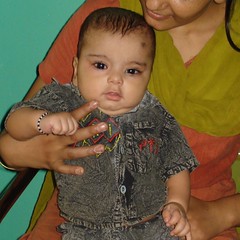
Little Prakash once again makes me ask that question. A few months back we were content to see him play and laugh and thought that the story ended there. He was attending our creche and seemed happy. But then a few weeks back we realised that he was losing weight and suddenly he started looking more and more like his sibling. We took him to our doctor and were startled to find out that he be having hydrocephalus. A condition for which there is no cure and where the treatment is complex, expensive and delicate. It requires placing a shunt that needs life long monitoring. Something that a family like Prakash’s can ill afford. And yet untreated it can cause severe retardation and be life threatening.
The past few weeks has been a heady mix of events some thrilling, some just satisfying and some worrisome. The Board results came and went and the 100% result was accepted with a sense of deja vu, our eyes searching for toppers and we were rewarded as it is pwhy kids who topped their respective schools in both classes X and XII. Our land was paid for and though we still have loans to pay back and a whopping amount of money to raise for building planer why, we did feel a step closer to the day when we would be self sustainable. Those were the macro issues, the ones that seem in sync with all our mission statements and vision paper.
However the last few weeks were also replete with micro issues, those that concern individuals of no consequence, souls that no one would ever know exist: a 24 year old widowed mom who is attacked by a vicious disease; a 11 year old post heart surgery girl with a rare ailment, a father in need of help. And yet these almost invisible people did drop our way, almost as if guided by an unseen hand.
It is true that along the way, while we diligently applied ourselves to meeting our goals, mission and objectives, we were faced with many disturbing issues that needed to be addressed. Somehow it seemed impossible to brush them aside with a simple: we are an education based organisation. We simply accepted them and found the best solution we could, hence losing our carefully elaborated mission statements, vision papers and more of the same. To the outside eye we started looking more and more like a haphazard entity that never quite finds the words to describe itself.
We were never disturbed by this. On the contrary we found it to be the natural and obvious way to go happily adding on more whys to the already existing ones! Anything else would have been
unacceptable. And slowly we became who we are bringing to mind Frederic Nietzsche’s words: he who as a why to live can bear almost any how.
So to the question why did pwhy copme to be, the answer is simple: to bear the hows that came its way!
by Anuradha Bakshi | May 30, 2008 | Uncategorized
 “A person taking stock in middle age is like an artist or composer looking at an unfinished work; but whereas the composer and the painter can erase some of their past efforts, we cannot. We are stuck with what we have lived through. The trick is to finish it with a sense of design and a flourish rather than to patch up the holes or merely to add new patches to it” wrote Harry S. Broudy. These words came to mind as I sat this morning browsing the pwhy pictures taken last week.
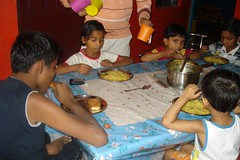
Had someone suggested a few months back that one would soon be seeing Manu around a table sharing a meal with his pals in a proper home, I would have smiled and told the person to stop dreaming, reminding him or her gently that dreams took time to become reality. It would have been akin to fast forwarding a film to reach the end without living through the story. And yet the picture you see is no trick photography, it is reality, one anyone can share each and every day. The foster care was not even an idea in our minds, at best it was a distant and impossible dream.
For the last week or even more I have been avoiding the much needed task of setting out to seek help for pwhy. Strange as I thought I had overcome my almost innate reluctance to ask for money and should and could have picked my virtual begging bowl without fuss, any time needed. But I guess inborn feelings stay longer than one thinks.
But what needs to be done, has to be done. I knew time was of the essence and the task I had to be undertaken. And in order to do so, it was time to take stock of the past. In Broudy’s words I knew that nothing could be erased or painted over and that the work had to be finished with flourish and honesty.
So here I am again seeking support to see pwhy through. Have we reached the middle of the road? I think we have. Much of we set out to do when we began had been achieved in ample measure. The class X results declared yesterday reinforce the point. All the children passed and in in both class X and XII it is a pwhy student that topped his school. Many had made the journey from street to home and many other achievements big and small dot our firmament. We have met every challenge that came our way and have done our best in finding the right solutions. The sustainability issue that had for long been our Achilles heel, has now been addressed as we have bought the land needed for planet why. There is no looking back!
However as I write these words we are in a tricky situation: that of having to raise funds both for the building and the day-to-day running of the project. And our needs have grown as many new whys dropped our way and could not be cast aside as that would have been defeating the very spirit of project why.
We do manage to raise a substantial part of our needs but still fall short. Perhaps the reason for this stems from what I will call the soul of project why. For almost a decade pwhy has been able to survive and thrive because it is infused with goodwill, one that has come from the innumerable kind souls who have answered each and every call for help. Were it to be fuelled by impersonal sources – no matter how regular and steadfast – alone, it would cease to be.
To many this may sound preposterous and even old-fashioned in a world where success is measured by the weight of bank accounts and the size of buildings. But for me that is not so. The mere fact that we have been able to grow and thrive is the direct result the immense love that we have received from people the world over, many of whom we have never seen. Our success is the outcome of the trust and belief that had come with each coin dropped in my begging bowl. We have reached where we are because pwhy has never afforded itself the luxury of sinking into comfort zones that would rob us of our very individuality and make us pallid clones of others. It is but natural and essential that we fall short, as this is what will enable us to always remain who we are. Ours is a work where patches and holes are banished, and each corner of the painting or note of the symphony is part of the whole.
On a personal level it is also essential that I retain the ability to beg humbly and shed any misplaced arrogance no matter how innate it be. Only then will the intangible and indescribable riches that are vital to the very existence of pwhy continue coming our way
It is now time to finish the story with flourish, one that cannot end without the presence of each one of you.