by Anuradha Bakshi | May 23, 2008 | Uncategorized
 This blog is not meat to be a personal one, nor is it meant to be one for reminiscing the past or delving in nostalgia. Yet today I beg your indulgence as I take a brief pause to remember Ram and Kamala on this day that would have celebrated 59 years of their union.
This blog is meant to share the project why story, but would there have been a pwhy, if Ram and Kamala had not walked this planet. I wonder.
The loss of a parent is always difficult to come to terms with. It digs a deep bottomless pit in your heart and soul, one that is impossible to fill, even with time. A word heard out of context, the whiff of an aroma, the chirping of a particular bird, the sight of an innocuous image are sufficient to trigger a Proustian reaction that is ample to bring back every single memory you had laid to rest.
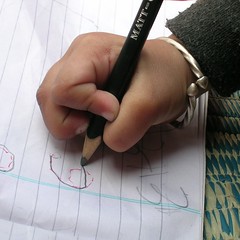
Yet today it is not with sadness that I remember them, but with a sense of peace and fulfillment. The huge void they had left was not only filled but is now almost overflowing. It has been filled with the smiles of every child at pwhy, with the hearts repaired, with the report cards held out with pride every year, the big and small achievements of children of a lesser God: the first drawing made by one who could not hold a pencil, the first word babbled by one that could not speak, the first step taken by one who was never meant to walk. And they live on in each and every moment of pwhy’s life.
Ram and Kamala gave me the most beautiful gift: that of life itself, and then went on to colour it with muted lessons of hope and courage. I just hope I have been worthy of what they taught me subtly and without fuss.
Pwhy could not have been without them as it is in many ways a reflection of who they were: a spartan erudite humanist and a woman of well beyond her times who wanted to change things and led by example; a reflection reinterpreted by the one who loved them unconditionally.
Today I simply remember them!
by Anuradha Bakshi | May 20, 2008 | Uncategorized
 We work hard to raise money so that we have the opportunity to help people but the more children we educate the more are being born that… so we are tempted to say that education will help our people to overcome poverty but if the resources remain the same and the population continues to grow… it’s a losing battle.
These very frightening words were sent by a dear friend who is a volunteer with an organisation that is deeply involved in education projects all over India. This friend also is a young highly educated Indian the very people on whose shoulders the destiny of India lies. I understand her concern ans perhaps would have shared it had I not been part of project why!
The education scenario in India is abysmal. But it is not only the state of education for the poor or underprivileged but also that of the so called rich and extremely privileged. A strange caste systems now prevails in school and one wonders what schools have become.
The simple definition for the word school in any dictionary is: a place for educating children. The crux of the matter lies in the definition of the word education and the one we at pwhy adopt is the one based on Delors 4 pillars of education: learning to know, to do, to be and to live with others. He says: these four pillars of knowledge cannot be anchored solely in one phase in a person’s life or in a single place. There is a need to re-think when in people’s lives education should be provided, and the fields that such education should cover. The periods and fields should complement each other and be interrelated in such a way that all people can get the most out of their own specific educational environment all through their lives.
To me the most important pillar remains: learning to live with others as therein lies the true success of education and this is sadly what is disappearing from the society we live in. Schools should be a level play field but is now turning into a mirror image of the social strata you belong to and the habitat you live in. Hence the richer you are the fancier looking your school is, and the poorer you are the more pathetic it will be. So any exchange, peer learning, learning to live with others is doomed to fail as you remain within the tiny part of society you belong to.
But I have digressed as the concern voiced here was that of population growth, or have I really? That is the moot point. Education we all agree is a spring board that can enable one to change one’s destiny but is the education we are today giving the children of India the right one to do that? The question raised has within it another element that we may tend to overlook: static resources or we can even say dwindling resources. And I speak with a certain authority as I was spent almost a decade raising these very resources.
Education alone can change the destiny of India and even help arrest population growth and maybe one day reverse it. Sadly it is perhaps not the kind of polarised education we see around us but one that would merge different strata of societies into schools that look like schools and not of seven stars resorts or slum backyards! That in itself would alter the content, change mindsets and bring a transformation that we cannot begin to imagine. All election oriented and fund draining dramatic programmes will lose their relevance as a symbiotic learning will emerge on its own.
Today we have idiosyncrasies like a pass percentage of 33% and a college entry point of 90+%! reservations in higher places of learning when we know the slum kid will never reach. These could slowly vanish on their own without laws and programmes.
But there is also another change that such an approach can bring. It may also address the resource issue as the better off kids may in such a situation become aware of their won responsibility and add to the resource pool. Pay it forward a simple fiction made into a movie launched a movement and a foundation. A child helps another and in return asks him or help to help three others and so on.
When we took on the challenge to give four kids the best education possible we were derided by many, particularly by those belonging to the rich side of the spectrum. And yet everyday these kids shows us that we cannot be wrong. In a pay it forward situation a rich kid could sponsor a poor one who in return would commit to help three or any number when her or she was in a position to do so.
Daydreaming? Perhaps or perhaps not. Change requires bold and seemingly preposterous action. Only one thing remains unchanged education is, cannot and should not be a losing battle!
We have to find the resources both financial and moral to go on!
by Anuradha Bakshi | May 15, 2008 | Uncategorized
 A mail about little Radha’s plight dropped by this morning. It asked some stark questions:when you run in to such cases have you been able to get any insight in how the parents intended to support so many children? what were they thinking when they had 4 children in one room? is there some way you have found to communicate that there is no difference between a girl and a boy?
I wish I had answer to these questions. But this is one of whys for which we have sadly not found answers till date and yet it is one of the most deafening ones as therein lies the solution to many of the problems that plague our society. Yet it is almost one of the most inaudible ones too!
Parents like Radha’s produce many children often in the hope of the one or more son that seems to be the touchstone to gage the credibility of women in our land. And this definitely transcends all classes of society and all creeds. As they produce one child after the other they are not aware or thinking about the future of these children or about they would support them. That is often left to God! The paradox of this quest for the elusive son is that they are all aware of the reality that each girl that comes along the way is a burden as she will have to be one day married but that does not stop them.
The flip side is darker as is proved by the terrifying figures of the sex ratio in cities like Delhi where the rich can find ways to abort their unwanted girl child and the poor just abandonned them in garbage dumps or door steps. According to Nobel Laureate Amartya Sen there are 38 millions missing women in India. So in a way Radha’s family should be lauded as at least they did not get rid of the unwanted daughters.
To the question about how they intended to support these kids in a tiny room the answers are again baffling and multiple. Having many children stems out from an atavistic past where many children died in infancy, children were extra hands on the land, where life was self contained and did not need stepping out from the habitat of origin, where families lived in clans and support systems were many. Sons were prized as they ensured continuity and protection of the land. The feudal system ensured protection of farm hands and those who did not own land as their being was a matter of honour.
When society changed and land got divided and could not feed the families it belonged to and as cities grew and were in need of labour, rural exodus started and simple illiterate families came in search of work and a better future. But the urban dream turned into a nightmare and with the total absence of any regulation and above all any housing policy, slums mushroomed helter- skelter and families found themselves living in dark hovels. Radha’s family is still small, sometimes over 10 people live in such places. I remember one case where the father was so tall that he either had to sleep at an angle or keep the door opened for his feet to stick out.
Life is a matter of survival in urban slums. In many cases people are daily wagers and the meal depends on what is brought home each day! It comes to a stage when people stop thinking beyond the day and live life one day at a time. But traditions, mores and atavistic instincts remain. Maybe they become a sort of lifeline in a world too strange to fathom. The yearning for boys is kept alive in spite of the fact that it has lost its meaning, the obsessive need to keep every ritual remains. I was horrified at the money spent for all the death rituals of an old woman who past away recently. The family, simple scooter drivers, fed almost 1000 people for 3 days. On the other hand the poor lady who died was never looked after. I shudder to think at the amount of money that is now owed to the loan shark.
So coming back to the questions asked by my friend and particularly the last one: is there some way you have found to communicate that there is no difference between a girl and a boy? The answer is sadly no, in spite of screaming one’s self hoarse and standing on our heads. There are more than 50 posts on this blog about the girl child and her plight some chilling beyond words. Every day the government announces new programmes for the girl child but rarely do they reach deserving beneficiaries because of complex paperwork, and often do not address the real problem as they are often looked at as simple monetary sops.
If we truly want to find viable solutions in my opinion one needs to be addressed are core issues. One of the main reasons girls are unwanted are that they need to be married and that marriage is a huge money drainer. Boys on the other hand bring money, cars, scooters, fridge, houses etc. Politicians, religious leaders and we the so called educated class should be the ones to set the right example. But sadly the now (ill)famed big fat Indian wedding is turning obese! And what is even more tragic is that in today’s India brides are being killed or forced to commit suicide because they have not brought enough dowry. This happened less than a month ago to young Astha whose parents had given a Mercedes car as part of her dowry. Till weddings mean money girls will not be wanted and boys welcomed.
This of course explains the different ways in which boys and girls are treated in families: education, food, pampering et al!
The other factor that I feel is never talked about let alone highlighted and is the cause of much pain in the lives of women is the fact that the woman is not responsible for the sex of the child. The X Y chromosome story is one that is never told. One cannot begin to imagine the number of women even rich ones who are derided and scorned for not producing that prodigal son. This is even true in rich and educated families. A simple campaign highlighting this could make a world of difference. We are all aware of the hue and cry raised by the so called conservationists and upholders of moral values when sex education was introduced in India. Not only is this essential is a country where AIDS figures are becoming alarming, but could be a way of also explaining how a child sex is determined and who is responsible for it.
There are solutions, but where is the political and social will to seek them, let alone implement them.
A deafening why no one is willing to hear!
by Anuradha Bakshi | May 15, 2008 | Uncategorized
 “Most of us can read the writing on the wall; we just assume it’s addressed to someone else.” wrote Ivern ball. The recent dastardly blasts in Jaipur sadly confirms this saying. While bodies still lay unclaimed, while families are yet to come to terms with the horror that has hit them, while reality is yet to sink in, the now jaded reaction drama is in full swing. Speeches are made about the spirit and resilience of the people of the land; blame game have begun targeting other political parties, and other nations. Sops are promised out to grieving families, wonder how many will actually reach the right hands, and wonder how money can heal loss.
The innumerable intelligence agencies are pointing fingers at each other. VIP’s are planning visits to the maimed city and thus ensuring front page coverage hence displacing all the disturbing and embarrassing issues making us almost wonder about how well timed the blasts seem to be. And international sympathy is surging.
The writing is on the wall but we all look away. Every day in our own city there are rapes of children and vulnerable women, carjacking have become the order of the day, murders for a few pennies abound, neighbours kill neighbours for a handful of coins, road rage is rampant.
The writing is on the wall as walls visible and invisible are built to widen the gap between caste, creed, or social status ; new malls and stores multiply with quantum leaps while tiny businesses are sealed and road vendors banned in the name of aesthetics.
The writing is on the wall but we just assume it is written for someone else as we carry on unabashedly, stopping maybe just for that small instant to mumble a few appropriate but empty words.
And yet everything points at the indubitable and unavoidable reality that all is not well in the world we live in. That sooner than later all of this may just happen to us, that we are not protected by impregnable walls. It is time to read the writing on the wall and accept that it is for each one of us.
by Anuradha Bakshi | May 11, 2008 | Uncategorized
For the past few days I have been in a state of postpartum blues, the kind women suffer after the birth of a child. Doctors have their own complex clinical explanations but to me it is simply the feeling of overwhelming emptiness that comes after what you have waited for, desired, expected, prayed for finally comes your way and instead of the feeling of elation should come your way, it is a terrible emptiness that engulfs you and leaves you rudderless.
Last week saw the realisation of two incredible feats came my way: we managed the garner all the funds needed for the land for planet why and are ready to close the deal, and dear popples got published. I should be jumping with joy, planning a holiday or a bash but al I feel is terribly empty and at a complete loss.
What comes to my mind are Oriana Fallaci’s words: To fight is better than to win, to travel much better than to arrive, once you have won or arrived you feel a great emptiness, and to overcome your emptiness you have to set out on our travels again, create new goals..
That is where I stand now. Needing to create new goals, charting new travels, conjuring new dreams as again in the words of Oriana Fallaci: to have realised your dreams makes you feel lost!
And there are many, some small, some huge, some seemingly easy others daunting. Garner the figure with a staggering numbers of zeros needed to build planet why, assemble the much needed money to run pwhy for the next months and then he next one; find the support to ensure that the foster care kids complete their education, find a possible treatment for little Radha, and maybe start writing another book: the project why story!
Yes to fight is much better than to win, to travel much better than to arrive. It is time set out on a new journey…
by Anuradha Bakshi | May 10, 2008 | Uncategorized
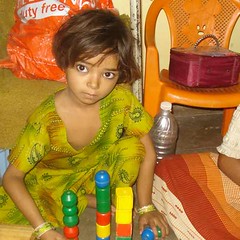
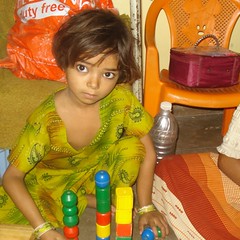
Little Radha is 7. She suffers from ostoegenesis or brittle bone disease has terribly deformed legs and is unable to stand. The slightest fall or hit causes a fracture as her bones have become terribly porous. She has already had more than a dozen in her tiny life.
She came to our office in the arms of her mother clad in a fleece outfit. The ambient temperature of the moment must have been 40 degrees Celsius. When we asked her mother why she was wearing such an outfit, the answer was simple and direct. She had no other decent clothes.
Radha lives in a sunken hovel, the roof of which is lower than a person standing and where not a shred of light enters. Her father lost his job as the factory in which he worked closed. He now sells tea but can barely make both ends meet as they have 4 children. Radha seemed a healthy child till the age of two when she first fell and broke her leg. It was then that she was diagnosed with osteogenesis.
1 in 60 000 children get osteogenesis and little Radha is one of them. Also known as brittle bone disease the ailment has no known cure. Management of the disease includes focusing on preventing or minimizing deformities and maximizing the child’s functional ability at home and in the community. Sound doable but in a home like hers it is close to impossible. Support groups exist but not for someone like our little Radha. The prognosis is scary as it not only affects bones but can result in brittle teeth, loss of hearing and easy bruising. The main cause is little or poor type of collagen.
Wheelchairs or braces are recommended and exercise like swimming is extremely beneficial. But where does a child like Radha go to swim or how does she use a wheelchair in the hole in which she lives. A child with OI needs good nutrition, rich in calcium, leafy vegetables, cereals, milk products all not within reach of a family that barely survives. The doctors had suggested this but for a family that can barely feed 6 mouth this was quasi impossible. And little by little her legs contorted as she suffered one fracture after the other.
New research suggests the use of bisphosphonates that seem to have has excellent results but that still seems at a trial stage. We will of course look into it!
Radha was denied any form of childhood and could not accompany her siblings to school or play. She just lived in her dark hole and dragged herself from one corner to the other. Two of her siblings come to our creche and that is how we came to know about her. Thank heavens her spine of head did not suffer any fracture!
Radha is an intelligent child who could learn like any other seven year old but her ailment closed all doors to her. We hope to be able to help her as best we can. As you know we at project why believe in miracles!