by Anuradha Bakshi | Jun 1, 2010 | Uncategorized
 Delhi’s flood of deaths that don’t matter screamed the headline of the morning paper. The writing was on the wall: 10 homeless persons die every day in our soon to be state-of-the-art capital courtesy the Commonwealth Games! The article makes scary reading. A third and soon half of India’s population will be living in cities unprepared or unwilling to build support systems. Solutions are “simple”: Shelters, affordable housing and hundreds of community kitchens. “But we aren’t making these happen,” says Harsh Mander to which the Minister in charge quips back: Delhi didn’t have the resources to build shelters.
Well said! We have zillions to build infrastructure for the upcoming games, to pave , unpave and repave perfectly good roads but cannot put up a shelter for those who have been rendered homeless to make way for these hubristic endeavours. But that is not all. The article also states that 93% of the deaths – 3381 souls – are due to starvation. That too in a city where every garbage can is replete with castaway food of the rich, where every wedding is a free for all in food waste, where milk is poured on stone deities and then runs free in the drains.
And it gets worse: men who die aka the homeless are not old and decrepit, but young working people.
A leading newspaper decide to track hunger. Do visit their home page. Browse the statistics of malnutrition of children in our country and if you have the guts browse the titles of their previous articles: mud for meals, 405 million poor by 2011, where tribals kill hunger with flowers, hot rod horror brands children in Jharkand and so on. I did and sat for a long time stunned and shocked. True I have seen more than many. But in spite of that the sheer magnitude of the issue is staggering. Where are we going? Where is compassion and care? Why have become inured to every aberration?
I know first hand how difficult it is to gouge a coin out of people to help others. I have been in the business for ten long years: the business of knocking at hearts and hoping they will open. But they rarely do, particularly in this city. Everyday more people become homeless. We have been silent and helpless witnesses to the destruction of slums, to people losing their homes and lives, to the silent human tragedy that no one sees. I have listened with seething anger to the reasons given for such acts and yes I know how illegal most of these homes are, but then why were they allowed to come up and not only that why where they tolerated for decades and why above all where people dwelling in them given voter’s IDs and ration cards. For political reasons of course as they were large vote banks that could be easily manipulated. Then why do the said politicos disappear when the bulldozers come!
The city is clearing away the poor to make place for the rich: slums get raised to build malls, road side stalls that feed the needy are destroyed to make the city more appealing to look at and yet the so called poor and now homeless are the ones who are busy toiling in the heat and dust to make rich dreams a reality. Something is wrong and we cannot simply be silent and mute spectators. We need to act or at least open our eyes and start looking with our hearts.
by Anuradha Bakshi | May 30, 2010 | Uncategorized
 Charity needs to be sustainable was the headline of a recent article in a leading magazine. Needless to say it caught my eye and I hastened to read it. It was an interview with a top honcho, a lady at that, who shared her view about CSR about charity. For her charity was a redundant term because it is a ‘one-time’ gesture and unsustainable. More power to you lady! I read on and could not but smile as once again it seemed our tale of forgotten biscuits was being revisited.
Ms Bali wants to make her biscuits healthier by fortifying them so as to fight rampant malnutrition ‘covertly’. Hence everyone who consumes the biscuits made by her company, and they are consumed by a large cross section of society, would be ‘healthier’! As she says: Our products are available throughout India. And, by fortifying them, if we are making them accessible to a large mass of people, we are not solving India’s malnutrition problem, but we are contributing to alleviating it. That is what she means by social corporate sustainability a new mantra I presume. Good wishes to her. I will not debate the issue here as this is not the aim of this blog. CSR has always been my ‘bete noire’ and I am yet to comprehend its true motives. I do wonder how enriching biscuits that are then sold amounts to CSR. But I agree with Ms Bali on the fact that charity has to be sustainable and not a one time gesture.
When we sought help to launch and sustain our nutritive biscuits programme, targeted mainly at the beggar children of our city, we were hoping to address the child beggar issue by making the business of begging non-sustainable. If one gave a biscuit instead of the expected coin maybe the handlers and mafia would look for other more lucrative ways. In the bargain you also gave nutrition; a real win-win situation. But sadly it did not work out for reasons I am yet to fathom.
The same happened with our rupee a day programme where we hoped to tap in the one perennial resource of our land: the numbers of people. What we asked was something that each and everyone could part with as one rupee got you nothing, not even a cup of tea. The idea was to make everyone a donor and make everyone participate in bettering the morrows of others. And it seemed so doable as all we were looking for at that time was 4000 such donors. In a land of a billion it seemed simple. But again we failed. And again I do not know why. It seemed so logical.
This has been my battle for 10 long years, a battle I am still nowhere near winning. Right from the outset, when I was handed over my first donation, I knew that this was just a temporary phase and that we would have to look at long term sustainability. The idea of depending on others is neither acceptable nor feasible. Planet Why still seems very elusive as we wait for the expert validation. And where it to go our way, the whole project is daunting in more ways than one. The other side of the spectrum is the tried and tested corpus fund, something I have always abhorred. But has not pwhy been a personal journey of getting over my own bete noires. What is at stake is too precious: the morrows of children and their dreams. So help me God!
by Anuradha Bakshi | May 26, 2010 | Uncategorized
 When Ruchika’s tormentor was handed over a laughable sentence some months back, the nation was outraged. Television channels were replete with debates on the issue and everyone wondered how the matter would end. It had taken many years to nail the elusive perpetrator and all one got was a suspended sentence and a paltry fine that any one could pay. I too had vented my anger and sadness in a blog entitled will I be safe tomorrow!
Today, six months later, the high profile molester is behind bars. he has been there for a week and will spent at least three more weeks there. The law has caught up with him in spite of all his contacts, his connections and the power he once yielded. That it took over two decades is another matter. It took a public campaign to get him nailed. When young Ruchika was molested there was no 24 hour TV, no activism, no public outcry. The family could just knock at various doors that failed to open. And battle lines were drawn with one side playing dirty. The family was humiliated and scorned. The young girl took her life. Justice remained blind. Even today the accused is behind bars not for having caused the child’s death, but for having molested her. Whether he will pay for the bigger crime remains to be seen.
There are millions of Ruchika who suffer in silence every day. They often lock themselves and loose the key. They know that they will not be heard, believed , let alone protected and vindicated. They are far too aware of the reality that surrounds them. They know the might of the adversary and what is often worse is that they often have to continue sharing the same space as most of such cases are perpetrated within the so called safety of one’s home. They just suffer in silence and try to perfect the art of becoming invisible, living in fear day after day. How does one protect such children? How does one protect the little girl abused by a kin? Who will ring the bell for her?
I hope that Ruchika’s case will help us open our eyes. I hope parents and caretakers will begin to look with their heart and see the reality as it is. That they will reach out to the child who sometimes slowly and almost imperceptibly begins to ‘change’. That they will find the time to listen and believe and not be swayed social or other pressures. Till that day does not come little girls will never be safe from lurking predators who prowl secure in the knowledge that no one will dare challenge their power.
by Anuradha Bakshi | May 15, 2010 | Uncategorized
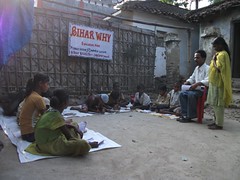
 BiharWhy! An incongruous and curious name. And yet this the one C has chosen for a the brand new education centre located in a little village in Bihar’s Supaul District. I must admit quite sheepishly that when C had murmured: to go to the village in Bihar and start a branch of pwhy after my long an exasperated diatribe, I had not believed him though I had lauded his intention and offered all support. Imagine my surprise when I got an email from C last week telling me that BiharWhy had been launched. The mail also had some pictures attached.
I sat for a long time looking at the pictures and slowly imbibing their stupendous meaning. The open air class, the little white mats on the mud floor, the lovely children and their teacher. It was a dream come true. I could not believe that something I had always held close to my heart had seen the light of day.
When one had taken the decision to only employ people from within the community to steer project why, notwithstanding qualifications et al, there was a covert reason: the hope that one day these very people would take ownership of the programme and take it back to their place of origin. That is why we had employed young people who had left their villages and come to the city in search of a better morrow. C was one such person. When he came to us with his half baked degree from Bihar and some vague skills (fine and art and electrical work!) we employed him to teach the primary children. Over the years C honed his knowledge, took extra classes and graduated to teaching secondary children as well as repairing broken fuses and painting the odd signboard! At that time he seemed set to continue as a teacher with pwhy for a long time. But that was not to be.
When we posted him to another centre he refused the move quite vehemently and I must admit that it was a shocker. I could have reacted as violently and dismissed him for dereliction of duty, but I have always been quite fond of this young man and even if that was not the case, the spirit of pwhy did not allow me the luxury of that decision. This was another why to be answered, a loud one that was a portent of things to come. So I gently proffered some options, one being to take back all he had learnt with us to his village. The seed had been sown. Time would tell whether it would take roots. If it did, then my absurd dream of reverse migration would have been fulfilled.
BiharWhy has seen the light of day. It is a reality today with over 50 children getting access to better education. C surveyed the area, met parents, the local authorities and everyone that mattered. Having been ‘in the city’ for almost a decade has paid as he is somewhat looked upon as the prodigal son that has returned. Everyone was willing to listen to him and wanted him to share his experiences and knowledge. So when he suggested he start a centre like the one in Delhi everyone was a taker.
But this is only the first step. The acid test is yet to be passed. BiharWhy has to survive and thrive and stand on its own. The road is along and not without obstacles. Bihar is not an easy place to operate in and had its own set of whys that will need to be tacked with caution. C will have to battle the administration, the local political power and the complex social problems with patience and determination.
I shared all my concerns with him as I know how difficult it is to survive and thrive! I told him of all the things we had done wrong in the hope that we would not make the same mistakes but it would be foolish to think that things will be easy. I juts hope and pray that he succeeds.
Note: C needs help and support. So of you think this brave venture is worth it, do lend a hand.

by Anuradha Bakshi | May 7, 2010 | Uncategorized
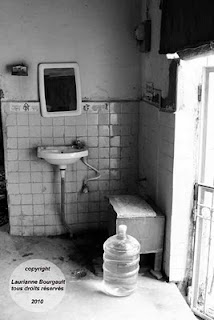 The house is strangely empty. Just a few days back it had been filled with strangers of all shades and hues. There were people everywhere: plumbers, masons, painters, electricians, carpenters almost an invasion! It had been rather irritating at first as we got pushed out of our space with alacrity and almost banished to a little corner but somehow I had got used to it and I must say in hindsight quite enjoyed the novel experience. My days were ruled by the motley crew of workers and I had learnt to live with it. The first lot arrived by 8.30 and then by 10 am the house was buzzing with noise and activity. I was often called to one floor or the other t
 o sort some problem or the other: where to place a pipe, was the colour right, where did I want a shelf put and so on. Time flew till the house got empty by 6pm, that was on days when the workers did not decide to do ‘a night’, which meant that they would be in till midnight.
I must admit there were moments when one got a little irritated, but these were few and far apart. When not needed I found myself ambulating around the house simply watching the men at work. As I had written earlier, I was amazed by the happy mood around. Not withstanding heat or dust, no one complained, quite the contrary, they found time to laugh and joke or sing. Many had their own songs on their cellphones and they often sang along joyfully even if they were out of tune. Sometimes work stood still and you wondered why till you discovered the workers praying in a corner: it was namaz time! You simply tiptoed away.
At times I found myself shuddering with fright at the sight of a frail worker with a load of bricks trying to get across the wobbly wooden planks that led from one roof to the other, or when one worker hung precariously on the jhoola (sort of swing) painters use to paint high walls. I often walked away, too scared to watch.
There were a few young workers, but as I had written earlier, I had made my peace with the curious case of child labour. I just hoped and prayed that they would one day graduate to becoming masons and then who knows, small time contractors though I wished I could have taught a modicum of the 3 Rs so that they would not make the mistake their contractor Murtaza did. You see Murtaza must have begun his career just like them, at a very young age. Today he takes small contracts. In our case he had to tile the roof and had quoted a price. When the work was completed he was forlorn. He had under quoted and made a loss of a couple of thousands of rupees. He admitted the fact sheepishly and I simply smiled and handed him the missing amount. He was elated. In other places he would have had to take the loss, one he could not afford.
Slowly the house that had at one time looked like having been quaked, started to fall in place. And then came the day when the plumbers and then the carpenters and then the masons declared they had finished and walked away. Only the painters were left and they too would soon move outside. An eerie silence filled the once buzzing space and though everything looked pristine and new, it was almost as if the place had lost its soul, albeit temporarily. I realised that from this day on there would be no music and song, no laughter and chiding, no prayers in the corner. I knew that I would have to learn once again to live in my space, one I had shared with a band of merry men who could teach one the art of surviving with a smile.
Strange but true: I miss my workers!
by Anuradha Bakshi | May 5, 2010 | Uncategorized
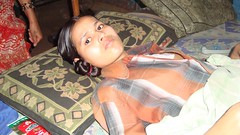
 Heera passed away a few days ago in her village in Bihar. I got the news two days ago. I still do not know what happened and may never know. I guess her young heart could not make up for all the years where it pounded in vain in her frail body in spite of all the holes. The operation had been a success in medical terms in spite of what the men in white called minor complications. She had been sent back to her home with the required medication and was to come back in three months for a check up.
I was numbed by the news, so numbed that it took me two long days to pick up my pen. Somehow this young girl that I met for a few moments touched me beyond words. When I first met her she stood quietly listening to all that was being said about her. She smiled briefly when I told her that she had to resume her studies after her operation. In hindsight I wonder whether she already knew what awaited her. I remember the day she spoke to me on the phone after her surgery and told me she was well and would soon be home. Did I miss something on that day too. I do not know. Even on the day she left, her smile was waned and her eyes evanescent but I quickly assigned that to the heat that was quite unbearable. When we said goodbye, I never knew that that was the last time I would lay my eyes on this brave and dignified child.
Today she has gone. I cannot begin to think how shattered her parents must be. Unlike many parents in India who often consider girls as impediments, Heera’s parents, though illiterate and poor, had left no stone unturned for the well being of their daughter. Not only had they educated her in the best available school, but had sold everything they owned to bring her to the big city and the best hospital. Today they had nothing left. Not even the one they fought for so passionately. I remember how her father use to come to us with hospital papers he did not comprehend and how we use to explain what was written to him and guide him on the steps to take. I remember how her mother, tired beyond her years by the weight of life itself, use to look at us with hope and the belief that maybe we were the answer to her prayers. I also remember how we truly believed that all would be well as it had in the past with all the other children with broken hearts. And then did not the doctors say that she would be healed after the surgery. Yes we all believed she would live. But God had other plans, plans we have to accept and live with. We all did the best we could.
Heera was a special being, one who touched our hearts, albeit for a few fleeting moments. I cannot believe she has gone. I share this poem as to me she will always be the laughter in children’s eyes.
Do not stand at my grave and weep,
I am not there.
I do not sleep.
I am a thousand winds that blow,I am the snow on the mountain’s rim,
I am the laughter in children’s eyes,
I am the sand at the water’s edge,I am the sunlight on ripened grain,I am the gentle Autumn rain,
When you awaken in the morning’s hush,I am the swift uplifting rush of quiet birds in circled flight,I am the star that shines at night,
Do not stand at my grave and cry,
I am not there, I did not die.
Author Unknown
I would like to thank all those who made Heera’s surgery possible. God bless you all. As I said earlier we all did our best.