by Anuradha Bakshi | Jun 23, 2010 | Uncategorized
 It is absolutely inane that as a society we have reached the sad day when we need to debate the issue of whether, what I can only call a cool blooded murder, can be viewed as socially acceptable and be called honour killing. I have listened with horror to the recent debates where those in favour – and yes believe it or not there are such monsters around – try to justify taking young lives to protect some misplaced value system.
There has been a spate of such murders in our city in the past few days and those who committed and/or favoured these barbaric acts justified themselves by saying they had no choice or it was inevitable! The story goes like this: if a young girl dares fall in love with someone of another caste or from the same clan then it is taboo and needs to be dealt with and deal they do: they simply kill the child. And to crown it all instead of downright and vehement condemnation by all we hear muted voices that say things like: we do not condone murder but… The but is too loud and unacceptable. The but reeks of vote bank politics, of misplaced and medieval and feudal ways, of weak minds and of rigid ones that refuse to bend. No one is willing to address the situation head on be it within the family, the society or the vote seekers.
Winds of change are blowing and will keep doing so. There is nothing you can do about it. And each such murder is simply paving the way for the next one as politician and law makers remain silent or split hair in ways best mastered by them. So instead of addressing the core of the problem they simply hover around the periphery in the hope of protecting their vote banks. The perpetrators get bolder and bolder and all hell breaks loose. Murder gains acceptability and is even glorified once you call it honour killing!
Since time immemorial parents have opposed their children’s choices but it is almost inconceivable to think that a parent would kill or order the killing of its child. Even in the recent cases the dastardly acts have been committed by brothers helped by their friends and the reason given is to salvage misplaced honour. I have seen this at work.
The incident happened when we first began our work at pwhy. In those times I had no real knowledge of social norms and aberrations. There was a birthday party in the street where we worked and we had been invited. As is often the cases part of street had been covered with a tent and there was a music system in attendance. As is also the often the cases though the birthday party was that of a one year old child, the guests were mostly adults: the entire neighbourhood and a plethora of relatives and friends. And again as is always the case there was a lot of booze though it remained invisible. The party was in full swing and spirits were a tad to high. Bollywood dance numbers screeched through the bad quality speakers and people danced. A young girl, she must have been seventeen then and was one of our staff, started dancing too with her friends. She is a mean dancer and she twirled with abandon. One must understand that young girls rarely have the chance to dance, and parties and weddings are the places where they can show their talent. Her parents where there too seated on the chairs that are part of the decor. Every one was having fun. Suddenly her two brothers appeared and dragged her away hurling abuses. She was dragged to their house where the two lads started beating her. I followed and screamed at them but to no avail. All I could here was the word izzat – honour – shouted repeatedly, as well as – jaan se mardege – we will kill you. Soon the parents came and the beating stopped. The poor girl was in tears and deeply humiliated.
What must have happened is that some drunk guy must have passed a leering comment and the brothers instead of defending the girl who was doing no wrong, decided to salvage the honour by punishing her. It was the same kind of reaction as the one we witnessed in last weeks incident where the murderer brother stated in an interview that he was facing regular humiliation because his sister had married outside her caste and was constantly taunted by his friends. So male ego is hurt and the only thing to do is to eliminate the cause once for all. Never mind if the cause is your sister, the one you played with, laughed with or shared moments. In a split instant all that is forgotten and all the remains is misplaced honour that has to be restored ,so off with her head!
As an eminent lady journalist said recently: that in such cases the daughter’s body has become the vessel holding the family’s honour. She is not considered an individual with her own dreams an aspirations and her own rights. And this cannot be particularly when girls even from extremely traditional families have now stepped out of their homes to taste the world outside.
It is now a matter of choice. Many girls may still accept old ways and this has to be their choice. But if one of them does decide to do otherwise those who love and care for her must understand her choice and accept it. The young girl who danced many moons ago is today an empowered young woman who has been able to get her family to accept her choices. She is aware of the so called honour of her family and I know she will respect it but in her own way and manner and her family has accepted it, in their own way. The battle between generations will go on as it always does and solutions will be found. Murder is not one of them.
by Anuradha Bakshi | Jun 22, 2010 | Uncategorized
 When I decided to start project why many years ago a host of supposed well wishers came out of the wood work to dissuade me to do so. There were the hard core cynics, the gentle detractors and the over anxious friends and relatives. I guess they were all stunned by my decision to sink a large chunk of my newly acquired legacy to as they said: help the poor!
The arguments used to discourage me were varied: what difference can you make in a country as big as India; you know nothing about running an NGO; you will waste you resources and be disappointed; you must be mad; what would your parents say if they were here; you are hijacking your children’s future; you cannot change things, it is a big bad world and you will not survive and so on.
At that time I must admit I had no defense to proffer. All I had was a deep intuitive feeling that what I was setting out to do was right and a stubborn nature that would ensure that I do it ans succeed. It was imperative that I do so and prove my detractors wrong. I set out on my journey with just one thought in mind: if I could change one life it would be worth it.
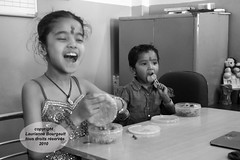
In the past ten years we have changed many lives and I will not subject you to a string of examples or try to blow the pwhy bugle. But I can say without hesitation that I have been vindicated on all counts. But what really struck me today as I looked at the two little sisters in the picture above was that when you change a life you set in motion what can best be called a ripple effect. Let me explain what I mean. Kiran and Komal are the nieces of Rani, a young woman who today practically runs our field operations in Govindpuri. She first joined pwhy as a unpaid volunteer way back in 2000 but soon graduated to the princely honorarium of 500 rs a month. A school drop out – not for academic reasons far from that but because she was beaten for not paying her fees and her mom decided that enough was enough – she joined us as part time volunteer but slowly she just became indispensable! Today she practically runs project why. Along the way the managed to pass her class X, XII and is now doing her BA second year. Along the way she also became computer savvy and even crossed the seven seas to go and root for pwhy! You must admit her life did change. But that is not all. Along the way two beautiful little girls were born in her family and that is when the ripple effect set in motion.
Today K and K are both in an upmarket school, the kind you and I would send our kids too. Tre admissions are not easy when you have a slum address but Rani never gave up. She wanted to give her little nieces everything she never had. The very best. But it was not easy. However all hurdles were overcome and the two little girls are now in school and doing exceedingly well. What is amusing is that we are all a part of this exciting journey helping with home work when needed or with the inane holiday projects children are subjected to. I must admit that when I watch them laughing and giggling I feel terribly proud and wonder what would have happened had I meekly listened to my detractors of yore years.
So today let me be a little cheeky and address all the barbs thrown at me a decade ago: you can make a huge difference even in a country like India; even if you know; nothing about running what is called an NGO, you can do so if you do not lose heart, your resources are never wasted if they can bring a smile on the face of a child; I guess one had to be a little mad to walk the road less travelled; my parents are surely proud and have walked with me every inch of the way; my children’s future was never hijacked but got better; things changed as the ripple effect set in and the world is not so bad when you learn to look with your heart. I have not only survived but thrived!
by Anuradha Bakshi | Jun 16, 2010 | Uncategorized
Bhopal is in the news.. again! This time it is not just the terrible tragedy that changed the lives of over half a million people in its aftermath but the other side as well: the cover up, the sell out, the dark games and more shocking revelations. What is disturbing is the disconnect between the real human tragedy and the flimsy excuses made for all the blunders: be it the failure to clean up the site or the escape of the main accused.
One thought one had become inured to almost everything as one does live in a land called India! But I could not believe my eyes, years, mind when I saw/heard our Environment Minister quipping: I have held that waste in my hand, I am still alive and not coughing. This after he visited Bhopal last year and was asked about the delay in cleaning up. And wait there is more. He also observed that the greenery around the abandoned premises was better than most other places. He asked if it would have been (so green)… “with all the toxicity around”. But that is not all: he announced that the centre would help in creating a memorial to the tragedy, one that would cost 116 crore, more than the amount needed to supply clean drinking water to the area. “It will be a national monument built in the memory of those who lost their lives in the tragedy,” he said, “and a reminder of the mistakes that were made so that they are not repeated.” I found this in an incisive article entitled Those who still go unpunished!
The article ends by stating that perhaps the envisaged memorial should have statues of all the politicians responsible for the aberrations of the last 26 years.
Bhopal is in the news again. And out comes the can of worms. When the terrible tragedy occurred 26 years ago there were no 24/7 news channels, no investigative journalism and all we got were the headlines in papers and the well filtered bulletins on the sole national TV channel. Then over the years small new items, rarely front page ones, informing all of the progress of the judicial process and maybe the protest of the almost voiceless victims. It is only last week that it all came tumbling out making us aghast and angry. We are suddenly privy to the political games, the judicial ones, the corporate ones and the diplomatic games and sadly once again what is enfolding in front of our bewildered eyes is a new cover up game. So committees will be formed and will give their reports and then what…. A few coins will be again handed out with the hope of shutting disturbing and annoying voices and the dark games will carry on.
The games that have been played for the last 26 years are beyond any sane imagination. A very comprehensive article appeared this week in a leading investigative magazine. Read it. It shows how for a few pieces of silver, every thing that is remotely good, fair, human, humane was sacrificed with impunity. How justice was subverted and how even today nothing has changed. The betrayal of hundreds of thousands of voiceless and hopeless victims is so huge that in the words of a leading activist all you can do is laugh helplessly. This activist was a young university student who had gone to Bhopal in 1984 as a relief worker. He never came back and became the voice the desperate victims so needed. I salute Satinath Sarangi. If there were more such children of India, things would be different. But a lone voice, however strong, however brave and however committed does get lost and silenced in the cacophony that has played louder and louder in the last 26 years. What is needed even today to redress the torts, to bring some solace to those who have suffered for so long is many such voices so that all dissonant voices can be silenced once for all. Otherwise all appeals for justice will turn into helpless laughter.
The victims have another reaction while some crushed and defeated wish they too had perished on that fateful night, others ask whether it would have been better if they had picked up a gun! Is this the last resort our democracy offers its people? When all fails – administration, justice, politics – is death the only option?
The writing is again on the wall but are we man enough to stop and read. I know this innocuous blog is not going to make a difference, but I have to write it because I am angry, because I too feel let down, because I want answers and because I have stopped and heard. And also because I have seen first hand how time and again the poor and voiceless get used and abused.
As I write these words, a bunch of politicians are sitting in a huddle trying to set matters right. I wonder what new clean up game is being invented. Somehow I find it hard to believe that justice will finally be delivered and the real culprits made accountable.
by Anuradha Bakshi | Jun 8, 2010 | Uncategorized
 Not so long ago the nooks and crevices of our house were regularly home to sparrow nests. At that time we often consider this invasion a nuisance though we never destroyed any. I cannot remember exactly when the sparrows stop nesting. I cannot even remember when we actually stop seeing any sparrow at all. But come to think about it it has been a long time since one has laid eyes on that tiny bird, one that once was an intrinsic part of our lives. When a friend told me that new urban designs were responsible for the disappearance of the sparrow, I accepted the fact quietly and learnt to live without our little friends. It was one more instance of man versus nature and man had won again.
Last week an article in a magazine brought back my little sparrow to life. It seemed that it was not architectural designs but cell tower radiation that had spelt the death knell of not only sparrows but of bees and other creatures. The article makes frightening reading. The cell towers with seem to be proliferating on the skyline with obsessive regularity seem to be the cause not only of the disappearance of little creatures, but of illness and death in human beings. EMR (electromagnetic radiation) seems to have invaded our cities and homes and we are helpless.
In the span of a short decade the cell phone, which was once the prerogative of the rich, has become an essential commodity for all. Look at people walking on the streets, every second one has a cell phone. I was surprised to find out that everyone that works in my home has a cell phone, the maid, the cook, the gardener. Our washer man who comes once a week has one too and so does the plumber, the electrician and everyone who rings the doorbell be it the courier boy or the delivery man of the local grocery store. Look some more, children of all age are proud owners of cell phones. And to meet this exponential growth in demand, cell towers have mushroomed everywhere. For many allowing a cell tower on one’s roof is simply added income. According to the survey done by the magazine even hospitals and schools have offered their rooftops to house cell towers. One can safely say that we are in the throes of a new invasion!
And yet there was a time not so long ago when we managed without them. I belong go the generation that grew up with one fixed phone in the house. Often, as was the case at home, the lone phone was placed in neutral space like a corridor. The phone had a short lead wire and I remember how one use to try and tug at it to get behind a door for those private phone calls that are the prerogative of every teenager. That was the only privacy one got. I also remember how one paced the corridor at particular moments of the day so as to be the one who picked up the phone, or how one glared at anyone else on the phone if that was the time one was expecting a call. The lyrics of an old favourite come to mind: Time it was, and what a time it was, it was , A time of innocence, a time of confidences, Long ago, it must be, I have a photograph, Preserve your memories, they’re all that’s left you (Bookends, Simon and Garfunkel). Come to think about it I have no photograph just fading memories.
I also remember the advent of the cordless phone and how it spelt an new kind of freedom. Never mind if there was a limit of a few meters, one was freed from having to pull and tug at a wire. When the first cell phone came it was way beyond every one’s reach and we all looked at it with some kind of wonder. We could have never thought that in the span of a few years
everyone would own one.
Bees are not your irksome insect that needs to be shooed away. Their hum is a comforting reminder that all is well on planet earth, that the plants will be pollinated in time and food will reach our table. The silence of bees is frightening and the harbinger of terrible times.
by Anuradha Bakshi | Jun 8, 2010 | Uncategorized
 Every time one feebly attempts to try and listen to those who extol the elusive virtues of the Commonwealth Games, heralded as the panacea to all our urban woes, as the magic wand that will transform our disorderly yet cherished city into a world class one, an aberration appears and calls us back to order. The latest was a news item on the front page of a leading daily. Vendors to be evicted in Games clean-up screamed the headline.
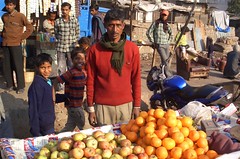
The vendors in question are part of the life line of our city. The local roadside cobbler that one rushes too in times of need, the lady who irons our clothes each and every day and has been doing so for decades now, the vegetable vendor who is an intrinsic part of every colony. They are the heart and soul of our city, people we depend on and cannot do without. My ironing lady has been ironing my clothes for the last 30 years. I have seen her children grow. She comes every morning to collect the day’s clothes and her smiling face is something I have got use to seeing. It somehow makes my day. When I was in Paris for 3 years and had to iron clothes myself…ugh… I remembered Phoolmati with fondness and realised how much we depended on her and needed her. The husband’s shirts were always ironed to perfection on so where my crisp cotton saris of yore years.
Many of our parents are such vendors. They are brave and proud people who left their homes many years back to come to the city in the hope of giving a better future to their children. Today their children are working in swank places but they still continue to labour and toil long hours, come what may. This is the only life they know, and quite frankly the only one we know too. I shudder to think where I will now have to head to get my shoe repaired or or to buy the missing element for the nights dinner! And the idea of not having well pressed clothes to wear is nothing short of abhorring.
Vendors, the powers that be say, are a security risk. I find that difficult to fathom. Gentle Phoolmati cannot hurt a fly, nor can our poor old cobbler. Then why this inane decision? The street vendors are the heart of the city and a real necessity. Why be ashamed of them? These small marginal economies are needed in a country with a population like ours. They help the poor survive. But then who cares about the poor. Off with their heads seems to be the order of the day.
by Anuradha Bakshi | Jun 3, 2010 | Uncategorized
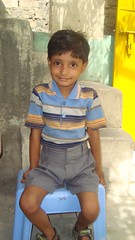
 Last week as I drove to the project down our little lane, I saw a small posse of men standing on the street in front of our centre’s door. There were about 3 or 4 of them, and one held a sheaf of papers in his hand. They looked harried and worried and I knew at once what was happening. It had to be another broken heart that needed to be fixed. I must confess that my initial reaction was one of mild exasperation: not again were the words that fleeted across my mind. We are just barely recovered from the tragic death of brave and beautiful Heera. I really did not feel we could quite face another ordeal. But of course I did not let any of my thoughts appear on my face: the show had to go on.
This time the little heart that needed to be repaired was that of Kajal all of six years old. Kajal is a tiny little girl who hails from Bairi Aghu a small village in the Beghusarai village of Bihar. She has one older brother age 8 who is in school in class I. Her father earns 2500 rs a month and her mother stays at home. This is their sole income. The family does not won any land or property. When she fell sick last month the family took her to the local dispensary, then the hospital who referred them to Delhi and the All India Institute of Medical Sciences. They came to Delhi, and took a little room on rent @ of 1000 rs and set off to get the little girl checked. They wanted to do everything they could for their little girl. They were told she has a hole in her heart and would need surgery. The cost a whopping 70 000 Rs, almost 3 years of the father’s wage. They were stunned and did not know what to do. Someone told them about pwhy and that is why they stood in silence clutching their papers on that hot morning with hope and fear in their hearts.
My mind was working on overdrive as I alighted from the three wheeler and braced myself to meet them. At that moment I did not know whether we would be able to once again raise the needed funds. Our erstwhile heart fix supporters had long vanished and getting funds now was a long and tedious process. I could imagine myself composing the appeal, posting on the net an hoping for the best.
Not wanting the family to have too much hope. I told them quite frankly that we would do our best but that I promised nothing. I added that I needed a picture of the little girl and that I would get in touch with them as soon as I had some news but it would not be before a few days. I remember the early days when one spent time with the families, trying to talk to them and counsel them. This time there was nothing like that. I was taken surprised at my dismissive behaviour. Had I become inured at the pain of others. Not quite. In hindsight I realise that I was apprehensive and did not really know whether we would be able to live up to the family expectations.
Some time later we had the photograph of the little girl and I set the operation in motion. The first appeal was posted on the pwhy page of facebook. At that time I did not even know the little girl’s name. I wondered how long it would take to garner the needed funds.
I had forgotten that pwhy was a place where angel’s do not fear to tread. A short time later a response appeared on our page. It asked a simple question: how much would the surgery cost? I answered and a few instants later, thanks to the magic of the net, from thousands of miles across the globe I got another message: I will sponsor the surgery. I was stunned. It was all over. Kajal’s little heart would be fixed. It was only a matter of time. The God of Lesser Beings had hear, listened and acted. One of his angel’s had appeared.
This angel is a very special one as she has often appeared in our lives. I remember the first time many years ago when we were battling to survive, she came out of the blue and took charge of things and settled everything right. And since she has always been around, watching us form far. And yesterday she knew we needed her and there she was dispelling all clouds and making the sun shine again. God bless her.
Yes, pwhy, is truly a place where angels do not fear to tread!
Note: we have the funds for surgery but do need some more help to ensure that Kajal gets all her medication and proper nutrition to make sure that all goes well.

 It is absolutely inane that as a society we have reached the sad day when we need to debate the issue of whether, what I can only call a cool blooded murder, can be viewed as socially acceptable and be called honour killing. I have listened with horror to the recent debates where those in favour – and yes believe it or not there are such monsters around – try to justify taking young lives to protect some misplaced value system.