by Anuradha Bakshi | May 1, 2010 | Uncategorized
 A recent article on the other side of the Commonwealth games ended with these words: However, no amount of figures can mask the despair of those rendered homeless because of a mere 15-day ‘sporting’ event. “As a society, we have grown indifferent to equality around us. The poor are either seen as a nuisance or an encumbrance or embarrassment. Most of us are migrants to the city; if we are not being sent back, then why should labourers or beggars be made to go?” The article said much of what I have been writing for over a year now: displaced people, raised slums and so on: 3 million people will be rendered homeless by the time the show is on the road! Out of them the 1.5 million workers who were brought from other states to put the show on the road. I wonder why it took so long for the media to wake up to this realisation and to expose the sordid underside of things.
Now it is too late. We have become inured to too many aberrations and mastered the art of looking away.
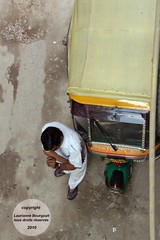
For the past month I have been living with workers as my house is being repaired. It is true that there were instances in the past when I had come close to workers but that was before project why. In those days my eyes were closed as I did not see with my heart. This time is different. Workers are not just your irritating plumber who never comes on time or your loud mouthed mason, they are people whose life I have seen up close and personal.
All these workers are migrants who left their homes for a variety of reasons, the most common one being poverty. Many were brought by wily contractors and then just stayed on. Many have been in the city for decades. Murtaza is our masonry contractor. He came to the city 15 years ago as a young lad. He worked his way up slowly from daily wage labourer to mason, to small time contractor. He is the guy who will confidently quote you a price for a rood repair or bathroom tiling. Yet he is still illiterate. His acumen stems from his experience and common sense. Today his family has joined him and everyone works together: his father, father-in-law, uncles, nephews etc. So when he takes on a small contract the money remains within the family.
Nabi Karim is our paint contractor. He is also Meher’s uncle! He too works with his family. Over the years, as his work became more lucrative, he brought his brothers, nephews and relatives from the village. The women and children were left at home. The city was not for them. And the land had to be tended too. This was the best option for all as the land was too little to feed everyone. Though still humble and unpretentious, he is slowly becoming big time!
The workers are a happy lot. They may not quite work according to your expectations but just stop and look at them with your heart. They turn up every day notwithstanding the weather and work in terrible conditions carrying loads on flimsy ladders or breathing dust and paint fumes. They work long hours without complaining breaking just for a cup of tea that I never fail to send or for lunch.
If you come by do not be surprised to hear music at every floor. Today’s’ worker has a new addition to his tool kit: a cell phone, and one that has an MP3 player. As you stroll along the house you will hear different songs: nostalgic songs from Bihar where some hail from or the more recent Bollywood numbers. These are often played by the younger workers. Most of the workers sheepishly come to you and ask if they can use a plug to charge their phones. Of course is my answer! Music does make the work less tedious.
The work is taking forever, but I am not complaining. I am quite enjoying sharing my space with these incredible and brave people who have learnt to survive in the worst conditions and come out winners. It is these people that some call a nuisance or an encumbrance. I just wonder what our life would be without them.
by Anuradha Bakshi | Apr 30, 2010 | Uncategorized
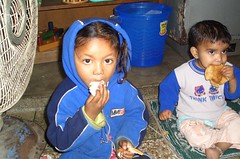
 I recently read an article entitled ‘eating disorder‘! This one was not about a lifestyle condition of page 3 aspirants. Far from that. This one was about the 1.2 million severely malnourished children of Madhya Pradesh, this was about under one year olds who are fed one roti smeared with chillies per day. The chillies ensure that the stomach is numbed and hunger vanishes. Water will fill the tiny tummies till the next day, the next roti with chillies. According to a UNESCO study, over 71% of tribal children are severely malnourished.
It was on the very same day that TV channels aired a story about how state granaries were used to house liquor while food grains worth millions rotted in the open. The next harvest was on its way and one wondered where the new grain would be stored. The weak defense put up by the granary officials did not hold any water. The reality was that umpteen crates of upmarket liquor brands were stuffed into the safe granaries, while sacks of grains were seen rotting in the open.
One wondered why the grains could not by some miracle reach the little hungry mouths instead of moldering away. But that is wishful thinking. The situation is Dantean. Children are hungry, farmers are hungry. Only middle men and traders smile. Something is terribly wrong. Our planning seems to have gone awry.
A solution has to be found. Food cannot be fed to rats when millions starve in the country. Everyone has a right to be free from hunger claim activists. Having even one hungry child negates all achievements and feats. Having millions should make us hang our head in shame. But once again we seem to have become inured. We waste food with impunity. Just look at the morning after any wedding. Food wastage almost seems to have become a status symbol. Bless my mom for having put an end once for all to my food wasting habit. I must have been 6 or 7, and had begun leaving food on my plate. No amount of cajoling or counseling helped. Mom had to bring out the ultimate weapon. She did. My half filled plate of food was simply put in the refrigerator and brought out at each subsequent meal. The deal was that I would not get any fresh food unless I first finished the congealed plate. It was a battle of wits and it lasted 2 days. The hunger pangs were unbearable and I capitulated. The congealed food was eaten and that was the last time till date that I ever left food on my plate. Parenting is not always easy!
It is true that there is a new found freedom sometimes bordering on arrogance that we see around us. It is visible in the gleaming motorcycles that have replaced the erstwhile bicycles, in the TV and DVD players that adorn every shanty, in the umpteen empty pouches that are strewn all over the slums, pouches of upmarket products duly advertised on TV channels and appropriately packaged for the poor @ of 1 or 2 Rs! It is also seen in the quantity of food thrown helter-skelter. Back home in the village it would have been fed to the animals. Urban values have prevailed on one and all. Wasting food is one of them.
How will it all end. I do not know. What I know is that children are not meant to eat rotis laced with chillies. I also know it is time we woke up and did something.
by Anuradha Bakshi | Apr 26, 2010 | Uncategorized
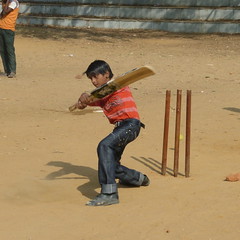
 “I would like to emphasize that while opening new schools, we should insist that adequate open grounds be provided for playing fields”decreed the Sports Minister in a recent letter to the Education Minister. Some years back I would have jumped with joy and said: way to go! But that was a few years back, before project why, before the many reality checks that came my way, when I held that private schools, specially the ones for the poor were just teaching shops and nothing short of an aberration, when I believed that only a common neighborhood school was the panacea we needed. I remember how I blogged passionately about these issues: be it the admission nightmare, the blood money sought, the lucrative education business, the arrogance of public schools, the pitiable state of state run schools and so on.
And then slowly things changed, surreptitiously I must admit. Even I did not realise how and when it happened. My diatribe against private schools became less vehement and my crusade for the more and more elusive common school became less strident. And lo and behold there came the day not so long ago, where I found myself writing a blog almost in favour of what I had once contemptuously called teaching shops. How did that happen?
The answer is complex and cannot be summed up in a single phrase. What did change things for me was James Toole’s book: The Beautiful Tree A Personal Journey Into How the World’s Poorest People Are Educating Themselves. The book is an apology for small private schools and, I must admit, sets you thinking. In Tooley’s book the tiny private schools tucked away in sordid slums are the means for the poor to claim ownership of the education of their children, as it is their money that made such schools possible. The result is for all to see. The products of these schools fared a great deal better than their counterparts in state run schools. They are not an aberration but stem out of a very real need. It is in no way an ideal situation I agree, but it is a workable option.
Children cannot wait for laws to be enacted, for convoluted and dubious projects to see the light of day. They need immediate solutions or it may be too late. And therefore little schools mushroom at every nook and corner. Often in small cramped spaces. Many of these manage to get the recognition tag which gives them an edge. You see even the poor and illiterate knows the value of a recognised school! Cynics may say that these tags are got through shady means, and I may have been one of them in times gone by, but today I accept the fact quietly. Every such school is a place where children study and learn. Who am I to criticise or pontificate? Specially today when the new laws decree that no child will be failed till class VIII. I shudder to think what will happen to children who are in state run schools where there is scant teaching. They are better off in the cramped premises of a small private school where some teaching does happen. And yes, they do not have open grounds for playing fields.
So if the Minister’s decree is accepted, no new private schools for the poor will come into being. In a city where every square inch comes at a whopping price, finding space for playing fields is impossible for such schools. I hope better sense will prevail.
by Anuradha Bakshi | Apr 22, 2010 | Uncategorized
 In a recent blog I had mentioned the story of the young boy who always came late to school because he supported his family by selling boiled eggs at the local watering hole well past midnight. He was the sole bread earner of his family.
Our house is being repaired and we have a band of workers. Among them a young boy who I think is 13 or so. When asked his age he is quick to mumble sixteen and a half as he has been told to as the child labour laws make employment of anyone under 14 illegal. Of course he has nothing to prove the fact. There was a time, way before pwhy, where I would have raised a hue and cry, summoned the contractor and insisted the boy was sent home. Today I just kept shut and allowed the boy to carry on. I knew that if I did send him home his family may not have eaten at night. You see he may too be the sole bread earner in his home. I have learnt many lessons in the past decade: one is to never act in haste and the other is to never act without having a better alternative to offer. In this case I had none.
Some time back I had visited the Child Welfare Committee’s zonal office to sort Utpal’s vacation guardianship issue, while waiting for our turn to appear before the Committee, we were privy to some of the ways the laws are applied in the case of child labour. The CWC premises have a holding area, a sort of jail, where children are brought after raids. The families are then informed and have to provide proof of the child’s age. This can take several days and till then the young ones are locked up. What is the offense? I wonder. If the parents get the proof the child is released if not a case is registered. I again say what is the offense? Who is guilty: the employer, the parents or the child? Questions that need answers. And then what does happen to the child, often a teenager, when he is released? Does he just find another job? Does he simply hang out in the street as there is no way he can be mainstreamed or educated? Is he sent back to his village and if so what does he do there, wait for the next opportune moment to once again board a train to the big city?
The laws that concern child labour are complex and nebulous. It is surprising that the Child Labour Act of 1986 seeks only to prohibit children from working in some sectors and simply ‘regulates’ child labour in others. That means that even after 4o years of independence, child labour was found to be ‘acceptable’. Think about this.
The National Policy on Child Labour of 1987 is the first step towards addressing the issue and talks of general development programmes to help the family and a project based action plan with special schools and so on. That is not what we saw at the CWC. Far from that. It seemed a case of a child being guilty and harassed parents left with the onus of proving that he was not. There was no development programme or project base action.
I am sure there are a lot of well drafted and great sounding projects and pots of money that has been released for the same. Sadly I am also sure that much of the money has never truly benefited any child. Like all issues concerning children, child labour is Gordian in nature. It has to be addressed with sensitivity and understanding.
Why does a child work? Certainly not because he really wants to. Often it is economic necessity that compels parents to send their young ones to work and there are enough predators around in search of cheap and innocent labour. Sometimes it is a simple fight or argument that makes a child run away from home in a fit of anger and take the train to the big city. More predators lie in wait. These children are unaware of their rights and become easy prey. What is shocking is that often it is people like us, who are aware of laws and rights, who employ children in their homes as a child is again less demanding, easier to handle etc.
Children now have the right to education though many will grow into adults before this right is truly implemented. A few raids will not put an end to child labour. In a recent interview the Chief Minister of Delhi was asked: Why are you allowing child labour at Commonwealth Games-related sites? Her answer was perplexing: I entirely agree that there should be no child labour, but these children were abandoned by the states they come from and also by their parents. They have moved to a bigger city only to get jobs that pay. But come to think about it is it really perplexing or is it the reality and the CM was aware of the magnitude of the problem and that paucity of available options.
A friend who is privy to the inside functioning of the powers that be, told me that she had once been told, quite candidly, by labour officers and social workers that they often turn a blind eye when faced with cases of 14 or 15 years old working. They simply ascertained that the child was well treated. This seemingly incomprehensible and ‘illegal’ action stemmed out of the fact that they knew that they had no better option to offer. To my mind they acted with sensitivity and understanding.
Laws need to be humane and need to address core issues. Child Labour is not an offense like murder. It stems out of need, hunger, desperation and is a means of survival. If we want to put an end to what we call consider an aberration, then we need to come up with valid alternatives that work.
by Anuradha Bakshi | Apr 19, 2010 | Uncategorized
 Now there is one outstandingly important fact regarding Spaceship Earth, and that is that no instruction book came with it wrote Buckminster Fuller. Spaceship Earth, I like the term! I like Mother Nature too! Today as I write these words millions around the world are stranded as volcanic ash clouds have claimed full right to the sky, not willing to share it with our tiny Spaceships. There is no alternative but too wait for the clouds to pass.
Nature often calls us to order, but we rarely listen. We always find a way to wriggle out of the situation. This time it did look different though there are now pressures from commercial interests to once again not listen. You see too much money is at stake. As we all know for the past many days flights have been grounded the world over leaving people stranded and lost. All carefully conceived plans went awry, our supposedly reliable flying machines became unsafe, the sky we had thought was ours to conquer was reclaimed by its rightful master. Nature had rapped us on our knuckles and we just had to listen. Man’s hubris was suddenly shaken, albeit for a short time.
As I write these words many are looking for that non-existent instruction book in the hope to find a solution that would restore man’s supremacy on everything: land, water, sky, space. But till then we just have to wait.
There is a lesson to be learnt: patience. Something we have forgotten. The clouds will pass and things will come back to what we call normal till the next warning. Sadly it is a foregone conclusion that we will again not mend our ways and continue our frenzy to master all with the sole objective of earning more wealth. We will continue to build on flood plains, to expand our concrete jungle, to cut trees, to rape Nature. We will insist on writing our own and faulty instruction book, one that suits our petty and pathetic interests and doggedly follow it.
Where will it all end? No one knows. Prophets of doom and cynics have their own interpretation. I am still looking mine.
by Anuradha Bakshi | Apr 19, 2010 | Uncategorized
 The heat is on. Boy it is hot. 44 Celsius and climbing and it is only the ides of April! I should be complaining but I am not. Wonder why? Please read on…
I decided to get my old rambling and falling apart house repaired this year after almost 2 decades. The idea was to begin in April and have all finished by May when the heat is really on. Little did I know that this year Nature had another plan. And as usual even with supposedly sound planning and the best of intentions of doing things in an organised way floor by floor, room by room, I suddenly found myself in the middle of a construction site with workers everywhere. You see the plumber had finished his work on floor 1 so needed to move to floor 2 and so on. Within the batting of an eyelid the whole house was under wraps and we were banished to two rooms. The cooler was of course out of commission, hot air blew from open doors and windows and my resolve to never use ACs in the day to limit my carbon foot print resulted in a fans only situation, and that also when the electrician had not cut the power!
Sunday then should have turned out to be a miserable day. Quite the contrary. It was a huge reality check. As it was terribly hot, I was unable to stay put in one place so I ambled all over the house watching the workers. There were many, of all ages, each one of them busy in their work, some on the terrace under the scorching sun, some carrying loads, some hung on the terrifying rope basket painters use in India for painting outside walls. They were busy with their work, chatting, laughing, fighting when needed! Sometimes one of them would run down to the kitchen to get bottles of cold water. But there was no complain about the heat. Heat or no heat they had to work. Most of them were daily wagers, and work meant food in the evening. It was as I said a huge reality check and somehow it did not seem so hot!
I remember another reality check I had last year when I had reacted rather unreasonably to the amount of kids that were packed in the creche in the hot summer. I had not realised that our seemingly hot classroom was far better than a tiny jhuggi with a tin roof!
So this year I for one am not complaining about the heat!