by anouradha bakshi | May 16, 2017 | Anou's Blog, Uncategorized
Every organisation has beginning. Project Why did not begin with a funding proposal ora a strategic plan – it began with the values passed down by my parents especially my mother Kamala Goburdhun. Her determination to pursue education against all odds and her quiet compassion shaped not only my life but also the work of Project Why. This is the story of the woman who guides everything we do
The Trust does not bear her name. Once again it was the flamboyant husband who won the match! But the real inspiration and the quiet and gentle motivating force as always in my life was Kamala Goburdhun née Sinha. Her lessons were not exuberant like those of her better half. They were subdued and tender, cameos of her life she shared with her only child. In the week mother’s are celebrated the world over, I would like to share some of these stories as each is echoed in Project Why.
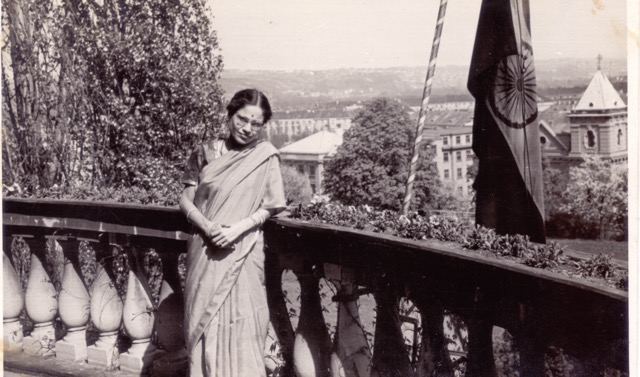
Kamala the child was determined to go to school and her doting father did not stop her from getting enrolled in the first school for girls that opened its doors in the sleepy town of Meerut where the family lived. The school was established in 1929. She was already 12 years old but that did not detract her. There was no looking back. For education she would break all the rules. And she had two formidable women in her corner: her paternal grandmother and her mother! The three would devise ways to win over the Gandhian father. Kamala went on several hunger strikes to be able to continue her studies beyond class VI, go to Banaras Hindu University for her BA, do her MA and LLB. Her final degree would be a PHD at Charles University Prague, after the loss of her first born. Kamala was your never give up woman.
But there is more in the life of this small town freedom fighter’s daughter who went on to become an Ambassador’s wife. When she reached the age when girls would be married, she made a pact with her father, a pact both would honour. She was adamant about not having a child in a land that was not free and hence would not marry before India’s becoming independent, and should she still be of age, would marry whoever her father chose.
But that was not all. Her concern for fellow women was so deep, that she agreed to work for the British in order to reach out to war windows in the villages of Western UP to ensure that that their pension was not usurped by some male member of the family. She drove a truck to reach the far fledged villages. She lived alone in Mandi House Delhi and commuted every week to her home in Meerut in her little Baby Austin. In the villages she reached out to women in more ways than one. A real trouper!
India became Independent. Her father found a man, a man that would take her away on a real magical mystery tour. But the transition from freedom fighter’s daughter to diplomat’s wife was not easy. The first challenge came soon after marriage. A dinner at home where one of the invitees was the British Ambassador. Kamala was appalled at the thought of having to receive him in her home. How could she get past the memories of a little child applying balm to the lacerated backs of her father and his companions when they came back from yet another non-violent protest. This was her task as in those days there was purdah, and women did not mingle with men.
It took her husband oodles of patience and love to explain to her that India was free, and it was the Indian flag that flew on the house she lived in. She was to the manor born and understood what was expected of her. Again she never looked back and was the perfect diplomat’s wife.
So when I look at Project Why, at the years gone by, at the work we have achieved, I realise that though the Trust bears my father’s name, it is her lessons that are imbued in every breath I take, in every step I walk. My unequivocal and obsessive love for India and my pain at seeing how things are going, my determination to educate as many as I can, my desire to make women stand on their own feet. Everything is what she taught me.
So today I understand that if not for you, Kamala, there would be no Project Why!
by anouradha bakshi | May 9, 2017 | Anou's Blog, Uncategorized
(Posting a series of success stories from the compilation The Project Why Stories 2000-2016)
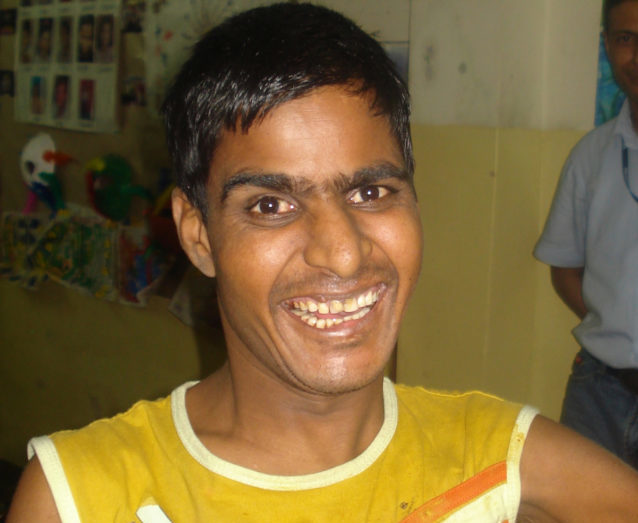
Project WHY’s journey starts with the story of Manu, a boy with special needs who the founder of Project WHY, Anouradha Bakshi, came across one fateful summer day in 2000. Manu was clad in rags, disheveled and filthy, limping and begging on the streets, crying out for help at being bullied and abused.
Manu wasn’t born a beggar. He came from a family that lived within its humble means – his siblings went to school, his father had a Government job and his mother loved him. An alcoholic father and his special needs were his only challenges. But after his mother’s death, and his sisters moving away after marriage, he was pushed to the streets, and often spent his days without anything to eat. His brother’s wife use to send him begging for a few coins. People fed him and treated him like a street animal, his father’s friends abused him, and kids pelted him with stones.
When Anouradha Bakshi answered his call for help that day in May 2000, in the streets of Giri Nagar, a journey began for both of them that would last ten years. The initial efforts were in finding an institution to take care of him, but with no success in that endeavor, a rented place in Manu’s locality was arranged – a larger plan slowly enfolded called Project WHY. Manu was the reason that really made Anouradha take the road less travelled.
Anouradha made herself a promise she would only reveal much later: Manu would have a home, a bed to sleep in, friends to share a meal with and even a TV.
Project WHY grew as a space to support underprivileged school children. Every day, the organization gained trust and working became better every year, especially for Manu. He was bathed, fed and had his own bed in the verandah of what was then our Project WHY office. And in 2002 when we launched our class for special kids, he was Roll number 1!
Some would perhaps think that was game over…Manu was given a TV and a place to stay. But not for the vision Manu provided or set for Project WHY. The challenges that had been addressed gave Project WHY the audacity to start dreaming big, …very BIG!!! Dreams of a long-term, sustainable future for children like Manu – The dream of Planet WHY. The first plan in this was to give Manu and his friends a place in which they could grow old and die in dignity. The idea of a green building, with terracotta bricks and old style flooring and many widows to let light and breeze in. It would be Manu’s home and workplace as he would be able enough to learn gardening or a skill. Land was bought, architectural plans made and Project WHY started looking for funds.
On January 7, 2011, Manu tiptoed out of Project Why’s and Anouradha’s life after having had a cup of tea and his favorite biscuits. It is only after his death that the true meaning of Manu’s life emerged. As Anouradha puts it, the biggest lesson Manu taught the family of Project WHY is to “never judge a child by their appearances and also believe that each and every child is special”. No life, however miserable, wretched or seemingly hopeless, is meaningless. Every life has a purpose.
Manu’s legacy is huge. If not for him, there would not have been a Project WHY. If not for him, so many lives would never have been transformed, be it the now thousands of children who have had access to education, the scores of kids with repaired hearts, the many hopeless souls who now have dignified employment, the bunch of disabled kids who now spend their day happy and so on. Manu was born to conjure miracles.
In true homage to Manu, Project Why lives on.
![A sticth in time #GivingTuesday#India]()
by anouradha bakshi | May 2, 2017 | Anou's Blog, Uncategorized
(Posting a series of success stories from the compilation The Project Why Stories 2000-2016)

Born to a poor family in Bihar, Gyanti Devi never had the opportunity to learn as a child. Soon after her marriage, her husband, who is severely handicapped, required treatment. This meant moving her life and her two children to Delhi in 2006, where they lived on rent in the village of Madanpur Khader. The area houses mostly migrant families and has a high dropout rate from government schools as well as issues of safety and nutrition.
Gyanti Devi’s case was brought to our attention by a friend of the Project, Sunita, at the beginning of 2014. With her husband unable to work due to his handicaps, Gyanti Devi needed income for her family but, with no skill whatsoever, was unable to find a job.
At Project WHY, we felt that our sewing or beautician classes could give Gyanti Devi the opportunity to start a career. However, we soon realised that, being entirely illiterate, she would need more than just vocational skills. Dharmender, the manager of our Khader centre, proposed that she spend the mornings learning to stitch with the vocational group, but also attend literacy lessons with the children for 40 minutes in the afternoon. She agreed to this and became one of our most motivated and diligent students, slowly building up her literacy skills with the children whilst also finding solace in her knitting.
Now, Gyanti Devi is a proud graduate of the Project WHY system and able to read, write and sew with ease. She has started a small business within her village stitching other people’s clothes, with which she is able to provide income to her family. She is also able to read the local newspaper and understand what is going on in the world. She points to an increased sense of freedom and opportunity with the skills that she now has. Previously afraid to take the bus alone, she notes that “I can now make my house budget and also can read the bus signboard.”
Armed with a new sense of financial responsibility, Gyanti Devi has spent the last three years building a new house for the family. She would get up early in the morning and take the interstate bus from Delhi to Palwal (Haryana) by herself, returning late at night. There, she would bargain and purchase the construction materials required. She kept detailed records of all labour payments in a notebook and is proud of her achievements. “I have successfully built my home for my family. So, I can say today that what every man can do, I can also do”.
Project WHY believes that every person should be able to change his or her life, and it provided the support for Gyanti Devi to do this and achieve her dream. She has created a better future for her children and she hopes that the skills she has learnt will allow her family to prosper for generations.
by anouradha bakshi | Apr 25, 2017 | Blog
The only thing that truly disturbed Malte during his years in Delhi was the poverty he saw on its streets.
Every afternoon, on his way home from his privileged school in Chanakyapuri, his car stopped at the same busy traffic light where young children begged for money. Seeing children his own age barefoot, hungry and without access to clean water filled him with questions. Why had he been given such a fortunate life while they had been denied even the most basic necessities?
Together with his sister, Malte decided to do something. They prepared small packets of dry fruits and handed them out to the children at the traffic lights. The smiles they received made them happy, but only for a moment. The packets disappeared within minutes, and nothing changed. Malte realised that while kindness could ease a day’s hunger, it could not change a child’s future.
That changed when his mother began volunteering with Project Why in 2014. Through her, he learned about children from Delhi’s slums who, despite enormous hardships, had been given a chance to learn, dream and build a different future.
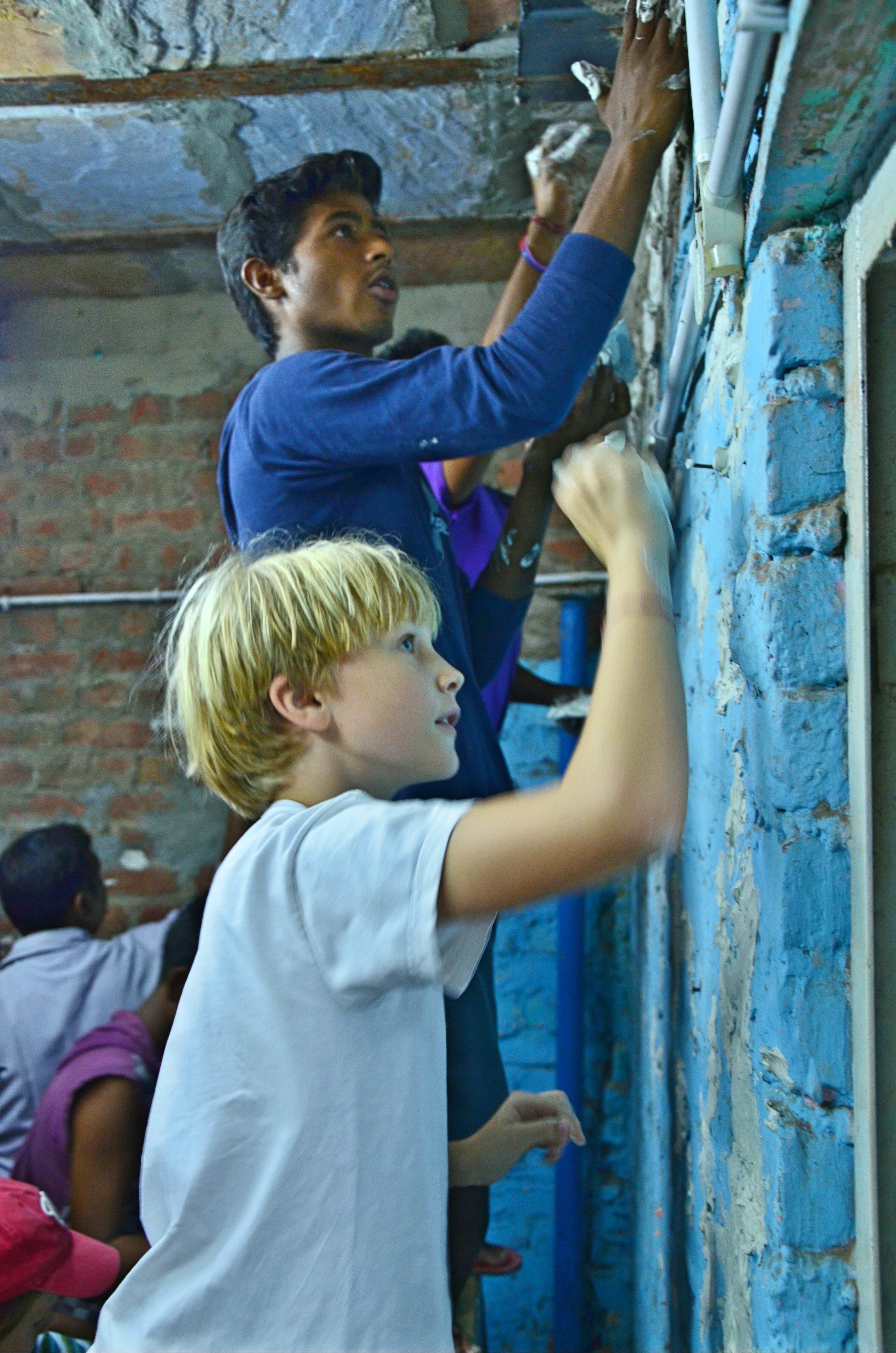
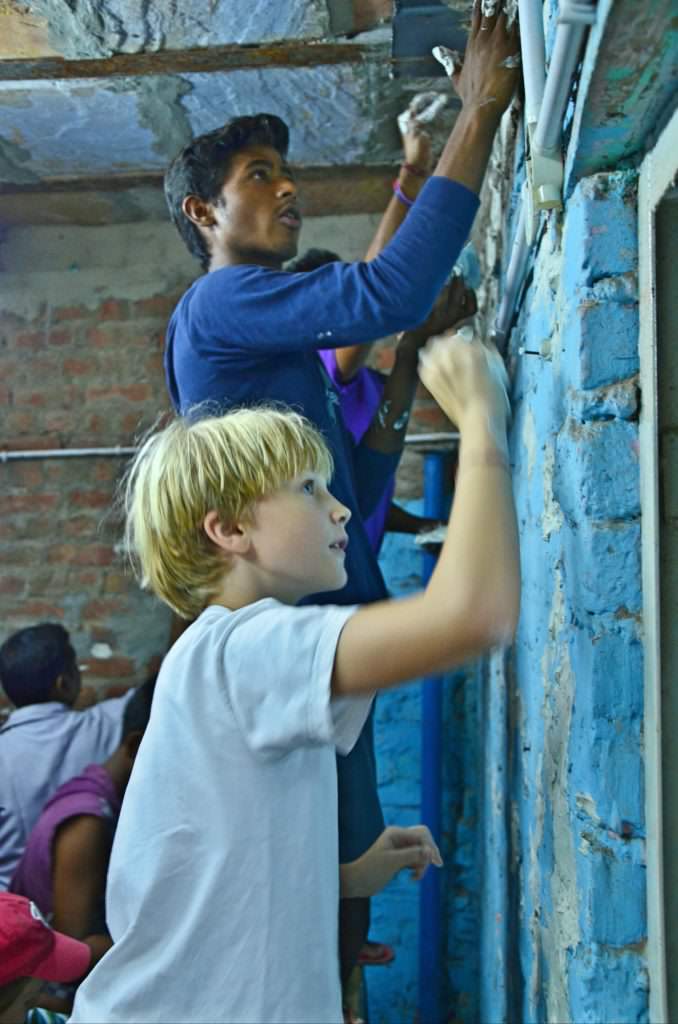
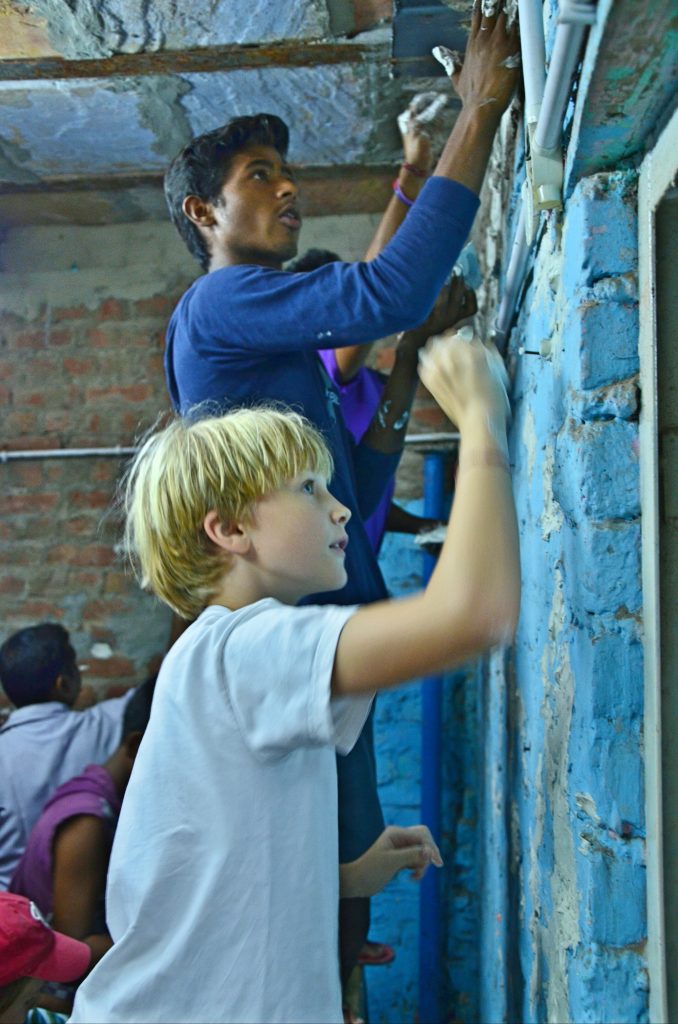
One Saturday morning in October 2015, Malte came to Project Why for the first time. He met the children, saw their eagerness to learn and was struck by the joy that filled the small learning centre. A few weeks later, he returned with his Cub Scout group to help whitewash the newly renovated Okhla Centre. Working side by side with the Project Why children, they transformed the building into a colourful and welcoming place. For Malte, it was a revelation. Here was a place where poverty was not accepted as destiny but seen as a challenge that could be overcome. And here, even a ten-year-old boy could make a difference.
But Malte wanted to do more.
Together with his friends Stefan and Scottie, he organised a fundraising campaign in their school. They designed colourful posters explaining the work of Project Why and invited the Project Why children to decorate traditional piggy banks, or gulaks, to collect donations. Then, for an entire week during the cold December mornings of 2015, the three boys stood at the school entrance, encouraging students, teachers and parents to contribute. Their enthusiasm proved infectious. Even the school principal and the American Ambassador stopped to make a donation.
By the end of the campaign, Malte and his friends had raised ₹12,000. The money enabled Project Why to build a bamboo roof over the Okhla Centre, giving the children a sheltered classroom that protected them from Delhi’s scorching summers and chilly winters.
Years have passed, but Malte has remained part of the Project Why family. He still asks about the children he met, enjoys returning whenever he can, and often donates his pocket money to buy school supplies for the centres. Whenever the scale of poverty in India overwhelms him, he looks for another way to help.
Perhaps that is the greatest lesson of all. One child cannot change the whole world. But one child can change a small part of it. And for the children whose lives are touched, that small part can mean everything.
by anouradha bakshi | Apr 18, 2017 | Anou's Blog, Uncategorized
(Posting a series of success stories from the compilation The Project Why Stories 2000-2016)
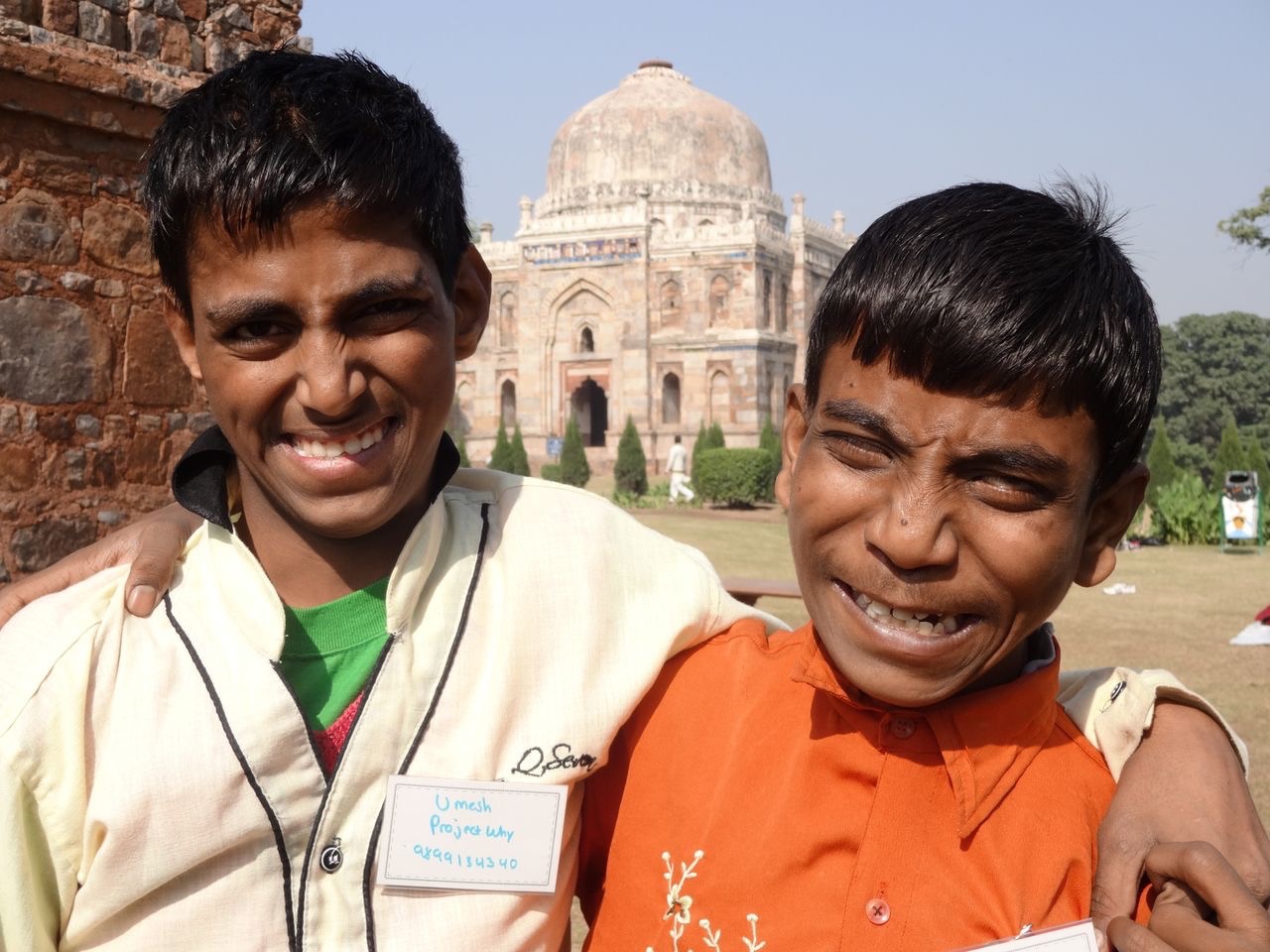
Indian society continues to treat disability with indifference, pity or revulsion. Low literacy, school enrolment and employment rates as well as widespread social stigma are making mentally disabled people amongst the most excluded in Indian society. These people are deterred from taking an active part in most families or even communities. Moreover, there is a stigma attached to children with disabilities, especially in rural India, and often even loving parents can do nothing to help their disabled child because they themselves are not aware of the disease or how to take care of their child.
The story of Muna therefore begins in 2005, when he first arrived at Project WHY. It was clear that he had never been adequately looked after. Upon further investigation, it was revealed that, whilst his parents cared about him dearly, they simply did not understand his intellectual impairments. Muna’s parents did not have the time nor the resources to give him due attention, as they had to care for his other four siblings.
Interacting with Muna, Project WHY found that he had little concept of personal hygiene. He would regularly soil himself, and had never been taught to have a shower/bath. He had no understanding of social interaction and rules of engagement. This was demonstrated in 2014 when Muna left a shop without realising he needed to pay for his juice and was severely beaten by the shopkeeper.
Having grown up in the industrial neighbourhood of Okhla, Muna would spend his days begging outside temples, occasionally stealing when money was unavailable. Residents of the neighbourhood would befriend him simply to bully and take advantage of his simple mind. Without the ability to communicate clearly, he was reduced to performing illegal errands around the community such as collecting and selling alcohol for under-aged children.
Project WHY began by teaching Muna the basic concepts of hygiene and to be self-reliant. He was taught to use a lavatory, to dress himself and to shower regularly. From there, we were able to build his confidence through speech therapy classes and develop his basic social interaction skills. Project WHY also initiated the process of educating Muna’s parents, who now understand his disability and the kind of care that he requires. They acknowledge his kind heart and sense of compassion even if he cannot communicate it in the same way as other children.
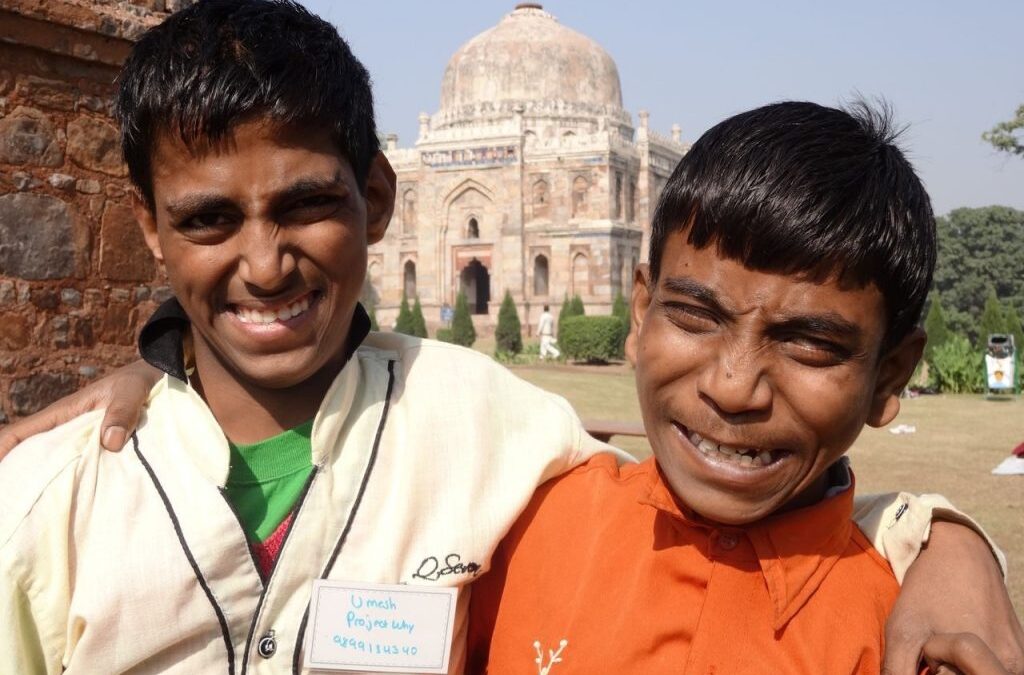
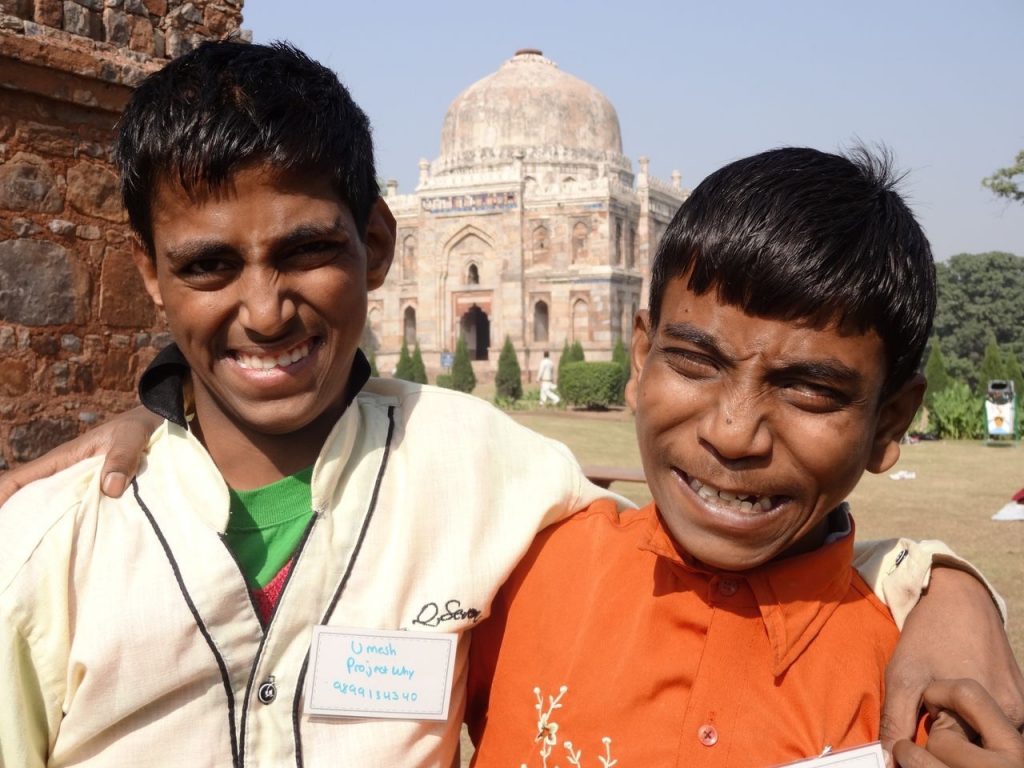
Today, at the age of 19 years, Muna is one of the stars of Project WHY’s special needs class. He is the first to welcome and befriend any new volunteers, including foreign students who do not speak the Indian language. He is very fond of activities such as art, ball games and dancing and, in spite of his difficult childhood, he shows an overall passion for life.