
the sting that lost its bite
The latest sting school. operation turned out lost all its bite when the reporter in question was arrested. I am referring to the case of the school teacher accused of waylaying girls students in Delhi. Though the story had created furore and even rioting when aired, somehow it had not rung true and I had chosen not to comment on it though I often find myself reacting to stories about abuse of children.
Sting operations seem to be the flavour of the times and they have undoubtedly redressed many a tort and brought justice to some. And though one had even been at the origin of Ghaziabad girls operation, the silence that ensues such operation is sometimes too deafening to bear making us wonder as to the role the media can and should play in such cases.
It is true that in the past year of so the media has risen as a watchdog bringing to light many wrongs hitherto hidden. The power of images and the ability to edit and replay them brings stark realities into the very privacy of our homes making us react and one has seen people reaching out to others in gallant ways.
Sting operations have a role to play in waking up the slumbering conscience of a lethargic civil society and that is why one should not allow it to be hijacked to even personal vendettas or suit vested interests. If there are more such fake stings that we run the risk of having restrictive laws slammed on them.
Media has to be extremely cautious and conscious with such operations and not view them as a simple way to up their TRP rates. They also need to follow up and inform their audience on the outcome of each case. Only then can this powerful tool become an agent of change.
the baby factory
The baby factory that was exposed in another now famous sting operation looked like a horror movie. Young minor girls from poor states brought to Delhi and then made to produce babies that were then sold! The reason for this is two-fold: the abject poverty on one hand and the draconian adoption laws on the other. This makes a heady cocktail for greedy predators always looking for a quick buck.
The fabricated baby was thus sold for a mere 10 000 Rs. The new parents even got a birth certificate with their names as parents making the deal as perfect as possible. Wonder how much the poor natural mother got after every one had taken its pound of flesh. And wonder what becomes of her after she produced one or x babies.
So many questions come to mind when one hears about this terrible tale. But the ones that linger on are those that touch the girl. Motherhood is sacred to every woman, no matter how poor she is and no one has the right to rob or appropriate itself this experience . The nine months one carries a child in one’s womb establish a bond that is almost visceral. The young girl who set out on a journey of hope could not have imagined in her wildest nightmare that this is the price she would be asked to pay for a better life.
The perpetrators of such a crime should be punished in the most draconian way possible but knowing our legal system that will not be so.
the boy in the red shirt
I would like to share two small almost negligible incidents that happened yesterday.
While showing the project to a visitor we stopped by our tiny Govindpuri primary centre. The room was so tiny that some of us remained outside where a bunch of young lads sat loitering. One of them wearing a bright red shirt seemed to be their leader. I asked him what he did and the answer was almost thrown my way: I just hand around. I persisted in my queries and this was what transpired. This young boy – about 15 or so – had dropped out of school in class V because according to him there was no teaching as teachers did not bother to teach. He then got a job but left it as the pay was not regular, and now he was looking for another one, just any kind of job would do.
Later in the day I went to the Greater Kailash M block market looking for some hairpins and rubber bands, ware usually sold by enterprising young men on the pavement in front of the shops. I, of course, had forgotten about the recent cleaning drive that had ensured the disappearance of all such stalls that had been there for as long as one remembered, sometimes passing from father to sons one had seen grow. The once bustling market looked strangely devoid of its soul. Refusing to give up I walked along around the market, knowing in my heart that I would find the elusive ware I sought. And then, as I was almost about to give up, I saw one of the familiar faces tucked in a shop doorway with a few trinkets on the ground. I approached him and asked him if he had the things I needed. He smiled and asked me to wait a minute and dashed to his car parked across the street and fished out the things I sought. He told me that all stalls had been cleared but he hoped that things would change soon.
I had once written a post about a young boy selling guide books in front of an exam centre and marvelled at the spirit of enterprise displayed by young Indians. It is sad to see that the new sealing and other suddenly discovered laws are hitting at the livelihood of the poor. Young people like the boy in the red shirt who dropped out of school not because of lack of ability or desire but because of abysmal teaching could easily find employment in the very small shops or road eateries that will be soon closed.
I am one to respect laws. But laws have to be applied from day one and not be circumvented for years by shady means and then resurrected to suit newfound interests. One cannot forget that between the two time has elapsed and realities changed.
only a matter a of degree
The recent imbroglio over the issuing of degrees to students of India’s prime medical school is a tragic reminder of the prevailing state of affairs in this country. The drama recently enacted on the streets and in front of cameras had shades of both Kafka and Marx (Groucho of course)!
To any sane mind the one and only requisite for issuance of a degree would and should be successful completion of examinations. Well that is not quite so in a land named India. here this simple administrative formality becomes a complicated saga of ego clashes and almost childlike behaviour. I will not sign the degree if it has the signature of that person says one protagonist, while another quips: the other person will not sign. All this while students who have toiled hard against many odds wait in mute and horrified silence.
Then one the silence becomes deafening they take to the streets, strike and get the media attention which seems to have become one of the only ways to get things done. But it does not prove adequate as ultimately the Courts have to intervene and rap on the knuckles of all concerned. But the stubborn kids will not relent and the final outcome is a burlesque one: two degrees for one person signed by different people.
This is the sad state of affairs in our land where institutions have been hijacked by politicians and bureaucrats; where the judiciary has to be solicited at the drop of a hat to resolve petty problems; where innocents are held to ransom while over sized ego clash in infantile ways.
whose reponsibility is it anyway
Very often in the nightmare that Delhi traffic has become, one can see ambulances flashing their lights and blaring their sirens to no avail. Many times other vehicles could slow down and move aside and give them way but somehow they don’t. The ambulance just has to wait or follow the traffic.
In other countries it is not so. As soon as one hears the sirens of an ambulance, traffic slows down and a way is cleared for the ambulance. I have often wondered why we in India do not do so. Are we inured to the pain of others? Have we become so insensitive that the life of another does not concern us? Or is life so dispensable that one more or one less does not really matter?
Yesterday a little boy died because his ambulance got stuck in a jam. However this was not a traffic jam but one created by workers of two political parties who clashed with each other. No one heard the blaring siren or I guess no one bothered to hear it. No one gave a hoot to the plea of a mother whose child was dying. Finally the little boy reached the hospital too late.
Then do add fuel to the fire, this tragic human incident was used by the two parties as political fodder as they engaged in a blame game that quite honestly made me want to throw up.
One wonders who is actually responsible for this little life ‘s demise and sadly one finds no answer.
The silence is deafening.
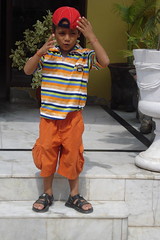
give me a wet one!
The last few posts have been grim and and bleak so I thought that one needed to share some happy times, and no one can compete with our dear Popples when it comes adding a ray of sunshine to one’s life.
After almost two years Utpal came home for his Rakhi break. Home this time was not mine but his mom’s room in our newly set women’s centre where Jhunnu now lives. In her room were his preferred toys and in her cupboard his clothes! The fridge has his favourite goodies and his mom cooked him a meal after 2 years.
Utpal’s joy was palpable and his excitement knew no bounds. He even went shopping with his mom as he did before, but this time his mom was healed and whole.
I was invited to tea and he set out bringing me one treat after the other. I could barely hold back my tears as I watched this brave little soul make up for lost time. At one pint he came to me and asked me for some money as he wanted to buy some chips. I gave him a twenty rupee note that was a little soiled. He looked at it and gave it back saying in a serious tone: give me a wet one! He did get another crisp one and I just hid the soiled note in the corner of my bag where it still lies.
startling statistics
A report based on government data for the period 1994 – 2004 reveals the startling fact that over 800 million people or 75% of India’s population lives on a per capita income of less than 2o rs a day. The report goes on to say that a person whose consumption is less than rs 9, is below the poverty line, whereas Rs 13 makes him above that line.
The report is startling and even if it not 100% correct, it still raises many questions that need to be asked. We have heard of India shining, India poised, India on the threshold of becoming a super power and yet if we peruse the statistics of this report we see that India shines only for under 30% of its population.
In recent days I have heard some other startling figures that are also a reality: a 4 bedroom flat rented at 500 000 rs a month, a bottle of vintage champagne sold at rs 50 000 a piece in an upmarket eatery which is the actual mecca for the young rich of our capital and where a few such bottles are sold every night, and even a never to be advertised gourmet menu in a luxury hotel at a mind boggling price. You just have to flip the pages of any women’s magazine to see shoes and bags at 50 000 or more, and cosmetics that would burn a hole in your pocket, not to mention the cryptic price on request appended to many a luxury items.
The new, or rather suddenly rediscovered urban laws that are being applied with new found vigour will result in swelling the quoted 70% as most of these hit the livelihood of the poor: street food, small shops etc. Slum relocation undertaken without viable options and with the aim to make our capital city fit for consumption for the forthcoming sports show will have a similar effect.
The writing is on the wall but no one is willing to look at it. No self respecting nation, let alone a democracy, can arrogate itself the right to be called shining if more than 50% of its population barely eeks out a living. As I have often held there are two Indias: one that maybe shines and another that lives in ever increasing darkness.
feudal atavism
Many incidents of incomprehensible and inhuman rage made the headlines in recent days. On each occasion I held on to my urge to react as I felt that my words would have no or little effect. However the pictures aired yesterday on all leading channels broke my resolve.
It was a story from a small town in Bihar where the mob decided to met out their own brand of justice to a young thief. What was disturbing was the fact that the police played to the gallery and tied the poor boy to a motorcycle and dragged him in full public view. All his was aptly captured on camera by a local journalist. Nobody reached out to help the boy. For those three hours all that holds a society together and protects it – the rule of law – was conveniently forgotten! From being the largest democracy in the world, we had travelled back in time to the middle ages or the roman arenas.
In the recent past there have many incidents that have brought to fore the latent anger and rage that seems to reside in apparently sensible people waiting for the slightest reason to break free. A young school girl is beaten by six teachers for having failed to do her homework. A young boy is beaten to death by his classmates for having soiled a shirt. A man is beaten to death for simply not giving way to a passing motorcyclist.
These are only some of the ugly incidents that have made their way as headline news. The reality was one has to face is that as a society we are giving up the rule of law and resorting to wild west ways. And when law makers or protectors resort to such ways too, then it is the beginning of the end.
One needs to stop and try and analyse the reasons that have led us to this day. And as is oft the case, the sated cliches come to mind: corruption, politicisation of institutions, arrogance of the rich and more of the same. But to this we also need to add frustration, lack of opportunities, impossible aspirations and the lure of riches, not to forget the now jaded caste and creed.
To add to the plethora of baffling realities one wonders why a district official gets suspended for not recognising the Chief Minister’s voice on the phone or why a cop gets suspended for hugging a cinestar convict. In spite of our democratic cloak, are we not atavistically feudal and thus resort to our feudal selves at each provocation.
Think about it.
another miracle
Our lohar friends have always held a special place in our hearts. We have known them for over 7 years and have been impressed by their wise ways and their humane qualities more than once.
In the last few months we saw a sharp decile in the number of children attending pwhy classes. True that many had graduated to secondary school but even then the drop seemed bewildering. We held counselling sessions with both children and their parents, coaxed and cajoled and even chided them. But to no avail.
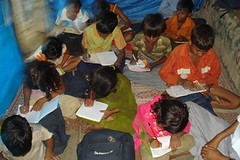
Then it struck us that maybe 6 years of the same repetitive pattern had taken its toll on their free wandering nomadic spirit. It was time for a change. Our formidable administrative duo of R and S came up with a brilliant idea: evening classes. And boy it worked!
From 5 to 7pm our little blue tent is filled to the brim with little heads, both boys and girls, and the once unruly and rowdy lot have turned into a bunch of serious students. Sometimes it takes just a tiny to change to achieve miracles.
an incredible night
Welcome to the why women centre!
Though the why women centre was born out of necessity it truly came alive last night when Firdaush our energetic volunteer from Paris decided to spend a night with the girls. It was a fun filled night but one where plans were made, dreams redefined and, beleive it or not, serious work initiated.
Bags and jewellery was designed keeping in mind parisian taste, creche activities planned, time tables set, but what was most important was that the spirit of the centre was defined: one of trust and understanding, laughter and gaiety and motivation and determination.
These women have come a long way and made a jouney many would have given up half way. The beat all odds and overcame many obstacles with no bitterness or anger. Somehow during that night the past was buried and healed once in for all and only tomorrow mattered. A morrow where they would reinvent themselves and prove to the often unforgiving world outside that nothing is impossible as long as someone is wiling to give one a second chance.
We invite to a sneak view of that incredible night
| www.flickr.com
|
the (mis)rule of law
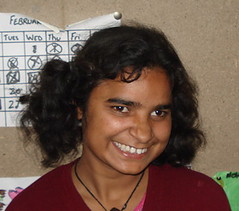
Champa may soon lose her home, one she has lived in since she was a very tiny girl. Champa lives at the ill famed transit camp with her mother who works in homes as a maid.
For the past few days Champa has not been able to comprehend why her mom has not gone to work. She normally leaves at 6 am, even locking Champa out. Champa cannot comprehend why everyone is shouting and cluttering the street. All this is disturbing and unsettling.
What Champa is witnessing from the confines of her simple mind is actually a plight that is befalling many residents in India’s capital city. The transit camp, as its name implies, is land that was given to slum dwellers two decades ago, when they were moved out of an upmarket location. At that time one wonders whether anyone understood what transit meant, or whether the authorities gave them a specified time frame. Over the years this camp turned into a vibrant and crowded colony, with multi floored structures where rooms were given out on rent. Greed and false promises of regularisation made by local politicians looking for votes lent a sense of false permanence and some original allottees even sold out their plots.
For the past year or so this long forgotten colony once at the edge of the city, came back into the limelight as authorities rediscovered the meaning of transit. Since many an attempt to seal or raise it have been made, each met with the understandable anger of the residents aptly supported by some local politico or the other resulting in the usual drama of protests and arrests.
But this time for reasons yet unknown it seems that this colony will be destroyed and thousands of men,women and children will yet again be rendered homeless notwithstanding their ration card or voter’s ID that proudly displays a transit camp address. This time it seems that the game is over and no amount of palm greasing or political support will help.
The transit camp issue brings to light one of the worst ailment that plague our social fabric. Whereas we all know that the rule of law must prevail, laws are never respected at the initial moment but allowed to be circumvented endlessly till all avenues are explored regardless of the human factor but propelled by the greed of one and all. As a society we have to be made to understand that laws need to be respected from the time they are promulgated.
Champa’s case is poignant. If her home is relocated she loses not only her home, but also the safety and protection of pwhy where she spends the only happy moments of a very sad life.
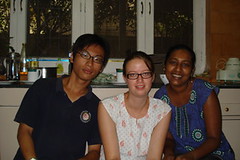
the three wise volunteers of pwhy
One of the biggest asset of pwhy has been its band of volunteers. They have come from every corner of the planet and each one has left his or her mark. This summer we were truly spoilt as we had not one, not two but three superb volunteers: Lucy, Xiong and Firdaush.
At first we were a little worried about how we would manage three volunteers in our tiny project but our concerns were soon allayed as these three young people just adopted us and found their place in a jiffy. It was as if they had always been part of pwhy.
Lucy a young student from Cambridge spent her mornings with our special kids and her afternoons in the newly opened Sanjay colony centre; Xiong from Singapore taught the secondary kids in the morning and then spent his afternoons at our Govindpuri centre and Firdaush brought high levels of energy to our creche and prep kids and some order to our Okhla centre.
What was truly amazing is how these young people adapted to the difficult environment they found themselves in: electricity cuts that made the heat unbearable, the filth of the slum lanes, the sometimes too spicy lunch, the often incomprehensible Hinglish. Nothing could deter their enthusiasm and drive. The seriousness and application with which they approached each task was laudable and praiseworthy.
They came from different worlds and yet seemed so comfortable in ours. Each one brought to pwhy something special, something that will stay forever in intangible and yet precious ways.
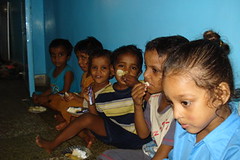
slain not fed
The recent spat between a young athlete’s coach and his mother has led to a child’s future being held to ransom. It is true that in Budhia’s case a solution will be found as he he is a media celebrity but the whole issue opens up a disturbing debate.
In an answer to a recent mail a friend wrote: The thought scares me that by providing support, we may also be creating a social monster which gets used to being fed. He was referring to my concern about the future of the children that transit project why or as a mater of fact the future of all children who acquire a mediocre education as that is what the present system has on offer. In its mission statement the lead India campaign states: our municipal schools are not equipped to impart even basic education but stops short of suggesting an alternative.
Seven years ago, when pwhy began, one lived under the illusion that education would open new avenues for children and hence give them a better future. Today if one were to be honest, experience has proved that it is not quite so. No matter how brilliant a slum kid is, he will never the the 90+% required to go to a good college, nor will he acquire the confidence, communication skills and the oomph required in today’s working world. His marks may help him break some barriers but what about those who just scrape through.
The social monster referred to above is just that child, the one who holds a degree or certificate in hand and thus as arrogated itself the right to dream big. The question one is compelled to ask one’s self is whether it is right to impart such education and feel satisfied? Is not one morally bound to think ahead and look for viable options?
The education for all campaign seems to have gone awry. There are schools without children, children with years of schooling and no knowledge. Budgets allocations increase each year but the situation on the ground worsens. Much needs to be done. Imparting a useless education is worse than no education at all.
Maybe there is a monster lurking, one that needs to be slain not fed
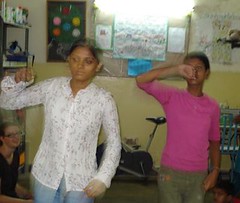
to hear or not to hear
 R and S are hearing impaired. R is 19 and S 14. They are both students of our special section and are real live wires. In the last years they have learnt many things from tailoring to cooking, from paper craft to weaving. R is a talented artist and S can cut and stitch a mean suit. They have evolved their won ways of communicating and have opinions on every and any thing. And yes they can even dance to the latest Bollywood number not missing a beat. R has finished training as a beautician and has a part time job at the local beauty parlour. S will also get the same training soon and join the ranks of the gainfully employed. Both are happy young girls who have taken life’s challenges in their stride.
They both belong to poor families. S’s father is a small time tailor and R’s father keeps poor health and thus does not work much. Like for all girls in India, their parents hope to get them married one day.
A few months ago some visitors from Europe came to pwhy and were touched by these tow vibrant young ladies. They wanted to know whether there was any way in which their hearing could be restored. We had of course explored all ways when they first came to us and had been told that only a cochlear implant could help the, the boggling 1 million rupees that such an implant cost put an end to our efforts.
Last week I got a mail saying that there could be a possibility of sponsoring the implants and seeking added information. True cochlear implants are done In India at the cost of 6 to 9 hundred thousand rupees. there is an added cost of 100 000 Rs for the operation and one has speech therapy for at least two years, regular implant programming and life long annual follow ups. The operation is daunting for any one and more so for simple families who barely survive let alone live. The likelihood of these two young ladies being married in another city or village is real and that would put an end to follow ups and complex programming. The implant could become an impediment rather than an asset.
As we sat with the teachers and special educators wondering what to do, we realised that both R and S were comfortable in their silent world. They had evolved their own ways of dealing with life’s realities. They somehow were far more independent than many other young girls their age who hear but have not been educated. They have various skills and hence many avenues are open to them. A complex surgery may turn out to be a hindrance and destabilise them completely. The whopping amount spent would ultimately bring more trouble than joy.
At times like these, the existence of two Indias becomes painfully real and puts us in a disturbing dilemma. To heart or not to hear, that is the question.
the neutrality syndrome
Yesterday India celebrated its 61st independence day amidst much fanfare and media hype. Once again promises were made from the rampart of the historic Red Fort and huge allocations were pledged to education and agriculture. Newspapers dutifully listed all achievements and reading them would have made any one proud. Staggering figures seemed to pervade all sectors of growth as India seemed poised to become a super power.
And yet was it not barely a week ago that a TV channel gave us the startling revelation that over 32 000 primary schools across the country did not have a single student? This sums up much of what is happening in our land. Brave and even laudable programmes and projects get launched but never reach the beneficiary. Somewhere down the line they get hijacked by vested interests.
A leading newspaper has launched a new campaign called LEAD where the operative word is DO! It is a well planned media blitz with all the right ingredients including a string of celebs and will in all probability bring its creators what they aspire for till the next campaign but somehow it seems to have hit the nail on its head.
We seem to have become a nation of non-doers. In response to an email sent on I day, a friend wrote back: Whenever I tell someone to save paper or adopt vegetarian way of life – the response is neutral or negative but hardly enthusiastic.
In a land so deeply divided between the have and have nots, the rich and the poor, the urban and the rural those of us who have the ability to make a difference have lost our enthusiasm and withdrawn ourselves in the comfort of neutrality. We seem to be waiting for the other to do! And this passing on the task goes down the line till there is no other left.
We will become truly independent only when each one of us shakes off this neutrality and acts, when we accept our part of responsibility in each things that is wrong and asks questions; when we finally accept to stand up and leave that mythical armchair. That day India will be truly independent.
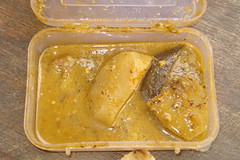
number nine..
Over the past 7 years now, we at project why have been doggedly teaching batch after batch of slum children with a measure of success, if success is to be determined by examinations results. Many have passed out of school and joined the working world, others have selected to pursue academics in some form or the other.
I must confess that for some time we too basked in the glory of our achievement sometimes forgetting to look at the stark realities that stared at us or maybe choosing not to see. But no one can be so inured as to not be outraged when three children open their single lunchbox and find rotten food.
I remember how horrified we were a couple of years back over Preeti’s lunch box, and how it had brought to the fore the plight of disabled children in India. And once again we set out to unravel the mystery of this lunchbox that belonged to three siblings that attend our creche.
A home visit brought to fore the reality of their lives. Eight siblings ranging between the age of 12 and a few months live in a tiny hovel. Their father who own 2 vehicles barely comes home as he spends his money, or most of it, on drink and women, and gives very little to support the family. However he does come home to claim his conjugal right with regularity. The mother manages as best she can and the children are often fed by neighbours. None of the children go to regular school.
This woman typifies many women that live abysmal and lonely lives in Delhi’s slums, away from the comfort and security of their village. They have been brought to practically worship their husbands and defend them with pathetic conviction, as if their lived depended on it. They know nothing of family planning, AIDS let alone women’s rights.
When we asked the mother why she dis not send her elder girls to school the answer was shocking though true to her reality: they only need to learn housework was what she quietly said.
That woman did not have dreams or aspirations, she just had to live or rather survive wondering where the next meal of her children would come from while she clutched the womb that carried her ninth child.
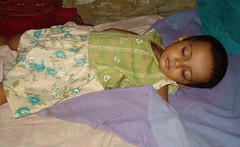
back home
Little mehajabi is back home after a successful open heart surgery. For the first time in her tiny life she sleeps soundly, her breathing normal. Soon she will be returning to where she came from and resume the simple life her parents live in the confines of a madrassa.
What her life will be no one knows but she lives today because two simple and illiterate parents refused to give up on her even though she was a girl and the youngest of 5 siblings. They refused to give up on her even though the costs of her recovery were daunting for a family that earned a pittance. In a country where the girl child is often treated with contempt, the determination of this family to save mehajabi is laudable and needs to be applauded.
One wishes there were more parents like them.
reality hurts…
“Goodness is the only investment that never fails.” said Henry David Thoreau and till very recent times I felt that way. Look with your heart, a maxim borrowed from the Little Prince is one I followed with conviction and I guess that is also why a project aimed at imparting education found itself mending hearts along the way.
And that is also why one did not shy of helping N when she was in need, no matter what the need was. Imagine my surprise when I came to know that a humane act was so grossly misconstrued by some that it led to recriminations and even show cause notices and possible dismissal for N. I must confess that such a reaction from seemingly educated people came not only as a shock, but also as a rude reality check that left me dumbfounded.
No matter which way I tried to look at the matter, I could not find any element of logic to warrant such action and reaction. I shared my dilemma with many friends and one of them wrote these words: I think a lot of people equate kindness (and following your heart) as a weakness. So many people live self-centered lives that they can’t imagine doing something for someone else without expecting some sort of reward or payment (even though kindness has its own rewards).
Maybe he is right and such people exist but I stil find it difficult to comprehend the totally unwarranted blow that has fallen on one who has suffered enough.
And quite frankly if following your heart is a weakness, then I hope I remain weak as long as I live.
reality bites
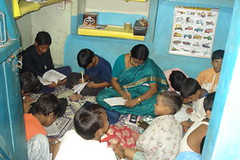
Our decision to close down one of our primary centres may have perplexed some of our friends and well wishers. I must confess that it was not an easy one but the writing was on the wall and we had to stand by our initial mission: that of empowering parents to take charge of the education of their children. So when we realised that most of the children were now attending private tuition’s we knew our task was done and we had to move to another place.
Sanjay Colony was the chosen location. In barely a month there are over 80 children who attend our classes regularly. Yesterday I was given the monthly report of that centre and its content more than validated our decision. More than 50% of the children were well below their class and some who were in class V barely knew the class II curriculum. This shows once again the abysmal state of municipal schools in India’s capital city where children are made to pass from one class to the other irrespective of their knowledge till they reach secondary school where they often drop out.
It is sad to see that nothing is really being done to address the situation and take on remedial measures. It is almost as if no one was really interested in educating the poorest of the poor. This is the reality in a country that is poised to celebrate sixty years of Independence and where education is a constitutional right of each and every child.
cameos of another life..
Recent days have seen a plethora of disturbing images flashed across our TV screens: a 17 year old boy gets beaten to death by his teacher for not sitting properly; 5 disabled men consume poison in public as they lose their source of livelihood; a one day old baby is found in a garbage dump with multiple stab wounds, to name but a few.
These make good copy and TRP rates for the media. They appear for a day or so and then are replaced by other images as the show must go on. In most cases they entail a few shocked reactions are then are forgotten.
However if one chose to ponder a while, one realised that each incident carries within it a disturbing reality that shows the endemic problems that exist in our society and are often the rule rather than the exception. They are cameos of the everyday life of millions of invisible Indians and reflect the plight of poverty, government apathy and many other ailments that plague our society.
It is true that the media reports them for their own purposed but that does not absolve us of the right to take note and react in an appropriate and humane manner.