
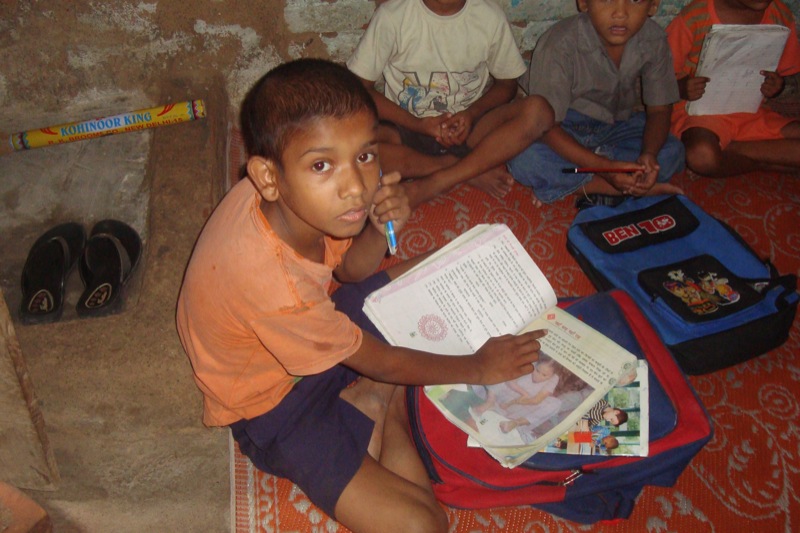
advantage the privileged child
 I had written about my apprehension about the scrapping of Boards and marks and switching to grades in a recent blog. Recent news items about the modus operandi have made me even more uncomfortable. Eight hours training sessions are being planned for principals who, in turn will need to train their respective teachers. The rush in getting it all done is nothing short of frightening.
My fear was validated by a mail sent by a volunteer who had come to project why some time back. He writes: the removal of the class X board exams is something close to my heart, so I thought I’d share my thoughts on the issue.
I am not exactly sure how high the stakes of class X board exams are for a child in India. However, I know that scrapping summative assessments in such a brute and unmitigated fashion and replacing it with what we call ‘formative/ continous assessment’ in education studies is a very very dangerous move. While it is true that formative assessment is becoming increasingly popular globally, in places like Hong Kong and Singapore, the changes are gradual, often incorporating a part of school-based formative assessment (abt 30%) with nation-wide high-stakes exams.
Such changes have to be carefully steered with good frameworks and appraisal rubrics, meticulous curriculum planning, adequate teacher training and the support of academic research institutions. I cannot imagine how things will turn out when India has not even resolved the intricate pitfalls that together contribute to a flawed school system. How are teachers going to be able to assess students in a long-term, formative fashion when many go awol ever so often? Added to the issues you raised in your blog posts about the inequality of opportunities arising from differences in socio-economic status, I really worry for all the children from the lower spectrum of the social ladder.
It is believed that the new assessment will cover a student’s for scholastic (curriculum-based) and co-scholastic skills including life skills, attitudes, physical and health-related merits. It is sadly obvious that such system will broaden the gap between children of the two Indias, children from better homes are bound to have better co-scholastic skills. The marks system at least gave the less privileged a chance to compete with their privileged peers. Once again our law makers have widened an already gaping divide. Kids from better homes will have a huge advantage. That is only one side of the problem.
Let us look at the other. Grades will be awarded by teachers who till now have been awarding marks. A simple eight hours training is all that is been given to change mindsets and old ways. How can one be taught to assess skills and attitudes when one has never done so. I cannot even begin to imagine how this will happen. Maybe the teachers of swanky public schools will pass the test but what about the others. Advantage the privileged child!
Then there is a third player in all this: the parent! I know how many hours I have spent helping my children in their project and assignments. I wonder how a poor harried, illiterate mother is expected to conjure the skills and find the time to do the same. Once again advantage the privileged child.
Then how will the slum kid be able to run this race at par.
Changes and plans that concern children should never be undertaken to meet some political agenda or to seek instant gratification. They need to be tackled with care and understanding. An idea may look good and even be path breaking. However what is important is the implementation and enactment. If not done properly it can boomerang. One has to tread with caution in any situation where children are involved. Hope our law makers realise that!
angels at work
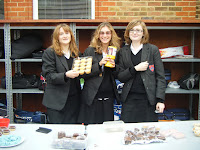
 About a year ago a young teenager came with her parents to spend a few days at project why. Harriet is no ordinary girl. She has mastered the art of seeing with her heart and that is how she looked at project why. Since then she has never forgotten us and has conjured many a miracle for us.
Yesterday we were treated to one more such miracle. She simply wrote: Thought I would let you know that the cakes sale went really well yesterday. We raised £55. I would have said there were over a 100 cakes and all of them sold within 10 minutes! I have enclosed a picture of me and 2 friends if you would like to see it (both friends made cakes that they brought in.) I have just totalled up our collection of spare change that we have been saving since Christmas it came to £30 exactly!
To the day cynical or uninitiated this may look paltry. But to me these figures are inestimable. Let me tell you why. Fundings come in diverse ways. The normal one is to apply for large impersonal grants, fill innumerable forms and hope for the best. In such cases there are no bonds, no feelings, no seeing with the heart nonsense. The other one is to try and touch someone’s heart. And then sit back and watch miracles play out. This is what has happened with Harriet and project why.
Every penny that drops our way is blessed as it is imbibed with love. And in hindsight this is what matters as it gives the whole funding process a new meaning altogether. There is something touching about young school girls in an alien land finding time from their busy schedule to bake cakes and then market them for a cause dear to one of their friends. And we feel humbled.
Harriet and her friends are very special young ladies. God bless them always.
new clothes for Diwali
 It is Diwali the festival of lights and new beginnings. Diwali is also the time when all, rich and poor buy new clothes at least for their children. Needless to say we too have been busy wondering what to get little Agastya, the new member of our small family. After much thought and much window shopping one zeroed in on a dhoti kurta!
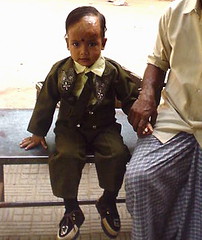
As I set about finding new clothes for my grandson my mind went back to Diwali few years back when little Utpal still lived with his mom, way before he went to boarding school. On that Diwali morning he came to see us all spruced in the brand new clothes his mom had bought him: pants, jacket and even a tie and to crown it all little cardboard lined shoes. I do not know why but he reminded me of a pastiche of little Lord Fauntleroy. It was all the mom could afford and yet she wanted her son to look his very best, at least for this special day. Needless to say I kept my little packet of new clothes for Utpal hidden. That Diwali was his mom’s day.
Yes, Diwali is important to one and all. Every family tries to celebrate the festival to the best of its ability and make it as special as possible. It does not matter if the shoes are bought in a swanky mall or on a street market, it does matter if they are sturdy or lined with cardboard. On Diwali every child has the right to wear new shoes.
I do not why I remembered this small innocuous incident today. But I am glad I did. The sight of little Utpal on that morning was truly touching and precious, a memory I carry in my heart, one that makes every Diwali special.
Happy Diwali to all.
at the fair

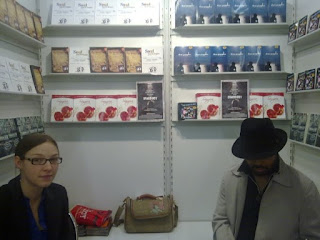
After being long listed for the Golden Quill Awards, Dear Popples is now at the Frankfurt book fair. What a journey it has been.
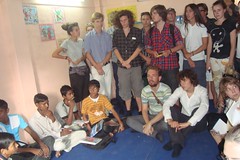
They saw with their heart
 A couple of months back I got a mail from Denmark. It was from a high school teacher and simply said: We have with great interest read about your Project Why. My colleague and I are going to New Delhi in October with a group of 23 students. For a long time they have been working with social and political conditions in India. In that connection it would be very interesting and relevant for the students to visit your project and talk to one of your representatives.
The idea of having 25 people at project why was daunting. Project why was such a tiny place, where would we fit so many people. Nevertheless I wrote to say they were welcome. As the visit was still some weeks away we somehow forgot about it. Last week another mail informed us of the impeding arrival of our young visitors.
On Monday morning as the clock struck 9, the young students and their two teachers reached project why. I must admit that 25 young people take a lot of place. They wanted me to present project why and we decided to move across the street to the foster care as there was a little more place there, or so it seemed. Soon we were all packed in a room. I had thought of giving then a short presentation and then send them to visit some of our centres but somehow the eagerness of these young souls made me tell the the project why story as I had lived it, straight from the heart. I spoke for a long time recalling small details. They listened almost mesmerised. As the story went on and we talked of Manu I could see a few hands surreptitiously wiping a tear. When I had finished there were many moist eyes and they has still not seen the project or met the children. I must admit I was taken aback and moved.
It was then time to start the visit and the first stop was at the special section. Shamika introduced the children to them and told them each one’s story. Soon the tears turned to sobs. Many of the young students were crying unabashedly. Many were surprised but I was not as I understood that they were looking with their hearts.
I wondered what touched these young people who came from the land of the plenty? Was it that suddenly all they had taken for granted till now seemed undeserved? I do not know. All I knew was that nothing would ever be the same for these young persons.
Seeing with your heart can be dangerous as it may entail unexpected changes in your life, changes you did not anticipate, changes that could make you a different person altogether. Perhaps that is why many of us resist seeing with our hearts.
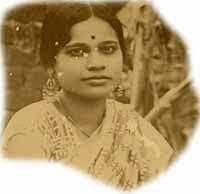
an ordinary girl…
 Ray Kurzweil, the futurist recently predicted that in 20 years or so we might reach a stage where we could live forever, and even become ageless and immortal. What a frightening thought. Does it not make the meaning of our lives futile. Are purpose and achievement not linked to the simple fact that we are mortal, and hence have just that much time. Living forever would be like not living at all. One would simply be frozen in time.
Why I am writing about such issues today. Simply because today the one who gave me the gift of life would have celebrated her 92nd birthday. And no one loved life more than her. Even when she was dying of cancer, this remarkable woman refused any palliative care that may have anaesthetised her as she wanted to live till the last second of her life, a life that she had ensured had been worth living. Kamala was an ordinary girl from a small town. She should have lived an ordinary life and died an ordinary death. But she chose otherwise. She fought to be educated and was the first in her town to do so. She eventually got a PhD. She fought social mores and got married in her thirties as she did not want to bring a slave child into this world and thus not marry before India’s Independence. At a time when girls were mothers before becoming women, she chose to work to defend women’s rights in remote villages where she reached driving a truck. And when she did marry, the ordinary small town girl became a diplomat’s wife set to conquer the whole world.
Yes mama was an extraordinary woman. One who lived life to its fullest. And yet she did so because she knew life was a given gift but not an eternal one; that time was short and that you never really got a second chance. She wanted to leave her mark in whatever small way possible. Se did it her way.
Any notion of supposed immortality would rob us of the desire to achieve and do something so that we too would be remembered after our final curtain call. Life derives its very purpose from the very notion that it is limited and transient. Immortality would take away the very essence of life.
Today I remember the one who gave me life.
Meet Kamala here.
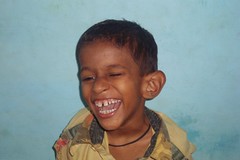
a child dies every 15 second
 In India a child dies every 15 seconds due to neonatal diseases, and 2 million children die before reaching their fifth birthday, 20% of the world’s child death occurs in India, one in three of all malnourished children live in India, over 46% of children under three are underweight in India… over 28% of child’s deaths are linked just to poor sanitation and unsafe drinking water. These startling and shocking figures are from the recently released Save the Children “Every One” report.
I sat stunned as I read these figures. This was happening in a country where a 4 bedroom flat is rented at half a million rupees, a vintage bottle of wine sold at 50K ; where millions are spent on flowers for a wedding, where food is thrown in the garbage after nights of revelry, where gallons of milk are poured on deities. This was happening in a land where shopping malls are erected everyday, where shoes and bags can cost more ten times more than what 75% of India’s population earns in a year.
Austerity is the flavour of the hour. Heated debates are held on whether those in power should fly in one class or another. Absurd reasons are given to justify each one’s view and while all this is happening a child is dying every 15 second. Everyday new policies are announced amidst much fanfare. Every day new programmes are heralded to supposedly alleviate poverty. And yet children are dying simply because of unavailability of safe drinking water.
Missions are organised to conquer space, to reach the moon. Whoops of joy are heard because water has been found on the lunar surface but here children still die for the simple lack of it. Something is terribly wrong.
Every child, no matter where or to whom it is born has the right to live. And each and everyone of us have a moral responsibility to ensure that it happens. We must act and act now. We cannot turn our faces away or pretend that we cannot see or hear. The figures mentioned above were recently published in a national daily. How many of us read them and just moved on. I do not know. I can only say that they got seared in my soul and spirit. Things could never be the same again. Whatever one thought one had achieved suddenly seemed inconsequential. There was a sudden need to review, reassess, rethink everything and start all over again.
A child dies every 15 second in India and I hang my head in shame.
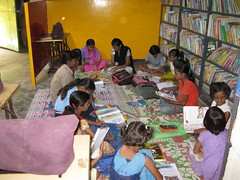
Through different eyes
 Megha visited the women centre some time back. She needed to write a blurb for potential donors. This is what she wrote:
Situated among the squalid gallis of Madanpur Khader village in South Delhi is located the Women’s Centre; one of the 13 centers operated by our project in the slums of New Delhi.
Unlike other centres of the project, this one is self contained in several ways. Led by Dharmendra, a man as charismatic as his film-star namesake, this centre has after school education programs for children from 1 – 8 standard, sewing and beautician courses for young women, a computer centre and a small apartment complex complete with kitchen for battered or abandoned women.
As I visited the centre, narrowly missing being swooshed in the face by a buffalo’s tail, it was a relief to step into the neat library space of the women’s centre. Young women were busy learning how to sow in a straight line, the creche was wrapping up and Meher, a child who fell into boiling hot water was being nursed after her plastic surgery to open the digits on her hands.
Dharmendra-ji invited us into his small office, offered a cup of tea and spoke about the previous year. Each time I meet him his stories amaze me; mostly because of the innovative solutions he finds to most mundane problems. The Centre opened about a year ago and one of the fastest growing aspects has been library usage. This was so popular with the children that Dharmendra-ji kept it open on Sundays, effectively giving himself a 7 day work week.
A few months ago, some books went missing. Dharmendra-ji had an idea who had stolen them but did not want to embarrass the child in front of his peers so he declared that no-one would have access to the library unless the books returned. Upset that they may not be able to use the library, the children then took initiative to organize themselves into vigilant squads. Bags were searched; entry and exists carefully monitored. And just like that, a few days later the books returned. Dharmendra-ji created a situation where the children valued a service enough that maintaining it gave them pride; so now, its the children who manage the lending and reading activities in the library giving themselves ownership of this service.
Overall, this centre is so popular that he now keeps a waiting list for students wishing to join the after school program. This is what you donor money is doing right now – quenching children’s thirst for education in a safe and loving environment!
common wealth – common woes
 I do not quite know why but I was interviewed by CTV (Canadian Televison) on my views about the forthcoming Commonwealth games. Perhaps it is because time and again I have voiced my concern over destruction of slums and the removal of street food vendors all done in the name of the CG! It was an odd feeling to be sitting on this side of the fence, when 27 years ago I sat on the other as head protocol for the IX Asian Games village. But that was way before project why, at a time when I like many others, was almost blissfully unaware of the other side of the fence. Then the Games were a matter of pride and had to be run successfully. Today was another story.
Till this interview I had not really given thought to what the Games really meant to me. As any other citizen of Delhi I felt irked by the constant traffic diversions at construction sites; as someone who was somewhat environment conscious I felt enraged at the Games village being constructed on the flood plain of Yamuna. All in all I never felt good about the Games. But it is only when I had to gather my thoughts for the interview that I realised what the Games really meant to me today. I think what disturbed me the most was the lost of livelihood that the sprucing up of the city entailed and that because many of the parents of the pwhy kids were food cart owners. The recent cleaning up drive has meant that they have lost their only means of earning. It is true that the court order banning the sale of cooked food was meant to curb the enormous bribes that were being paid, but once again it is the victim that was punished and not the perpetrator. The aftermath is yet to be felt as many are still hoping that like always this will be a temporary measure. Alas that does not seem to be the case.
The end of food carts also spells the end of an age old tradition and somehow that is something difficult to swallow. Are the famed Games going to change the very ethos of our existence. Sad but true!
What else are we going to brush under the carpet. I guess what comes to mind are the beggars in the city. I am sure they will be rounded up for the duration of the games and then let free again. I would have been elated if the Games had been the reason for addressing problems and finding long term solutions. Maybe one should have started a campaign urging people not to give money to beggars as that is the only way beggary would end: the day it becomes not profitable. My mind goes back to the little beggar girl.
I wish the Games would mean the end of pot holes on Delhi’s roads. I wish the Games would mean a more efficient garbage disposal system.. I wish… the list is endless. But we got a taste of what the Games are going to mean to the Delhizen. Yesterday the CG Committee was on a visitation to assess the degree of preparedness of the city. The authorities came up with yet another cover up scheme: all the roads leading to the main event venues were simply blocked. The committee whizzed from one venue to another while ordinary citizens spent gruelling hours on choker block roads for their daily commute.
Brace yourself, CG times are not going to be easy or should I say be prepared for common woes!
a strange slumber party
 I read with amusement laced with consternation and outrage the new gimmick adopted by politicians to we their voters. The publicity drama is being called: slumber party with Dalits whereby people of a political party spent a night with a Dalit (low cate) family. What got my goat was ensures that beds were from Lajjawati’s house and thereason given by a media coordinator was: “We have to get this done, the house should also look like a Dalit’s house”.
Stop! Where are we. It all looks like a page form Alice in Wonderland and the Mad Hatter’s party. Why can a Dalit family not have a bed? And why should all this made to be looked like a TV reality show? Something is terribly wrong.
We have Dalits in the project family. Children as well as staff. Some are teachers and one is by far our best programme coordinator and slated for higher posts. But everyone has got his or her place because of his or her skills and merit. No one is there because of his or her social origin. For the past years we have been to their homes and shared many meals and fun moments. And let me tell you they have beds, sofas, TVs and more.
I do not know how effective the slumber party politics will be or how they will translate in votes. In my mind it just makes the gap wider and deeper. It is not by spending a night in a Dalit’s home that the social fabric of India will change.
a blogger’s journey
 I was pleasantly surprised to find a blog about our blog! The author wrote: Today I want to write about a blog which energize me each time I visit it. The blog, Projectwhy drowns my cynicism and taunts me too. I often lament about things but don’t do much about it, other than blog. But at projectwhy, one sees the other side of life and the way it is dealt with, in such a sincere manner. The author touches so many lives and continues to shine ever so brightly for them. I also love the way she deals with many of our current issues..
I must confess that I sat for a long time savouring the words and feeling elated. I must also confess that I began this journey way back in 2005 when I did not know what a blog or blogging meant. I use to write long emails and painfully send them one after the other to my mailing list. What I wanted was for people to share what was happening in our lives, to be sensitized to the reality around them and to learn to look with their hearts. I still sometimes peek at the very first post I wrote and smile at the naive words and candid tone. But it did set the mood for what was to come. Today I feel I have reached my destination and achieved what I set out to do. It took almost 1000 blogs to do so each sharing a joyful moment or raging about an injustice. The common denominator was probably that I only wrote about what I had experienced. The blogs are not only an account of the trials and tribulations of project why, but also a personal journey where I too have learnt to shed my cynicism and look with my heart no matter what I saw.
I has been an exhilarating journey of discovery that has had its nadir, but no matter how bad things looked there were always moments of pure unadulterated joy that has lifted the lowest of moods, the latest being little Sohil. When I watch him dance, I forget, albeit for a moment, that we are fighting for survival, that things are bleak and that tomorrow is very far away!
a peek into project why
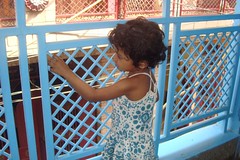
 It has been a long time since I have taken you on a tour of project why. Somehow the picture of little Komal peeking through the balcony inspired me to do just that. True that from the pwhy building balcony you simply see another building but that is when you look with your eyes. Try to look with you heart and suddenly everything changes.
So let us talk a stroll through pwhy. It is 8.45 am. The office is abuzz with activity as most of the teachers have come to sign in after their early morning spoken English class taken by Jillian our long term volunteer. Instructions are given and everyone sets out to their respective class. By 9 am the office is empty. A walk down the stairs and we reach our creche. The toddlers are still coming in and little shoes are aligned in a straight row. Some kids are already settled. It is toy time and every is busy with hos or her toy of the day. We tiptoe out and walk own another flight of stairs and are greeted with a loud Good morning ma’am. It is the special class and morning exercise time. Whether you walk or not, hear or not, comprehend or not does not matter, morning gym is for everyone and everyone loves it. The music is blaring and everyone is happy.
A walk across the street and a climb up two flight of stairs and we reach our erstwhile foster care. The foster care kids are now in boarding school but their special roomies still lie there. Manu, Champa and Anjali still live there but while they are in class the space gets used for other activities. We walk through the second creche and the prep class. Every one is busy settling down. We leave them to their taks and peep into the junior secondary class. A score or so of boys are busy revising for their exam.
A short drive takes us to Govindpuri Nehru camp. We alight from the three wheeler an walk through a maze of lanes and reach the tiny jhuggi. A class is going on in earnest. We continue our journey and reach Okhla. About 100 children are busy studying. Two volunteers are also taking an English class. The teachers share their concern about a wall that has cracked after a truck banged into it. The matter is serious and we will need to find funds to redo the wall. A quick drop at Sanjay Colony and we are back to Giri Nagar where it all began almost a decade ago. Today the little street is host to our senior secondary and our computer centre as well as our library which also doubles up as a primary class. Everyone is busy and we quietly walk away.
A drive takes us to the women centre. We are surprised to see how choker block it is. Over 50 women are busys with their sewing and beauty class. A few children are left in the creche waiting for their parents and over 150 kids are packed on the terrace all lost in their work. It is impressive, 150 kids almost pin drop silence. You only hear the teachers!
Yes the walk has been virtual but it reflects the reality and fills me with a sense of pride and deep gratitude.
silent class
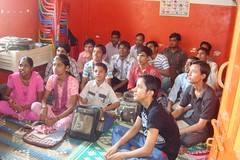
 There is a new class at project why and like everything else it happened quite by chance. The special educator who comes thrice a week to work with our children came to me last week and asked me whether project why could provide some space for a bunch of deaf and dumb students who needed after school support to keep up with their studies. As you may have guessed we said yes immediately. That is the way we are. The logistics would be worked out and all would fall in place.
The reason for which I agreed to the request is that I more than anyone else believe in inclusive education and I more than anyone else know how things are on the ground in the government schools these kids go to. The extra support can and will make all the difference.
So a a few adjustments were made and space crated for these students who now come thrice a week to catch up with their school studies and what is wonderful is that little Bittoo, our hearing impaired child joins the class.
It is a wonderful silent class and I invite you to peep in:

the old water man
 He leaned against his cart forlorn and dejected. No one seemed to want to drink his water today. He was a wizened old man who could barely stand, let alone push his cart. He had been coming to this very spot, year after year, actually at each Durga Pujo. He always placed his cart in front of the biggest Puja Pandal, next to the temple and every year he made quick business. Something had changed. This year he was alone. The usual food carts were absent and with no one eating food, no one needed to quench their thirst.
He was not aware of the new court ruling that now banned selling cooked food on the streets. He was illiterate and no one in his home spoke to him, let alone share with him the on goings of life. He felt like a burden and looked forward to leaving his son’s home early and spent the whole day out, even if he had sold all the water he had in his cart. He kept a rupee or two for himself and dutifully handed the balance to his daughter in law. At least that way there was no recriminations. But today, when everyone would be expecting a killing, he would return empty handed. he did not even want to think about what would happen.
The old man is part of what is known as the informal economy, the hawkers and street vendors; people who come to the city looking for jobs and then not finding any create their own. It is estimated that there are over 4 lakhs such vendors in Delhi. They make barely enough to live and have to pay huge bribes to be allowed to function. According to an NGO they pay over 600 crores annually! This was one of the reasons for the new law but what it amounts to is punishing the victim and not the perpetrator.
In the last ten days or so we have seen furious activity along side the main road in Govindpuri. All street hawkers are targeted by the police. Some try to slink into the nearby alleys. Others have just closed shop. Wonder how many new families now go hungry at night. Street food has been an age told tradition in Delhi and the hygiene factor is not really one that I buy. A hot samosa may send my LDL cholesterol flying but has never given me a Delhi belly. The idea of a cold samosa makes me lose my appetite.
Many of the parents of our children run food stalls. That is how they have survived for years now and looked after their families. They feed the poor and the middle class with affordable and healthy food. Such people cannot afford the swanky fast food joints which seem to be getting a thumbs up all the way and which are proliferating by the minute. The new order will make the list of unemployed swell. And with no new jobs on the anvil where will these people go. Are we just going to watch the death of an age old tradition and say nothing?
Just like the old man, many across the city are slowly seeing the end of their journey So help them God!

a good heart is better
 My grandson will be with us in a few days. The excitement is palpable. Everyone seems tobe walking on air. The old house is being spruced up. The wood has been polished, the windows are squeaky clean and the ancient and worn out floor is almost gleaming. Everyone is busy and yet time hangs heavy, refusing to pass reminding me of Bergson’s theories. The same time will fly once the little fellow lands and then hang heavy again when he leaves. But the purpose of this post is not to write a treatise on time!
Little Agastya is just 8 months old. His whole life awaits him and as any dotty granny I wish it is filled with all that is good and beautiful. Do we not always wish that for our children! And yet what we forget is that we are responsible for what lies ahead. We adults hold the coloured crayons that will fill the blank canvass. The little child will become what he sees, hears, feels and experiences. It is for us to show them the very best.
In a recent TV debate on violence and aggressive behaviour, someone said that what we failed to teach the young of today were values such as compassion and empathy. In a world ruled by possession and control, principles like fellow feeling and tolerance seemed passé and outdated. Children grew up to believe that the measure of success is in the things you had to flaunt and vaunt. Hence you smothered your child with objects of all shades and hue, the bigger the better, the dearer the better!
A good heart is better than all the heads in the world wrote Edward Bulwer-Lytton. I wonder how one teaches a child to have a good heart in our day and age. How does one teach compassion? How does one teach concern, tolerance, humanity. By example of course but examples are few and moreover the child should never feel alienated. I remember a friend who had no TV when her child was growing up. One day the child came back from school upset and crying. The reason was simple: she could not be part of the break time chat that revolved around the latest episode of the latest TV serial aired. So how do you strike the right balance in your quest to teach values to children. The TV programme suggested that compassion be taught as a subject in school. My mind went back to days where we had moral classes in school. But those days are gone too.
My little grandson is still too tiny but as he grows I would like to make him discover the true meaning of things: make him feel the caress of the wind, listen to the humming of the birds and the rustle of leaves. I would like to read to him passages of the Little Prince and make him discover the secret of the fox. As he grows I would like to teach him to celebrate difference, make his own choices and walk the road less traveled.
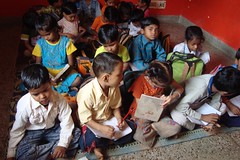
Change for 5$
 A mail dropped by in my inbox. It was from an organisation that was launching a new funding campaign. My first reaction was to trash it immediately but something made me read on as the mail seemed to be personally addressed to me. I was curious to know what was wanted of me. The answer was in the last para: Your blog is extremely well written and read. A mention about Anand Charity, its mission, its current projects or the fundraiser would immensely benefit us. It would allow us to reach out to and touch more underprivileged people. We would be very indebted to you for your help.
How presumptuous! Did people not know that I ran project why and hence was also constantly looking for funds to survive. But again I did not trash the mail and decided to find out more about Anand Charity. I clicked on their website and as is always the case with me looked for the faces behind.
What I saw filled my heart with pride and joy. Seven smiling faces of young Indians, each from the best schools and universities, each with a message that went straight to my heart. They were, all just like me, paying back a debt they felt they owed. It had taken me half a life to get there. They had not wasted any time. They were true children of India and the very best. They had learned the fox’s secret in the Little Prince and knew how to see with their hearts.
Today their organisation is reaching out to help organisations like project why. They fund projects related to education, health and disaster management across India and they have launched a fundraiser urging people to part with just 5$. I wish them success andI hope they succeed. They have to so that they become role models for young Indians. And perhaps they can show me the right way!
It is only when more young Indians learn to see with their hearts that India will truly change. God bless them.
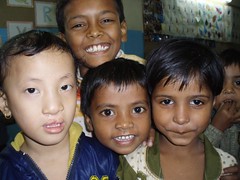
Restore not remove
 Restore, not remove is an article I urge you all to read. In the wake of the decision of scrapping class X Boards, it comes as an eye opener and is quite unusual as it urges the powers that be to restore two jaded institutions namely the NSS and the NCC as ways of continuous evaluation of children as continuous evaluation seems to be the flavour of the day.
I must confess that I would not have thought of this and yet the more I ponder over this suggestion, the more I like it. I had blogged recently on the grade system wondering how it would actually work in situ. The task seemed daunting as one had to train teachers to accept new ways and that is no easy task. Kaveree Bamzai seems to have come up with the ideal solution, one that does not need any new inputs or training as both the NSS and NCC are part and parcel our education system. As she says in her article today’s over active and energetic children would be better off playing soldiers and doing real social work than watching useless TV programmes targeted to the young.
The NCC and NSS may at first sound a little passé and outdated. But I urge you to look at them with fresh eyes. The NCC teaches discipline as well as opens new avenues to young minds who can learn a host of activities ranging from battle tactics to para jumping. The NSS is a way of teaching compassion and responsibility. What better values than we think of. I myself can never forget the weekly visits to the orphanage during my school years in Saigon. I think somehow what I do today finds it first seeds in those visits. Instead of finding new ways of creating good citizens, a relook at these two institutions could do wonders. They just need some smart repackaging.
In earlier days free time was spent reading books. Sadly today children have stopped reading and watch TV instead. The slum children or their parents never savoured the joys of reading; they just jump started straight into the TV era. Parents both privileged and underprivileged have scant time for their progeny, schools have abdicated their real role and the huge void thus created had been filled by useless and often absurd activities. As the author of the article points out the youth of today, our so called good citizens go on UTV Bindass’ Dadagiri to look for cheese cubes in a bowl of leeches and eat sauce mixed with human hair.
We desperately need to look at education again and why not restore what was good and healthy like the NSS and NCC or the forgotten SUPW (socially useful productive work) which took children to slums and old age homes.
We cannot afford to have a generation of MTV roadies. If this does happen we would be responsible of having failed our children as children are just what you make them to be.

Bye bye boards.. hello grades
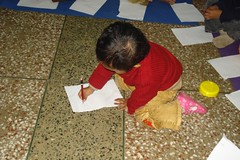 The recent scrapping of the class X Boards has been welcomed by one and all. Then why is it that I am feeling uneasy and slightly rattled. I sat for a long time trying to figure out what was disturbing me and why I was not jumping with joy. Was I not the one who had always been against examinations that tended to assess a child’s future on her of his performance on a single day. Was I not the one who once extolled the benefits of alternative schools to all those who would hear me. And yet here I was brooding over the news of Boards being scrapped. What had changed?
The answer was simple: then I thought of my kids, now the faces that came to mind was those of the pwhy kids whom I had seen toiling over class X exams for many years now and succeeding. What was disturbing me was how they would perform in the new scenario. What would we expected of them and how would they be able to compete with their peers from privileged homes and schools? I decided to try and find out what would be expected of them in the new continuous evaluation system.
The new CBSE grading system would comprise of a summative and a formative assessment. While the former would be based on the term end examinations, the later was far more complex and would evaluate class work, home work, assignment and project work. The system again seemed to tilt in favour of the privileged schools where project work and assignments were the order of the day. Sadly in government schools that was not the case at all. In such schools the only thing that mattered was learning and mugging for one exam and one did that with the help of guide books, past question papers et al. Now all this had ended and much of the performance of the student would be assessed on work done in class along the year.
I read somewhere that special training classes were soon to be held for teachers. I wonder how they will achieve changing mindsets and old ways. Extra classes and tuition days are now passe. Every child will have to perform day-after-day. Knowing the situation prevalent in government schools one wonders how that will happen and one also wonders how one needs to reinvent one’s self to address the new situation. I guess things will fall in place after a few batches and that in the ultimate analysis it is all for the better but I still ask myself how a student whose family can barely buy her guide books will be able to come up with all the resources needed to complete an assignment or project that the child will have to complete in a cramped tenement she shares with many.
a little bundle of joy
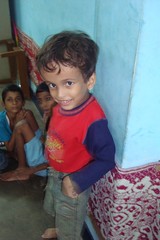
 Sohil is the new kid in the special section. He is 6 years old and has hydrocephalus. He also has spindly legs and malformed feet making his gait unsteady and awkward. But that does not deter him from doing everything his new pals do.
Come dance time and Sohil surreptitiously moves towards a wall and takes his position. In this way he knows he will not fall. And once the music plays, Sohil dances with his heart, his huge head and tiny body gyrating and moving just like any Bollywood star.
Little Sohil is very talkative and loves asking questions. He is extremely friendly and goes to every and anyone. He is the darling of the class and is loved by all but his special friend is little Radha and they are often together. My heart misses a beat each time I see them. Do they actually realise that they are soul siblings? Do they know that they both have truncated lives and can not dream of many morrows? Is that why they are so attracted to each other.
Radha and Sohil are both extremely bright and intelligent kids. In spite of their handicaps they are extremely independent and have a rare thirst for knowledge. They are like little sponges wanting to imbibe everything that comes they way and always wanting more. Their joie de vivre is infectious. They deserve to live long and fruitful lives and yet we all know that their sojourn on this planet is short, very short. Had they been born on the other side of the fence they could have perhaps dared aspire to more. But that is not to be.
When Radha and Sohil are in class there is no space for gloom or despair. Everyone gets touched by their special brand of optimism and moods get lifted by magic. Life is celebrated in its purest form and everyone is joyful. And for a brief moment all is well on planet earth.
Watch Sohil dance, you too will be touched by his magic
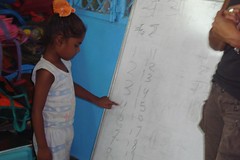
all the way
 For the past almost ten years now, project why has been giving what can best be called after school support to hundreds of slum children. For the past almost ten years we have basked in the glory of knowing that all our children passed their examinations and that no one dropped out. For the past almost ten years this seemed to be our mission and we were true to it. The challenge now was to see our work become sustainable and thus freed of any vagary that could hamper or even halt it midway.
Thus was born the idea of planet why, and though its primary function was undoubtedly to raise funds for our work. But that is not where it stopped as, almost intuitively and even surreptitiously, silent yet deafening whys were heard and needed to be addressed. One of them was simply: after this, what? Or in other words what would happen to our kids after they completed their schooling keeping in mind ground realities. Let me elaborate a little. It is a fact that in spite of our best efforts most of our children will never be top of the class. What must remember that they run the race with huge handicaps: a late start, a hostile environment, no support at home, no English at home, no access to extras (books, computers, internet), no positive stroking, no encouragement and much more. That they even manage to complete their. studies is nothing short of a miracle. But the question that begs to be answered is what do you do with a class XII certificate with poor marks? The answer is: not much. And the reality is that with no extra skills or learning the child is often doomed to follow the father’s footsteps and become what he could have without his long school years.
Parents of such children do not have the means to give them the required added skills needed to change their lives and break the cycle in which they are caught. The long school years look like a terrible waste. This has been disturbing me for some time now and that is perhaps why planet why was conceived the way it has been: a way to take the children a step further and give them the skills they need to become productive. Hence after school they could learn an added skill: be it in the guest house (housekeeping, catering, gardening etc) or in the courses we envisage running when we have the space and infrastructure to do so: plumbing, electrical work, TV repair, mobile phone repair etc.
It is imperative that we do so and sooner than later. Otherwise the very spirit of project why is defeated.