
Project Why 2.0 was after the pandemic, when we had to reinvent ourselves, rebuild our donors network and adapt to a new normal.The year was 2021. We limped back to some semblance of normalcy, with some changes but ready to continue our journey notwithstanding the short Covid hiatus.
Our mission was always to ensure our children get the best start in their lives after school. For a long time we believed that what was needed was a good school leaving result as it was essential to get admission in a good college. And we fell back into old patterns though I was not comfortable with this approach. But I had to set my qualms aside as there was larger elephant in the room that need to be addressed and that was: what will happen to Project Why after I leave this world. So before making any sea change in our programmes, we needed to secure our future. Time to. conjure another miracle.
The miracle happened in the form of a donor who promised long term support for one centre and also promised to find out more donors like him. But there was a caveat: we had to accept to change ourselves to meet the demands and challenges of the 21st century. We accepted his advice and slowly transformed our functioning. Last year the elephant in the room was dealt and we could see Project Why living beyond me if we payed the game right.
After a much needed organisational change to make us more efficient of course but also to transform what has till date been an organic sometimes hap hazard structure to one that would gain the confidence of our potential donors. In spite of some hiccups, some resistance and some pain we were able to do so. Today we have a modernised and strong administration that will stand the test of time.
It was rime to address the other elephant in the room: how to prepare our children for the challenges of the 21st century. It was a clear that a simple BA would not get anyone anywhere.
The main objective of Project Why 3.0 is to make our children ready for the rapidly changing employment scenario as just teaching the 3Rs is in no way sufficient.
To this end we began making some changes to our programmes. It was decided to put emphasis on English and computers. Today all children from class I to XII are learning English every day and have computer classes thrice a week. This has been very successful and appreciated both by parents and children. And of course speaking English and having a good grasp of computers are skills needed in the future.
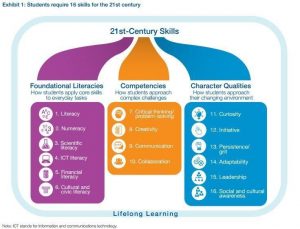
While surfing the Internet to find out what are the skills needed for children today I came across an. interesting article of the World Economic Forum. It states the following Today’s job candidates must be able to collaborate, communicate and solve problems – skills developed mainly through social and emotional learning (SEL). Combined with traditional skills, this social and emotional proficiency will equip students to succeed in the evolving digital economy. Good leadership skills as well as curiosity are also important for students to learn for their future jobs.
The article has a graphic (shared above) that gives details the skills by dividing them into three categories: foundation literacies, competencies and character qualities. A quick perusal of the graphic shows us that what we are teaching children today can in no way prepare them for the future. We need to find a judicious system whereby we teach children the curriculum needed to complete school while integrating the skills they need to gain meaningful employment.
The present education system in India was designed by the British to make ‘babus’,people who would do what they are told and not think for themselves. What is needed in today’s day and age is the absolute contrary. According to the article to succeed today you need critical thinking, creativity communication, collaboration, curiosity, initiative, leadership and so on. Certainly not to do what one is told. What is needed is the ability to think out of the box. The million question dollar question is how?
The answer was provided in the article itself through another graphic,
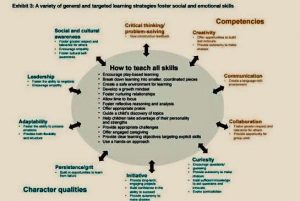
This graphic outlines the approach that needs to be taken to introduce and perfect these skills within the existing structure. As we can see the idea is to create the right environment for children to grow and bloom.It is suggested to encourage play-based learning and break down learning into small pieces. The child should be allowed time to focus in order to foster reflective reasoning. The child should be allowed to discover topics taking advantage of their own strengths and personalities in an enabling environment where the child is praised.
Specific examples are given for each skill. For eg to develop creativity the child should be given autonomy to make choices or to ameliorate communication one should create a language rich environment. To awaken curiosity encourage questions and to foster critical thinking it is necessary to give constructive feedback. The bottom line is simply that one has to flip the equation and make the child the centre of all activities. This is quite akin to the Socratic method that uses open-ended questions to spark curiosity, critical thinking, and deeper understanding, moving beyond simple answers to explore “why” and “how. Ask More, Tell Less: Instead of giving answers, ask questions that guide them to discover the answer themselves. This boosts critical thinking and problem-solving,
develops communication and listening skills, fosters a love for learning and intellectual curiosity, builds confidence in expressing ideas.
The task is daunting and will require teachers to get out of their comfort zone and change their approach to teaching. The curriculum remains the same, the way of teaching changes. It is a huge challenge but we have never shied away from any challenge and I have full faith that my team will rise to the occasion and do wonders.
Come to think of it, I have always felt uneasy with the way children are taught as . Way back in 2006 and even before I had given my views on education several times an always believed in Jacques Delors 4 pillars of education: Learning to learn, learning to be, learning to do and learning to live with others. Sadly one was not able to incorporate these in our way of teaching.
But today the writing is on the wall and if we do not make the needed change our children will not be ready for tomorrow. So Project 3.0 is just that: changing our approach to education so that Project Why children can think out of the box and shine.
That is the difference we need to make today, so help me God
A very pragmatic vision for the needed shift in Project WHY’S functioning. Thanks for laying the ground and offering clarity for the way forward.
Reading your blog has given me a clearer understanding of the approach that needs to be adopted as an educational professional while working with children from marginalized sections of society. Our primary responsibility lies in preparing them for the challenges of the 21st century and in narrowing the gap between the haves and the have-nots.
This vision undoubtedly calls for well-structured and thoughtfully designed teacher training programs that align educators with the philosophy and goals outlined in the blog. In this regard, I sincerely request that the core committee at the centre consider planning specific teacher training or referential programs to help update and equip teachers so they remain aligned, informed, and in tune with the renewed vision of Project WHY as articulated by Anou ma’am
Thank you.