by Anuradha Bakshi | Dec 28, 2006 | Uncategorized
Nanhe’s predicament haunts me ceaselessly. As someone wrote: this is the battle of the mind and the heart, and none of them are wrong.
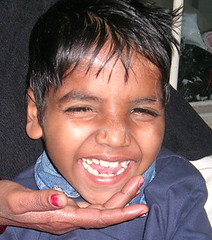
Nanhe is precious to many of as we are addicted to his smile. Somehow when Nanhe smiles than for that tiny moment everything seems so easy.. and most of us would like to believe that we would fight to save it no matter what.
Easily said than done as this time the battle is anything but fair. Till now, every time the smile was in danger a few days at the hospital, a surgical intervention, a few strips of medicine was all that was needed. But now he needs a new kidney and suddenly the adversary has turned formidable.
The docs dismissed the mom by quoting an sum that would seem astronomical to any one, let alone a poor widow with three challenged kids and a pitiable cart that she fills with whatever she thinks saleable. It would have seemed the same to us but somehow offers have come without our asking.
But the real issue is not whether we can raise the money or not, it not even whether we can find a kidney or not in lies in doing what is right for Nanhe. I recently read an article on compassion and about the need for caring, and how little of it there is around. But in situation like this compassion itself is challenged. Where does true compassion lie: in getting a complex surgery done knowing it is wrought with danger, in spending an astronomical amount of money to give some more time to a child who will never be able to survive this world, in finding the courage and the right words to tell a mother that her son is dying.
One could also try and explain to her that it is in not simply the one hundred thousands rupees asked for but the cost of dyalisis and expensive medecine, the risk of rejection and so much more and the care needed afterwards. one could gently remind her that she has three more children two of whom as challenged and the other a daughter that needs to be married soon. But have you ever tried talking to a desperate mother fighting for her child’s life, even the gods in heaven sometimes have to accept defeat.
Once again today I wish I had a dream catcher
by Anuradha Bakshi | Dec 26, 2006 | Uncategorized
My mother died of cancer. Many do. The difference was that she stubbornly refused all form of treatment. She bore her excruciating pain with rare courage. Life had to be lived till the very last breath was her leitmotiv, and she did, remarkably alive as she quietly died.
She could have had the best treatment and at least the most sophisticated pain killers, but somehow she refused them all. For many years after her death I battled with ifs and buts and ceaseless torment. My demons were only set to rest when I met a leading oncologist who shared his view about terminal diseases with me.
Dr de Souza had been with Bombay’s leading cancer institute for many years and has held a unique discourse to many patients and their families who come remote parts of India. Strangely enough he has ofter sent them back, counselling them not to spent their meagre resources or sell their last possessions for a treatment that will never cure the disease. One must remember that the poor only come to such specialised institutes when the disease is too far gone. His advise is to take care of the living and their future rather than fight a lost battle. Instead of hospitals he set up hospices so that the terminally ill could be cared for, and the family find some support.
All this came back from some recess of my brain as I made sense of our poor little Nanhe’s mom was trying to convey. She had just been told that both Nanhe’s kidneys had packed up and that his only chance of survival was a kidney transplant. I wish he had just taken the Dr de Souza way and sent her home with the right advise, no matter how harsh and cruel it sounded as what awaited her was even worse.
The doctors who gave her this unreachable ray of hope knew Nanhe’s condition and what awaited him. They were aware of the fact that even if he got a kidney he would never walk, never comprehend the world and never be able to survive. One is not even thinking of the innumerable obstacles that exist on the way to an organ donation. To rid themselves of the constant nagging of a loving mother, they just told her to buy a kidney at the cost of Rs 100000. Maybe they thought she would be scared away by the astronomical figure, but they forgot they were dealing with a mother.
But we know we are.
But how does one tell a mother that there is nothing much that can be done for little Nanhe. How do we tell her that her son is slowly getting ready to move on to another and hopefully better world. How do we explain to her that what the doctors have said were empty words, and that for this one time ever a mother’s prayer will not be heard.
We have had many a difficult moments, bu this is one that defies them all as where does one find the words to say that Nanhe’s smile is today in real danger?
by Anuradha Bakshi | Dec 26, 2006 | Uncategorized
Have you ever wondered how much a handful of spinach costs? A few coins on a market place, a little more in a fancy store… and a few leaves picked up in a field would not be missed by its owner.
Not quite. In a remote village in the state of Bihar a little 10 year old girl lost three fingers as she dared to pick a few spinach leaves from a field. Before you express indignation let me simply add that the little Khushboo is a dalit and the owner belongs to a higher caste! And if that was not enough the girl and her father are too scared to open their mouths.
At times like these I am left speechless as nothing one can say can even begin to explain this horrific equation: a few leaves of spinach = three little fingers! I hang my head in shame as I try and look for the beginning of an answer that would explain this..
One has heard ad nauseum about the reservation issue that is threatening to destroy our social fabric. One is led to believe that the creamy layer of the so called lower castes will hog up all our place in the sun. But nothing can make up for the three tiny fingers cut off in a fit of rage for a few leaves that may have just wilted and rotten had they not been plucked.
Why did little Khushboo commit that offence? Was it to ensure that her family would not go hungry, was it because she could not bear to see her mom beaten by a defeated and helpless father, was it because it had been so long since she had tasted the freshness of a green vegetable. This is something no one will know as the little girl will keep her secret locked away inside her.
When someone decided to divide human beings into what is known as castes, I am sure that the reason was not to give one caste the licence to snip off fingers. So we before we battle about the right of one caste to accede to higher learning, maybe we would address the question of Khushboo’s finger and take on the responsibility of their loss. Khushboo’s fingers, Priyanka’s life are just two examples of the countless tragedies that some of our own suffer because they were born in the wrong caste.
It is not reservation or affirmative action that will right his wrong. Neither is it the few fleeting expression of indignation that cross our minds as we see or hear such stories. We need to go deep within ourselves and to see what made us lose our human compassion down the line, what hubristic demon took possession of us and made us lose all sense of reality. What gave us the right to treat another fellow being in such a barbaric manner.
Khushoo’s fingers will heal and her father may have to pay a few more rupees to find a man for this child. The perpetrator may or may not be caught. At best he will spend a few days in jail as all he took away were three little fingers. And all of us will move on with our lives till the next tale of horror jolts us back into momentary compassion.
by Anuradha Bakshi | Dec 25, 2006 | Uncategorized
o
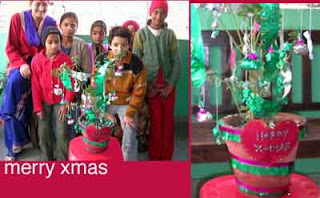
The world celebrated Xmas. In a tiny lane of an urban slum in Delhi a bunch of very special kids did too. Just like children all over the world they wanted a Xmas tree and nothing could stop them.
Nothing to write home about, some would say, but what if I told you that each and every child in this little group is different: some have remarkable minds locked away in useless bodies while others try to make sense of the world with limited means. Some are condemned to a world of silence while others live in immobility. Oops I forgot to tell you that all of them have never known the thrill of opening a present and have only survived on hand me downs!
But somehow the Xmas spirit is such that it breaks down all barriers so we were not surprised when we saw them storming to the terrace in search of a potted plant, any one would do. In the most remarkable example of cooperative effort and armed with bits of papers, cloth and heavens knows what else, they set out to create the most beautiful tree I have ever seen. True it broke all conventions, but while doing so it set its very own and these seemed closer to the Xmas spirit.
This tree was imbued with the purest form of joy, it was one that needed no borrowed trimming or expensive decoration, even a discarded old white sock looked pretty as it dangled in the blowing wind and as they proudly posed for the customary picture, the air was redolent with the abundance of giving that emanated from this humble tree.
I do not know whether anyone of them knew about Xmas and its significance, but somehow they had intuitively grasped its ever essence.
Isn’t that what xmas is all about!
by Anuradha Bakshi | Dec 21, 2006 | Uncategorized
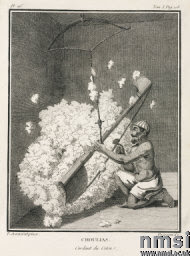
I happened to be standing at the gate when the cotton carder went by. Hearing the high pitched sound of his carding bow was a Proustian experience as it brought back a flood of long-forgotten memories.
There was a time when you could plan your day with almost clockwork precision just by listening to he sounds of the passing hawkers. There use to be many in our street: the vegetable and fruit vendors, the cobbler, the kabariwalahs the best recycling man ever. There was the man repairing jewels, the one who sharpened your knives and even one to clean your ears. Not to forget the toy vendor, the ice cream seller and so many more, each with their own calls that brought the street alive. Some were perennial, others seasonal, but to many like us they became familiar faces that were part and parcel of our lives.
Today there but a few, particularly in up market areas where forbidding gates with placards barring entry to hawkers have sounded their death knell. And with it the end of many small jobs that fed families and many trades that will soon be forgotten, trades that often use to be passed on from father to son.
I recently spent time with a shopkeeper friend whose shop came under the sealing hammer and who will move on the a mall miles away. His shop sold a medley of items; a great place to buy that gift one often remembered at the last moment. Over the years one had established a relationship with him and his family, seen the son get married and witness the birth of the grand child. Many recipes, and pieces of advise were shared, not forgetting the cups of tea! As I left the shop, my precious packet tucked under m arm, I realised that it would people of my generation who would feel the loss the most. The shopkeeper will find a new life in his squeaky clean mall, and will soon have a new clientele; for him it is a matter of survival. But we, the middle-aged middle-class middle everything individual will find ourselves disorientated.
I do not see myself trudging to an impersonal mall miles away for that gift. An appropriate amount of money in an envelope would have to do.
A was filled with sadness as I saw that one more chapter of our lives was ending. We had no option but to adapt as best we could and we would ultimately. But as I looked at the face of the brave cotton carder, now aged and tired, hoping that someone would stop him, I imagined the numerous evenings when he would have returned empty handed and his family would have slept hungry. At his age he had no other option and had had to fight the advent of polyfill quilts alone and bravely.
In our rush to embrace modern ways, do we realise the price that needs to be paid.
by Anuradha Bakshi | Dec 18, 2006 | Uncategorized
The Jessica Lal verdict is out. It took a long time coming. Wonder why as she was shot in a place filed with Delhi’s own page 3.
For seven years we were almost mute witnesses to a mockery of justice where the entire system connived to save the killer who was a is said in today’s parlance well connected. Muscle and money power went to town and after six years or so those who had brutally ended a young life were set free for want of evidence!
Jessica was not a known person but she suddenly became the girl next door and somehow a city felt threatened. That is when civil society woke up from a long slumber to show its might. And it dis. Notwithstanding political connections or arm twisting of any kind, the existing machinery set out to redress a wrong and it did. Even the last ditch effort of a high profile lawyer who took the now jaded route of turning the victim into an accused failed miserably. The killer was found guilty. Jessica can now rest in peace.
This case has restored one’s faith in the judicial system but it has done more than that. It has shown that civil society is a force to reckon with. True that J’s case was a high profile one, that she had a spirited sister who refused to give up and give in. But this whole fight will come to naught if we as a society do not realise that our role goes beyond high profile cases. We today have the proof that we have the power to change things, to redress torts and thus to make a difference but with it comes to responsibility of reaching out to those who are invisible, and remain voiceless.
There are many unknown Jessicas who have been abused or killed. There are numerous families who hope for justice but do not know how to get it. There are many killers at large who are protected by the system. They need civil society to take on their cases and see that justice is done.
Let the Jessica Lal verdict be a verdict of hope, a verdict that makes us believe that things can change, one that rids us of our inertia and drives us to act. Then maybe the little Ghaziabad girls too will get justice they so deserve!