by Anuradha Bakshi | Jan 3, 2007 | Uncategorized
A friend dropped by this morning. We had not met for a long time, yet there was a time when we shared the same ideas and concern and were all set to rebuild the world over innumerable cups of coffee. At that time we both taught in universities. We liked the same books, the same songs and shared similar aspirations. I cannot remember what was said and thought, but I do recall that we both felt deeply that things were not right.
Life took its course and he remained a teacher and still teaches in a prime institution. I left my comfortable, pensionable post as I had felt stifled. Family obligations saw me criss-crossing the planet and it was only a few years back that I set roots and felt I had reached my destination.
The last time we met, we only knew one side of the invisble divide that fractures our country and conjured the other the way we wanted to see it. But this time it was different, I had crossed the line and experienced first hand what reality was, seeing each and every of my preconceived notions being blown to pieces, and re-looking at the very issues we had debated upon with new eyes.
It took me but a few minutes to get to my pet subject and talk about my dream of seeing the children of India grow together, side by side, without any labels stuck to their foreheads, taking time to build their own. Somehow I had expected T to agree to what I said. I was astonished to see his reaction and stunned when he mentioned public-private partnership in education.
A pall was cast on what had started as a happy meeting. We fumbled through the next few minutes and bid farewell. For a long time I sat in silence wondering what had happened in those years to change things between us. Why was it that felt so deeply about bridging gaps whereas all others be it politicians, educationists and so forth maintained that solutions lay in widening the gap. Had history past and recent not given us sufficient proof of how the very fabric of our society was getting destroyed by the multitude of divisive policies we were following leaving far behind the ‘we the people of India..’ of our Constitution?
T’s reaction was disturbing as I knew that he was intrinsically a good person, truly wanting to see change. He taught the best minds and thus could impart new ideas and ideologies were he to believe in them. Then why a total rejection of a common school idea. And why on the other hand was my belief strengthened each and every day. What had happened to both of us who started much in the same way?
Maybe it was the fact that I had experienced the other side, or was it that time was not yet ripe, that our social baggage was so heavy that we were still not ready to accept our children rubbing shoulders with ‘their’ kids!
All these questions plagued me all day along.
Yet I was to be validated sooner than I thought. The evening news carried the following: the brutal murders of many young children in NOIDA have touched a chord around India. For the first time, residents of NOIDA’s bungalows are now venturing out, offering a helping hand to those who work in their houses.
The year 2006 was a year that saw so many conviction. Now taking the same spirit into 2007, the battle has just begun and so tragic as it is that it’s taken the horrific serial killings to bridge the glaring class divide between an urban slum and a swanky suburban town.(NDTVnews)
Sad that so many innocent lives had to be lost to see this. I wonder how many of the mothers must have sought help when the child disappeared. I can also imagine the reaction of the likes of me who must have offered kind words and maybe money but were unwilling to make that trip to the police station.
But it is not time to cry over what cannot be changed, but celebrate this new beginning and to ensure that this very fragile spark is kept alive. There are so many who can get justice if they have our support and maybe it is a way of redressing a system that has run amok. Filing a simple FIR, as one discovered today, is a nightmare even for an educated person. Simple rights have been usurped by a feudal attitude that sets the rules turning victims into accused.
One has to also ensure that this new found compassion does not become another power game or get hijacked on the way by those waiting in the wings for any cause to espouse to fulfil their own agendas.
I said earlier that maybe the time was not ripe for the elusive common school system. However I want to believe that if people have found it in their heart to reach out to their poorer brethren, then slowly they may also come to accept one day to have their kids share a school bench.
I guess the penny will drop when one comes to understand that in doing so we are not doling out any charity but investing in our own tomorrows.
by Anuradha Bakshi | Jan 3, 2007 | Uncategorized
How many more children will have to be abused, mutilated and killed, how many more mothers will have to live with questions than can never be answered before we become responsible as a civil society and say enough!
We are supposed to have a law and order mechanism but what we forget is that these work only for those who have money, power or at least a vote. The parents of the dead children of Nithari did not have any of these. Migrants from other states, they came in search of work with a hope that maybe they will be able to give their children a better life. Instead they sent them straight to a horrific death.
Imagine the plight of a parent whose child has disappeared. Imagine his sense of utter defeat as he knocks at the portals of a police station and is sent away over and over again with contempt. Imagine his despair when he is told that the children of the likes of him do not exist for the so called system. Imagine the days and nights spent in waiting for a miracle that never comes. And finally imagine that closure comes with a set of clothes, a heap of bones and the realisation of the horror that one cannot begin to imagine.
Then try to envisage what that parent feels when in the dead of night and numbed with excruciating pain he realises that just a stones’ throw away another child also disappeared and within moments everyone was on their toes: policemen, politicians, admin bigwigs et al and within days the child was back home.
Welcome again to the great divide of India, one that is even more poignant in a land where democracy is supposed to protect each and every one. Have we forgotten the preamble of our constitution where we promised to secure to all citizens among other things justice, social, economic and political.
When did invisible barriers appear along the way and segregated people and marginalised some. When did our constitution get hijacked by hidden agendas and why did we just sit and watch it happen. Was it because the likes of us knew that we would remain on the right side of the fence.
Once again one’s head hangs in shame. The past months has been filled with such moments: the orphanage in ghaziabad, the little fingers for a handful of spinach, and now countless children mutilated and killed, their organs traded so that someone with money could live making some rich on the way.
2006 was the year of people power but before that power also falls prey to the great divide it, we need to act if we are to redeem the right to be worthy of ourselves. Or let me put it another way, one that maybe is better understood in our pathetic times, it is time to act now if we are to protect and secure our own future, as the day is not far when the cumulative pain and anger of those we have shunned away will rise and I know that on that day all the gods in heaven will be on their side.
by Anuradha Bakshi | Jan 2, 2007 | Uncategorized
“Go buy a kidney for your son, it costs one hundred thousand rupees” were the words said almost casually to a desperate mother by a doctor of a leading government hospital. The son is our own Nanhe battling renal failure.I guess for the doctor it was a quick an easy way of getting rid of a annoying woman.
But this post is not about Nanhe. Many of us have been trying to shun the images of the little children of noida, massacred over the years our own Mr Hyde. As the story unfolds so does the horror makes us wonder what makes a so called human being lure children and kill them mercilessly. Why were only skulls found. What happened to the bodies. is this the work of a paedophile.
This morning a news item seemed to suggest that we may in the presence of a organ sale racket and that the children were used to that end. And as the enormity seeps in, it makes sense, terrible sense..
Wonder how many desperate parents and families are told each day to ‘go buy a kidney‘ by doctors? We all know what desperation leads and are aware of market forces as these permeate any situation where a buck can be earned.
So poor children easily seduced by a treat or a handful of pennies seem easy targets. And another handful will take care of the law and order machinery. Poor parents are easily shunned off and the macabre game is on.
So do you tell nanhe’s mom that the kidney that may save the life of her son has taken the life of another’s mom’s child? Or does one convince doctors to assess the implications of their words before they utter them?
I wonder
by Anuradha Bakshi | Jan 2, 2007 | Uncategorized
Many newspapers and news channels chose to sum up 2006 in India as an year where people power finally emerged. True they have many reasons to do so: Jessica and Priyadarshini got justice, the Right to Information Act was salvaged from potential hijackers and the son of MNC boss returned home safely after being kidnapped.
The media too played a pro-active role in getting justice to many individuals be it a slum kid dreaming to represent India, a poor old couple begging for survival, little girls in an orphanage being abused by their caretaker, a little challenged kid abandoned by his family..
So can we dare to say that all is well on planet India?
Maybe not. There are many Jessicas waiting for justice, many old couples in need of help and as we all saw in silent horror many children kidnapped and killed as parents knock uselessly at the doors of police stations. The difference is hat they are from the wrong side of the invisible barriers that divide us and do not have what is required: money, contacts, access and even the not so often mentioned miracle tool – good command of English.
Some manage to break the barriers if for some reason or the other they get picked up by he media and if in the heat of the moment some tangible action comes their way, well and good, otherwise they sink into oblivion after their brief moment of glory.
This is not meant to be a cynical post but a simple call to all the invisible voices who came o the fore to help get justice when they felt it was in danger. Time has come to ensure people’s power reaches out to all those who have been hurt, abused or let down and to bring about long term changes to ensure that they get justice.
The Noida children could have been saved had the police registered the FIRs and set out to look for them with the same diligence as in the case of high profile children. Civil society should go beyond addressing specific cases and seek out long term solutions.
They have the power, what is needed is the will to exercise it. Only then can the invisble barrers be broken.
by Anuradha Bakshi | Jan 2, 2007 | Uncategorized
Come January 1st and we all set out making new resolutions for the new year. I use to do it too and then somehow these were forgotten as life took on its course. This year I just let January 1 be like just another day, the difference being that I watched it go by with more awareness. And just another day it was with its share of simple joys, its tinges of drama and its moments of weariness.
In the street where I work and which is far remote from the glitz and glamour, nothing seemed different. The street vendors let out their call at the appointed time, braving the cold and morning fog, shops opened their shutters, people set out to work as a day missed would mean a hungry family and barring the rote like ‘happy new year’ people exchanged, it was an ordinary day.
2006 had slipped into 2007 without much ado.
To me each day is a new beginning and that is what makes it extra-ordinary. As one set out in the morning one cannot begin to imagine what it will hold. But come to think about it just the simple fact that it goes by quietly is a celebration in itself. So much could go wrong, and yet nothing has.
Each day also brings its set of challenges that need to be met as well as moments to savour: it could be an extra smile or a tiny achievement many would not see or that warm cup of tea enjoyed in the watery sunlight that was finally agree to pierce through the dense fog.
We seem to have lost the ability to seek out simple joys and look for causes or crutches to ‘celebrate’ and maybe January 1st is one of the most jaded.
Yet it is just another ordinary or extra-ordinary day, depending on how you wish to look at it.
by Anuradha Bakshi | Dec 29, 2006 | Uncategorized
There are laws and declarations, organisations and institutions and more all seeking to protect children’s rights to be children. Conferences are held and debates too..
But if I were to tell you that the right to be a child lies hidden in every child rich or poor waiting for the opportune moment to spring up and claim its place?
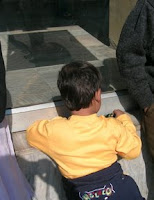
Yesterday our star friend gave pwhy kids a treat: a movie and all the add ons that make a movie show worthwhile, the fizzy drink, the popcorn bag, the burger and the scoop of ice cream. Never mind which side of the city you belong to and whether the goodies carry a label or not, you do not need laws and conferences to savour them. They just have to be there and little eyes light up, hands are held out and the thrill is palpable.
It was a motley bund of children of all caste, class and creed. Some had never been to the movies in a hall, specially our little lohars (gypsies). And even those who had never got the whole lot of goodies.
They wore their Sunday best, never mind the jarring colours and the ungainly cap a worried mother has insisted upon. Nothing could and would spoil their day. Today they had claimed their right to be kids for the duration of the outing. They knew that they had to go back to their dark world, to chores and jibes and even blows, yet for now they were kids and we all needed to understand and respect that.
click on the picture to share this special moment