by Anuradha Bakshi | Feb 5, 2007 | Uncategorized
I cannot remember when I last stepped off the whirling world to take a breath and muse over days gone by. Life went on at a frenzied pace and there never seemed to be time to take a pause and cast the much needed critical look.
One may wonder what set off these musings. Simply an empty inbox on my screen.
For the first time in many years did I wake up to an unread (0) status on my email. This triggered a series of questions in my mind and to answer them I realised that one had to take a pause and look back.
The past year has been a rewarding one, when many obstacles were cleared and life set on an even keel. It was a year when many little broken hearts got fixed, when a little boy and his mom were rescued from a life of hell. It was also a year when pwhy took on a new role and reached out to free little girls from the hands of their abuser, a year when a little boy defeated all medical rules and sprung back to life. It was also a year when new friends came forward to support us; a year when we even got our own little building and began a new centre. A year to be celebrated and feted.
It is true that many of the things mentioned above were already being done but the difference this time is that it all came easy. I remember with a tinge of regret the days when every new programme was a challenge. I remember with nostalgia how every tiny need entailed hordes of emailing and was gathered painstakingly cent by cent. I also recall the abundance of mails of support one got and the immense positive energy generated, the thrill one felt when someone committed some support however infinitesimal.
And today an empty mailbox that speaks volumes. Am I being once again faced with a new avatar of the dreaded comfort zone syndrome. Maybe. But this is one I need to fight to the hilt as it may sound the death knell of the very essence of pwhy.
Pwhy could only happen because so many people across the globe came together and infused it with life. Pwhy could succeed because of the immense support I got each and every time I sought it. And no matter how easy seeking funds becomes, pwy can exist if and only if it continues to get the love and goodwill of people.
There can no more be empty inboxes as money alone can never sustain pwhy. After all pwhy is just a simple love story.
by Anuradha Bakshi | Feb 4, 2007 | Uncategorized
I have always hoped that some day we will have lots of little primary extensions so that more and more children remain in school. And it has been my dream to do this by drawing all resources from the community.
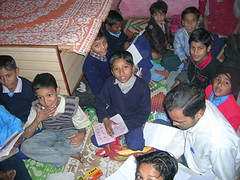
Our little Nehru Nagar class is a step in that direction as the classroom is a jhuggi in which people live. As they are out the whole day they leave us their home, bed and all. Sophiya and Satish tuck themselves and their pupils wherever they can and classes go on in earnest.
From the very moment we began, I knew that if we were to make a difference, we had to create a model wherein all resources came from within. The last seven years has vindicated this view as both space and teachers are in-house. But we are still dependent on outside help for the funds needed to run.
The solution of course lies in our ability to market our one rupee a day dream in the right packaging to my peers and my pwhy parents.
We are slowly getting there with baby steps and hope written large!
by Anuradha Bakshi | Feb 4, 2007 | Uncategorized
 Yesterday I dropped by my Lohar (gypsy)friends. My conditioned being expected to be greeted by long and sad faces as their homes had been raised to the ground just a few hours before that.
My heart did miss a beat as I alighted from my three wheeler and saw them all sitting in front of their erstwhile homes, their belongings strews all over. However as they saw me their faces lit up in the customary huge smile as many ladies came and hugged me
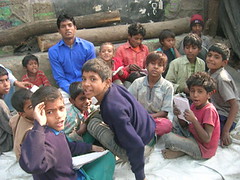
As we walked towards the space where our classroom was, I was amazed to see that in front of each ‘home’ the fire was lit, the tools laid out and men and women at work. Every faced smiled and someone ran to get the two new members of the clan: little Tania (3 months) and tiny Sagar (1month). The class was as full as ever and every child eager to show off. It seemed that barring the fact that roof and walls had gone, life was still on!
This has been the place where these 30 odd families have lived for over 25 years. I wonder what our reaction would be if someone broke the walls of our home and took our roof off! Gypsies are known for their resilience but what I saw today was more than that, it was a free spirit that refused to give up, a mind where fear had no place. They had perfected the art of zen survival.
As I walked back I was reminded of Tagore poem:
Where the mind is without fear and the head is held high;
Where knowledge is free;
Where the world has not been broken up into fragments by narrow domestic walls;
Where words come out from the depth of truth;
Where tireless striving stretches its arms towards perfection;
Where the clear stream of reason has not lost its way into the dreary desert sand of dead habit;
Where the mind is led forward by thee into ever-widening thought and action—
Into that heaven of freedom, my Father, let my country awake.
Here where a bunch of people who held their head high, we are the ones who let them down.
Note: there are 1000 odd gadiya lohar familes who have lived in Delhi since the fifties. they were promised relocation that they never got. They however were given voter’s ID cards.
by Anuradha Bakshi | Feb 4, 2007 | Uncategorized
In today’s world many of us have mastered the art of living according to rules and regulations, our lives carefully divided into little boxes and our reactions dictated by directives that are proved and tested by scientific means.
So when in this world a doctor and a hospital inform us that a child;s kidneys are not functioning and that he is severely anemic, the relevant little box of our mind sends the message that his days are counted. And you set out counting the days!
But then to your utter dismay, nothing seems to be following the pattern as the child perks up and starts smiling again till one day you find him at the door of his classroom. And days follow days as you train your mind to forget what was written on that hospital sheet.
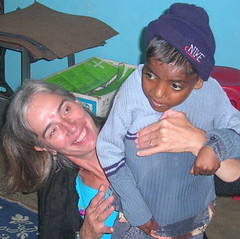
Our little Nanhe is back in a class and eager to participate in every activity. So yesterday when his friend Heather dropped by Nanhe not only danced but partook of the treat she offered: his favourite samosa.
Now did I not read somewhere of that forgotten hospital sheet: diet light, no fried food..
by Anuradha Bakshi | Feb 2, 2007 | Uncategorized
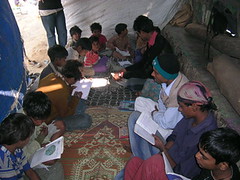
A class is in progress in the
Lohar camp. The camp has over 40 shanties along a main road. It has been in existence for over 25 years and even has a name and postal address. Most of its 250 odd inhabitants, all
gadiya lohars – iron smith gypsies – have voter ID cards. It is reasonable to say that they have a civic identity. There are over 90 such camps across the city some in existence for more than 50 years.
These 1000 odd families stopped wandering and settled in Delhi over half a century ago. Their abode remained shanties along side roads where one often sees them beating the iron and selling their ware.
We began our classes in this camp more than five years ago.Since we have witnessed many a demolition that seem to take place with regularity. The next day the shanties are rebuilt after a few palms are greased.
Nomadic tribes were promised relocation at the time of India’s Independence. We even found some official looking papers to prove that some semblance of resettlement had been initiated. WE helped the lohars file a writ petition in the high court and brought the plight of these lesser citizens to the NHRC. But as proceedings dragged the lohars got weary and lost interest or sunk back into the legendary resilience of nomads.
A few hours after this picture was taken the camp again demolished. This time the authorities did not spare us either but left with the usual: kal phir banalena – you can rebuild it tomorrow-! But we know that this cat and mouse game cannot continue for much longer as this camp comes in the way of the Delhi Metro project and the day is not far when our lohars will lose their shelter.
The future of these proud people we have learnt to love and admire is in danger. More than any of the migrants who have been given shelter or relocated over the years, these 1000 families need to have their basic constitutional rights restored in a city the made theirs much before others. However we fear that once again they will remain invisible and their voices unheard.

The picture above was one of the class yesterday; this is the same class today
Note: this camp has been in existence in this very place for over 25 years! Our classes began five years ago
by Anuradha Bakshi | Feb 1, 2007 | Uncategorized
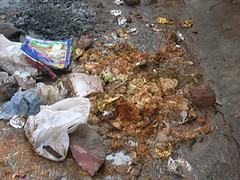
 This is a picture of the morning after a wedding party in our street. Yesterday as is customary in our city, tents came up, the street was blocked and the paraphernalia needed, set in place.
This morning we saw the aftermath: large quantities of wasted food, and mounds of plastic ware.
The venue: gali no 3 govindpuri.
Such sites are so common in the densely populated areas of our cities and in the many urban slums that we have become inured to them. But today the site of so much wasted food was extremely disturbing for was it not just a week ago that a TV channel ran a series of programmes on hunger in India. The startling figures came to mind: of the 16 crore of children under six, 6 crore live below the poverty line!
We have all been to wedding parties and witnessed wastage of sorts. But somehow the site of large quantities of food lying on the street was unsettling. Food has always been respected in India and even deified. To see it walked upon and trampled was almost blasphemous and raised many questions.
What made normally god fearing and tradition abiding people act with such disregard? Normally in rural India, wastage is negligible if not non-existent. Even peelings are fed to the domestic cattle or left in a safe place for birds. What was even ore perturbing was that this was not happening in the shining India, but on the other side of the fence, one where people still live in want and debt.
Does the journey from village to city make one lose so much; does the label of urban entail adopting all urban ways, even the bad ones? And above all how does one instill in children born in urban slums lost values when what they see is the exact opposite?
Young children are endowed with an intuitive common sense that is unfortunately lost down growing up lane. Young Kiran, age 6, was with me when we took this picture. Her quiet words echoed my feelings when she simply stated: why did they not give this food to the cows.
Yes little girl, to the cows or to one of the million of children that sleep hungry every night.