by Anuradha Bakshi | Apr 24, 2007 | Uncategorized
I had heard the story of the the one-eyed child who lived in a small village and was the butt of cruel jokes and a sad laughing stock. His mother climbed a rocky hill on her knees to reach a shrine where it was said miracles happened. Sometime later her child lost his other eye and turned blind. At first she was unable to understand what had happened till slowly she realised that people had stopped making fun of her child and were often seen helping him and being kind to him.
This story has many explanations and many lessons to be learnt. But it came to my mind as I battled a real life situation today. We have been trying to find alternatives for Babli and Jeetu. Whereas many know Babli’s story, Jeetu belongs to times before one actually became a blogger. He lost his Mom when he was still a tiny baby. Now almost 8 he is tended for by a father who barley eeks a living. The father, like so many others, drinks and becomes abusive and violent. Last week he was seen threatening his son with a tyre that he was about to hurl on him when one of our staff members intervened.
Babli and Jeetu have parents but just in name as in either case these parents have scant time for their progeny. We were hoping to send them to karammarg but were told that a recent decision of their Board was to only take orphans.
Babli and Jeetu are not exceptions. There are many like them who though having parents live a life of abject neglect. They are left to their own devices. Jeetu does not even go to school in spite of all our efforts. Babli is a surrogate mother to her family. Her father even makes take care of the tobacco and cigarette cart he has while he is busy gambling. One year after her heart surgery she has not grown an inch or put on a pound. Having parents who do not care is worse than being orphaned as orphans are quite often taken care of by relatives and treated with kindness.
Jeetu and Babli are muck like the one eyed child, their lives worse than that of the child with no parents. Their homes situation is so hopeless that it becomes impossible to help them in situ. Their only hope is that their family – or what goes by that name – accepts to give them a better chance.
Sometimes decisions are taken in a hurry, one can only hope that they are not irreversible. It is the plight of children like them that made us seed planet why. If not for all the children at least for those who drop by our way.
by Anuradha Bakshi | Apr 22, 2007 | Uncategorized
Some of you may remember the very special gift I had sought this year for my b’day. Yesterday was unwrapping time as team project why gathered for a day long workshop and everyone read their essays ( for want of a better word). I must confess that I was really thrilled as everyone, even those who were illiterate had made the effort to produce a page.
When I began the workshop by asking each one to read what they had written I was met with a volley of giggles, exclamations and no ways! But I held on and soon everyone settled and one by one they read what they had written. Some in barely audible voices, some with theatrical aplomb, and some amidst giggles. I wish i had done this exercise before as those few paragraphs were a deep insight into each and everyone. Having known most of them for many years now, I could validate much of what I had till then just felt intuitively.
They had been asked to write about how the years in pwhy had transformed them, it at all, and why should anyone one ‘love’ them. Some felt is necessary to eulogise pwhy and ma’am. Others were bold enough to state that they should be loved for this or that reason. Some went back to their school days and their relationship with their own teachers. There were even one or two who delivered a passionate speech on the state of the country.
There were however some heartwarming and even poignant common threads: new found self confidence, ability to talk to foreigners, realisation that they could achieve what once seemed impossible. All in all it was a great experience and one that met my secret agenda: that of getting each one of them to take on the running of their own centre. I explained to them that i wanted each one of them to feel responsible for the work they were doing, to make its budget, to list its assets, to maintain daily accounts and above all to state its relevance.
There were raised eyebrows, incredulous looks and much whispering. But step one had been taken towards a change in roles and I knew that this was a great moment for all of us at pwhy.
(to be continued….)
by Anuradha Bakshi | Apr 20, 2007 | Uncategorized
Whenever one feels low or a tad dejected a miracle drops by to lift one’s spirits in a nano second.
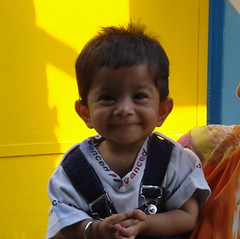
This week’s miracle was a visit by little Anisha and her sunshine smile. All woes and bad thoughts were whisked away as she entered the room in her mother’s arms and greeted us with her dazzling smile. Was this the same child who just a few months back could barely breathe?
She regaled us with her new antics and one could not resist puling her now plump cheeks. Anisha who was barely surviving with numerous holes in her heart, was today alive! And we at pwhy granted ourselves the right to celebrate our sunshine girl.
by Anuradha Bakshi | Apr 18, 2007 | Uncategorized
Our new budget for 2007 – 2008 is on line. Normally a budget is not something you blog on. However project why has reached a stage where in a case of force majeure it has become necessary to review and reinvent.
The Damocles sword of the now (in)famous sealing laws hangs on our head. The not so elusive year 2010 is just round the corner and it would be foolish to think that slums will remain where they are. On the other hand the promise of building flats for slum dwellers in situ is at best only for a chosen few, if not a another political sop. The likelihood of slums being once again pushed to the edge of the city seems more like a reality waiting to happen.
Thinking that project why could remain as it is for years to come is unwise. The sensible option is to start planning for the future while keeping within the spirit of project why.
We now have 10 working modules in 7 locations. Our first step would be to empower the staff in each of these 10 module to take on their management. Hence we have asked them to prepare individual budgets and maintain daily accounts. We know that we will have to hold their hand for some time but in the ultimate analysis they will one day be able to handle their work independently and thus run their programmes in whatever location they find themwelves in. Pwhy then becomes the validating organisation that would seek funds. It would also have a training and monitoring role.
On the other hand we still have some children and adults that would need us on a lifelong basis. These are not those we sought but those that landed in our existence. Planet why is what we have considered as a viable option as it would also enable us to raise on our funds in the future. This is also a imperative as we cannot expect funders to support us for ever.
Budget 2006 includes a new programme that we have called community outreach. This was done as it was felt that education alone could not bring about the kind of change we dreamt of. Awareness on issues like RTI and environment (water, plastic menace etc) are important factors that need to be taught to both parents and children. Moreover the need for health and hygiene awareness needs also to be addressed. We are happy to share that after 7 gruelling years we have finally been accepted by the community and approached by local doctors and other community leaders for joint programmes. This is a major breakthrough in our effort to bridge the gap between various sections of the community. Moreove this programe will also try and address various social issues that plague the community.
2007 looks like being a year of transformation and remodeling. We are awre that it will throw up many new challenges but we hope to meet them with success.
by Anuradha Bakshi | Apr 17, 2007 | Uncategorized
Some of you know Kiran. She has been part of pwhy since its very inception. She was actually born the day we began our work in Giri Nagar.
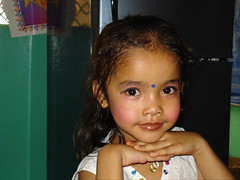
Kiran is a lovely child in more ways than one, and she is an extremely sensitive and humane person. Her favourite place at pwhy is the special section where she often spends time helping the teachers with their work and interacts with each and every child. The picture you see is when she lent her face for a make up class and sat a long time while Neha, Rinky and Shaheeda set to task.
Her family has always wanted the best for her and dreamt of putting her in a nice school. They were willing to pay a reasonable amount and had saved for it. When she was ready for class I they set about finding a school but soon found it was not so simple. Kiran had been to a playschool where she excelled but that was not enough. Tests ensued and the dreaded rejection that this intelligent child could not understand.
Her admission became a topic of daily conversations in her little home till the day one well wisher (or so called) stepped in and said he could get her a seat in a school. Kiran sat for the entrance test and got in. Her fees and other expenses – a whooping 15 K – were paid as everyone scrapped the barrel. Last week in her new uniform little Kiran set off to school. The same afternoon the well wisher – a true Shylock – asked his pound of flesh: 20 K commission!
Kiran’s story is shared here to underline a larger issue. What many do not realise is that this is the trend not the exception. More and more parents from what we like to call the underprivileged class are wanting to send their children to good schools. This is because the government run schools, particularly at the primary level are in an appalling state. Parents who are now second generation migrants to Delhi and respectable citizens with voting rights, are aware of this reality. The private schools or rather teaching shops that proliferate in slum areas have also been exposed as a costly and poor option. Parents want a good +2 school.
We have witnessed in the past years many parents from slums trying to get an admission for their children. This is often the case when one parent is educated. For many the search is futile and the child sent to a private unrecognised school, for others like Kiran things look possible till the hammer falls.
The child is now in school. If the money is not paid there is a likelihood of her being poorly treated or even dismissed. If the racket is exposed then the child will be ill treated for sure and finding another school is almost impossible. Paying the money is not an option as not only does the family not have the resources, but they are reluctant to walk this road.
Kiran’s story is the story of many children in today’s reality. I am a die hard believer in the common school system where children from many walks of life will learn together. But the writing on the wall points in a different direction as one hears more disturbing trends on privatisation of schools. Many do not realise that it will ring the death knell for a large chunk of India’s young population.
by Anuradha Bakshi | Apr 16, 2007 | Uncategorized
Remember Babli? Yes the one whose heart was fixed with success but life was not. The little girl who wanted to be a police? Seems she needs us again as she of all the 12 children who have had heart surgeries is the one who has not grown an inch or put on a pound.
Babli is as neglected as she was before and though she does now go to school, she often misses pwhy on a pretext or another. The spirited little girl of yesterday is slowly turning into a listless child. We have tried for months now to counsel her parents but to no avail. Her father seems too busy playing cards and her mother too busy clocking overtime at the factory she works in.
What cannot forget the bright eyes filled with huge dreams that use to meet ours when she was in hospital, almost as if she knew that the operation was her way to transforming her life. As time passed on and she got better, the dreams seemed to fly away. I wonder if she too slowly realised that she was now confined into the well scripted role of an elder sibling.
It was time to act again. After much deliberation we have decided to convince her parents to send her to karam marg where she can go to school, play in the open with other children and make up for lost time.
We hope that her parents will agree.