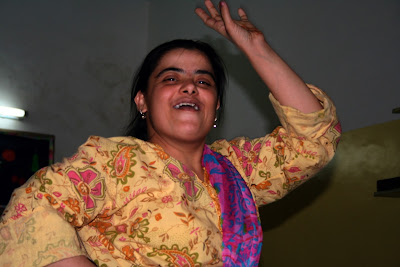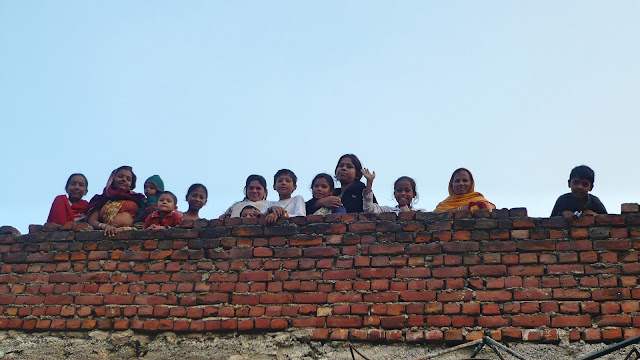
Project Why’s very special class #ThrowbackThursday
This is Project Why’s special class as it is today. And here is how it looked in earlier times.
Did you know that 5,000 children die everyday from water related diseases?
There is an odd phenomenon at Project Why where children, often girls, get up in the middle of a class and leave in a rush. Our teachers finally why and the answer they received was: “it is time for the water to come.” In many slums, water comes in a communal tank for a fixed amount of time so all abled bodied people- children included- are needed to fill as many receptacles a possible.
Different containers for different needs: drinking, cooking, cleaning, washing, etc. In some areas water comes on alternate days and so the need of keeping water clean is imperative. Sadly, the water does not often remain clean and that reason why so many children under the age of 5 die of water related disease.
She lived in the tiny tenements that are tucked away between factories in the industrial area of Okhla. In those areas most parents work long hours and children are left to their own devices, becoming targets for lurking predators who find them easy prey to steal and to push drugs.
Needless to say Project Why was on board! The problem was that in such areas there are no empty spaces to rent or use and it was left to the ladies to find space.
The two ladies were back the next day, huge smiles on their faces and the news that they had found a space and even got permission from the local cops and politician. It was a garbage dump close to the railway line. No problem. We would reclaim it.
Spare Grace, Lemongrace, Red Cabies and Badycon were the words proudly displayed by the local vegetable shop now catering to the growing expat clientele. To the uninitiated this translates as asparagus, lemongrass, red cabbage and baby corn!
India is a land with a multitude of languages but English has become the administrative language and is quickly becoming a vernacular language as well. Today, even the poorest parents understand the necessity of English for their child to succeed, and as a result signs reading “ENGLISH MEDIUM” dot the city.
So do all Indians speak good English then? The answer is no.
English medium schools in poorer areas often do not employ teachers who speak English- at least not a form of English a fluent speaker would recognise.
The job market today requires a working knowledge of English and the students at Project Why rely on our resources for their English education. Project Why relies on the resources of our dedicated volunteers and on workshops.
Recently we bid farewell to Eva who taught the Okhla teachers and children for one year. Her intervention went a long way in building confidence in the teachers. The importance of volunteers able to teach English cannot be stressed enough.
n January 2016, Damyanti held a week-long spoken English workshop under the aegis of the Book Council of Singapore that culminated in a bi-lingual poetry and story reading event. The use of pod casting has helped us continue this venture and we have regular in-house reading events.
Project Why has adopted these measures to help teach our children English. What ideas do YOU have for expanding English literacy?
Do you think English is a skill that spells success?
Do you think children from deprived homes should learn English?
Can YOU come to Project Why to help teach our children?
Sometimes you do not have to look far to find things to celebrate. You simply have to look with your heart. I sometimes kick myself for not taking time to simply stop and savour things around me, more so because I’m blessed to have Project Why which is a constant source of celebration. This week I did just that by slowly browsing the pictures taken in the last seven days.
There was much to celebrate, from the birthday party of a young girl who has chosen to mark her special day year after year by giving a special treat to the students of our special section.
Let us shift gears and peek at the little ones. Silence please, kids at work. Some are creating,
Please join Project Why on its
Child labour is cheap. A child is submissive, and can be made to work under poorly lit and poorly ventilated spaces.
A child can be used for stitching, embroidering, weaving rugs and carpets, making matchsticks and firecrackers, and rolling beedis in backbreaking conditions.
The Child Labour (Prohibition and Regulation) Act, 1986 is being amended and is now in Parliament. According to Nobel Laureate Kailash Satyarthi, two of these amendments may defeat the very purpose of the Act.
The first is the one allows children below 14 to work in family enterprises.
Helping out after school is acceptable when it is truly a family business, but what stops anyone from exploiting this law? Anyone can claim a child as ‘family’ in the Indian poor classes, and even if a child is truly family, it is hard to ensure he or she will be sent to school once this amendment comes into force. Most of the children that land up in big cities are often brought by ‘uncles’ from the village who turn out to be middle men and traffickers. When Project Why opened our Yamuna centre we were faced with parents coming during class and asking for the child as she/he was needed to pluck vegetables. It took us a long time to get make the parents understand.
Another amendment is even more detrimental to child rights. At present, Child Labour law prohibits employment of a child in 18 occupations and 65 processes. The proposed new amendment reduces the prohibited occupations to three: Mines, Inflammable substances and Explosives. So the children under 15 working in ‘family-run’ businesses like domestic work, bead-making, carpet-weaving will be legal.
The question that needs to be asked is whether the child making beedis in his family business will be able to go to school? The only caveat one can think of is to define ‘family’ and limit it to parents and legal guardians, but in India, where the record of implementation is very low, that seems impossible. Children can help their families and even learn their skills but this should not come in the way of their health, education and leisure time. But these options aren’t available to the poorest of the poor.
Sanjay, a Project Why alumni, a gypsy ironsmith’s son, and a Project Why teacher, today walks the ramp in the world’s fashion capital, Paris. That was possible because his family allowed him to study and work in a trade other than theirs. Sanjay made his dream come true.
Project Why is a place where children are given the RIGHT TO DREAM.
Do you think that every child has the right to dream, and dream BIG? In a country like India, should children under 14 be allowed to help in family enterprises? Should any child, under or above 14 be allowed to work in factories making matchsticks or firecrackers or as domestic help?