by Anuradha Bakshi | Jul 30, 2008 | Uncategorized
 On my drive back from the project I was accosted by a beggar woman at a red light. As I travel in a three wheeler, I cannot roll up the window and look away. And anyway I never do, as I cannot forget the words of a beggar woman of yore years that were perhaps one of the greatest lesson of my life.
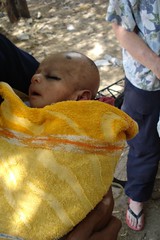
The woman held a small baby girl in her arms and almost thrust it in the vehicle. The child seemed to be asleep but one look at it made you realise that the sleep was induced and the child drugged. His head flopped backwards and is body was flaccid. As I was not carrying any eatable, I gently asked the woman to move on. The light turned green and we went our way.
For the past few weeks I have also been disturbed by a little 2 year old who lives close to our computer centre. She has recently come from the village and is the daughter of a rather elderly man know for his anti social activities in his home state and who often comes to Delhi to escape authorities. His wife is illiterate and live sin constant fear of her husband who is to say the least quite a terror. This little girl is their second child, he first being handicapped and let in the village. We did try to convince them to send the child to the project, but in vain. The little girl spends her days on the street in front of her house or in the homes of neighbours who often shoo her away.
I wonder what the future holds for these two children of India. Actually one need not wonder, one easily guess their future. The beggar child will soon be tugging along her ‘mother of the day‘ (as the woman may have simply hired it), and as soon as she is a little older will be the one knocking at car windows. As she grows older she may be even given a pair of crutches. One day she will be married off and may be the one holding her baby and begging.
The little girl from the slum does not have a brighter future. She will follow the her uncaring parents from village to city to village. She will never attend a school or get an education. She will never have friends, or toys and one day when she is barely pubertal will be married off to some older man just as her mother was and will produce other children who will have the same fate as her.
The tragic part is that there is nothing much one can do as these children belong to strong mafia like social groups that are totally impervious to change. And yet they become a challenge that one needs to address. The question is how!
by Anuradha Bakshi | Jul 30, 2008 | Uncategorized
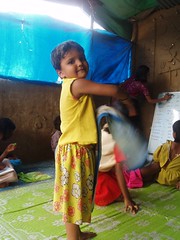
 Yesterday I was interviewed by the Sari Kids. It was for the film they are making on pwhy and that they plan to show to their friends and peers in business school when they got back. The film is replete with images and cameos of their month long stay with us and they of course, wanted me to give a brief account of what one could call the project why story: its inception and genesis, its achievements and failures and above all its dreams for the future.
I must admit I am always uncomfortable in front of cameras as most of the times one is unclear about the real motivation behind the shoot. But this one was different as we sat comfortably talking about pwhy. The camera just sat unobtrusively on a table and was soon forgotten. And what was intended to be a twenty minutes interview turned out to be an hour long chat with friends, notwithstanding the age difference!
It was easy to share the pwhy journey with these wonderful kids and I found myself talking of the very personal journey that was at the origin of pwhy, not needing to circumvent or colour any event for fear of having them misinterpreted or used without he proper context. The story was much the same as the one too oft recounted, but somehow this time it seemed much truer and heartfelt as they words flew uninterrupted. There was no pressure, no time schedule, no pointed questions, no drama. Facts followed each other, interspersed with personal comments and pointers. And for the first time I saw how almost picture perfect the pwhy story was. We had actually and with a reasonable amount of success met every challenge thrown our way and were in more ways than one ready to face the ultimate one: that of making pwhy sustainable.
The lights went out, the camera was switched off and yet for a long time I sat lost in my thoughts trying to make sense of all that had been said. The disturbing question left unformulated still in my mind: had the journey been worthwhile?
The words of Forest Witcraft came to my mind: “A hundred years from now it will not matter what my bank account was, the sort of house I lived in, or the kind of car I drove…but the world may be different because I was important in the life of a child.”
by Anuradha Bakshi | Jul 24, 2008 | Uncategorized
 “The sun illuminates only the eye of the man, but shines into the eye and the heart of the child” wrote Ralph Waldo Emerson. How true he was.
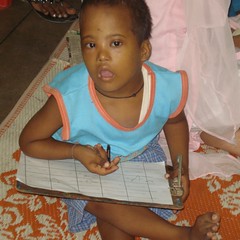
A few days back a little ray of sunshine entered our world. Pooja is 7 year old and has Down syndrome. Since she joined our special section nothing is quite the same. Pooja is an endearing soul and like all kids with trisomy is extremely affectionate and warm. She took no time in making a place for herself in the hearts of each and everyone. She is filled with mischief and a bundle of activity but someone no one seems to mind. Even the most taciturn of the lot cannot help but smile at her antics.
A few days back she commandeered poor Geetu’s lunch box hours before lunch time and decided to eat it. The normally prim and proper Geetu who is a tad possessive about her lunch simply smiled and even fed her. Pooja has still not accepted to follow the time table and the staff too indulges her so she makes her won day and decides who to sit with to what to do. Sometime she is seen practicing writing skills with the more advanced lot, or she decided to butt in puzzle making time of the other group and with a flick of her hand and a mischievous smile destroys the carefully constructed puzzle. What is amazing is that even Anurag who normally would throw a fit, simply smiles at her and sets out to rebuilding his puzzle.
We know that Pooja will soon settle. But what is amazing is the way in which her classmates have accepted her and made her one of them. The motley crew that makes up our special section is normally quite a handful each with their complex behaviour and mood swings. But somehow with this little bundle of joy, they seem to have set all aside. Is it because they intuitively know she needs their support and love. My little special kids never cease to amaze me. Evey day in their own unique way they teach me invaluable lessons to cherish.
by Anuradha Bakshi | Jul 23, 2008 | Uncategorized
 The parliamentary debate on the confidence motion trust was a gloomy moment for all self respecting Indians. I will not delve into the matter as enough has and is being said. I followed bits and pieces of the day long saga with dismay, horror and immense sadness. Less said is better. I simply chose to mention a brave speech, that of Rahul Gandhi and who was heck;ed all the way.
Again I am not one who condones nepotism and dynasties nor am I a sycophant. What got my attention in this speech was the fact that perhaps it was the only one that referred to the other India in a humane and real way. When RG spoke of Kalawati, he gave a voice to the hundred of millions of faceless and voiceless Indians.
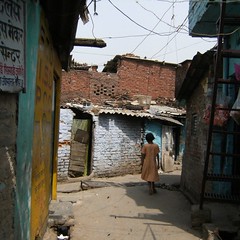
There are Kalawatis everywhere. People who live a hand-to-mouth existence in a land that is becoming more and more indifferent to their needs.They pass by us so quietly that we never see let alone acknowledge them. Yet many are the warp of our very existence. And even if they do not impact us directly they are the lifeline of those who make our lives more comfortable. I am talking about the man who sells hot food to the construction worker, the man who sells handkerchiefs, socks, and cheap ware on road sides, the one who sells plastic toys a father will take back to his child at the end of a long day.
Imagine the plight of such people as they set off every morning, weather notwithstanding, with their bundle, or cart not knowing whether they will be able to bring back sufficient money to feed the family for the next 24 hours. No one buys kerchiefs or head scarves every day! And every day the same amount of rupees buy much less food. Every week we make the appropriate sounds of dismay as we are hear the new inflation figures on our slick TVs in the comfort of our air conditioned room. Yet the size of our weekly basket barely suffers. For the Kalawatis across India the story is different and it is time that we took notice. I guess that is what RG wanted to do. But did we? Or should I say did those that matter notice. We all know the answer. they were too busy playing to the world gallery and bringing shame to each one of us.
I do not know whether the nuclear deal is good or not. I do not know whether RG’s speech was a clever political gimmick or one from the heart. I only know that it brought to the fore the reality of millions of our own country mates. I wonder how many of us can even begin to imagine what such a life means. I must admit that I too was one of those living in absolute denial. Pwhy changed all that.
I see the how inflation and price rise affects the common Indian in the lunch boxes of children everyday. I see it in the eyes of a child burning with fever who was not taken to the doctor for want of money. I see it in the backs that seem more bent and the gaits that have lost their spring. Can you imagine what goes on in the mind of a woman as she waits outside her home late in the evening, her kitchen fire cold, her vessels empty and her children hungry, waiting for her husband to come back with the the handful of rupees that will buy a meal and praying furiously that he does not stop by the watering hole. There are many such women and they live but a few stones throw away from us.
Have we all lost our conscience, or have we simply lost our ability to feel. Are we so lost in hubris that we are unable to see what is happening around us. I do not know. I just feel here is something terribly wrong. In all the hullabaloo of the parliament tamasha I just heard the silent deafeaning voice of Kalawati
by Anuradha Bakshi | Jul 17, 2008 | Uncategorized
 I normally do not watch TV in the early evening. I was busy with the usual evening chores and had to go to my daughter’s room. The TV was on. A local metro channel diffusing its evening news. I was about to mouth the question I had come to ask but was stopped short as I heard the voice of the newscaster recounting an incident where a young girl had been humiliated in a nearby suburban school. All chores forgotten I just watched.
A young girl had been punished by her teacher for not being up to the market in class. The teacher who seemed to belong to some ante deluvial time had chosen to write in black soot across the face of the child the following words: I am not good in my studies, and then paraded the child across the school. The teacher of course had threatened the girl of dire circumstances were she to tell her parents about the incident. The young girl had not murmured a word. However the next day she had refused to go to school. Seeing the angst on her face the parents coaxed the child to reveal what was wrong. She ultimately did.
The parents went to the school authorities and the police playing the scene according to script. The teacher was suspended and further action may follow but will and can it wipe of the hurt the child suffered, the invisible scars seared on the girl’s soul that no one can see let alone heal. No matter what punishment will be meted out to the erring school teacher, no matter the profuse apologies tended, no matter the words proffered to sooth the hurt child, the harm is done. This young girl will bear the hurt of this humiliation for a life time. It may be forgotten in good times, if good times there are but will come back to haunt her each time life poses a problem. Public humiliation is by far one of the worst form of retribution, one that cannot be meted out to a child by anyone, let alone a teacher.
This incident makes one go back to Dickensian days of Dunce tables and Dunce caps. Lot of water has flowed since those days or so we thought. But an occurrence like this one makes us wonder whether times have truly changed.
But if that was not enough another horror that befell a tiny 9 year old came to light. A little class IV girl had been raped in the toilet of her school in broad daylight. As I write these words the follow up drama is in full swing. Enquiries, suspension, political condemnations, financial assistance and the much sought headlines. But my heart goes out to the little girl who has been scarred for life. Such incidents leave deep lifelong invisible scars not only on the body but on the soul of the victim. And if that was not enough, one must not forget that we live in an insensitive and biased society where far too often the victim is made to feel guilty.
I can only once again recount the plight of C, now 17, a past student of ours who was raped at the age of 4 by a neighbour. The rape was so violent that the child had to have a hysterectomy. The rapist did his time in jail. C grew up but . As a teenager she found herself ostracised by her peers and their families and labeled as the girl who had been raped.
Child rape is something abhorrent. I have no words to condemn it as everyone falls terribly short of what I want to express. I cannot begin to understand why an adult feels the need to violate a child. I look helpless at the impotent laws that far from protecting the victim seem to benefit the perpetrators with impunity.
In all the hullabaloo that normally follows incidents like the ones above, two little girls are suffering in silence. And no one seems to be concerned. They belong to homes where child psychology and post trauma stress are unknown. They belong to families who are simply busy surviving. They will have to find their healing alone, if healing there is.
At this times one can but remember the words of Herbert Ward: “Child abuse casts a shadow the length of a lifetime.”
by Anuradha Bakshi | Jul 14, 2008 | Uncategorized
 A room without books is like a body without a soul said Cicero over two thousand years ago. Belonging to a generation where books were possibly our only real entertainment I readily second that. Then over the years, books played second fiddle to the new entertainment star the TV and then slowly third fiddle till they were relegated to the back row of the orchestra as an instrument barely played let alone heard.
I must admit that I never stopped reading though I must also confess that I was not able to instill this passion in others in my family. I lost the battle to the ever growing presence of the idiot box and its various courtesans – namely the remote control, the VCR, VCD and all else. Book reading for many just seemed a chore and a bore.
When project why began and before I was initiated to the reality of the school scenario in India, I had wanted pwhy to be a place where children could come after school and spend quality time. One of the things I wanted in pwhy was a library with an abundance of books so that children could be made aware of the magic of the written words. Like Skinner I too believed that we shouldn’t teach great books; we should teach a love of reading, as therein lay true education. But soon enough the dream of pwhy being a children centre replete with books, toys and games took a back seat as we were faced with alarming drop out rates, failing in school and the uncompromising abhorrence of parents to creative pursuits.
Reality moulded us into a school support centre where creativity had scant place. Books were only those taught in school and the few that found their way sat quietly in some dark corner, too few to make their presence felt. Even when we felt the need to have books – for the smaller kids at least – the cost itself ensured that there was never a book per child. The dream I once had seemed farther then ever.
Then one day a few months back I received an email from Willy of the Omprakash Foundation. It was I must confess mind boggling as it talked of sending tens of thousands of books to several projects in India and sought my help. And though the task was daunting and way off our beat, the fact that it concerned books made me accept readily. I guess that if it had been clothes or something else, I would have beaten a hasty retreat!
What followed was a journey into uncharted territory, one that was sometimes quite harrowing as we battled administrative and other blocks. But one did not give up and last week the consignment reached Delhi. Thanks heaven our friends from Omprakash Foundation were there too and afer some minor and sometimes amusing hurdles we at project why got not one, or ten or even hundred but twenty thousand books!
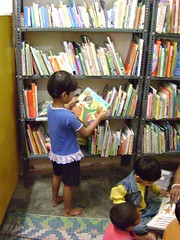
Though many still lie in boxes waiting for space, each of our centres now has books, either on a shelf when space permits or in a trunk and the children are for the first time in their lives discovering the magic of holding a book. It has been pure magic as they dive onto the trunks and retrieve books then go about flipping pages. The excitement is palpable whatever the age as they share what they see or even fight for a particular one. The teachers too are excited and planning new activities around they newly acquired treasure.
I watched all this with a sense of satisfaction and some glee. Somehow a long forgotten and almost lost dream seemed once again possible. The presence of so many books had suddenly made my dream of a children centre possible. It was time to fine tune the idea.
Ther soon will be a weekly library period in the time table. I remembered Willy telling me that in his school there was a moment called DEAR (Drop Everything And Read). Perhaps we too will have that at pwhy some day.
Some time back a friend sent me link about a new library fad whereby you borrowed a person not a book. Somehow it did not seem exciting to me. I also remember how moved I had been by Fahrenheit 451 the brilliant Truffaut film about a world without books. For me books remain a very important part of my life and high up on the list of my favourite things.
I hope that now they can also become part of the lives of the project why children.