by Anuradha Bakshi | Aug 14, 2008 | Uncategorized
 The UNICEF report of the state of Asia Pacific’s children 2008 was published just a few days ago. According to this report 20% children under five who die every year are from India. The figures is staggering: 2 million. the report goes on to state: Unless India achieves major improvements in health, nutrition, water and sanitation, education, gender equality and child protection, global efforts to reach the MDGs will fail…as more services within countries are privatized and the government share of health budgets diminishes, public facilities become more run down and health workers leave for better paid jobs in the private sector or outside the country. The divide between rich and poor is rising at a troubling rate within sub regions of Asia-Pacific, leaving vast numbers of mothers and children at risk of increasing relative poverty and continued exclusion from quality primary health-care services.
It is a sad reflection of a country that celebrates three generations of freedom.
Our real achievement seems to have been a staggering increase of the gap between the rich and the poor. India is far from shining. The children of India are still waiting for an elusive Bill that will give them their constitutional right to Education. And while a city is gearing up to meet world standards to host an international sporting event, children are withering away in dark holes in a city that has forsaken its poor.
Can any society worthy of its name claim to be shining if its most vulnerable group remains neglected? I wonder. Children have no voice, and are not vote banks. Yet they need the maximum care and protection. It is not so in India today. Child labour is rampant, child abuse of all shade and hue unbridled and though politically correct statements are made by one and all, they are rarely translated into action.
Two million children below the age of 5 die quietly every year in India. Is anyone hearing.
by Anuradha Bakshi | Aug 11, 2008 | Uncategorized
 A dear friend commented on my recent post way to go India. He wrote: I read with joy your latest blog post. 2 messages in particular struck a chord: One, how Project Why stood firm against institutional considerations and put the needs of the children as top priority. Having worked in the Education Ministry of Singapore and probably carrying on a career making education policies in future, I realized this is a dilemma most middle-tier leader face. As a young intern and observing how the current leaders go about formulating policies and making decisions, I was convinced the paramount factor is what’s best for the children – and their teachers, without whom education is impossible too, and any other administrative glitches can be ironed out. Two, the motivation and vibrancy of youth. The older I grow, the more I feel I lose this tendency to initiate things, and more importantly sustain them.
I sat a long time mulling these words and their relevance particularly in a week where we celebrate 61 years of Independence and the first individual Olympic gold ever won. And instead of elation and euphoria I am filled with despondency and sadness. Is one medal in a land of a billion and counting, reason to celebrate. I cannot tell. What stares at me are the eyes of millions of potential medal winners who will never be able to do so because we have collectively failed them in every which way possible.
A tiny and unobtrusive news item must passed unnoticed by many. The Right to Education Bill was not taken up by Parliament but sent to another committee for review as vote bank politics is far more important than sending 200 million children to school. It is in 2002 that the children of India got the fundamental Right to Education. A bill was drafted in 2005 and still waits to be passed or killed! A sad state of affairs when Bills on salary raises for members of parliament are passed in a jiffy. The writing is on the wall. No one is truly concerned about the plight of the children of India and with every delay a large number of children miss their chance to be educated. It is true that the Bill threatens many bastions and social divides as one of its clause is reservation of 25% of seats in the best schools for kids from across the street and hence everyone is up in arms: how can the drivers or washer man’s kid study with mine! In all this the children are forgotten and cast aside.
The lofty idea that education would promote equality and social integration across class, caste and gender is not something we are comfortable with. True it makes great conversations pieces as well as excellent copy for campaigns and ads but when it comes too close it is simply rejected. It was way back in 1966 that the Kothari Commission had mooted the idea of a common school and though many feel that this would be an answer to education for all, it has remain a dead letter for almost half a century. The CSS (common school system) is not something we truly want.
Generations of children have been sacrificed to the alters of greed, vote bank policies, dubious lobbies are more of the same and in those lost years the divide between the rich and the poor has grown unabashedly in all walks of life, even schools who now look more like spas than places of learning. No one is truly concerned about what is best for children or should I say best for all children. The reason being that children do not have a voice and are not a vote bank! Debates will continue, it is politically correct to do so. What makes me seethe with anger is that political parties are not able to bury their differences and come together to pass such a Bill, and unless they do so no Bill that aims at inclusiveness can ever see the light of day.
In this 61st year of Independence and in the euphoria of a gold medal can one hope that things will change. I doubt it unless each one of us, particularly those who were lucky to be born on the right side of the fence, come out of our torpor and do something before we lose our ability and motivation to do so.
Will be able to do so? Only time will tell.
by Anuradha Bakshi | Aug 10, 2008 | Uncategorized
 If change is to truly come about, it has to be routed through women. This is something I have firmly believed and yet something that has remained elusive. When project why began almost a decade ago, one of the first things we tried to set up was a self help group for women only. The idea was to get women together around an economic activity and then try and raise awareness about burning social issues in the hope of making the group an agent of change.
My mother who was in many ways an avant-garde feminist of sorts had always held women responsible for their own plight. She reveled in pointing out that most of the crime against women was perpetrated by women themselves. The most glaring example being that of the mother-in-law daughter-in-law relationship. And she went to add that it was women alone that could free themselves and bring about change.
A two day old bay girl was found in a plastic bag near a garbage dump in Delhi last week. We seem to be the capital of abandoned baby girls. Needless to say that it is far to often women who commit this abomination: a desperate girl not wanting to hear any more taunting, or one wanting to spare another a life of ignominy or perhaps a kind soul hoping the child would find a better life. What is shocking is that this is happening in India’s capital city! The reality is indubitable: little girls are not welcome. And it is also true that women alone can make them feel wanted.
Our erstwhile women’s group failed to bring about the results we wanted. Our efforts to get women to start a small unit making healthy snacks for school children – in lieu of the few rupees given to children to buy dubious eatables – failed miserably. In hindsight there were many reasons for the failure. Women were not willing to go out and market their ware. They wanted to make the snacks for a salary. This was probably due to the fact that their husbands prompted them to do so as everyone felt that NGOs have loads of money to spare. Or maybe it was because everyone who comes to the city feels he or she has a right to a job. Hard work is a prerogative of the village. Or perhaps it was due to our lack of experience in the field. Whatever the cause the attempt failed miserably and the idea was shelved.
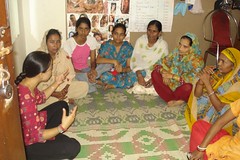
When we seeded our women centre it was primarily to give refuge to women shunned by society and help them rebuild their lives. But right from the very first day we felt the need to reach out to local women in the hope that some day we would be able to revive old dreams and get our women’s group going. The challenge was to be able to have them review their lives and make appropriate changes. The ploy was to first gather home around an innocuous activity like stitching. Then as time went by and bonds were created we moved on to weekly meetings around a variety of subjects and cups of hot tea! Then a series of unforeseen circumstances slowed down the momentum but some time back Rani and Shamika took on the challenge and revived the process.
Now every Thursday over a dozen women come to discuss and debate several issues and share their views and dreams. And perhaps in days to come we will be able to revive our women’s group around a new activity that all would have decided upon. It is a first step in the right direction. I hope it does live up to our expectations: that of helping women set themselves free!
by Anuradha Bakshi | Aug 8, 2008 | Uncategorized
 The teach India campaign is in full swing, or so we would all like to believe. Our tryst with them was short lived: we did not fit the model they proposed as we could not take in the minimum of 100 volunteers that they offered – we had asked for six. The organisers could not understand why in spite of our 9 centres we were unable to accept the 100 volunteers offered. To them the maths was simple: 9 centres into 2 shifts into 6 days = 108!
We tried to explain to them that it would be terribly unfair and even disruptive to the children and their teachers to have a new volunteer each day of the week. And though they did try to pressurise us, we stood firm: the children and their well being was far more important to us than being associated with any campaign no mater how glitzy or big.
I decided to spend some time on the website of the teach India campaign and landed on their message board. I was saddened to see that there were many young volunteers waiting for a phone call that would tell them they had been selected and would assign them a teaching opportunity. The message board was replete with words like: not received a call, no reply, no call, I am disappointed, how long?????
My heart went out to these young Indians who had taken a first step towards making a difference and were waiting for the call that would allow them to do so. Some even said they had registered 2 months ago and the campaign being for 3 months I wonder if their phone will ring. There were a few lucky ones and they shared their experiences which were heartwarming. The idea is a winner and it would be a tragedy if it failed.
In the midst of all the message threads was one that brought whoops of joy: tt simply said: Can we Form a Group if teach India doesn’t call us and go ahead. For me those simple words showed that no matter how the blitz ended it had succeeded as it had ignited a sparkle in young India. Here was a group of youngsters who were not waiting for calls but simply going ahead. They had understood the real message, the one that would save and change India. One did not wait for someone else but took on the challenge and make it happen.
I sincerely hope that the thousands of would be volunteers who may not get a call will not give up but will find it in themselves to carry the torch and teach India
by Anuradha Bakshi | Aug 7, 2008 | Uncategorized
 When little Prakash was born we were delighted as he was a bonny baby. His mom was part of our programme for pregnant and lactating women and all seemed to pint to the fact that our three month intervention programme worked. But we were in for a rude shock.
Months went by and instead of thriving, Prakash began to wither. His head was the only part of him that seemed to grow, the rest his body could not keep up. His milestones were delayed and it was as if the child was vanishing. He sat in a corer of the creche, his legs folded not able to stand in spite of being 14 months old. Hi social skills remained poor and all you got from his after a lot of prompting was a toothless smile. Local doctors felt he had hydrocephalus. A series of tests were done but with no clear results. His pitiable state was heart wrenching. Not able to stand helpless we sent him to the paediatric ward of leading hospital and we has diagnosed with rickets! We were aghast as rickets is a form of severe malnutrition.
I began reading about rickets and discovered that one of its main causes is vitamin D deficiency or in other words lack of sunshine. The penny dropped. In a city where housing is a huge problem, greedy landlords have brought down their old structures, one with courtyards and sunshine, and built airless and windowless rooms where night reigns all day. When we were looking for a room for 7 month pregnant Madhu, Prakash’s mom, we found one across the street. It was dark and that is where the mother spent her last months of pregnancy and delivered Prakash. It was also there that he spent the first few months of his young life. NO matter how well we tried to feed the mother and then the child, we were unable to make up for the sun rays.
Many children are born and live in dark holes where the sun never shines. This is the price to pay for urban dreams a far cry from village life where the sun is abundant and where children spend time in the open, even as babies who are oiled and massaged and left out in the courtyard under the watchful eyes of the clan. I remember being shocked when many years back our cook brought his mother to the city for a medical check up. The woman looked very old, as all village women do, and was thin as a reed. But when her blood tests were done her haemoglobin was over 13, something rare in India. I knew the family was poor and wondered how that could be possible. he answer was simple: the family ate black millet instead of wheat flour, as the millet was what they grew in their fields, and black millet is know to be rich in iron. The family also ate lots of seasonal vegetables that grew in their yard something impossible in a city.
We will tend to little Prakash and hope he improves and makes up for lost sun. But I wonder how many little Prakashs live undiagnosed in the city.
by Anuradha Bakshi | Aug 6, 2008 | Uncategorized
 To abort or not to abort that is the question? The last week has been replete with debates and discussions on the issue. The fate of a little unborn child lay in the hands of an archaic legal system and complex medical opinions. Two days back the courts decreed that the child was to live. This is not the latest plot of some avant garde movie but a real story.
An unborn foetus was diagnosed with a congenital heart problem. The parents sought legal sanction to abort the baby though the foetus was 26 weeks old on the grounds that they would not be able to bring it up. The hospital gave vague and contradictory opinions and to crown it all there was also a typographical error that sealed the fate of this unwanted child. The case has led to an onslaught of divergent opinions and debates- a mother’s right, the right to life, the plight of disabled children in India, the lack of support systems – and the battle is still on. Help has also be forthcoming for this baby: offers of adoption and free medical care. The one question that has not been raised is why this family went public with this issue in a land where clandestine abortions are an easy option? And one also wonders whether the parents now in the media and public glare will come to terms with the situation and give this child all the love and care it needs. Only time will tell.
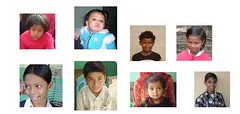
All the children in the picture above have congenital heart conditions and thank heavens their parents did not think of aborting them. They belong to very poor families who and yet each one of them did everything they could to ensure their kids would live. Was it their prayers or the hidden hand of the God of lesser souls, but they all found their way to our heartfix hotel where broken hearts get repaired. Today they are all living healthy lives like any other kid and though there may be problems in the future I know they will all be overcome.
In another city lies a little 9 day old. Born to a surrogate mother to a Japanese family this child is also unwanted. Her surrogate parents separated while she was still in the womb of another woman and both women do not want her. The laws do not allow a single parent to adopt so she today is nobody’s child. One just hopes that the laws will bend a little to allow this child to have a real morrow.