by Anuradha Bakshi | Oct 10, 2008 | Uncategorized
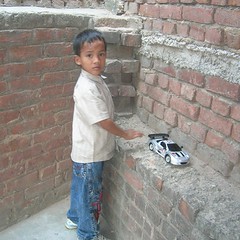
 Utpal was home for his Dusserah break. Home to Utpal is the women centre. Normally his mom is there for him but this time she was not. She has again been admitted to a rehab centre and will be there for a few months. Utpal came home to his favourite TV programmes, his toys , his old battered scooter and his favourite goodies that one had filled the fridge with.
Utpal came home to his extended family: the staff of the women centre who were all them for him and tried to make up for the missing mom. Though nothing was unsaid and everyone played the game to perfection – Utpal regaling one and all with his new antics and the staff walking the extra needed mile – one could feel that somehow something was amiss. Mom was not there. Many would wonder how a barely present mom, one lost in the hubris of her bipolar disorder, one that often shouts and sometimes hit could be so dearly missed, particularly when one had tried to ensure that all cracks and holes possible but then a mother is a mother.
Utpal, the true survivor did put up a brave front and did not let anyone feel that there was something missing. The only one who knew was me. He did not say anything, but during the time we were together he let his guard down. The big boy that he now wants to be perceived as became a small child veering between moments of extreme affection and tantrums. He snuggled against me and hugged me tight and then insisted I take him out ad spoil him silly. It was not toys or cakes he sought, but some way to fill the huge void left by a missing mom.
by Anuradha Bakshi | Oct 8, 2008 | Uncategorized
I got a mail this morning from Gooj, an organisation I have a lot of respect for and who are doing an incredible work for flood victims in Bihar. The mail was meant to update everyone on their activities on the field and remind one of the horror of the situation. They are doing remarkable work and need to be lauded and supported.
But this is not why I write this blog. Actually a para at end of the long mail caught my eye and made me shudder in disgust: But I would certainly like to send out a word to a few CSR people who call up our office and ask questions like- “how far is Kosi river from Saharsa” and if they don’t get the exact no of kilometers they threaten to report my colleagues to me. Or the wife of a CMD of a public sector company who gave us some ration and clothes at a function with a lot of fanfare; three cameras, a speech delivered thrice to get the right flavor; resulting in wastage of precious time of a GOONJ team member. Or arguments on why a truck can’t be unloaded at 2.00 am in the night? Please do understand that our team is working round the clock under tremendous pressure and with very limited resources. They are also human beings and without any logical reasoning it’s not right to make uncalled demands on them. (The truckwould anyway be allowed to move out in the morning only). A person from a reputed organization told us that they would give us their contribution at a special function organized for the purpose, for which someone from GOONJ would need to be present. When we said that we didn’t have an office in that city the person wanted someone to travel out or else threatened to give the money to some other NGO. My humble submission to such demands; kindly go ahead and my humble appeal is not to use this as the only opportunity to show how concerned we are. Good work always shows and one doesn’t need banners all around for that. The need of the hour is to spend our time and resources in the most effective manner.”
Phew. I can understand how hurt and angry Anshu, the spirit and heart behind Goonj, must have felt when he finally decided to write those words. I also understand how he felt as it is a feeling I share having also been at the receiving end many times. How can I forget the lady from a prestigious club who brought a few sweaters on a hot September morning and her personal photographer in tow. She insisted that the special kids wear the sweaters in spite of the sweltering heat, so that she could have a photograph for the newsletter of her club! Or can I forget the man who in response to our appeal for help for Raju’s open heart surgery wanted to know why we were spending so much money for just a poor child. Can I ever forget the big star who wanted Arun another open heart surgery candidate to be carted to a web world center to be part of a media blitz. Charity has lost its meaning and become a bizMess. What was meant to be a subliminal act has lost its spirit and makes a little girl to simply ask a heart wrenching question: is it wrong to help those in need?
The list is endless and points to one simple fact: people have forgotten the art of giving. What transpires from the few examples listed above is that it no more the recipient who matters, the star of the show has to be the donor. What do I get if I give? And if you do not give me what I want I will go elsewhere. I wish we could all say please do so. Sadly we are a still dependent on the few coins cast our way as the price to pay is too big. Too many voiceless and helpless souls depend on our ability keep our faces straight and even mouth the needed words of gratitude.
Today when the world is falling like Humpty Dumpty from his wall, no kingsmen will be able to put him back unless there is a change of perception and attitude. One needs to give up arrogance and embrace compassion and learn to share even the little one still has. Hubris has always been self destructive. I am an absolute dodo in such matters but my instinct tells me that the patch up solutions that seem to be the order of the moment are simply delaying the inevitable as they aim at protecting and salvaging a system gone awry.
by Anuradha Bakshi | Oct 5, 2008 | Uncategorized
 The time has come wrote my dear friend A in reply to one of my sombre mails; if ever, this is not the time to despair he added. Strange words at a time when the world economy is collapsing. But A goes on undaunted:We have reached the end of An Age. The next one is here. The world is about to move into a system where Human value will be he currency. What if you could buy education for compassion or two meals a day for making someone happy! Have fun this festival – the world has woken up after a slumber of 40 odd years – light up the world with your Unique Value – and Welcome to The Age of Imagination.
Don’t smile or smirk. These words are imbued with meaning and wisdom. They are almost prophetic. It is time we saw the reality of things instead of beating a dead horse and finding solace in ways that have proved time and again to be worthless. Human values have been too long sacrificed at the alter of material ones fuelled by greed, want and cupidity. Our world is not a pretty one even though we would want to believe otherwise. It may be big and fat but it is not beautiful. I do not know if one can truly at this moment begin to imagine a world where values would be extolled above all else; our age has simply done away with them.
As I wrote earlier perhaps it is not the right time to write about compassion and other lofty ideals as we sit perusing the stock market and counting our losses. Or perhaps it is. What betteer time than this to garner the courage to look deeper within ourselves in order to find solace and strength. The tiny seeds of compassion and forgiveness and love lie patiently waiting to be watered. Maybe it is time to practice mindfulness as taught by Thich Nhat Hanh and learn to live in the present and be grateful for all that we have. It is also time to seek values that would hold true and be lasting and learn to draw solace and joy from he simple things we have forgotten.
Two meals a day for making someone happy is not as Utopian as it may seem. How long as it been since you have truly made someone happy, and by someone I do not mean a near and dear one but an outsider, one you did not know, one you did not expect anything from. How long has it bee since you have stopped and looked around you, listened to the sound of birds chirping or felt the caress of the passing wind. How long has it been since you have held the hand of a unknown child and walked a few steps with him. How long as it been since you have felt compassion for others and also for your self. There was a time not so long ago where I too felt the need to run helter skelter after material things that I felt I needed. But strangely one I had them I felt the aching need to look for newer ones till the fateful day I met Manu and my life changed.
Today no matter how grim the newspapers headlines are or how hard things I set out to work with a spring in my walk. I do not know what awaits me but I know that there always be something that will bring a smile to my face and warm the cockles of my heart. Oh they are intangible things, the kind you normally pass by. It can simply that the newcomer in the creche who had been wailing every single day has finally stopped crying, or simply a sound made by one that had till then never spoke. It could be a messy and even ugly painting made by one that could barely hold a brush or a bright pink report card accompanied by a grubby sweat that a young one insists on stuffing into your mouth. These are not things money can buy; these have been achieved by slow and patient work and unwavering belief!
And these are things within the reach of all of us if we take time to stop and look with our hearts.
by Anuradha Bakshi | Oct 5, 2008 | Uncategorized
One of the tools used during the recent HDCA workshop was photo mapping. A cross section of pwhy children were given cameras and asked to take pictures of what they liked the most and what they disliked the most. The result was stunning and something I want to share with one and all.
The pictures below do not meet any canon of perfection. They are hazy, over or under exposed, badly centered and sometimes even out of focus but I urge you to look at them with the your heart. If you do you will be privy to the lives of children we normally never see or at best pass by: the ones that don government school uniforms and live in part of the city we never roam, children whose family left their homeland on hope of building a better future for their children, children who also have dreams and aspirations, many of which are akin to our own.
As I gleaned through them I must admit that my eyes welled many times. If you look for a common thread almost all the children took pictures of the God and Goddesses in their homes, pictures of their moms sometimes doing housework in appalling conditions, pictures of their family and siblings. Many photographed greenery, trees, plants and gardens and most took pictures of garbage and filth. There were some animals and even a banner seeking help for flood victims. A nice house, motorbikes and even a car led us towards the world of their dreams. Men at work on a road construction site or vegetable vendors were a subtle reminder they wanted to free themselves off and yet one that was their reality. nd pictures of school and library proved that they knew what education meant.
Each picture told a story, one that these children wanted us to know but did not have the words to express. I hope we have the heart to listen, see and understand.
by Anuradha Bakshi | Oct 4, 2008 | Uncategorized
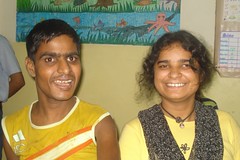
 Manu and Champa have now been flat mates for over six months. They share the flat with four other little residents and are all part of what we call fondly our foster care programme for want of a better name. In a few months if all goes well the four little ones will leave for boarding school. Whether others will replace them is a million dollar question and will depend on the dirty but life giving word: funds!
But that day is yet to dawn and for the moment life is bindass in our little flat. What is amazing is that our attempt at inclusive living is a success. Not because of well defined rules or training but simply because every one in the flat follows his or her heart. It does not matter if Manu is in his thirties and Champa in her twenties, for little Aditya and his pals they need to be helped and looked after.
I remember the days when the issue of Manu’s daily bath was a huge issue. The simple act of helping a mentally and physically impaired soul have his bath brought out the ugliest side of our land: caste, gender and more of the same. Compassion, humaneness and such values were all forgotten. Yet Manu’s bath at the foster care is no big deal. If Praveen the housemaster is busy little Vicky and Nikhil set out to task and help Manu with his bath. One pours the water the other applies the soap and in a jiffy Many is squeaky clean. Then little Aditya climbs on a stool and sloshes Manu’s hair with oil and voila Manu is ready for the day. If Champa needs help with her mane of hair and Aunty the housemother is not at hand, bossy Babli sets to comb the unruly tresses. For these little kids caste, gender, age, social origin, disability or all of the these are not an issue. Manu and Champa are their flat mates and if the need help our little brigade is ever ready!
When the idea of setting up this programme was first mooted I smiled with glee. here was my chance to show to all that children were the ones capable of ironing all issues, bridging all gaps and fostering humane values if given a chance. And this is what I see each and every day as this motley crew learns to live, laugh, play and learn together. Inclusion is not something that needs to be taught, you simply follow your heart.
by Anuradha Bakshi | Sep 30, 2008 | Uncategorized
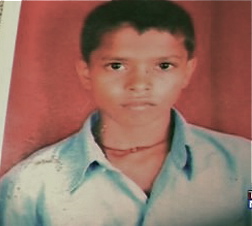
 The festival season has begun. In the next few weeks festivals of all faith will dot the calendar reminding us of the indubitable reality that we are one though some would want us to believe otherwise. Complex rituals, feasting and fasting, revelry and merriment are normally the order of the day. But as I woke up this morning I felt none of the habitual joy and excitement. What kept haunting me was the face of a little boy who lost his life in last week’s bomb blast.
Little Santosh was barely 10. After school like many other little boys in Delhi innumerable slums, he helped his family who ran an egg and tea stall to eek out a living. Santosh has been sent to get some more eggs as being Saturday and festival time business had been good. Like all little boys Santosh liked being sent off on errands as it allowed him to walk through the crowded markets. On that fateful day the observant lad did not miss the dropped packet and being an honest child he picked it up and tried to return it to its rightful owner. His last words were cut short by a loud bang that blew the little boy and ended his young life. A deafening why rents the air: why did this have to happen?
Another set of disturbing faces have been haunting me of late: that of young educated boys who seem to be perpetrators of the terrible acts that take innocent lives: those who drop bombs or drive away after running over another, those who whip a gun out if slightly riled, those who commit senseless acts that leave one flummoxed. . A muted and perturbing why also begs to be answered: why do young souls turn to such dastardly ways?
And above all the most disquieting why that begs us to ask who is responsible for all this and what part accrues to each one of us.
We were debating this issue yesterday with a dear friend and somehow what the powers that be, the vested interests, the seekers of answers want us to believe does not quite ring true. At best it is nothing but a half baked view of things. If there is divide in society that leads to all this carnage it is not one of faith or creed or social appurtenance. It is far more insidious and surreptitious as it is one we do not want to see and yet it is time we did have the courage to do it. The divide I refer to is the one between the have and have nots to use a jaded term, one that is growing at a vertiginous speed; one whose consequences we cannot even begin to fathom. As the rich grow richer they also seem to become more remote. Is compassion the goat to be sacrificed at the altar of what is know today as success? And as the poor grow poorer they do so while their dream and aspirations grow in quantum leaps.
The fragile and yet all important egos of the young craves for recognition. Everyone wants to be valorised, remembered, recognised, in a word to be someone. No one wants to become a faceless and nameless soul that runs the risk of sinking into oblivion. Each one wants to have an identity and sadly as things are today, no one is willing to give them one. The education doled out to them is faulty and even their most valiant efforts at studies never enables them to reach the ranks of their rich peers; success in their world is limited to a few add ons that no one sees. They may be able to achieve a little more than their parents but a heavy lead ceiling hangs over their lives and can never be broken. In other lands education enables one to rise to unknown heights and break the glass ceiling but in ours even education has bowed to the unwritten rule that governs society: schools for the rich and those for the poor. The divide becomes even more glaring as to counter the slums of the poor we have gated communities for the rich, society is getting ghettoised.
The majority bows quietly and accepts to play the game. A few do not and desperately seek that elusive recognition, that misplaced moment of so called glory. Some even go a step further and fall into the trap of lurking predators looking for the fall guy, the one who will translate their vile schemes into reality. The game is on…
Is there are a way out? One wonders. Perhaps there is but it requires moral courage and commitment. It requires many of us to give up some of the what has been acquired and perfected over the years, it requires to look deep into ourselves and not look away. The main issue is to find ways of bridging the gap that exists between rich and poor and not by handing a few hand outs that we would not miss. Real and solid bridges have to be carefully built, ones that will ensure that everyone is looked at in the same way. I am no social reformer or political activist and what I say is simply based on what I have seen and experienced over the last 10 years. The simple solution that I propose is one that I have always heralded: that of the common neighbourhood school, one that is a centre of excellence and a level playing field for every child born in this land. Education has to be given its place at the helm. One could even have and Indian Education Service like the IAS to attract the best in the land. But to succeed the common school has to be made mandatory and therein lies the problem. Will we have the courage to accept this. And yet it is only then that the lead ceiling can turn to glass.
But even education is not enough without compassion as in the words of Thich Nhat Hanh compassion is the only energy that can help us relate to the world outside. Sadly compassion has long been sacrificed to many altars and is almost an alien notion. When I launched my one rupee a day programme it was also to try and rekindle compassion in a large section of society, to try and reach out to those one usually does not think of as donors and draw them into the world of giving. It still feels intuitively right.
Little Santosh did not have to die and yet he did. He is one of many innocent lives who die because we do not have the courage to face realities, because we look at the effect and forget the cause, because we have simply forgotten to look and see with our hearts. There should not be any feasting or revelry this festive season. Maybe it is time to ponder on the true meaning of the day when good conquers evil and start asking ourselves where evil truly lies in our own reality.