by Anuradha Bakshi | Dec 30, 2008 | Uncategorized
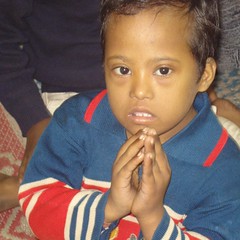
When I was back there in seminary schoolThere was a person thereWho put forth the proposition
That you can petition the Lord with prayer
sang the Doors many years ago. The passionate lyrics of this song came back to me this morning as I sat composing what was to be my new year appeal.
In a few hours 2009 will dawn. New year greetings are flying across the world wide web, choking inboxes and saturating mobile phone lines. Each message bravely carries a missive for peace, understanding, and hope. Needless to say that the past few months have been notorious by the absence of peace, understanding and hope. Senseless terror and unfathomable economic vagaries have shaken every one’s beliefs.
Pwhy has not also taken its share of beating. It is sad but true that when things take a downside, people find it easy to downsize or even stop their commitments to causes leaving the like of us in dire straits. One would have hoped that the tumble everyone has taken would have redefined priorities and reinstated values like compassion and empathy. But alas, that is not the case.
It is time to petition the Lord with Prayer.
Had pwhy been a business house, it would have been easy to shut the door, put the key under the mat and sit down in some dark corner to lick one’s wounds and wait for things to pass. But when you hold over seven hundred smiles in custody you do not have that luxury. When you have umpteen doors each one concealing its set of dreams you cannot even start deciding which one do you shut first: the one that costs the most but is not also the one that shelters the most desperate souls, the newest one you put up but is not the one that is the most vibrant?
No, Sir, you just cannot shut any of them. You need to find new ways to survive and thus reinvent yourself and petition the Lord with Prayer.
Today more than ever, I wish my one rupee a day programme had taken off. I wish I had given it a better chance and withstood all the false starts. I wished I had pushed it with more passion and not allowed myself to be skunked. I know that too many the one rupee programme seemed puerile and even silly but the essence of the programme was to ask so little from each one that it would not be missed and hence no matter what happened, the tiny amount would still find its way to us and keep us going. In hindsight perhaps I was not able to make my case heard convincingly enough. So here I am again with the same entreaty in a new packaging. I am asking everyone who believed in what we do to commit a fix amount, no matter how small, for us every month so that no door needs to be closed, no smile needs to be lost and no child risks to drop out of school and lose his morrows. Is it asking too much.
Today I petition the Lord that I may be heard.
by Anuradha Bakshi | Dec 29, 2008 | Uncategorized
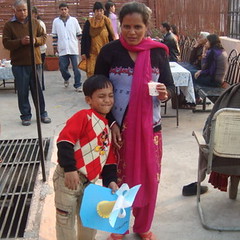
 Yesterday was a special day. After almost six months little Utpal was to see his mom again. The day before I had asked Utpal whether he wanted to see his mom dance and act as the inmates of thecentre were putting up a new year show. Utpal’s eyes light up with joy and I was treated to his mischievious lopsided smile I so love. Mom dancing that was something he could not miss.
I felt a lump in my throat as I remembered all the false start mother and child reunions Utpal had gone through. Would this finally be the right one? Would Utpal’s mom come back to us healed and ready to face life? Easier said than done as she is deeply disturbed and needs a lot of healing and care. Would I ever be able to fulfill the promise I made to little Utpal: that of giving him back a mom!
The battle we have waged for many years has been quite uneven. Little Utpal has played by the rule and never made a false move. He settled in his boarding school without batting an eyelid. made friends, brought report cards filled withs stars, performed on stage, learnt to skate, and even began to play the piano. And each holiday he settled with ease in whatever place we sent him to be it a rehab centre or our women centre, with or without mom. As I have always said, he was is a true survivor.
So it is with a spring in his walk that he took off yesterday to see mom dance. He came back happy and full of stories: mom danced well said he as he proudly showed me the little clip on the camera, and then went on to show me the little paper windmill that his mom had made in her craft class adding with pride: you keep it, it is for you. Needless to say it now sits on my work desk next to his Xmas card and little cars.
Soon it will be time for mom to come home. I do not know what will happen but I do beseech the God of Lesser Souls to make this the final home coming. A little boy with huge eyes and an unwavering spirit deserves to have his mom back.
by Anuradha Bakshi | Dec 26, 2008 | Uncategorized
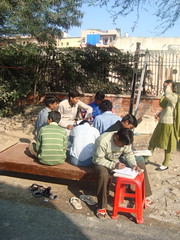
 This picture was taken yesterday. Our class X boys busy studying on the roadside in the morning sun. They often do that as their classroom, or what goes by that name, is very cold. But somehow the picture took me back to the day it had all begun. I still remember the way a vile school principal contemptuously told me that the likes of our students were simply gutter snipe and could never clear their Boards. The challenge was taken and for want of a classroom, classes began in the road side just a few meters away from where this picture was taken. In those days we did not have chairs or stools, a simple mat sufficed and cups of tea kept the chill away.
What we lacked resources was amply made up by the passion, commitment and zeal we all displayed. I remember coming almost every morning and sitting close to the boys, hoping against hope that that my presence would make up for all that was missing. Time was short as we had just under two months to achieve was seemed impossible: ensure that all our 10 boys cleared their Xth Boards. And they did!
Since that day every year a new batch of students has repeated the feat and I must confess a little sheepishly though, that now one has almost taken this for granted. As time passed and the project grew one had to take on new responsibilities and meet new challenges and many small miracles just went passed unnoticed.
Another picture did take me recently on a journey down memory lane, but this own was different. It brought back the almost palpable energy, vitality and spirit of what pwhy truly was: the passion to take on any challenge that comes our way, even it seems impossible and even if all screams to the contrary. I guess that is what we are all about and will strive to always be.
by Anuradha Bakshi | Dec 25, 2008 | Uncategorized
 When the terrible attacks on Mumbai occurred almost exactly a month ago, we like many the world over, watched in helpless horror. We mourned the senseless deaths of innocent people. We searched for elusive answers to the disturbing whys. And as is always the case in life we settled back in our ways and life took its momentarily suspended course. Mumbai somehow seemed very remote and we felt too small to have any role to play. But that was not to be. A wondrous moment was in the making.
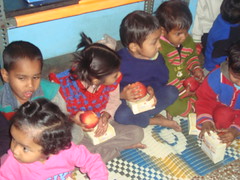
A few days back a mail dropped in my inbox. A friend of a person whose life had tragically ended on that terrible Wednesday wanted to provide a small meal to pwhy kids in memory of her departed friend. So on Xmas eve, she along with her friend’s family, came to pwhy laden with boxes of yummy snacks and a bag of shining apples. I am convinced that the kids knew that the moment was almost hallowed. Their beautiful smiles and endearing eyes managed to convey what they could not word. And for those few magical instants time stood still and all that is ugly and sad was forgotten as one watched these little souls open their boxes or bite into their apples.
It was a blessed moment. One of hope and healing. One that urged us to look beyond the obvious and seek real solutions, one that compelled us to see that there were millions of little souls who still believed that a better tomorrow was possible even if the only evidence they had was the sweetness of their first whole apple.
It was a touching moment as I watched the brave little family who in spite of the terrible loss they were still coming to terms with, found it in their heart to come and bring a smile on faces who were still learning to smile.
It was a beautiful moment that proved that no matter how small or inconsequential one may feel, each one of us had the ability to reach out to another and craft something special.
I felt simply blessed.
by Anuradha Bakshi | Dec 24, 2008 | Uncategorized
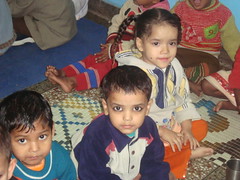
 I am going to be outrageous today as I dare to hope that the proposed school fee hike in public schools may just be a tiny first step to the cherished dream of a common neighborhood school. Let me try and explain what I mean.
That education has become a commercial venture is sad but true. And this is across India as I learnt first hand just a few days ago. Gita who works is our home has a young daughter who lives in Calcutta with her mother. Gita nad her husband who works in the Gulf have just one dream: to give the best education possible t their only child. The child is not ready for school and for the past weeks the family has been filling forms and going through the tedious and onerous admission procedures. They have dutifully bought forms at 500 rs a piece ans completed them. They were shocked when a school told them that they had to produce the mother as she needed to be interviewed. They tried in vain to explain the situation. The nightmare is far from over and I just hope the little girl will get into a good school.
It is the word good that gets my goat!
Over the years certain schools have acquired the label good! Slowly and surreptitiously an insidious caste system evolved in what was meant to be an even playing ground, and slowly and surreptitiously the hallmark of good schools became the size of their fees, and not the quality of teachers or other such parameters. For a good school in Delhi you have to pay in thousands and more. And now with the dreaded rise the costs will become simply mind boggling. And as a parent said : we might have to pull out our children from expensive school to a cheaper one.
During the recent election campaign a politician aptly commented: Having a house in the city is beyond the reach of the middle class. If the fees of children are increased, then schools will go out of the reach of the middle class and only the children of the rich people will get education. Education is the fundamental right of children. This of course was uttered to gain political mileage but it seems to be the way things are going. Schools will soon become out of reach of the middle class and the likes of Gita and her husband who toil day and night to try and ensure their child gets the best.
Rather than the cheaper school can we not start talking of the common neighborhood school run by the state. Or is it is too infradig to think of sending your middle class child to such schools? How long will it take to some to terms with a reality that is staring us in the face. Is it not time to demand that state run schools be made into good schools, and redefine the word good once in for all!
As long as good is defined in germs of the size of fee paid, there is scant hope. Education is not better if imparted in fancy buildings. The best lessons can be learnt under a tree! By making education a commercial activity one is hijacking one’s own future. If good education is allowed to percolate to the lowest level, it will usher a better society for all. This is something we seem to have forgotten.
by Anuradha Bakshi | Dec 23, 2008 | Uncategorized
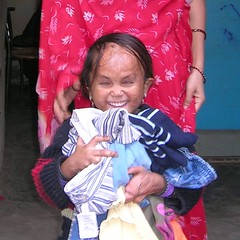
 Meher
Meher came into our lives just a few months ago. Her story is nothing short of tragic and yet her
joie de vivre is infectious. From the time she walked into the women centre she adopted us all.
Though officially enrolled in the creche, Meher has become part and parcel of the centre where she practically lives. Her booming voice, her incredible self confidence, her larger than life smile and endearing ways make you forget the scars on her face or her maimed hands.
True that some may find her a tad spoilt, but what the heck, she deserves every bit of pampering and overindulging to make up for all that was taken away from her on the fateful night when a cheap mosquito net caught fire and scarred her for life when she was barely a few months old.
Meher has an incredible spirit. In spite of her tiny age she wants to live life to its fullest. She seems strangely aware of the fact that she is not like others and is probably conscious of the fact that people look at her with a mix of pity and even horror and yet she is not one to hide behind anything. She faces you head on and ensures that you look at her and acknowledge her existence. And once you do she treats you to her breathtaking smile that almost washes away all her scars. Her message seems simple: look at me, I also exist.
Meher is probably an extreme example but over the past decade I have seen this spirit in almost every child that has come the pwhy way. They all bear scars though for most of them these are invisible: scars of humiliation at the hands of uncaring parents, scars of indignity meted by brutish teachers, scars of embarrassment at their poverty, their disability and so on. The list is endless.
And yet, when given a chance even the tiniest one, these children, no matter their age, want to tell you just like Meher: look at me, I exist. They do it in subtle ways: a good report card, a lesson well learnt or sometimes simply a hesitant smile and a hand held out. And if you respond then there is no stopping them.
There are millions of such children, waiting in the wings for someone to simply tell them : I see you and know you exist!