by Anuradha Bakshi | Oct 24, 2009 | Uncategorized
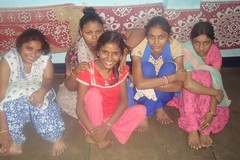
 They are our special girls! Champa, Anjali, Preeti, Ritika and Neha. When together they can bring the roof down! They love dancing, singing and giggling like any teenager, and like any teenager they sometimes sulk and fight.
Champa and Anjali live in our residential programme. Anjali is an orphan and Champa’s mom is too old to look after this very special child. Preeti who is as bright as any of us was struck by polio at a young age and walks on her hand. Her muscles are so atrophied and would not be able to hold calipers. If inclusive education existed in India, Preeti would have been in school like other girls her age and led as normal a life as possible. Instead she is shunned by her own family who find her an impediment. During the recent festivals she was left all alone at home while her family went out to temples and fairs. Anjali walks with a limp and is a little slow, but she too could and should have been in a normal school, but that was not to be. She lost her mother a few months back and was left all alone in an unsafe environment with predators lurking. Champa is perhaps the most disabled of all. Though she can belt one Bollywood hit after the other she is unable to even dress herself. She is so childlike that anyone could lure her with a simple toffee.
What is the future of such girls. Bleak is anything. And yet when you seem them together you get touched by their zest for life and their joie de vivre. It is for these very special girls and others like them that we felt the need to go beyond our initial mission – education of children – and think of a viable alternative: a place where such young ladies could live their entire lives in a safe and enabling environment. That is how planet why first came to be conceived. A simple residential option was not sufficient. We wanted to give our girls a reason to live, a place where they would feel useful and wanted. Hence planet why the guest house!
I can imagine my girls thriving on planet why. Young Preeti has all it takes to become the manager of the guest house and Anjali could become a great housekeeper. And in spite of her shortcomings and limited skills Champa would also find her place in the show. The journey that has barely begun, promises to be exciting and we hope to be able to reach our destination in a not so distant future. So help us God!
by Anuradha Bakshi | Oct 18, 2009 | Uncategorized
 I had written about my apprehension about the scrapping of Boards and marks and switching to grades in a recent blog. Recent news items about the modus operandi have made me even more uncomfortable. Eight hours training sessions are being planned for principals who, in turn will need to train their respective teachers. The rush in getting it all done is nothing short of frightening.
My fear was validated by a mail sent by a volunteer who had come to project why some time back. He writes: the removal of the class X board exams is something close to my heart, so I thought I’d share my thoughts on the issue.
I am not exactly sure how high the stakes of class X board exams are for a child in India. However, I know that scrapping summative assessments in such a brute and unmitigated fashion and replacing it with what we call ‘formative/ continous assessment’ in education studies is a very very dangerous move. While it is true that formative assessment is becoming increasingly popular globally, in places like Hong Kong and Singapore, the changes are gradual, often incorporating a part of school-based formative assessment (abt 30%) with nation-wide high-stakes exams.
Such changes have to be carefully steered with good frameworks and appraisal rubrics, meticulous curriculum planning, adequate teacher training and the support of academic research institutions. I cannot imagine how things will turn out when India has not even resolved the intricate pitfalls that together contribute to a flawed school system. How are teachers going to be able to assess students in a long-term, formative fashion when many go awol ever so often? Added to the issues you raised in your blog posts about the inequality of opportunities arising from differences in socio-economic status, I really worry for all the children from the lower spectrum of the social ladder.
It is believed that the new assessment will cover a student’s for scholastic (curriculum-based) and co-scholastic skills including life skills, attitudes, physical and health-related merits. It is sadly obvious that such system will broaden the gap between children of the two Indias, children from better homes are bound to have better co-scholastic skills. The marks system at least gave the less privileged a chance to compete with their privileged peers. Once again our law makers have widened an already gaping divide. Kids from better homes will have a huge advantage. That is only one side of the problem.
Let us look at the other. Grades will be awarded by teachers who till now have been awarding marks. A simple eight hours training is all that is been given to change mindsets and old ways. How can one be taught to assess skills and attitudes when one has never done so. I cannot even begin to imagine how this will happen. Maybe the teachers of swanky public schools will pass the test but what about the others. Advantage the privileged child!
Then there is a third player in all this: the parent! I know how many hours I have spent helping my children in their project and assignments. I wonder how a poor harried, illiterate mother is expected to conjure the skills and find the time to do the same. Once again advantage the privileged child.
Then how will the slum kid be able to run this race at par.
Changes and plans that concern children should never be undertaken to meet some political agenda or to seek instant gratification. They need to be tackled with care and understanding. An idea may look good and even be path breaking. However what is important is the implementation and enactment. If not done properly it can boomerang. One has to tread with caution in any situation where children are involved. Hope our law makers realise that!
by Anuradha Bakshi | Oct 17, 2009 | Uncategorized
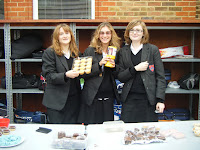
 About a year ago a young teenager came with her parents to spend a few days at project why. Harriet is no ordinary girl. She has mastered the art of seeing with her heart and that is how she looked at project why. Since then she has never forgotten us and has conjured many a miracle for us.
Yesterday we were treated to one more such miracle. She simply wrote: Thought I would let you know that the cakes sale went really well yesterday. We raised £55. I would have said there were over a 100 cakes and all of them sold within 10 minutes! I have enclosed a picture of me and 2 friends if you would like to see it (both friends made cakes that they brought in.) I have just totalled up our collection of spare change that we have been saving since Christmas it came to £30 exactly!
To the day cynical or uninitiated this may look paltry. But to me these figures are inestimable. Let me tell you why. Fundings come in diverse ways. The normal one is to apply for large impersonal grants, fill innumerable forms and hope for the best. In such cases there are no bonds, no feelings, no seeing with the heart nonsense. The other one is to try and touch someone’s heart. And then sit back and watch miracles play out. This is what has happened with Harriet and project why.
Every penny that drops our way is blessed as it is imbibed with love. And in hindsight this is what matters as it gives the whole funding process a new meaning altogether. There is something touching about young school girls in an alien land finding time from their busy schedule to bake cakes and then market them for a cause dear to one of their friends. And we feel humbled.
Harriet and her friends are very special young ladies. God bless them always.
by Anuradha Bakshi | Oct 16, 2009 | Uncategorized
 It is Diwali the festival of lights and new beginnings. Diwali is also the time when all, rich and poor buy new clothes at least for their children. Needless to say we too have been busy wondering what to get little Agastya, the new member of our small family. After much thought and much window shopping one zeroed in on a dhoti kurta!
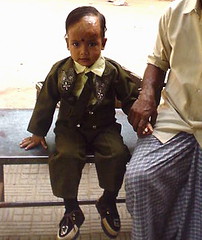
As I set about finding new clothes for my grandson my mind went back to Diwali few years back when little Utpal still lived with his mom, way before he went to boarding school. On that Diwali morning he came to see us all spruced in the brand new clothes his mom had bought him: pants, jacket and even a tie and to crown it all little cardboard lined shoes. I do not know why but he reminded me of a pastiche of little Lord Fauntleroy. It was all the mom could afford and yet she wanted her son to look his very best, at least for this special day. Needless to say I kept my little packet of new clothes for Utpal hidden. That Diwali was his mom’s day.
Yes, Diwali is important to one and all. Every family tries to celebrate the festival to the best of its ability and make it as special as possible. It does not matter if the shoes are bought in a swanky mall or on a street market, it does matter if they are sturdy or lined with cardboard. On Diwali every child has the right to wear new shoes.
I do not why I remembered this small innocuous incident today. But I am glad I did. The sight of little Utpal on that morning was truly touching and precious, a memory I carry in my heart, one that makes every Diwali special.
Happy Diwali to all.
by Anuradha Bakshi | Oct 16, 2009 | Uncategorized
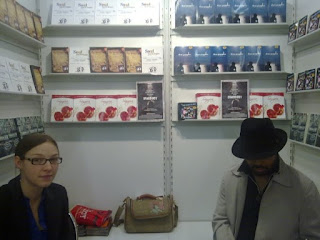
After being long listed for the Golden Quill Awards, Dear Popples is now at the Frankfurt book fair. What a journey it has been.
by Anuradha Bakshi | Oct 14, 2009 | Uncategorized
 Ray Kurzweil, the futurist recently predicted that in 20 years or so we might reach a stage where we could live forever, and even become ageless and immortal. What a frightening thought. Does it not make the meaning of our lives futile. Are purpose and achievement not linked to the simple fact that we are mortal, and hence have just that much time. Living forever would be like not living at all. One would simply be frozen in time.
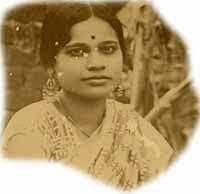
Why I am writing about such issues today. Simply because today the one who gave me the gift of life would have celebrated her 92nd birthday. And no one loved life more than her. Even when she was dying of cancer, this remarkable woman refused any palliative care that may have anaesthetised her as she wanted to live till the last second of her life, a life that she had ensured had been worth living. Kamala was an ordinary girl from a small town. She should have lived an ordinary life and died an ordinary death. But she chose otherwise. She fought to be educated and was the first in her town to do so. She eventually got a PhD. She fought social mores and got married in her thirties as she did not want to bring a slave child into this world and thus not marry before India’s Independence. At a time when girls were mothers before becoming women, she chose to work to defend women’s rights in remote villages where she reached driving a truck. And when she did marry, the ordinary small town girl became a diplomat’s wife set to conquer the whole world.
Yes mama was an extraordinary woman. One who lived life to its fullest. And yet she did so because she knew life was a given gift but not an eternal one; that time was short and that you never really got a second chance. She wanted to leave her mark in whatever small way possible. Se did it her way.
Any notion of supposed immortality would rob us of the desire to achieve and do something so that we too would be remembered after our final curtain call. Life derives its very purpose from the very notion that it is limited and transient. Immortality would take away the very essence of life.
Today I remember the one who gave me life.
Meet Kamala here.