by Anuradha Bakshi | Feb 12, 2007 | two indias
Two young ladies age 6 and 11 visited project why last week. Their mom a high executive in the hospitality industry had brought them along as she felt it would be a good experience for them.
We went hopped from one part of pwhy to the other: from a building in a narrow lane, to a tiny shack in side a crowded slum, to the class in the garbage dump via the broken lohar camp to our smart computer centre.
The girls kept silent as they imbibed what they saw. As we bid good bye I could asked the younger one whether she would like to come and teach her peer group all the songs she learnt in her fancy school. her eyes lit up as she looked eagerly at her mom before nodding her head. Her elder sibling remained silent.
Later I asked my friend what the reactions of the girls had been and was not surprised when she told me that the little one was eager to come back while the older one had not said much barring the fact that it had made her sad.
Once again the two Indias were evident. The yet candid and unspoilt little one had immediately felt at ease and one with other kids her age as social and economic origins meant nothing to her, she was a child amongst other kids. The older one had more to deal with as she felt apart and different yet sensitive enough to feel sad!
Once again this vindicated my view of the necessity of a common school to bridge the now glaring gap between the two Indias.
by Anuradha Bakshi | Feb 12, 2007 | two indias
A journalist from a leading western newspaper dropped by last week. She was researching an article on the impact of globalisation on the other side of India. She had visited some of the slum resettlement sites and expressed her indignation at the state of these rapidly set up spaces devoid of every basic need; water, schools, dispensaries etc. and wanted to know my views on the subject.
After she left I sat down for a long time trying to process what we had shared in those two hours and what I had experienced in the past years.
Globalisation has hit India. It is visible in the proliferation of swanky stores that sell everything you can dream of provided you face the money. I recall the days when one carefully made lists handed over to people who were going abroad. If I were to make a list today I wonder what it would contain.
Globalisation has hit India as is evident in the number of plastic pouches you see strewn on the streets of any slum: shampoos and shaving creams, detergent and hair conditioner, sauces and jams, coffee and you name it. A few years back the only pouches you saw were those of tobacco related ware.
Globalisation has hit India as foreign companies and MNCs realise the mind boggling size and buying power of this new market. To tap the size you need to flood the market with bite size goods at bite size prices, and as far as the other side of spectrum is concerned there is no limit.
Globalisation has hit India as is evident by the number of malls that are mushrooming everywhere: I even saw some being planned in lush fields that can only be reached today by a single track dirt road.
Globalisation has hit India as is seen in the multitude of gleaming bikes in slums and the variety of new cars in the now legendary traffic jams. Never mind if the bikes have been paid for by plastic money
Globalisation has hit India as is evident in the re-planning of this city where the planners in their hurry seem to have forgotten every rule in the book. An underpass imperils an age old heritage monument whereas a proposed games village threatens to choke an already dying river. And just today a building in a resettlement colony collapsed killing many people as its foundations had weakened following an unplanned and hurried demolition drive.
To many globalisation and liberalisation are welcome practices if India is to become a world class nation. But the way it is happening is wrought with dangers we may not be able to see at present. One of the most glaring effect seems to be on the increased gap between the two Indias where if one India is shining if not dazzling, the other is being pushed into further darkness. This may not be apparent to all, but our journalist did feel the need to add to every article she wrote on the shining India, a few words to temper the mood with references to the other India.
The writing is on the wall but we have lost the ability or sensitivity to see it. Plastic money that now inundates slums heralds the recovery nightmare and probable suicides. Pouches that strew slum lanes are slowly choking the city with apocalyptic consequences. The banning of street vendors, neighborhood trades and small shops will lead to increased unemployment and threaten the safety of the city. Slums relocated miles away will result in more kids being denied education and more people losing their livelihood.
Globalisation has hit India but unless we tailor it to our needs it may become a hydra headed monster difficult to tame. I recently met DK Matai ACTA is an initiative aimed at addressing these very challenges in a global way. But each one of us can and needs to address them too, and the least we can do is become aware of the flip side of the coin.
As I have written many times before, reaching out to the less privileged is no more an act of charity but an investment in the morrows of our children. One has to become sensitive to the reality that globalisation cannot be at any price.
I gall when I see the price tag attached to some of the items in luxury stores: a hand bag at 30K or ten months of salary at a minimum wage does not ring right. The urban poor cannot be wished away, they stand at our door step with the same dreams as ours.
Globalisation yes, but not at any price!
by Anuradha Bakshi | Feb 8, 2007 | Uncategorized
One will spend life in jail, the other is waiting for the gallows. They both thought that their political connections could give them licence to kill and get away with murder. But they did not. Public opinion ensured that and Jessica Lal and Priyadarshini Matoo got justice at last.
In September a professor was killed in front of hundred of people. Only 4 came forward and I remember writing about one of the them as in him one saw hope as he stood by what he believed was right. In the TV interview aired then he did mention his fears. At that time he was given police protection and we all hoped against hope that he would testify.
Yesterday all the four witnesses turned hostile, including Komal Singh Senger. Today the key accused moved the High Court for bail. In five months the powers that be had fixed every thing.
Original video tapes were doctored, and the prosecution’s case was full of glaring lapses. Now the family’s only hope is that the case is handed over to the CBI.
It all looks like a repeat of the previous cases.
Though many may blame the four witnesses there are a few questions that come to mind. Here again it was a murder that took place in a crowd that had professors, students, political leaders and many others, yet the witnesses were all simple peons. Wonder what happened to all the others. In September footage of the beating was aired over and over again by all channels. The final footage shown during proceedings omitted crucial scenes. Witnesses who should have been protected were left to their own devices and at the mercy of political goons. Wonder what threats or lollies were proffered.
The family has given up hope. Will public opinion rise again and see that justice is done. Seems a sad reflection of the reality we live in if in every single case justice will depend on whether the media will start a campaign or not.
Where is ou collective conscience gone? Don’t we realise that this can happen to one of us?
by Anuradha Bakshi | Feb 7, 2007 | Uncategorized
Many years back, when the first fast food outlet opened in Delhi – I think it was a pizza something – I told many friends that they would never be able to compete with our own desi brand of fast foods: the zingy chats, piping hot samosas, delectable and sinful poories and melting hot jalebis -. Ask any LSR student of yore years about the gooey peas chat – mattar chat -and you will be treated to a Proustian expression. And how can we forget the oily but scrumptious bun omelet that has satiated many a hungry student.
Street food has been a tradition in Delhi, one that has withstood the test of time. An interesting outcome of globalisation is this tradition as now you can have chowmein, and momos and swharma at any street corner in India’s capital city. Just a few years back one had to make a trip to Delhi Haat to have a plate of momos, now we just walk down the street from our Govindpuri centre and get them.
This is post is not a trip down memory lane, neither is it a gastronomic review. It is an appeal to the powers that be not to take away the soul of our city and leave us rudderless as today’s papers rung the death knell of one of the oldest institutions of this city.
Street food is the grand old tradition in Delhi from the times when Kkhomchewallahs (street vendors) used to come to one’s doorstep to sell all kinds of snacks, chaats, ice creams, sweets and more. And yet the Supreme Court has decreed their demise. With a stroke of the pen our highest judicial body has wiped away an age old way of life. The erstwhile street vendors are now to be replaced by pre packed food. Just imagining a cold chola bhatura makes me lose my appetite.
True that hygiene is sometimes not quite up to the mark, but it is also the case in outlets that run from kiosks. Those who have been to Nehru Place must have seen how food outlets operate even though they run from supposedly legal spaces. Somehow the planners forgot simple things like water points!
But there is also a grimmer side to this decision. If street vendors are not allowed to operate many people will lose their jobs and many families will sleep hungry. On the other hand the popularity of these vendors is visible and one wonders where the people who eat there will go.
Just down our gali is a man who sells hot poories and lovely potato subzi. A plate of 5 poories, subzi and a bit of curd comes for 6 rs. Every morning as we drive by the smell of the poories is enticing. The place is crowded with young office goers who have no families, workers, auto richshaw drivers and others busy gobbling their hot morning breakfast. I must confess that I too have succumbed to the temptation and partaken of the treat many times.
The decision to have these vendors only sell food cooked at home and wrapped in some plastic container is the pits. Once again we have been struck by the now sated option that our administrators have made theirs: rather than face problems and find solutions, pass them on or do away with the problem altogether.
In the frenzied rush to make Delhi another Singapore or Shanghai, one cannot forget the millions who serve this city and ensure it runs. One cannot wish away people and institutions that have survived many a storm. They have to remain as they give the city an identity. Imagine Paris without roasted chestnuts, or Singapore without the morning soup vendors. What needs to be done is ensure stringent regulations, subject vendors to rigorous testing and give them assigned space. But do not subject us to cold samosas or pre-packed chat! Our desi fast food can compete with any burger giant if it is allowed to survive!
by Anuradha Bakshi | Feb 5, 2007 | Uncategorized
I cannot remember when I last stepped off the whirling world to take a breath and muse over days gone by. Life went on at a frenzied pace and there never seemed to be time to take a pause and cast the much needed critical look.
One may wonder what set off these musings. Simply an empty inbox on my screen.
For the first time in many years did I wake up to an unread (0) status on my email. This triggered a series of questions in my mind and to answer them I realised that one had to take a pause and look back.
The past year has been a rewarding one, when many obstacles were cleared and life set on an even keel. It was a year when many little broken hearts got fixed, when a little boy and his mom were rescued from a life of hell. It was also a year when pwhy took on a new role and reached out to free little girls from the hands of their abuser, a year when a little boy defeated all medical rules and sprung back to life. It was also a year when new friends came forward to support us; a year when we even got our own little building and began a new centre. A year to be celebrated and feted.
It is true that many of the things mentioned above were already being done but the difference this time is that it all came easy. I remember with a tinge of regret the days when every new programme was a challenge. I remember with nostalgia how every tiny need entailed hordes of emailing and was gathered painstakingly cent by cent. I also recall the abundance of mails of support one got and the immense positive energy generated, the thrill one felt when someone committed some support however infinitesimal.
And today an empty mailbox that speaks volumes. Am I being once again faced with a new avatar of the dreaded comfort zone syndrome. Maybe. But this is one I need to fight to the hilt as it may sound the death knell of the very essence of pwhy.
Pwhy could only happen because so many people across the globe came together and infused it with life. Pwhy could succeed because of the immense support I got each and every time I sought it. And no matter how easy seeking funds becomes, pwy can exist if and only if it continues to get the love and goodwill of people.
There can no more be empty inboxes as money alone can never sustain pwhy. After all pwhy is just a simple love story.
by Anuradha Bakshi | Feb 4, 2007 | Uncategorized
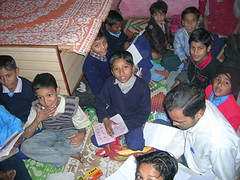
I have always hoped that some day we will have lots of little primary extensions so that more and more children remain in school. And it has been my dream to do this by drawing all resources from the community.
Our little Nehru Nagar class is a step in that direction as the classroom is a jhuggi in which people live. As they are out the whole day they leave us their home, bed and all. Sophiya and Satish tuck themselves and their pupils wherever they can and classes go on in earnest.
From the very moment we began, I knew that if we were to make a difference, we had to create a model wherein all resources came from within. The last seven years has vindicated this view as both space and teachers are in-house. But we are still dependent on outside help for the funds needed to run.
The solution of course lies in our ability to market our one rupee a day dream in the right packaging to my peers and my pwhy parents.
We are slowly getting there with baby steps and hope written large!
by Anuradha Bakshi | Feb 4, 2007 | Uncategorized
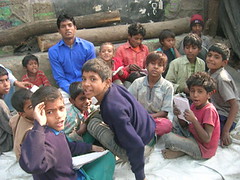
 Yesterday I dropped by my Lohar (gypsy)friends. My conditioned being expected to be greeted by long and sad faces as their homes had been raised to the ground just a few hours before that.
My heart did miss a beat as I alighted from my three wheeler and saw them all sitting in front of their erstwhile homes, their belongings strews all over. However as they saw me their faces lit up in the customary huge smile as many ladies came and hugged me
As we walked towards the space where our classroom was, I was amazed to see that in front of each ‘home’ the fire was lit, the tools laid out and men and women at work. Every faced smiled and someone ran to get the two new members of the clan: little Tania (3 months) and tiny Sagar (1month). The class was as full as ever and every child eager to show off. It seemed that barring the fact that roof and walls had gone, life was still on!
This has been the place where these 30 odd families have lived for over 25 years. I wonder what our reaction would be if someone broke the walls of our home and took our roof off! Gypsies are known for their resilience but what I saw today was more than that, it was a free spirit that refused to give up, a mind where fear had no place. They had perfected the art of zen survival.
As I walked back I was reminded of Tagore poem:
Where the mind is without fear and the head is held high;
Where knowledge is free;
Where the world has not been broken up into fragments by narrow domestic walls;
Where words come out from the depth of truth;
Where tireless striving stretches its arms towards perfection;
Where the clear stream of reason has not lost its way into the dreary desert sand of dead habit;
Where the mind is led forward by thee into ever-widening thought and action—
Into that heaven of freedom, my Father, let my country awake.
Here where a bunch of people who held their head high, we are the ones who let them down.
Note: there are 1000 odd gadiya lohar familes who have lived in Delhi since the fifties. they were promised relocation that they never got. They however were given voter’s ID cards.
by Anuradha Bakshi | Feb 4, 2007 | Uncategorized
In today’s world many of us have mastered the art of living according to rules and regulations, our lives carefully divided into little boxes and our reactions dictated by directives that are proved and tested by scientific means.
So when in this world a doctor and a hospital inform us that a child;s kidneys are not functioning and that he is severely anemic, the relevant little box of our mind sends the message that his days are counted. And you set out counting the days!
But then to your utter dismay, nothing seems to be following the pattern as the child perks up and starts smiling again till one day you find him at the door of his classroom. And days follow days as you train your mind to forget what was written on that hospital sheet.
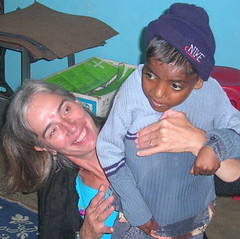
Our little Nanhe is back in a class and eager to participate in every activity. So yesterday when his friend Heather dropped by Nanhe not only danced but partook of the treat she offered: his favourite samosa.
Now did I not read somewhere of that forgotten hospital sheet: diet light, no fried food..
by Anuradha Bakshi | Feb 2, 2007 | Uncategorized
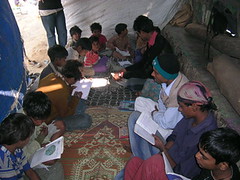
A class is in progress in the
Lohar camp. The camp has over 40 shanties along a main road. It has been in existence for over 25 years and even has a name and postal address. Most of its 250 odd inhabitants, all
gadiya lohars – iron smith gypsies – have voter ID cards. It is reasonable to say that they have a civic identity. There are over 90 such camps across the city some in existence for more than 50 years.
These 1000 odd families stopped wandering and settled in Delhi over half a century ago. Their abode remained shanties along side roads where one often sees them beating the iron and selling their ware.
We began our classes in this camp more than five years ago.Since we have witnessed many a demolition that seem to take place with regularity. The next day the shanties are rebuilt after a few palms are greased.
Nomadic tribes were promised relocation at the time of India’s Independence. We even found some official looking papers to prove that some semblance of resettlement had been initiated. WE helped the lohars file a writ petition in the high court and brought the plight of these lesser citizens to the NHRC. But as proceedings dragged the lohars got weary and lost interest or sunk back into the legendary resilience of nomads.
A few hours after this picture was taken the camp again demolished. This time the authorities did not spare us either but left with the usual: kal phir banalena – you can rebuild it tomorrow-! But we know that this cat and mouse game cannot continue for much longer as this camp comes in the way of the Delhi Metro project and the day is not far when our lohars will lose their shelter.
The future of these proud people we have learnt to love and admire is in danger. More than any of the migrants who have been given shelter or relocated over the years, these 1000 families need to have their basic constitutional rights restored in a city the made theirs much before others. However we fear that once again they will remain invisible and their voices unheard.

The picture above was one of the class yesterday; this is the same class today
Note: this camp has been in existence in this very place for over 25 years! Our classes began five years ago
by Anuradha Bakshi | Feb 1, 2007 | Uncategorized
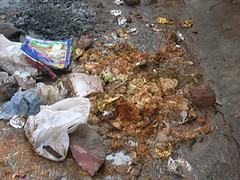
 This is a picture of the morning after a wedding party in our street. Yesterday as is customary in our city, tents came up, the street was blocked and the paraphernalia needed, set in place.
This morning we saw the aftermath: large quantities of wasted food, and mounds of plastic ware.
The venue: gali no 3 govindpuri.
Such sites are so common in the densely populated areas of our cities and in the many urban slums that we have become inured to them. But today the site of so much wasted food was extremely disturbing for was it not just a week ago that a TV channel ran a series of programmes on hunger in India. The startling figures came to mind: of the 16 crore of children under six, 6 crore live below the poverty line!
We have all been to wedding parties and witnessed wastage of sorts. But somehow the site of large quantities of food lying on the street was unsettling. Food has always been respected in India and even deified. To see it walked upon and trampled was almost blasphemous and raised many questions.
What made normally god fearing and tradition abiding people act with such disregard? Normally in rural India, wastage is negligible if not non-existent. Even peelings are fed to the domestic cattle or left in a safe place for birds. What was even ore perturbing was that this was not happening in the shining India, but on the other side of the fence, one where people still live in want and debt.
Does the journey from village to city make one lose so much; does the label of urban entail adopting all urban ways, even the bad ones? And above all how does one instill in children born in urban slums lost values when what they see is the exact opposite?
Young children are endowed with an intuitive common sense that is unfortunately lost down growing up lane. Young Kiran, age 6, was with me when we took this picture. Her quiet words echoed my feelings when she simply stated: why did they not give this food to the cows.
Yes little girl, to the cows or to one of the million of children that sleep hungry every night.
by Anuradha Bakshi | Feb 1, 2007 | Uncategorized
One is often so engrossed in the now, that one forgets to delve into the realm of the after. Yet unless we take time to do that, we may remain frozen in time.
Spiritual masters often ask us to visualise the future if we want to see it realised. I guess there is some truth in that. We have many nows in our lives, each pertinent to a particular field of our activities and each requiring its own visualisation.
Maybe it is time for me to assess the now of pwhy and make some projections. Let us consider this instant as ground zero and dream a little.
A bunch of children of all ages and sizes were brought together under the pwhy aegis a few years ago with the sole purpose of trying to better their tomorrows. The first task was to keep them in school as education was often hailed as a panacea to all ills. We set about this task and completed it with success. Somewhere down the line we realised that what was offered as education was in no way going to make a difference to these young lives as much more was needed. So we set about qualifying and quantifying the missing elements or defining the true ground zero.
One common factor linked all our children: they belonged to an urban slum. That sole factor dictated the quality of their lives: poor habitat, bad education, abysmal medical health facilities, few employment options one one side and great expectations fuelled by urban dreams on the other. To lace it all a feudal attitude vis-a-vis those in power.
The fact is that most of what is mentioned – habitat, school etc – has fallen into this state of despair because existing government programmes have been hijacked down the road. And as the end beneficiary are often kept in the dark, no one is ever able to redress the torts.
Hence if we look ahead from ground zero and allow ourselves to dream a little what we see is a day when people will be in a position to ask for all that is rightfully theirs and has been lost in transition. We tend to forget or maybe do not give enough importance to the tools that we have been given. I refer to the Right to Information Act that enables every Indian to seek redressal for a few rupees.
If that day is to dawn, then one needs to empower people and teach them responsibility. And the only way to do that is to catch them young. It has now become imperative for us at pwhy to move beyond the books and curriculum and teach our children the art of being a citizen.
by Anuradha Bakshi | Jan 30, 2007 | two indias
A short news item aired yesterday showed relatives of children killed in Noida by serial killers blocking a road and protesting the slow pace of the probe.
My mind travels back to the week where the whole nation watched the nightmare of NOIDA unfold. Rewind to a few weeks earlier and one’s thoughts go to the plight of the 50 odd Ghaziabad orphanage girls waiting to be released while their abuser smirked on.
Somehow the girls seem lost in some incomprehensible labyrinth of justice and bureaucracy that mere mortals cannot reach. The mind races back to the time when one could visit them in spite of the harrowing presence of their abuser, and bring them a few moments of solace.
Now one just sits helpless and lost.
Recently we experienced the deafening furore of Ms Shetty and her tryst with the celebrity big brother. The racist remarks ultimately paid. Few months ago Jessica and Priyardhasini got the much awaited justice when voices took on their case. But those voices belonged to well educated, English speaking upmarket people and hence they were heard. They belonged to the right India, as did those that ensured that little Anant return home safely!
The Ghaziabad girls and the Nithari children do not have that luck. The voices heard yesterday were not the right ones.
Let us not forget that the true perpetrator of the crimes against the Nithari children was not the predator but the police and the administration. Today again it seems that the same game is being played.
In a few days or weeks, the tired parents will have to go back to the task of surviving and even these feeble voices will die out.
I had feared this would happen and hoped that we would see the writing on the wall and do something. My fear has been confirmed, my hope shattered.
Many heralded 2006 as the year of the rise of civil society, maybe one should add a rider: it only words in one India, the other remains unchanged.
by Anuradha Bakshi | Jan 29, 2007 | Uncategorized
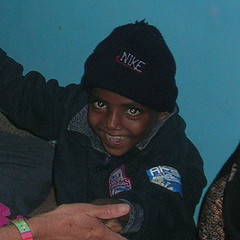
Nanhe is back. And the smile too!
Everyone was stunned as he entered the class in Sitaram’s arms. Moments later a palpable excitement prevailed in the classroom as his little buddies set about to greet their long lost pal.
All else was forgotten: Anurag stopped jumping, Umesh stopped whining and even Shalu stopped complaining. Little Sapna came alive, Himashu smiled and Manu forgot his swollen gums and quietly handed over his puzzle.
No words were needed for his pals to understand that Nanhe had come back from very far and that this was a very special moment. Had not Nanhe defeated all logic and all medical prognostics, was he not the one who had chronic renal failure and severe anemia.
We watched him in awe as we could sense the strength of his spirit soaring high and my thoughts went to Daisaku Ikeda’s words: Human life is indeed wondrous. You may be ill physically, but as long as your mental state is strong, it most certainly will exert a positive influence on your body. there may be no better remedy than hope.
by Anuradha Bakshi | Jan 29, 2007 | utpal
When Utpal walked into the gate of his brand new school he was making a tryst with destiny.
He would one day walk out of that gate and take on the world.
I have often let my imagination run wild and imagine what he would become: a conventional doctor or a hot shot choreographer.. any one’s guess I suppose.
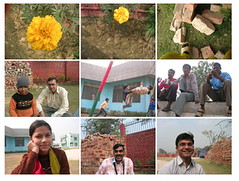
yesterday we spent the day with him in his school and as we lazed around in the balmy winter day, he took my camera and started shooting pictures. He went done on a knee, took time and shot a series of pictures. He shot his buddies, his pals in the kitchen, some of us and even took some shots of flowers and trees. You can see them here.
Quite frankly they are not bad.. and some could even make it to a competition.
I watched this little chap and once again marveled at the incredible journey this little chap has made in the last 4 years: from a searing frying pan to a boarding school. At moments like these you can only say Chapeau Bas – hats off – to mr godJi and his incredible talent!
by Anuradha Bakshi | Jan 28, 2007 | Uncategorized
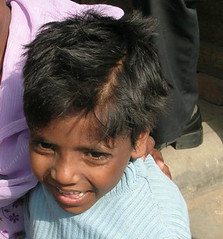
Last week nanhe was discharged from hospital. The discharge slip read: hemoglogin:3.2, BP not detecteable, chronic renal failure. A dismal prognostic to say the least.
When consulted all medico friends confirmed our fears.
Nanhe is special and his smile has made us weather many a storm. Not knowing what to do as no conventional options were possible, I shared my angst with many friends. Many messages of love and support poured in, and many sent healing in various forms.
The days went by and defying all norms, Nanhe held on and two days back he delighted us with a huge smile. For that one moment time stopped. That smile was nothing short of a miracle.
I recalled Deepak Chopra’s words: Miracles happen every day. Not just in remote country villages or at holy sites halfway across the globe, but here, in our own lives, and wondered as to what message that smile held.
Time has stopped for that moment indeed, but reality hit us soon after. Nothing had changed actually: nanhe was still that very special child who could never stand on his own, his mother was still that poor widow with three more challenged children and his tomorrows look as bleak as ever.
Yet his holding on despite all odds could not be without purpose.
I remember nanhe’s last day in class, when he played mentor to young Himanshu. I also recall the innumerable times when his smile has wiped away many a doubt and lifted my sagging courage. I recollect the number of people around the globe who have warmed up to this special child and who have prayed for him over and over again.
How can one forget the often illogical yet passionate strength of a mother’s love. Nanhe’s mom has been a perfect example of that, not giving up one bit but doggedly carrying on, carting her child to the hospital, pleading with doctors and getting for her child more than one could hope for.
Nanhe lives and even smiles. I guess somewhere we are blessed to be able to still have this child with us.
These are moments where logic and reason fail, and only wonder remains.
by Anuradha Bakshi | Jan 26, 2007 | Uncategorized
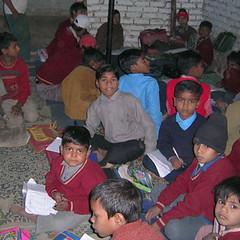
Final exams are just little over a month away and all pwhy kids are busy revising. Government schools held their usual end of term exams in December and we all waited for the results to help us structure our revision programme.
When no result was forthcoming by mid January, we asked the children to find out from their class teachers when these would be available. The next day, little Jyoti from our Govindpuri section came back telling us that she had been slapped by her teacher for having dared ask! We were ready to go and meet the teacher in question but were stopped by the children. Their scared eyes spoke volumes. They knew that our visit would result in more unwarranted abuse.
In another school, children were told that the papers had not been checked as schools had been closed for a few days because of the severe cold. In yet another school, answer sheet lay strewn on the floor at the mercy of rodents.
All in all, we could only gather half of the results.
This is but another example of the state of municipal and government schools. It is a cause of worry as marks of each terminal exam are included in the finals. We were also told that if a child has 75% attendance he automatically passes into the nest class. No wonder than that there are kids in class V who are unable to read or write. They will swell the ranks of drop outs as they reach class VI!
Almost everyday one can find some news item or the other about the abysmal state of government schools in the capital: no toilets, no drinking water, no classrooms, no teachers…One of the reasons for this deplorable situation is undoubtedly the lack of a literate and empowered parents’ group. With the proliferation of shady small teaching shops a.k.a. public schools, only the poorest of the poor land in municipal schools. They simply sit on the benches – or floor – marking time till they exit the school in class V. many will never make it further.
There is something extremely lopsided or insidious about the various policies for the poor. One startling example is the reservation policy in higher education. With the present state of primary education no deserving candidate can ever make it to the portals of an engineering college or medical school. It is only when we clean up the state of primary education that a tangible change can begin to happen.
by Anuradha Bakshi | Jan 26, 2007 | Uncategorized
All over India celebrations are on today. Flag hoisting and parades, people cheering and waving flags everything is on cue to mark the 57th anniversary of our Republic. How many of us are truly aware of the meaning of this day?
Somehow the essence of the constitution got lost along the years and what remained is the pomp and display associated with it.
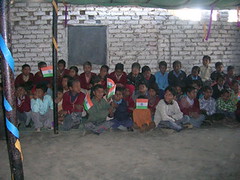
Of all our centre there is one that never fails in its celebrations of our republic our Independence days. Every 26/1 and 15/8 the children of the Okhla centre organise a show. They hoist the flag, sing the national anthem and some patriotic songs and then delight us with the never to be missed bollywood numbers. This year they even had a play and their on gandhiji!
It is with pride and a tinge of sadness that I watch these children. As they remember the day that saw our constitution come into force, I cannot but think about how little of what was promised to them 57 years ago, has actually come their way. It seems as one part of India was conveniently cast aside along the way.
Most of these kids belong to some reserved category or the other but none is aware of what reservation means. They go to poorly run schools from where many drop out. They die for want of medical care. Their morrows are often hijacked by some predator or the other and they soon find themselves on the wrong side of the law. And often they go to sleep hungry.
And yet on these special days all is forgotten as they celebrate being Indians.
This year the President chose to mention crime against children in his R Day address. He was of course referring to cases like Nithari. But there is a more insidious crime tat we are all guilty of, one that is invisible and almost intangible. That of having let down a whole slice of India denying them the basic rights that were meant to be for all Indians.
The children of Okhla did not forget the importance of this day; in their eyes lies a question that needs to be answered: why have they been forgotten them.
by Anuradha Bakshi | Jan 25, 2007 | two indias
50 odd years ago a group of people huddled together to draft a constitution whereby every Indian that had been freed from its colonial master would be protected and given equal opportunities and access to resources. Its preamble resolved to secure for all its citizens:
JUSTICE, social, economic and political;
LIBERTY of thought, expression, belief, faith and worship;
EQUALITY of status and of opportunity;
and to promote among them all
FRATERNITY assuring the dignity of the individual and the unity and integrity of the Nation.
The constitution was to reflect Gandhi’s vision of “…an India in which the poorest shall feel that it is their country in whose making they have an effective voice; …an India in which all communities shall leave I perfect harmony. . Woman will enjoy as the same rights as man.”
On 26th January we will be celebrating our 57th republic day with the usual pomp and parade. And yet a news channel chose to herald the week with a chilling series entitled the Republic 0f Hunger.
Justice, liberty, equality , fraternity seem very empty words in a land where over 30 % of our children go to sleep hungry. And that is not all that has gone awry, every dream and aspiration enshrined in our constitution has been shattered.
If we look at the reality that surrounds us we find none of the four pillars of our constitution. there is no justice, equality, liberty or fraternity, or if there is, it is only for a chosen few. It seems we have ensured that exact opposite.
Justice is denied to the poor who enjoys no liberty, equality and least of all fraternity. They remain voiceless and subservient to a new set of masters who enjoy all the spoils. Events in the recent past have proved this more than once: be it the callous attitude of the police in the Nithari case, or the murder and rape of two poor parents looking to save an ailing child, or a little child losing her fingers for a handful of spinach.
Over the years we have perfected the art of dividing in a way that surpasses Manu. Today’s India is fractured in a million pieces: we have castes within castes, and more. Our political masters ensure we do not forget this. Even children talk that language today.
50 years after our freedom for British rule, the benchmark of success remains how well you speak English and how much money you have! Instead of equality you have two distinct Indias : one that shines, and the other that lives in darkness. The lines that divides the two may look invisible but is impregnable.
60 million children do not get a square meal a day, this after 60 years of freedom. What is frightening is that no one seems to care. They become statistics that fuel new causes to espouse, numbers that will help accede to more international funds and good copy for the media.
As more programmes and projects are set up to tackle these issues, new found ways to siphon funds multiply. It is sad but true: our colonial masters have now been replaced by masters of corruption, the new found mantra that permetaes avery aspect of our existence.
60 years of indepedence and what stares at us is an India divided in two, in every which way possible. Be it education, medicare, housing or any other basic need, things are not the same depending on which side of the fence you were born.
So as we celebrate our 57th republic day, maybe one stop and reflect on the meaning of a Constitution meant for all Indians and ask ourselves what went wrong, and how we can begin to undo the torts.