by Anuradha Bakshi | Oct 6, 2012 | Uncategorized
How many times have you seen your favourite film? I wonder. Personally I am not a great cine fan and rarely go to the movies. I did once, but cannot remember having seen a film more than 2 or at best 3 times. Often the extra times were to please a friend and were not my cup a tea. I would have preferred spending the two yours reading. So if I told you that in the past few weeks I have seen a single film so many times that I have lost count you would not believe me. But this I a fact!
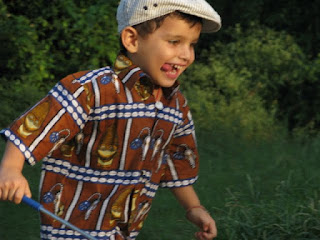
Now before I carry on I must admit that this new fad, if I can call it that, is courtesy the new man in my life: Agastya my grandson. This little man has changed my life in more ways than one and managed to make me do things I never dreamt I would. One of them being seeing a movie n times. It all began like this.
One day my husband showed the little fellow bits of Mamma Mia on his computer and the little one got hooked. After that day, every time he was allowed to watch the screen, he wanted to see Mamma Mia. I honestly thought he would get tired of seeing the same movie over and over. No way. So for the past month or more I was treated to Mamma Mia day in and day out. He would get up in the morning and even before saying Good Morning, would turn his endearing eyes to his grandpa and say ” Put Mamma Mia”and if the old man did not comply then he would turn to me and say ” Nana is not putting MM!” So MM it was early morning and MM became our good night song.
But that is not all, in between viewings of MM, I was made to discover other things: Doraemon and Chotta Bheem. I must confess I have never been a cartoon nut even in my younger days but lo and behold grandma had to get hooked on these two cartoons and rather than resist and turn my face around and pick a book, I decided to follow the little leader and watch these shows. I must say rather sheepishly that I got somewhat hooked and found myself following the stories. Utpal watches these shows too and never got me to follow them as the fleeting images I saw as I came in and out of the room were never enough to make me want to sit down and watch. But having to forcibly, well not quite, sit with Agy made me watch and enjoy the episodes. The endearing cat robot Doraeomon comes or the daring little Chutki became part of my life too. Grandma had to rock!
My little boy flew away yesterday night after a last viewing of Mamma Mia. The house is so empty but my head is ringing with Abba songs. I am missing my little man. May be I should simply go to my room and watch Mamma Mia!
by Anuradha Bakshi | Oct 3, 2012 | Uncategorized
Square foot for square foot your maid’s rent is probably higher then yours. The rents for shanties and jhuggies across the capital have hit the roof. People are paying 30 rs a square foot for flimsy tenements not larger than 10 square feet with no bathroom, kitchen or running water. This fact was revealed in a study by the the School of Planning and Architecture’s (SPA) National Resource Centre.
We have experienced first hand the skyrocketing of rents over the past decade. Ten years ago you could still find a shanty for 500 rupees a month. Today the same space is nothing less than 2000 Rs. And migrants have no option but to rent such jhuggis are rooms in any part of the capital is nothing less than 5000 Rs a month. A poky, windowless room with an apology of a bathroom goes for 5K in the Govindpuri lane where we are located. And Madanpur Khader village that till recently had rooms @ 1000 a month and provided shelter to migrants is undergoing a mutation. With medical tourism at its height and Apollo Hospital a stone’s throw away, landlords are evicting their poorer tenants, knocking off the old structures and erecting swanky guest houses and service flats for the relatives of long term patients. It is a roaring business with many takers. The erstwhile tenants are now running helter skelter to find alternative accommodation in a city that has none.
We may turn up our noses in disdain and even disgust while passing through a shanty town. We may feel that such aberrations have no place in a city like ours. But have we ever stopped to think as to why this has occurred? And above all do we realise the strong link that binds us to the inhabitants of these shanties. But let us begin with the first statement: how and why have we reached this situation. Have you ever wondered if our city has adequate provisions for housing its poor? Big cities normally have poorer quarters with high rises. We have zilch. Many years back private houses had the ubiquitous servant quarter that were meant to house those working within the premises as well as their family. So your maid husband could be an plumber, electrician, carpenter or simply an employee in a shop. Then slowly the concept of large well constructed servant quarters was transformed as people redid their houses taking in the servant quarter space to make a new flat that could be rented. The servants were relegated to tiny rooms on the roof often with just an asbestos sheet to ward the heat or cold. The room was barely sufficient for one person.
When migrants came to Delhi many many decades ago they looked for space to live. They often found some vacant space and erected bamboo poles and a plastic sheet begin with. They knew the space was illegal and so did the authorities. But the later did not evict them as they saw a way of lining their pockets. The poor migrant had no option but to pay. When the numbers grew the political parties started looking at them as potential vote banks they needed to woo. They were given an identity in the form of a voter’s card and soon became legal! This game carried on. The migrants felt emboldened and the flimsy structures were soon replaced by more concrete ones and then just as the rich did, they too decided to become landlords: roms were built on top of the one they lived in and rented to newcomers. This happened in every slum in the city from the larger ones and even the legal rehabilitation colonies to the tiny ones that often sprung up on small pieces of empty land across the city. These are the rooms that now fetch a hefty rent.
These places house the people who are the backbone of the city and as I said earlier people who are closely linked to us. The ones who carry out repairs or even build our homes, the ones who look after our every day needs and care for our very own, the ones who make our lives a tad easier. Have we ever stopped to think about where our maid or our plumber lives? I think we should.
The shanties and hovels a large part of the city live in are homes to those who stay in them. I have been always impressed by the care taken in setting them up: the kitchen corner with shelves lined with gleaming utensils, the sole bed that always dons a bright cover, the school bags of the children that hang neatly in another corner and so on. The space is squeaky clean. I have visited many such homes and been warmly welcomed each and every time with smiles and warm cups of delicious tea.
But these living conditions are abysmal and appalling. Any city that expects any of its inhabitants to live in such conditions should hand its head in shame. The surroundings are dirty and often dangerous. Many such homes are build next to factories and often lower than the roads. Many factories discharge their chemical in the open drains where children often play.
It is time something was done for these people and time for the city to embrace its own with the dignity they deserve. But for that the Government would have to build proper housing. I do not think that is about to happen if we are to believe today’s headlines: Government plans to sell surplus land to ease fiscal crunch!
by Anuradha Bakshi | Sep 27, 2012 | Uncategorized
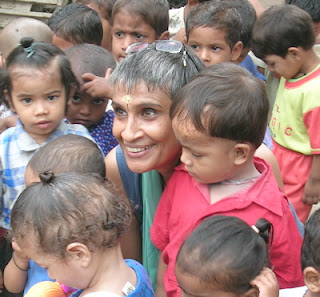
Six years ago a supporter and friend asked me the following question: Excuse me saying this, but why don’t you sell this house.. imagine how many heart surgeries it would sponsor. I answered the question then to the best of my ability stating that liquidating an asset, no matter now big was against the essence of pwhy. The question was disturbing to say the least and remained in my mind. Yesterday a very young volunteer asked me a similar question. His was perhaps less direct as he wanted to know whether I felt guilty staying in such a large house after seeing the conditions in which the children of pwhy lived.
Six years later I was on the rack again and though I gave him an answer I hope sounded sincere, I realised the need to address the question once again as I presume it is one that undoubtedly comes to many minds but often remains unsaid. Yes I live in a big house, this is an indubitable fact. The house was built by my parents and being their only child it came to me with a rider though. It was to be in my custody and then revert to my daughters after me. So legally it is not mine! But the question has a deeper meaning that needs to be addressed. I think what people want to know is whether I feel guilty living a privileged life or to put it in kinder words whether pwhy has changed my outlook and directions in life.
I have said loud and clear that for me pwhy is the repayment of a debt. I realised how privileged I was when I visited my ancestral village in 1983. The village my family hails from is one of the most backward you can imagine. When I visited it it had no proper road access and none of its girls had been to school. Had my ancestor not left this village I too would have been uneducated, married in my teens, grandmother in my thirties. Instead there I was a diplomat’s daughter, smothered in luxury, highly educated and so on. That is when I realised that there had to be a big payback time. What it would be, I did not know then, but that it would happen was certain.
The years went by, but the feeling never left. I carried on with my responsibilities waiting for the opportune time. It dawned in 1998. My parents were gone, my children grown and my wandering the world done for once for all! I was in my late forties and felt it was time to sink roots and redeem my pledge. Pwhy was born.
I did not know what shape it would take. Only time would tell. And somehow from the very moment it too seed, it seemed as if destiny had it all chalked out. Every step was taking me in the right direction. When friends and well wishers tried to put a spoke in the wheel proclaiming that the task at hand was too huge, I retorted that all I wanted to do was change life.
But I am not here to tell the pwhy story. We are talking of guilt. Honestly I do not feel guilty about having a big house. It has been part of the plan. It is something I cannot change so I humbly accept it. But things have changed for me. And the biggest change has been that for the first time in my life I feel complete.
What has changed for me is that I am humbled each and everyday. Humbled by the love and generosity that has come my way, humbled by the miracles I see unfold, humbled by the love I am given in ample measure.
by Anuradha Bakshi | Sep 25, 2012 | Uncategorized
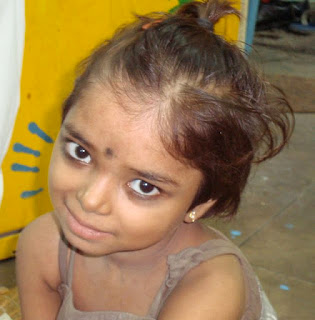
Every morning my grandson Agastya comes with me to Project Why before setting off to his school. We land up at the gates of the Project roughly the same time as Radhey brings the special kids in his auto rickshaw. And almost every morning Radha is sitting in the rickshaw waiting for someone to pick her up and take her to class. Now Radha sits in the corner that is Agastya’s spot and normally when anyone sits in that corner, Agastya has a tantrum. You see no is meant to take Agastya’s spot be it in the rickshaw, the dining table or any space he has claimed. But strangely when he found Radha sitting in his spot, Agastya said nothing but simply went and sat beside her. He stared at her malformed legs for a long time, questions puzzling his tiny mind but said nothing. He simply gave her a huge smile. A teacher soon came and picked her up. She waved bye bye and Agatya waved back.
As we left the centre he asked me what had happened to her. Now what do you tell a 3 year old. How do you explain osteogenesis imperfecta to a toddler. How do you tell him that it is an incurable condition that will ultimately take the little girl away. So you do your best and simply say she is hurt, badly hurt. That is what I did. She was hurt and could not walk. He accepted my explanation but his face remained serious. I wonder what was going on in his head. After some time he simply said: but she will walk tomorrow.
Oh how I wish these innocent words coming from the mouth of a child could be true. What would we all not give up to see Radha walk. But the sad and bitter reality is that she will not, even the God of lesser beings cannot conjure this miracle.
Every morning as we set off for the centre my darling grandson asks me whether Radha will be there, in his spot. He looks forward to that brief encounter probably knowing without knowing that she special, truly special. And I take comfort in his words: but tomorrow she will walk knowing that that tomorrow will never come.
by Anuradha Bakshi | Sep 24, 2012 | Uncategorized
We will take a few blows, but do not throw us out of school are the chilling words many pwhy students told their teachers last week, a day after the High Court heard a petition on the abysmal plight of the schools they study in. The story goes like this.
For the past months or more children have been regularly complaining of the state of the schools they study in. From lack of basic facilities like toilets and drinking water to cramming of students in classes – in some cases 150 in a class meant for 50 -, from corporal punishment to teachers absenteeism, from broken ceilings to non functioning fans, the complaints were many each more shocking than the other. This was supposedly XXI st century India, the India our rulers would like to showcase as a glitzy and shining land, yet the accounts of these children seemed to be out of a Dickens’s novel. Moved by their concern I decided to get in touch with a lawyer friend known for his social activism. He asked me to bring the kids to his office in the High Court. The children shared their woes and were asked to write them down, get them signed by as many as possible and send them to the lawyer. Days passed and we kept waiting for the children’s letters but none came. Instead we got a litany of excuses. The penny dropped: the children were scared of writing their problems. It was time to act again and empower our kids
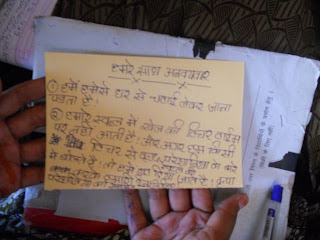
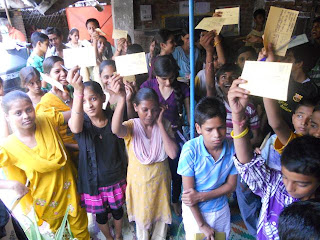
I rung the lawyer up and he told me he would come and talk to the children of their rights and organise a postcard campaign where children would be given postcards and would be urged to write their woes. The cards were to be addressed to the Chief Justice, Delhi High Court. So on a bright Sunday morning a post card campaign was organised in our women centre and heaps of children shared their concerns. It was touching to see them write what they had carried for so long in the hope that someone would hear. They has just one wish: to be able to study in the best conditions possible. The post cards were written and handed over and a few days later a petition was filed in court and heard by the Acting Chief Justice. The government was given 4 weeks to file their reply. The voice of voiceless children was finally heard.
But the feeling of achievement was short lived. The next day itself the furore of the school fell on these kids. A sample letter was written of the blackboard for all to copy. The letter said that an NGO – us I guess! – had plied them with toffees and biscuits and ‘forced’ them to write these letters. Some older kids were even beaten resulting in them saying: We will take a few blows, but do not throw us out of school ! The fear of being cut off the rolls loomed large.
We will take a few blows, but do not throw us out of school are words one must ponder on as they reveal how much these children want their education. In spite of the fact that corporal punishment is against the law, they are willing to take some blows as long as they remain in school. The scare of being thrown out of school is used and abused by their teachers. They know they hold a trump card however unjust. I cannot but remember the young girl I found many years ago crying on her home from school. When I asked her what happened she told me had been beaten by her teacher. When I asked her why she replied she did not know. And how can I forget the secondary boys’s answer to my question: what would you change in your school? I would have bet my last rupee that their answer would be: we would stop the beating. Imagine my schock when they said: we would tell the child the reason for which he was receiving a beating. Acceptance of beating without reason is nothing short of scary. And nothing has changed over the past 12 years. Kids are still being beaten in schools and have simply learnt to accept it. How would this translate in their adulthood is question begging to be asked.
The state of Government run schools has deteriorated over the years. This is sad but true. If one side of the spectrum has witnessed a proliferation of private schools of all shades and hue, the other has to live with degradation and decay. One wonders why as the State runs perfectly good schools like the Central Schools. Why then is not each and every school of the same as calibre as Central schools?
Today we are a city that prides itself of having an Ice Bar and Jimmy Choo and Louis Vuitton outlets. But in this very city an innumerable amount of bright and innocent children are being denied their right to a good education, the only way they could better their morrows. Is it no time to do something for them!
by Anuradha Bakshi | Sep 4, 2012 | Uncategorized
“Have the people stopped eating and drinking because of the drought?” is what an MLA on a junket said in his defence. Thirteen such MLAs are on a South American spree, many with their spouses and you and I are paying for it! Another MLA defended himself with these words: “There has been enough rain in my constituency and farmers are busy cultivating crops. Due to the recent rainfall, our canals are full and plantations are lush. So, I am rid of all guilt.” The cost per legislator is 600 000 Rs and on their way back they have a two day shopping stop in West Asia. These are the people WE elect to represent our needs and issues. I guess we bear some of the responsibility. The crassness of their remarks is nothing short of shocking. The study tour of course consists of Tango classes, a lesson in Mayan culture at Machu Pichu and discovering the Copacabana beach! All this whilst those who elected are busy surviving
This is one story.
There is another which is even more insensitive. At the London paralympics our athletes do not have coaches or escorts living with them in the village but officials and their wives/daughters are enjoying their stay in the games village! A wheelchair bound athlete needs an escort to help him gets dressed, go to the toilet and get ready for the event. But our officials do not understand that or should I say do not give two hoots. We all know how the disabled are treated in our country. I guess the paralympics are just one more option for regular junkets and not really an apportunity for brave athletes.
In a country where 5000 children die every day of malnutrition do we need to pay for junkets for our elected representatives and officials. A question that needs to be answered but who will?