by Anuradha Bakshi | May 23, 2007 | Uncategorized
When my children were young, summer holidays always spelt disaster as one would be plagues with a leit motiv of I’m getting bored or What do I do now. One would try and plan things but they never quite met the standards of demanding kids. Those were the days before Internet or even video games. One just had the good old VCR and films borrowed at the local library as life saviours.
Today things have changed. Parents have more money and new summer options are being marketed. I recently saw an ad for summer holidays for children within India and in faraway lands were the tag could be as high as 1 lac of rupees, notwithstanding the plethora of summer camps in the city. Even in the area we work in, many of the private teaching shops offer courses in painting, dancing and more of the same making them an option for harried parents.
For those who cannot afford it, it is the street that plays the role of a summer camp, where children play in spite of the heat and spend time as best they can. This is one of the reasons project why never closes but then we can only reach that many kids.
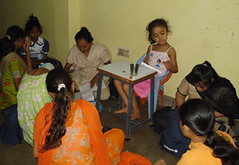
One kid decided to create her own summer camp. What began spontaneously has now become a serious affair. Every morning Kiran is ready at 8.30 and comes to us to project why. Gone are the days when she tagged along and followed us with the proverbial bored expression. She now goes straight into the special section and is there to welcome the kids as they come. Then after morning exercises that she still leads it is time for serious work as per the timetable. Kiran all of six years and some months settles with her little group – group A – and asks for the day’s copy books. She is soon busy giving out work and checking it as it is completed. She knows the ability of each child and doles out the work accordingly: If Champa one of our slowest learners gets simple letters written large, Pooja has now graduated to three letters word, and Anurag is still learning to write his name though she shared proudly with we today that he can write Anu and now she plans to attack Rag.
I watched her today as she sat on a chair – a concession to her size – and interacted with her class that ranges from age 8 to age 30 and thought to myself how perfectly tuned everyone seemed to be. Here was a group that had nothing in common – neither age, nor caste, nor creed – ; each one had a disability that branded them an oddity in the wider world yet under the strict yet loving care of a little six year old they sat and learnt in total harmony.
There were so many lessons to be learnt if one cared to look wth one’s heart.
Chapeau bas to this young child who had created her very own unique summer camp.
by Anuradha Bakshi | May 22, 2007 | Uncategorized
I normally am rarely at home during the course of the day and thus am not aware of he comings and goings that dot a normal working day seen from the inside of a home. Yesterday I remained indoors on doctor’s advise and spent most the time in my tiny office which is next to the main entrance of the house and thus closest to the gate.
My hope of getting some serious work done was soon shattered by the door bell that rang at disturbing intervals. Bar the ironing man and the gardener all other interruptions came from a new persona: the courier man.
Soon a little pile of envelopes of all shades and hue littered my usually pristine desk. There were a few bills, a few invitations but the majority of the pile was made of diverse promos and publicity material. Though we are only three in the house, my husband is a member of two prestigious clubs and thus on several mailing lists. From sarees to silverware, from furniture to food, from electronic goods to art exhibitions everyone seemed to consider us a valued customer. And each envelope was glossier than the other and in sizes that would never fit the slit of a mailbox. And if that was not enough, most of the envelopes were packed in high quality transparent plastic lest they get soiled!
Like in most homes, the carefully wrapped messages would soon find their way in the waste, and in city like ours where waste segregation is still an unheard concept, the carefully worded suggestions to valued people who simply add to the burden of a collapsing planet.
Everyone is talking of global warming and the need to act. And one of the simple ways of doing so is my protecting trees and saving paper. Is not time for us as concerned citizens to raise our voices against this flood of publicity that now targets our very homes? I know that many will talk about the numerous jobs that this industry gives and supports. But is it not time to alter perceptions and reinvent things in a more environment friendly way?
In the times of the Internet and the electronic media, there have to be ways of halting the proliferation of publicity material that is suffocating the planet. And if one insists on printed material then one should use only recycled paper. I have often written about my concern on the proliferation of pouches that have hit urban slums and litter the roads and clog drains. Companies who market these are rich enough to invest into developing environment friendly packaging were it made mandatory. But in the game of money making who will bell the cat. And the cat is often within our home and goes by the name of comfort and convenience. It is so much easier to get a plastic bag from the shopkeeper than to carry a cloth one; it is easier to sump all garbage in a plastic bag than to segregate it.
Added to comfort and convenience is another culprit that goes by the name of convention. When we began our work almost 10 years ago and looked around we found that all organisations had beautiful brochures and pamphlets. In our earlier days we did the same but thankfully because of paucity of funds and the ever changing nature of our work we had to put a stop and look for alternatives. Those were the early days of the net and we jumped the bandwagon and created our website that we managed in-house. The rest is history and today even the printer has stopped making his customary sale calls. And today when people ask us for litterature about the project we refer them to the site and the blog and if needed print out one set of the required information.
Be it plastic, paper or water laws alone can never suffice. One has to change mindsets and alter our ways of thinking and be prepared to be called marginal or wacko. When my daughter got married we did not print wedding cards. Barring one person everyone did turn up.
It is time each one of us starts giving up old ways and find new ones. It is not an easy task but it is the only one that will help our children have a future.
by Anuradha Bakshi | May 21, 2007 | Uncategorized
Bye bye hot samosas was the the blog I had written some time back when one first heard of the probable banning of all street food in our city. Yesterday the Supreme Court decreed and imposed a ban on all street food.
We often fail to see things unless we have a real reason to. For as long as I remember I have driven past roads in Delhi not quite looking at street food. Lately I have found myself actually doing so and have been amazed by the abundance of what is soon going to disappear: From small road stalls to carts, from samosas to meals via fruits and zingy snacks, the street food culture permeates the very soul of this city! And true to its globalisation efforts we now have Chinese food and burger stalls too! Frankly I cannot begin to imagine the streets without these. It is true that if we look closely at some of these stalls we are compelled to frown at the hygiene standards or the safety norms; however life without them seems a tad sad.
That was nostalgia but the problem does not end there. In my pre project why days street food was that forbidden treat we sought once in a while, but many of us do not realise that for millions in the city it is a lifeline!
At 5 or 10 rupees a plate it is a hot meal for those who do not have families or time to get up and cook. To others it is the sole way of having some fruits or a sweet treat. And to thousands of families it is the much needed income that brings a meal at the end of the day.
It was heartwarming to see that a leading TV channel had launched a campaign to save Delhi’s street food on the lines of earlier campaigns to get justice. And the pictures that were aired were those of humble people who candidly defended their right to a meal.
That Delhi is bursting at its seams because of the daily influx of migrants is a reality that no one can overlook, but can one deny the fact that this has happened with the tacit approval of those in power. Swelling vote banks, new causes to defend were all part of a hubristic game and no one saw the writing on the wall.
As numbers grew so did the support network: food stalls, street barbers, cobblers, cycle repair shops et al. And greed broke all bounds: the greed of the politicians who wanted more voters, the greed of the administration who saw more sources of dubious income, the greed of the people who found new shortcuts to earning. Till the day when someone saw red and petitioned the courts.
I cannot but begin to imagine how the new law will be brought into force keeping in mind the host of people that it will affect: livelihood of some, sustenance of the other and above all extra income of yet another. The scenario is quite frightening as no real option seems to have been put in place. The ban on street food will swell the ranks of the unemployed and increase lawlessness. Or will it be a cat and mouse game that will benefit the greedy law enforcers as the fact that street food is available in the remotest recesses of the city makes it easy to move into a grey mode.
All this is yet to be seen, the large issue remains that once again it is the poor that is hit. We will still find ways to fulfill our nostalgic urges as in all likelihood, traditional street food will find new moorings. What will disappear is the hot lunch option that sustains a multitude of people who toil hard in this city and make it a better place for us.
by Anuradha Bakshi | May 15, 2007 | Uncategorized
Children sometimes say the most astonishing things. Many times it takes you a while to decipher the words as they often assume that you know what they are thinking and deliver the rest in what can best the best riddle..
Kiran and I were riding in the three wheeler when she suddenly said: Pamika -read shamika my daughter – pablic main thi naa.. which can be translated as: Shamika was in public, wasn’t she? Then as she saw my bemused face she added: School, kaun se school main thi.. which school was she in?
I mumbled : French school and pat came the next sentence: who pablic hai na.
That is when the penny dropped and I could say Eureka!
What little Kiran mean was asking was whether Shamika studied in a public school as compared to a government school. To her there were just two kinds of schools: the public ones like the one she went to, and the to municipal or government ones.
Her parents and her favourite aunt had gone to the later. But the whole family decided to make a huge effort and get her admitted in a public school to give her the best start possible. Her admission has its own share of drama that she witnessed as nothing can be hidden in the tiny homes. Kiran processed the information in her own way and then came up with her perplexing query as she reviewed every one she knew.
The above incident can lead to many debates but what stays in my mind is the vulnerability of a child ‘s mind as it handles information it receives. What one must not forget is that such maters remained ingrained for a long time.
by Anuradha Bakshi | May 14, 2007 | Uncategorized
Sunday 13 May was an special day at project why. A Right to Information meeting was held at our Okhla centre. Santosh and Priyanka tow RTI activists from Parivartan and Kabir, came all the wau from east Delhi to explain how this Act could make a diference in the lives of humble Indian citizens. The meet had been organised by Amit and our community awareness team.
It was a hot sultry day and at first attendance was scarce as many believed that the meeting was dubious reasons ranging. A little prompting from Pushpa and Manju our Okhla centre teachers and numerous trips by kids to their home did the trick and soon some parents and bystanders arrived. As the meeting began more people joined in. Santosh and Priyanka introduced the RTI in simple terms replete with case studies and slowly the motley crowded got interested and started sharing their stories. The main theme was ration cards and ration availability, something that seemed to touch everyone. A palpable excitement pervaded the atmosphere as simple people slowly realised that they too had a voice, and one that could be heard.
Slowly people started to raise their own issues ranging from admission in schools to the precarious nature of their habitat and our RTI activists showed them how even such issues could be addressed through RTI.
The seed had been sown. And though there were a few discordant notes namely voiced by some drunken men, the general mood was one of optimism and hope. But we cannot rest o our laurels, this is just the embryonic beginning of what can be an incredible journey. We will help file some applications this week itself as the proof of the pudding is in the eating. Simple souls have short memories and the wretchedness of their lives may soon obliterate this fleeting moment of hope.
It is our duty to do so.
by Anuradha Bakshi | May 12, 2007 | Uncategorized
Global warming is hitting our planet faster than we can imagine. The Intergovernmental Panel on Climate Change released its latest report: “Climate Change 2007: Impacts, Adaptation and Vulnerability,” in Brussels, 6 April 2007 and the findings are alarming and urging everyone to act.
Recent magazines and newspapers have started highlighting the issue with regularity and publishing lists of what can be done. Many websites have come into existence each trying to make us understand the gravity of the situation and suggest remedial actions. Yet there seems to be no urgency in the matter be it on the national level or the individual one. The number of cars and bikes are increasing in quantum leaps, trees are being felled with renewed alacrity, the sales of incandescent bulbs is as healthy as ever and quite frankly none of us seem to care.
Plastic is being used with impunity and water wasted with abandon. In slums with the advent of credit cards and easy loans, there has been an increase in the number of motorcycles that young people use even to go to the next block and rev with glee to impress. The panni or plastic bag is to be seen everywhere from hand to choked drains, and plastic pouches litter the streets flaunting the names of the biggest MNCs. From washing soap, to detergent, to shaving foam, to ketchup, to chewing tobacco, to coffee, to jam, to shampoo every brand has its packaging for the poor.
A recent informal survey showed that each slum dwelling used an average of 10 to 15 pouches a day. We tried over the years to raise awareness on environmental issues but too not much avail. Perhaps we did not do it convincingly enough. One of our projects entitled once is not enough lost momentum. Maybe we ourselves did not see the writing on the wall.
Two years back we even launched a sustainability programme based on raising awareness on bio-diesel. In 2003 – 2004 we gathered one ton of seeds from the pongamia trees that proliferate in Delhi and milled about 300 liters of SVO the crude form of bio-diesel. We organised a meet to introduce slum migrants to this new fuel. Unfortunately because of lack of resources this project had to stop. Today each year, tons of plum pongamia seeds replete with oil are swept away and then burnt by the local municipality sweepers.
I guess we too did not persue the matter with the required passion. However recent events have once again made us face reality and revive all our past efforts. A workshop on global warming and related maters was held with the staff and an action plan drawn. It was decided to revive once is not enough, a simple project that asks each one of us to find one more use of any thing they are about to discard. It could be paper, a plastic bag, a bottle, a box.. The idea is to delay its landing in the garbage dump.
The Okhla children held a rally against plastic and went to many slum clusters explaining how its inordinate use could harm our environment. Teachers are now talking to the children about global warming and how we can help in arresting it.
It is not an easy task as most of the things we need to fight against are the the very ones that spell success and achievement in the lives of the urban poor. Others are the ones hat brig ease and comfort in our lives. But we will carry on as best we can as no education can be complete unless it teaches what is relevant to our day and times.
This is long journey, one we hope will lead to the day when our students will turn into young adults who walk three blocks rather than take a bike ride. We also hope that the day will come when MNCs will look into eco-friendly pouches and the pongamia seeds that go waste every year will yield their liquid gold.