by Anuradha Bakshi | Apr 20, 2008 | Uncategorized
 As we were travelling last week across Delhi to show our the planet why land to some friends our vehicle often stopped courtesy the mind boggling traffic jam that Delhi is experiencing these days with the construction frenzy that seems to have taken over our city.
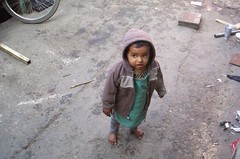
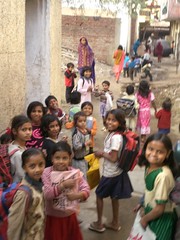
At many of these stops the children of constructions workers waived at us with broad smiles and innocent faces. These kids live in the tiny tents pitched around the sites. They are often brought from far away states by exploitative contractors who find these new migrants easier to manipulate than the local ones. They live under abysmal conditions and barely get enough to eat. Their children never go to school. The average of children in these families is 4 and soon they join the ranks of child labour so rampant in our shining capital city.
Each of these kids will be left without education and will follow the pattern of their parents: early marriage and multiple children who will in turn remain illiterate and so on. It is not difficult to imagine the multiplier effect on the population of India.
According to the HRD Ministry’s own figures, almost 90 per cent of India’s children drop out of school and never even make it to higher education. In the light of this the situation starts looking apocalyptic and India will remain the country with the largest numbers of illiterate in the world.
All education policies have failed and the state of government run schools is deplorable. While political honchos are busy redefining creamy layers of so called backward communities, children are simply dropping out. One of the so called solutions often proffered is to privatise education. This is absurd in a land where the Constitution guarantees free education and compulsory education to all children between the age of 6 and 14. (86th amendment).
The plight of India’s children is lamentable. Here are some facts from the 7th All India Education Survey, 2002
- Less than half of India’s children between the age 6 and 14 go to school.
- A little over one-third of all children who enroll in grade one reach grade eight.
- At least 35 million children aged 6 – 14 years do not attend school.
- 53% of girls in the age group of 5 to 9 years are illiterate.
- In India, only 53% of habitation has a primary school.
- In India, only 20% of habitation has a secondary school.
- On an average an upper primary school is 3 km away in 22% of areas under habitations.
- In nearly 60% of schools, there are less than two teachers to teach Classes I to V.
- On an average, there are less than three teachers per primary school. They have to manage classes from I to V every day.
- High cost of private education and need to work to support their families and little interest in studies are the reasons given by 3 in every four drop-outs as the reason they leave.
- Dropout rates increase alarmingly in class III to V, its 50% for boys, 58% for girls.
- 1 in 40, primary school in India is conducted in open spaces or tents.
- More than 50 per cent of girls fail to enroll in school; those that do are likely to drop out by the age of 12. 50% of Indian children aged 6-18 do not go to school.
Think about it.
by Anuradha Bakshi | Apr 19, 2008 | Uncategorized
 I had written a post a long time back when I had been touched by a simple unexpected gesture coming from a little boy. One does not expect such acts by children belonging to what is called poor homes! And yet one does need to be born in a manor to have impeccable manners.
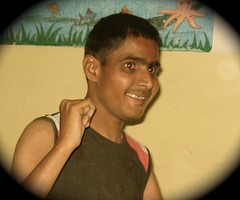
Yesterday morning Xavier and I went to the foster care to share a cup of tea with the children. AS we arrived they has just finished breakfast and we pulled up two chairs and set with them. Soon the tea arrived. Manu who sat as usual at tho head of the table was a tad fidgety and one could not fathom why as he has been all smiles since he has moved into his own place!
Before I go on I must explain to you the lay out of the veranda of the foster care. In the center there is a dining table and in one corner are two easy chairs with a coffee table.
After a while Manu got up and walked to the easy chairs. He cleaned the table with his hand and then gestured to xavier to come and sit in one of them. As I was busy talking he loudly called out Ma’am yahan a (ma’am come here) pointing to the other chair. I did as told and carried my cup of tea with me. He then pulled up a dining chair and sat with us a huge smile on his face.
Manu has spent most of his 36 years roaming the streets. He was what one may call a beggar. His own family was rather uncouth and coarse and most of the people who crossed his path were the same. Yet the day he gets a home, Manu the mentally and physically challenged soul behaves like a perfect host!
I wonder what it takes to be to the manor born!
by Anuradha Bakshi | Apr 18, 2008 | Uncategorized
 Tommy can you hear me sang the Who in their famous rock opera way back in 1970! Soon we at project why will be singing Rinky, Saheda, Pooja can your hear us! These were the words of an earlier blog written about four months back.
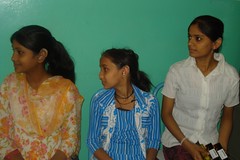
Today we are singing with pride and emotion: Rinky, Saheeda, Pooja can hear us! Yesterday they were fitted with their brand new digital hearing aids and could hear for the first time in their lives! There have been many blessed moments in the project why story but this one was one of a kind.
Rinky, Saheeda and Pooja are fantastic girls. With help from no one they learnt to get over their impairment and not simply survive but live life to its fullest. Rinky today works part time in a beauty parlour and has her very own clients! Saheeda is multi talented and will soon be starting training as a beautician. Little Pooja is endearing, bright and full of potential. They have all evolved their own sign language and can communicate with any and everyone and are all mean dancers who can fool anyone as nobody would believe that their perfect steps are done to music they cannot hear.
When they were fitted with their hearing aids they were first perplexed but then all smiles as they heard their very first sound. We are all moved to tears. However we know that this is just the very first step and there is a long way to go. They will need to learn to make sense of what for quite some time will just be incomprehensible noise disrupting their once silent world.
It maybe easier for little Pooja as she is still young, but for the older ones the journey will be an arduous one, with frustrating moments and we will have to be with them all the way. But somehow I know that these three exceptional girls will overcome all obstacles and come out as winners.
Today they spent a long time with two wonderful souls Jo and Dagmar who started on the thrilling journey of teaching them basic sound. It was moving to see them try and voice the sound that come so easily to us but that often became simple shrieks or groans. Yet they kept smiling and trying as if they were driven by a frenzy to make up for so many lost years.
by Anuradha Bakshi | Apr 18, 2008 | Uncategorized
It is a sad but unequivocal reality that there exists two Indias. In spite of all talk of unity and integration the truth is that we are a fractured society in strange and multiple permutations and combinations. There are the rich and the poor; the ones that speak English and those who do not; the one that belong to one caste or the other; the rural and the urban; the traditional and the modern; the ones that belong to one faith or another. The list in not only endless but mind boggling as it follows no logic at all but seems to suit different vested interests at different times!
I am still watching with utter helplessness the building of the 2 kilometer wall that will soon encircle the homes of many of our kids and that is being erected to block out the slum dwellers from their middle class neighbours! Wonder what it will take to see this wall fall. In Satara it took a threat of suicide by 100 dalit families and three years to bring down a 150 meter wall that was erected to confine them to one part of the village.
In both cases the wall was built by a court order!
Even policies meant to bridge differences turn out to be quite farcical as they too tend to crate further walls and often seem to be steered by hidden political agendas as is the case with the present debate on the creamy layer that is undoubtedly giving many a sleepless night to politicians.
Yesterday for the first time I traveled in a luxury tourist bus coach. We were taking some friends to see our plot of land. To my utter dismay I found another wall! The driver’s cabin was separated by a glass door from the rest of the coach. The coach was air conditioned to almost freezing temperature but the driver’s cabin was not. It simply had a small fan and was incredibly hot. I was shocked to say the least as to my mind it is in the drivers hand -quite literally – that lay the safety of his passengers and not having a door would have made scant difference in the comfort of the passengers.
There are walls everywhere, visible or invisible!
by Anuradha Bakshi | Apr 17, 2008 | Uncategorized
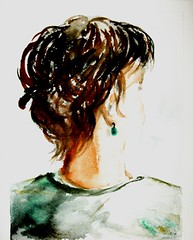
 This painting is one of a set sold by Iride, an Italian artist, to help sustain project why. I have never met Iride and she has never visited project why. She came to know about it through a volunteer who spent a few weeks with us.
Of all the paintings that she sent, this one entitled Donna touched me the most. Somehow it depicted the sum and substance of project why: an eternal quest for answers to all disturbing questions that come our way. The painting in its evocative strokes spells hope and belief. The faceless donna represents to my mind all those still waiting for a better morrow.
Iride is also one of those wonderful souls that have reached to help project why without finding it imperative to check antecedents, balance sheets etc. She was just touched by what she heard and maybe saw through pictures and followed her heart.
Donna also symbolises all the hearts the world over who have reached out and helped us all along. I am often asked, usually by the media, where our funds come from. The answer all expect is some well defined and established entity: an organisation or institution. But that is not the case with project why and I am often at a loss to find the words to explain the source of my funds as they come from the heart something that seems to have become terribly unfamiliar in the world we live in. They ask for numbers but how can I make them understand that a tiny amount or a huge one has the same value when it comes from the heart.
Iride’s painting touched my heart!
You can see some of her other paintings here
by Anuradha Bakshi | Apr 15, 2008 | Uncategorized
 In 2006 I had written a post about the total ignorance of most OBC parents about reservations in education. Sometime later I had highlighted he quasi impossibility for genuine cases to get the prized OBC or SC certificate and the absurdity of government forms.
Last week the Supreme Court confirmed reservations for OBCs excluding the creamy layer. Something that seemed acceptable to many but even before copies of the said judgement left the precinct of the Court a hot debate had begun about redefining the creamy layer in order onec again to protect vote banks et al!
The indubitable truth is that without a ‘proper’ definition of the creamy layer few OBCs will reach the portals of higher learning. And the debate will continue endlessly and aimlessly. No one is interested in improving government schools, containing drop out rates to ensure that deserving candidates have a chance to reach the gates of IITs and IIMs, while youngsters like Shiv will find their place in the sun.
A recent article highlights this in no uncertain terms. 90% of India’s children drop out of schools! These are figures of the HRD Ministry. And what becomes clear form this is that the first aim should be to ensure that children cross the boundaries of school. Sadly instead of cleaning up the mess existing in primary education our politicians are now busy redefining the creamy layer as the SC judgement defined the creamy layer or elite as defined in 1993 where the slab was put at annual incomes not exceeding 250 000 Rs.
The exclusion of the creamy layer did satisfy many anti reservationists but does not ensure political benefits and hence the debate will continue and the plight of children 60 years after independence will remain the same.