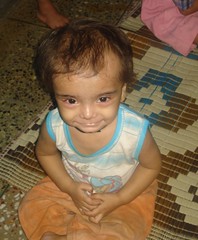
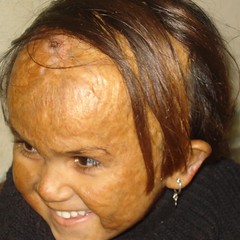
Utpal and Meher had a terrible tryst with fire when they were juts babe in arms. That terrible moment changed their lives forever. Perhaps this is the way the God of small persons operates.
Were it not for their scars these two spirited kids would have had very different lives. Utpal the child of a dysfunctional alcoholic family would have still been moving from home to home (as his parents were often shooed away by their landlords) and Meher would have had to bear the jibes and barbs of her peers who laughed at her maimed hands and scalded face. Neither Meher nor Utpal would have been in school.
But the God of small persons had decided otherwise. Both these children had been singled out and destiny had other plans for them but to accede to these plans the little souls had to undergo a baptism by fire. Today Utpal is in his third year in boarding school and had just been promoted to Class II and Meher has had her first surgery to repair her hands and face. Next year she too will join Utpal in school.
Strange are His ways… all we can say is Chapeau Bas!
We were rummaging through old home photographs and memorabilia when my eyes fell on a small leather bound book. It was a copy of the new testament and belonged to Ram, my father. A couple of pages had been earmarked. I opened the first such page:
At that time the disciples approached Jesus and said, Who is the greatest in the kingdom of heaven? He called a child over, placed it in their midst, and said, Amen, I say to you, unless you turn and become like children, you will not enter the kingdom of heaven. Whoever humbles himself like this child is the greatest in the kingdom of heaven. And whoever receives one child such as this in my name receives me. Whoever causes one of these little ones who believe in me to sin, it would be better for him to have a great millstone hung around his neck and to be drowned in the depths of the sea. (Matthew 18)
I had never heard Ram quote from the Bible or any other religious text and thus this came as a surprise. What was even more astounding was the content of the page marked. It was almost uncanny and surreal. Had I not been sitting and ruminating about how I would make both ends meet as we were/are again in the midst of a sever financial crunch. And had I not even considered, albeit for a tiny instant, packing everything up and moving on. True this was just a fleeting moment of weakness only I was witness to. But nevertheless it did happen.
Was this a message from Ram showing me the way and giving me the strength needed to carry on? I guess so. My thoughts went back to the day when I had stumbled upon a diary written by my mom and found in it many answers I sought. Once again in spite of being in another realm, my incredible parents had reached out to their hurting child. I knew what I had to do and above all knew that I would succeed.
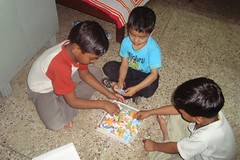
The little boys are lost in their game. At this very moment it is all that matters. The only aim is to try and win. They are not bothered about tomorrow or times to come.
On Monday these three boys and their pal Utpal and didi Babli will pile up in a big car with their bags and baggage and drive to their new school the place which if all goes well, will be their home for many years to come and will change their lives forever. As they cast their dice and move their pawn across the board, they are totally unaware of all the drama that preceded this moment and how close we were to see it all blow away. Yet the miracle happened like so many that came quietly, unobtrusively each time one prayed for them.
Yes we have had our share of miracles that even the most cynic or hardened soul has to acknowledge: a little girl whose scars will soon vanish, a host of little and big children who have passed into their new class, a child of God who once again has proved to us that spirit is stronger than any bodily ailment. True that each miracle came with its share of angst and worry, but all was soon forgotten.
Does one get a little nonchalant and even blasé in such circumstances and start believing that all is well and nothing can halt the winning spree? Not quite as past experience has proved beyond doubt. There is always something that calls us back to order and makes us realise that nothing comes easy. As I was basking in the glory of all that had been achieved came the startling yet expected news: there were no funds to see us through the month! I must admit that it was quite a shock. It is so easy for us humans to think that all is well and that nothing can come and cloud our sunshine. But everything comes at a price and perhaps the price of all the wonderful miracles that have come our way is our ability to remain humble and remember that one has to toil to achieve what we seek.
It has been a long time since I have held out my virtual begging bowl. Apologies to those who have expressed their disapproval at my use of the word begging. I will try and explain why I still insist on using it. Perhaps it is simply because it reflects in the best manner possible the attitude of humility that needs to be respected at all times. The price that needs to be paid lest we sink into hubristic realms. The past years have been replete with lessons some truly uplifting, others quite deflating. Yet what has transpired is that you ultimately win if you are willing to play the game by the rules.
So after a long time I am once again going to write innumerable mails to solicit help with the hope that once again people will look with their hearts and help us.
The scars on this beautiful face will soon be things of the past. Today a 10 am, little Meher will be admitted in s swanky hospital under the care of a top plastic surgeon and tomorrow will begin a series of complex procedures all aiming at rebuilding her scalded face and her maimed hands. To me she has always been beautiful and I feel in love with her indomitable spirit the moment I lay my eyes on her. It was also when I hurriedly mouthed a prayer to my friend the God of Lesser Beings seeking a miracle.
As always he heard my plea and the rest his history. He sent his messenger: Nina a warm hearted volunteer who crusaded for Meher with rare passion. A beautiful complex network was set in motion, and soon the miracle became reality. Meher is on her way to recovery. Once again, just as he had a few years ago, the God of lesser beings had decided to set things right. If all goes well little Meher will next year join the band of pwhy kids in boarding school.
When I sought a miracle for Meher, it did not stop at getting her reconstructive surgery as that alone would not secure her future. To me what was more important than her face was her hands as they held the key to her morrows. If Meher was to break the circle of poverty in which she was born, she had to be given a sound education and for that she had to regain the use of her hands. Armed with a good education the world could and would be hers. Without that she would simply follow in the footsteps of her mother and probably be married off as soon as feasible.
I have always been weary of half hearted attempts at helping others. I have always felt that often these are done for all the wrong reasons. Reaching out to another is a complex and delicate operation. Often it can do more harm than good if one is not careful. If you cannot go all the way then it of often better and wiser to leave things as they are, rather than create ripples that can go out of hand. It is undoubtedly very gratifying and uplifting to reach out to someone in need, but before handing out the help sought one has to look at the long term implications and see whether one has the strength to go all the way.
Some months ago our dear friend Sabrina shared a project she had in mind. She wanted to write a song and record it with the pwhy children. What was special about the song was that she wanted the lyrics to be written by the children and based on their dreams and wishes. It seemed wonderful but I must admit I was little nervous. Sabrina and Chris came in February. There were workshops and rehearsals, and even a recording in a studio. They left with images and sound tapes and leaving me even more anxious. This morning I got a mail and a link to the song. I was simply floored.
The song is beautiful but what is touching are the lyrics, yes the ones based on the dreams of my children. So what do they dream of you may ask? Simple things: flowers and trees, no fighting but peace, schools and universities, play grounds with a swing and clean water, to be a dancer or simply to read, new shoes, a doll and a gift for their mom!
Take a minute and listen to the song. Look at the beaming faces and the trusting eyes and ask yourself a simple question: are these children asking for anything more than what should be rightfully theirs? Are these simple wishes not something we could and should make theirs?
Once upon a time in a big city a little boy was born. His parents belonged to different faiths and both had their own families that they could not or did not want to leave. They both also had a little boy eachfrom marriages they had not really wanted. They met, fell in love and as is often the case gave life to a child they could not really tend to or care for. Like many others the little boy was brought into the world for all the wrong reasons. No one ever thought of a life map for him or cared about his future. He was just two weeks old when he landed quite inadvertently into the arms of a bunch of people and crawled into their hearts. They decided to build him a future, one that would be safe and secure.
He learnt to smile, to hold his head, to sit up and to crawl under the watchful eyes of caring strangers. As the story of his life enfolded, the hopelessness of his existence became a stark reality. In a land where the right labels were mandatory his were lopsided and flawed. He had no caste, nor creed. He did not even have a proper father. The caretakers who had taken on the challenge of crafting him a solid morrow felt that perhaps his chances would be better if he could fly to another land with new parents.
Luck seemed to be with him as a seemingly kind couple reached out to him. The tedious process of what is called adoption was set in motion. As adults began playing the complex game of adoption, the little boy’s life was filled with joy and hope. Wonderful gifts, smart clothes, outings to fancy places and scrumptious treats cames his way. He turned one, and then two and three. His life was almost picture perfect and he enjoyed it oblivious of the drama being played. Yes there were a few days spent in ugly buildings called courts but the new mama and papa were always there to buy him an extra treat.
Then one day everyone seemed to be jumping with joy as the big people had decided that he could be adopted and even the grim court seemed happy that day. Everyone thought that it was only a matter of days, perhaps weeks and the little boy would fly away. But then a phone call and news that another little boy had been found for the couple in their own land and the new papa and mama had to fly away to complete another adoption game. But they promised to come back for the little boy. Months went by, and then a whole year. The little boy was four. He still showed off his now faded tshirt and said it was his other mama that gave it to him. The paper work seemed endless and the wait unending. The new papa and mama stopped calling and then one day a call informed his real mama that they were giving up and did not want the little boy anymore. They did not even want to be part of his life at all. The game had ended and the little boy had lost! All he had left were a few faded and hazy pictures, some broken toys and some hazy memories of the mama and papa who spoke in a funny way.
This is not a story. The little boy exists and is in our creche. We are all stunned by the news. We can understand that sometimes administrations and laws are callous and complex and do not go he way we would like them to. But what has really shocked us and hurt us is the fact that the people who once wanted this child and were willing to give him the world and more did not want to have anything to do with him.
I am not normally in favour of adoption. In this case I relented as the little boy’s situation was terrible and that he would have to live with too many shadows in a society that could be cruel to children with his kind of past. Somehow it felt right to have him grow in a land where he could run his race without handicaps. I had been concerned about the complexity of the legal battle and scared of its outcome. I had even suggested to the adoptive parents that were things not to go the right way, they should at least ensure that the child gets a sound education as that could be his key to freedom. I had feared that perhaps things would not turn our way but never had I imagined that the very people who had once wanted him with passion would not only turn away but leave the child high and dry. How can anyone be so callous or heartless. I guess the God of lesser beings saw through them and decided to make a course correction in time.
The little boy will next year join the five little pwhy children in boarding school. Till then he will remain under our care, safe, secure and truly loved.
No adult should ever be allowed to play with a child’s life. This is the worse case of child abuse!

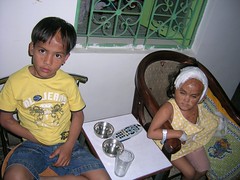
 Utpal and Meher had a terrible tryst with fire when they were juts babe in arms. That terrible moment changed their lives forever. Perhaps this is the way the God of small persons operates.