by Anuradha Bakshi | Sep 21, 2011 | Uncategorized
 To be poor in India you need, according to the Planning Commission to spend less than 32 Rs a day or 965 Rs a month if you live in a city! The Planning Commission (PC) suggests that spending Rs 5.5 on cereals per day is good enough to keep people healthy. Similarly, a daily spend of Rs 1.02 on pulses, Rs 2.33 on milk and Rs 1.55 on edible oil should be enough to provide adequate nutrition and keep people above the poverty line without the need of subsidized rations from the government. It further suggests that just Rs 1.95 on vegetables a day would be adequate. A bit more, and one might end up outside the social security net. For health you need to spend not more than 39.70 a month and only 99 paise a day on education. What is strange in all the numbers proffered by the PC is that they do not consider habitat as a necessary expenditure for the poor. Wonder where they are supposed to live. No this is not April Fool’s day and not a joke. Spend a penny more and you cannot benefit from welfare scheme, or get the famous below poverty line line (BPL) card! What are we trying to do: show the world that we are not poor?
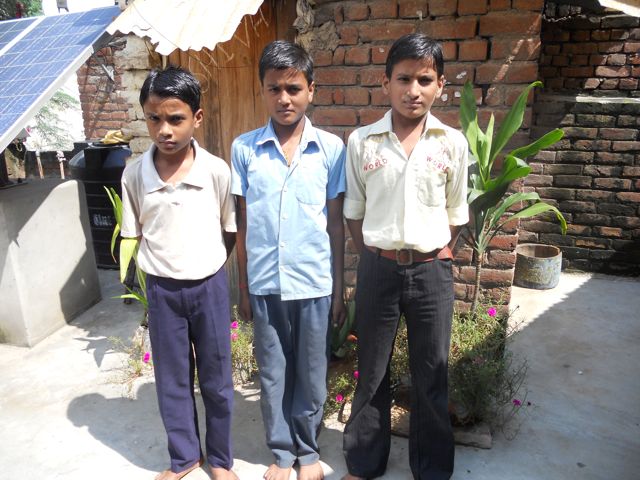
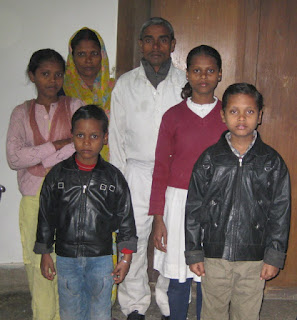
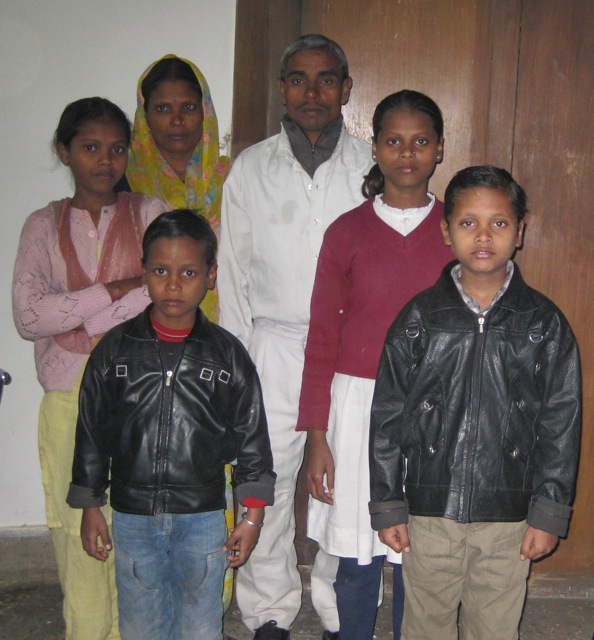
Even the beggar who sleeps under a bridge spend more than the stipulated 32 rs. But let us get serious. If you are a family of 6 and you spend more than rs 5790 then you are not poor. Let me put this sum that may look large to the uninitiated into context. Ram Bachhan the guard at our women centre has four school going children and a wife thus making them a family of six. He used to work for a company but then got severely ill and lost his job. Till quite recently they were considered poor and had a BPL card. But the card was not renewed for reasons known only to the powers that be. They live in a rented room for which they pay 15oo rs, or 50 rs a day. On any given day they buy at least half a liter of milk for their tea at the cost of 16 rs, 2 kilo of rice at 20 rs a kilo, 20 Rs worth of vegetable per meal that is 40 Rs, 20 rs for pulses, 10 rs worth of flour, let us say that their daily cost on tea, spices, oil etc comes to 20 rs, 20 rs for fuel, and 20 rs for toiletries. All this comes to 238 way above the 32×6=192 stipulated to be poor. This is the bare minimum. It does not include illness, education, shoes, clothes etc. And talking of shoes the Planning Commission stipulates 9.9 rs a month for shoes or less than 120 rs a year. We all know the price of shoes and with 4 growing school going children one does need more than a pair per year! As for health, well if you spend more than 39 rs a month you are not poor! A quack in the slums charges 50 to 100 rs a visit and then there is the cost of medicine. We all know how much medicines cost!
You will agree that the figures are ludicrous. In urban India a cup of tea costs 5 rs and a meal at a road side cart 20rs. So if you have 2 cups of tea and one meal then 32 rs does not take you very far. You will agree that the figures are ludicrous and makes us wonder what goes behind the scene. At best it shows that those who make rules and laws are completely divorced from reality. Maybe the members of the commission should try and live on 32rs a day for a month. One should maybe suggest a new TV reality show in this vein. I wonder whether this is our government new way of saying that we are not that poor, or maybe simply on saving on welfare schemes. All I can say with confidence is that this is outrageous.
Ram Bacchan earns 4000 rs and his wife 1500 rs. You can see by just doing some simple maths that the earnings barely cover their expenses. Forget about saving even though they have two girls that will one day need to be married. The BPL scheme enabled people like Ram Bacchan to survive. Today he is struggling to keep life going. Saving is a word that is not in his dictionary. I wonder what will happen to him when prices rise again. Will a child be withdrawn from school to go to work? That would be terrible as all his children are exceptionally bright and doing very well in their studies and could if given a chance aim for a better future.
One never grudges the extra taxes imposed on us for welfare schemes. I suppose no one grudges such schemes as long as they reach the beneficiary but alas that is not the case. For a government that professes to be pro poor such statistics are out of sync. By no means would you call Ram Bacchan and his family ‘rich’. One would not resent it if they received any aid. Actually one would welcome it as it could possibly ensure that his children manage to break the cycle of poverty and maybe become teachers or IT professionals. They have the wherewithal to aspire to this. His daughters often top their classes. But he has lost his BPL card and looking at his expenditure he now does qualify as poor.
There are many like him and I hope that civil society that finds its voice to espouse causes dear to it – we saw it recently during the Hazare campaign – will rise to defend the voiceless poor. We at pwhy intend to take up Ram Bacchan’s case by filing an RTI to find out why he was denied renewal of his BPL card. We plan to do this as a project with the senior children of the women centre so that they can learn to be active and good citizens. Will keep everyone posted.
by Anuradha Bakshi | Sep 20, 2011 | Uncategorized
 Ever since I received a mail about the house of the richest Indian, I have been plagued by the facts and figures of this unthinkable mansion: three helipads, parking space for the owners 200 odd cars, a floor for maintenance of the same, two floor health centre, a movie theater, a ballroom, elevated gardens and 4700 m2 per person. It was built at the whopping cost of one billion dollars, making it one if not the most expensive house in the world! In it will live a family of five who will be cared for by a staff of 600. The monthly electricity bill is a whopping 700 000 Rs. It is all mind boggling and for me it is difficult to begin to understand how a family can call this a home. The building looks ugly and the pictures of the interior remind me of a museum and not a home. It looks more as if its owner is trying to make a statement if one is to beleive McDonald who writes : perhaps he (Mukesh Ambani) has been stung by his portrayal in the media as an introvert. Maybe he is making the point that he is a tycoon in his own right.
I am reminded of a quote by Lisa Edmondson who says : he who is humble is confident and wise. He who brags is insecure and lacking. It seems that the richest are the most insecure. Many of the homes of my richer friends (not in Mr A’s league of course) have always seemed empty and soulless to me, even though they are fit for any home and decor magazine. I have found the true meaning of homes at the other end of the spectrum in the dwellings of people one could name the poorest in India: in Utpal’s home when he had one, in Babli’s home, in Munna’s home, in Manisha’s home and not to forget in the homes of all my Lohar (gypsy) friends before they were bulldozed to make the city beautiful for foreign guests. The one common factor of all these homes is that they have an open door quite literally so. You do not even need to knock. A simple koi hai (anyone there ) is ample. (Try entering Mr A’s home, you will probably land up at the cop station.)
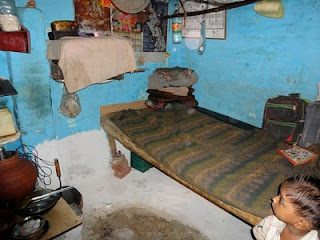
In the homes of the so called poor you are immediately greeted with warm smiles and offered the best place to sit. You are a guest in the true Indian tradition. You are offered the best place to sit, often the sole bed, and before you know it a cool drink or warm cuppa is in your hand. There are smiles on every face and you feel at ease and welcome. You soon forget how dilapidated the surroundings are or how hot or cold it is. True that the first time you encounter such homes you are a little puzzled as they resemble nothing you have seen before, but after some time you get the courage of looking around and you realise the love and care that has gone into making a hole a home. The sole room is a bedroom cum sitting room cum kitchen cum kids room in one and yet you soon see personal touches: a picture hanging, a shelf with some decoration pieces, another one with the few good cups, kitchen ware neatly arranged in one corner and so on and surprisingly in spite of the squalor that surrounds it there is an almost pristine feel around. Once the initial shock over, you realise that the place is filled with warmth and life. And wonders of wonders you feel good and welcome.
What astounded me was the fact that I have never got the feeling that any owner of such homes is embarrassed or ashamed. I remember when I use to visit Utpal in his sordid home, he must have been three at that time, he often walked ahead of me and then climbed on a rickety plastic stool and with is pudgy hands caught hold of two hanging wires and plugged them in a dangling socket to get the sole fan going. At first I was horrified but soon realised that this was the way it was done and like all slum children, Utpal was wise beyond his years. Or can I ever forget how little Ritu the tiny lohar girl use to drag me into her home and make place for me on the bed before she marched on to find her mom and ask her to make me a cup of tea. And believe you me, I never wanted to leave these places as they were filled with all that was good. In learning to survive the poor had mastered the art of living. They were humble true, but confident and wise. They did not need more than the tiny space assigned to them to be who they were.
Entering the intimate world of the poor has been the most uplifting experience of my life. I have learnt many lessons in humility and courage, in fortitude and patience. But what has been the most valuable was the fact that these people were the repository of traditions and mores even though sometimes their tenacious belief in them could be infuriating.
The poor live with dignity and wisdom; maybe there are lessons for all to learn.
by Anuradha Bakshi | Sep 16, 2011 | Uncategorized
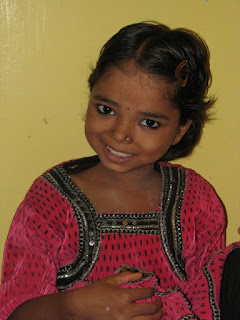
 Every time Radha breaks one of her fragile bones, my heart misses a beat and my blood runs cold. Radha had a fall last week and once again broke her leg. It must have been the evil eye as she was doing so well and on the day the mishap happened had won the prize of best dancer of the class. Today she lies in her dank and dark home and I find myself questioning the heavens.
Osteosis Imperfecta or glass bone disease is hell for anyone but more so for someone born on the wrong side of the fence. In a city like Delhi which has forgotten that the poor also need a roof on their heads, families like Radha’s live in unbelievable conditions. Even if you earn 10 times more than the stipulated 20 Rs a day that qualify you as poor in the books of the State, you can at best afford a jhuggi in one of the umpteen slums that have mushroomed in Delhi. These dwellings are often sunk in, airless and unfit for any living being and come at the whopping price of at least 1000 rs a month. Often the tiny space of barely a couple of square meters is shared by 6 or more people. That is the abject reality of habitat for the poor in our swanky capital city. It is bad enough, but when you suffer from glass bone disease it spells disaster. I am not even mentioning the total lack of facilities in such homes. Our new special educator who comes from a small town was shocked to see Radha’s home. I wonder what he would have said had he seen the one she lived in before!
Yesterday someone forwarded my an email about the home the richest Indian, where each occupant has seven thousand square meters to him or herself. I must admit that seeing the pictures and reading the figures was galling particularly at a time when my mind was teeming with pictures of Radha with her leg in plaster sitting in the flooded hole which she shared with so many. The pictures once again brought to the fore the stark reality of the two Indias that lived side by side but never met. I wondered whether those who had a surplus of space even knew about the plight of the likes of Radha. Imagine one family of five having thirty seven thousand square meters to themselves and the other barely five! Something is wrong and needs to be addressed but when will that day dawn?
Once again the plight of Radha brought to the fore the urgent need for many Planet Whys. Sadly I cannot even get one off the ground.
by Anuradha Bakshi | Sep 15, 2011 | Uncategorized
 When we launched our focus on quality programme in 2010 I did not quite know what results it would yield! But to my mind getting the primary kids to learn spoken English was something I intuitively felt would bear fruits. Quite frankly I was thinking far ahead to times when the spoken English of our kids would help them in getting a better deal in let us say work interviews!
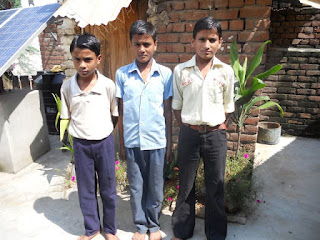
To my utter surprise and delight I did not have to wait that long to see results. Firdos, Suraj and Vikash who are students of our women centre are the first beneficiaries of our programme. They have been admitted to the English medium batch of the secondary government school. It may sound a small feat to those who do not know how things work. To get admitted in the English medium batch, children of class V have to sit for an English exam and pass it. It is often very difficult for children from deprived homes to make the cut but these three boys did. It was another ah ha moment for us and we were thrilled beyond words.
It is heartwarming to know that our decision to introduce spoken English classes for the primary children was a good one. Just wanted to share this bit of good news!
by Anuradha Bakshi | Sep 12, 2011 | Uncategorized
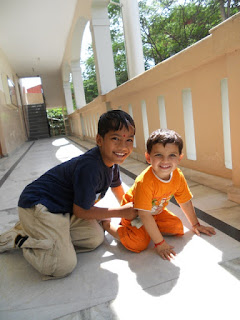
 Yesterday was a blessed day! It was PTM day at the boarding school but a very special one as little Agastya my grandson was with us. Agastya and Utpal share a very special bond. What makes it unique is that in normal circumstances the twain should not have met as they belong to diametrically opposed worlds. Whilst Agastya was born with the proverbial silver spoon, Utpal was barely wanted. It is a miracle conjured by the God of Lesser beings that changed matters. He commissioned the same old biddy to be part of their worlds.
I must sheepishly confess that when Agastya landed in my life I was a little worried about Utpal’s reaction. I needn’t have as he immediately opened his huge heart and took him in. He just became the big brother. Now the two have a great time when they are together and Sunday was just that.
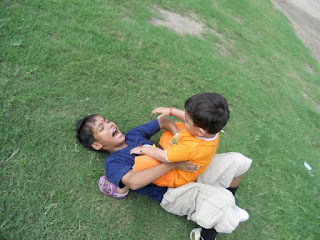 The boys romped around the school, played ball, ate biscuits, had a great time on the slides and swings and rolled in the grass to their hearts content. It was a joy to watch them. But as I looked at them so carefree and happy the moment turned somewhat bittersweet. While the future of one of them was safe and secure the other’s was at tremendous risk as it hung by a flimsy string. It was heart wrenching to think that Utpal who was laughing his heart out had no one in the world to call his own. His mom has not given sign of life for many months. His fate has been decided by a court that stipulated that he spend his time between the boarding school and my home.
To secure Utpal’s future we need to ensure that his school fees are paid till the end and then need to sponsor his further studies. We also need to guide him at every step through his childhood, teens and further. We need to love him, chide him when needed, support him and stand by him. In a word to be his family. It is a huge responsibility and a tad scary. Yet I know that these need to be done with determination and compassion. There is no option available.
Looking at Utpal brought to the fore once again the huge question that hangs around us like the proverbial elephant in the room: pwhy’s future. As age catches up I find my energy dwindling and cannot put the same zeal I once had into day-to-day fund raising, hence the need to find ways to secure pwhy in the short and long term. Planet why seems more and more like a chimera. A sound idea that did not find takers as the costs are high and the returns intangible or of of the kind that do not make sound commercial sense. A child’s future, a life with dignity and so on are not solid enough grounds.
Cynics would say you can only do that much. I know many Cassandras who feel that one should not worry and let things take its course or if needed trim the project to size. Easier said than done. I have been over the past sleepless nights trying to imagine who would be axed: the little children of the creche, the new primary centre, part of the women centre… and each time my blood has run cold. True I could find many logical reasons to let go of any of these but the heart finds none. Little eyes look at me with hope and trust and all my highfalutin thoughts vanish. What remains is the knowledge that I need to find ways and means to protect them all.
I refuse to believe that in this big world there are not enough people to hear my appeal and reach out. I guess I have to try harder at least till I am around.
by Anuradha Bakshi | Sep 9, 2011 | Uncategorized
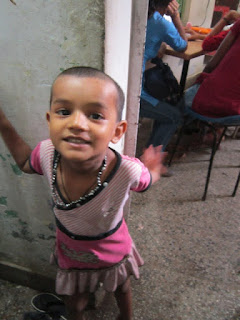
 In Parliament last week the Minister for Health admitted that 1,74 million children under five die every year in India. I do not know how many of us reacted when the news was aired. I do not know how many of us realised the enormity of the statement. 1,74 million is no small figure! More than half of the deaths were in the first 28 days of life. The causes stated were: pneumonia, diarrhea and of course malnutrition leading to extremely low immunity. Forget the causes; the simple fact that so many children die is unacceptable in a country where according to statistics again some of the richest people live.
I urge you to stop a moment and give some thought to the above numbers. Let me put the statistics into context: the annual number of malnutrition related death in India is more than the total live births in the UK and one-third of newborns in the US. That is huge by any yardstick. 3000 children die every day of malnutrition in a country where food is thrown unabashedly at every wedding or religious feeding frenzy, and in homes; where grains rots with abandon every year for want of storage. All this should shock us out of our lethargy in the same way as corruption did a few days back, but food security is a cause the haves will never espouse. It is something too alien to them. But I ask do such stats not disturb you every time you throw food be it at home, in a party or in a restaurant? It is time it did.
As a state and a society we are guilty of 3000 murders a day! And let me remind you most of these are due to corruption in the so called social programmes heralded each year with great fanfare by the Government in power. A simple and quick look at such programmes show that most address the causes stated above. There are programmes for immunisations, early childhood nutrition, pregnant and lactating mother and of course education that has now become a constitutional right though no one seems to understand the full significance of such a right. If we did then the sight of any child begging on the street or working in a teashop should outrage and revolt us and should make us ask questions of our elected representatives. But it does not, simply because our children are safe and secure.
The Minister made his statement in parliament and so no cynic can state that the figures are cooked up, if anything they err on the low side. What disturbs me is that such scary statistics do not outrage and incense us. Recently we caught a glimpse of an outraged India that stood up against corruption. Will we one day find it in us to stand up against hunger, even if it does not affect us directly. I hope that day will dawn!

 To be poor in India you need, according to the Planning Commission to spend less than 32 Rs a day or 965 Rs a month if you live in a city! The Planning Commission (PC) suggests that spending Rs 5.5 on cereals per day is good enough to keep people healthy. Similarly, a daily spend of Rs 1.02 on pulses, Rs 2.33 on milk and Rs 1.55 on edible oil should be enough to provide adequate nutrition and keep people above the poverty line without the need of subsidized rations from the government. It further suggests that just Rs 1.95 on vegetables a day would be adequate. A bit more, and one might end up outside the social security net. For health you need to spend not more than 39.70 a month and only 99 paise a day on education. What is strange in all the numbers proffered by the PC is that they do not consider habitat as a necessary expenditure for the poor. Wonder where they are supposed to live. No this is not April Fool’s day and not a joke. Spend a penny more and you cannot benefit from welfare scheme, or get the famous below poverty line line (BPL) card! What are we trying to do: show the world that we are not poor?