by Anuradha Bakshi | Oct 6, 2011 | Uncategorized
 Sometimes life hits you in the head with a brick. Don’t lose faith. I’m convinced that the only thing that kept me going was that I loved what I did. You’ve got to find what you love. And that is as true for your work as it is for your lovers. Your work is going to fill a large part of your life, and the only way to be truly satisfied is to do what you believe is great work. And the only way to do great work is to love what you do. If you haven’t found it yet, keep looking. Don’t settle. As with all matters of the heart, you’ll know when you find it. And, like any great relationship, it just gets better and better as the years roll on. So keep looking until you find it. Don’t settle wrote Steve Jobs.
I first heard this words from Steve Jobs a few years back at a time when I was going through a bad patch. These words were from the famous speech he gave at Stanford University in 2005. His words made me sit back and look at my life with different eyes. Project why was five years old and despite minor hiccups was doing great. That was also the year we got public recognition for our work. I pondered a long time on the thoughts proffered and realised that they in more ways than one chronicled my journey. For many years people had chided me on not settling, as I moved from one pasture to another. I had shunned a career in the government, dabbled with a radio job, taught in a university, worked an an interpretor, run my own conference business and yet never settled. It is only when I decided to do something for the elusive other that I sank roots. I finally settled and each year got better and better in spite of small impediments.
Jobs’s personal story recounted in the same speech was also an eye opener as it proved beyond doubt that nothing was impossible. And somehow the maxim that we followed was the quite similar. It did not matter if you were born poor or if you could not access the best education the sky could be the limit if you wanted it to be. That is what we believe in too.
Your time is limited, so don’t waste it living someone else’s life. Don’t be trapped by dogma — which is living with the results of other people’s thinking. Don’t let the noise of others’ opinions drown out your own inner voice. And most important, have the courage to follow your heart and intuition. They somehow already know what you truly want to become. Everything else is secondary added Jobs.
In this one speech Steve Jobs has given us a great Art of Living. He leads by example. We all feel the loss of this endearing human being. May he rest in peace.
by Anuradha Bakshi | Oct 6, 2011 | Uncategorized
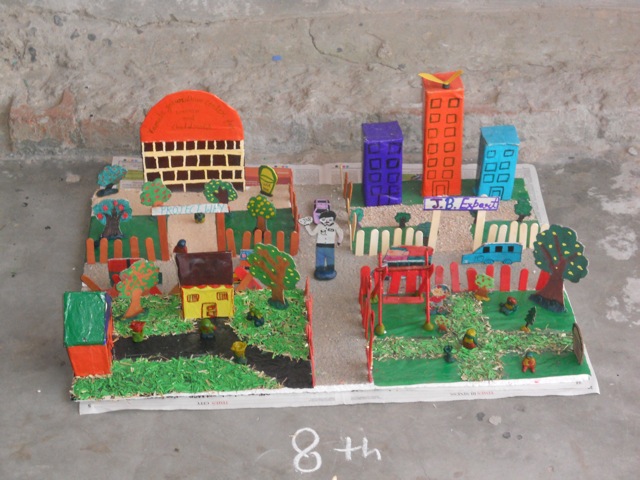
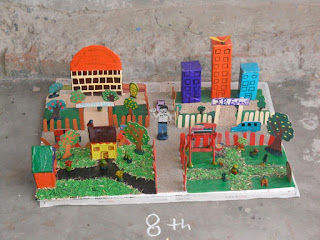
 The children of our women centre celebrated Gandhi Jayanti in their own inimitable style. Boys and girls of all classes participated in the celebration. The children made posters and colourful models to show their vision of Gandhi. It was quite unique. Many kids thought that making things out of waste material was a way to actualise Gandhiji’s teachings. Others felt it was respect for a clean and healthy environment. Yet others came up with models of solar cookers and flour mills propelled by wind. Each class had completed their presentation with utmost care. I loved the class VII model of an ideal city where everything was eco-friendly.
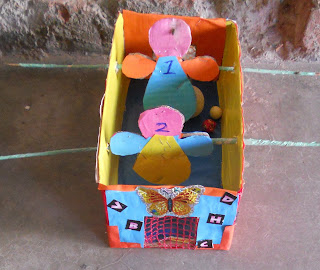 But my all time favourite was the little babyfoot (table football game) made out of a shoe box by the tiny kids of class III. It was perfectly made with little nets at the goal post.The little game actually worked! The bright little girls who had come up with the ideas were very proud of their creation and needless to say got a prize. A student of class IX had prepared a speech and delivered it with great aplomb. I was very impressed by the creativity of the children and very proud of them.
It was then time for a discussion about Gandhiji’s teaching and I was really amazed by the maturity displayed by the children. They talked about kindness and compassion. About how the poor should be helped, about how violence should be avoided, about truth and integrity. As we talked the debate got widened and we touched upon subjects like education and the recent poverty figures of the planning commission. Every child however young was fully aware of the cost of things and the family budget, something we would not see in rich kids. They knew the price of everyday needs and how much their parents spent on rent and electricity. I was deeply moved as it showed once again how kids from poorer homes grow up faster than one would wish. These are the kids that have been let down by one and all, kids that deserve nothing but the best.
by Anuradha Bakshi | Oct 6, 2011 | Uncategorized
 Though the Right to Education is in place there is still along way to go according to 15 activists who visited 60 schools. Provisions of the Right to education Act notwithstanding, dirty toilets, shortage of books and staff, broken benches, no playground and absenteeism are still the major issues in many Delhi government schools is the conclusion drawn by those who visited the schools in our capital city. In a school located in the constituency of our present education minister the computer lab lies shut as there are no teachers to teach the subject. Such is the state of education in a country where Education is now a Constitutional Right.
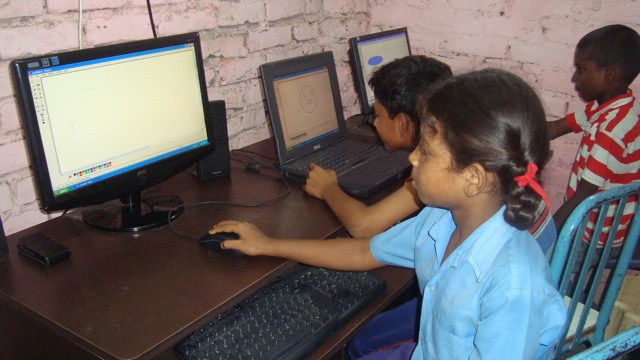
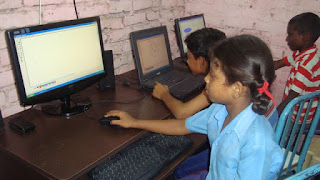 What makes me see red is the fact that it is once again children who are at the receiving end. Children who have enormous potential and scant resources. Children who can excel if give a tiny chance. I more than anyone else can say this with conviction as for the past 11 years I have been helping such kids. In a reclaimed garbage dump or under a hot tun roof we have been able to remedy to the lacunae of the government schools and teach hundreds of children who have done us proud. Our children have mastered computers and learnt dance and sing over and above learning their school lessons. Many of them now have good jobs and have broken the cycle of poverty in which they were born. Why have we succeeded: simply because we wanted to, notwithstanding anything.
Where there is a will there is a way goes the saying. By this adage one could infer that the Government has no real will to implement the Right to Education. How can we forget that children are not vote banks and are voiceless and that giving them education is also perhaps running the risk of giving them a voice. A look at published statistics tells its own story: In absolute numbers there are 1.5 million children who are dropouts or have never gone to school. There are in total 5,442 schools in Delhi.3 The enrolment figures amount to 1.7 million (17.5% of the population). The gross dropout rate is 69.06%. This does not leave much to be said about the levels of retention in schools across the capital city.In absolute numbers there are 1.5 million children who are dropouts or have never gone to school.Eighty percent of the class 5 pass outs from MCD schools do not know how to read and write their names. Only 14% of the students who enter a govt school in class 1 make it to class 10 and just 4% manage to pass class 10 says a report of the Centre for Civil Society
It is time we woke up and did something!
by Anuradha Bakshi | Oct 3, 2011 | Uncategorized
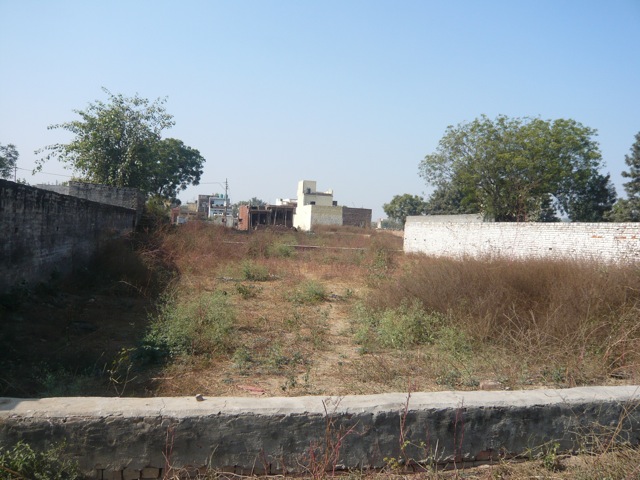
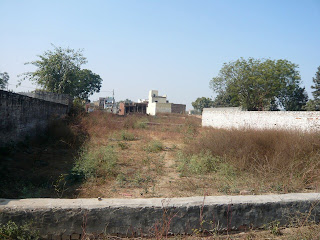
 This is, to me, the loveliest and saddest landscape in the world. It is here that the little prince appeared on Earth, and disappeared wrote St Exupery. I am reminded of these words as I look a this picture. This is a picture of land where Planet Why is/was to be. There are moments when the picture comes alive and I can imagine planet why just I want it to be: a beautiful green guest house filled to capacity with happy clients and a wonderful children centre buzzing with activity. I can visualise the place to the last detail, see the smiles and hear the laughter. Then the image changes and the land remains as it is: barren and sad.
If I am true to my words then we have just three months to conjure a miracle, failing which planet why and all it stood for will be laid to rest. To quote St Exupery again: a rock pile ceases to be a rock pile the moment a single man contemplates it, bearing within him the image of a cathedral, I have contemplated my barren land it time and again with the image of my cathedral but till now nothing has happened. My prayers and pleas to gods and men have remained unheard. Now I have under hundred days to offer my ultimate entreaty.
So let me take it from the top one last time. The challenge of every self respecting not for profit is sustainability: how to ensure that it generates its own resources and thus can carry on its work unheeded. Needless to say it is and has always been up most in my mind. Our sustainability story began way back with a series of naive attempts: candle making, chocolate makings, card and bags production. It goes without saying that these not only failed miserably but also burnt a hole in our lean pockets. We quickly realised that this was not the way to go. Then came the one rupee a day a project. This was something we truly believed in! Somehow it seems in sync with who we were: a grassroots project with a grassroots team and this approach seemed eminently doable. The idea was to contact a wide cross section people and ask them to give us one rupee a day! This would be something any one could do, or so we thought. To cut a long story short the whole idea fell flat: people did not warm up to it believing that one rupee could not make a difference and many of my won staff found thought it was infra dig to ask for such a tiny sum. The whole idea had to be shelved though I somehow still believe in it.
The quest for our elusive grail continued. We flirted with the idea of making clothes for children, of running a nursery for oil seeds, of Diwali hampers and so on. Needless to say they all boomeranged! Sustainability had never seemed so elusive. Time passed till the fateful day when someone mentioned the Ninos Hotel in Cusco. It was an ah ha moment; the grail seemed within reach. Our sustainability would be through hospitality. A guest house would be our way of raising funds. The idea looked so perfect. It was almost scary. There were many false starts and hiccups but we managed to purchase the land and begin planning in earnest: architectural plans, costings, 3D model and to crown it all a validation of the business plan by renowned consultants. We just had to raise the funds and we would be in clover! Alas things did not turn out as we would have hoped. The figures and numbers were huge. Our contacts into the world of the rich and endowed non existent. Our network inadequate. Many did try and help and at one time we even thought we had succeeded. But it was not to be. The end result is that we are today exactly where we were a year back.
The problem I think is that project why is where you see with your heart, something very few people still do. When you pitch a proposal like planet why which requires people to dig deep into your pockets you have to come up with cold statistics to convince them. We do not have such figures. What we have is intangible yet precious: dignity, care, compassion. Your return on investment is measured in smiles, success in examinations, better opportunities for those who have none and so on. These don’t cut any ice when you are on the market for big bucks.
31 December 2011 is the day we plan to lay planer why to rest if nothing happens. We have less than 100 days to make it happen. So help me God!
by Anuradha Bakshi | Oct 2, 2011 | Uncategorized
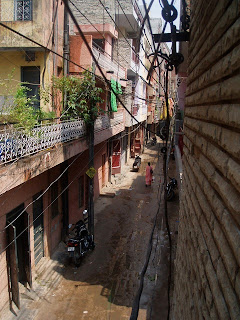
 Gali No 3, Govindpuri is where our main centre is located. It is also the street that houses our flat share for volunteers. To the uninitiated it may look like cramped, dirty, messy, chaotic, congested place. And in many ways it is: tiny lanes that once housed single story units now have been remodelled to include multi storied flats for rent; lanes that once only say bicycles or at best scooter are now crammed with cars and motorbikes courtesy the arrival of credit cards; for want of fresh air in their houses which have no natural light people tend to bring out stools and chairs and sit on the street; hawkers ply the lanes peddling their war. You can buy almost every and anything you want: vegetables, fruit, clothes, kitchenware, cleaning implements, snacks and ice lollies: you name it they have it.
The place brims buzzes with activity. On our street ground floors have often been converted to tiny shops and businesses: you have small grocers, repair shops, photocopying facility, a shoe vendor, restaurants, juice vendors and even a flour mill. Old women are employed by the mill owner to clean the grain before milling. These ladies often sit on the street itself and each time we need to pass in our three wheeler they have to gather their grain to make way! The tiny lane sees many traffic jams that get nightmarish when any building activity is going on.
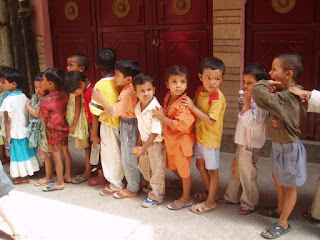 Twice a day we too add to the traffic in our own way: that is when our creche children are dropped by the school transport at the top of the street and need to walk to the centre and vice versa when it is time to go home. It is all part of the daily humdrum of life in our street. What is amazing is that no one complains: one just tries to find the best alternative possible so if a delivery van blocks the street for instance, you simply tun around and take another one. At times you come in the morning and see a tent erected in the middle of the street: it could be a wedding, a religious ceremony or a funeral. You simply park your vehicle on the main road and walk to your destination.
All the lanes give onto a main road which though large always seems congested. It is a main bus route and hence many buses ply on it. Add to it cars, auto rickshaws, cycles, motorbikes, and all other imaginable vehicles and you have a huge mess. But that is not all we still have to add all the hawkers, street vendors to make it a colourful vibrant chaos. The place is teeming with people whatever the time of the day. It is an aggression on all your senses though not an unpleasant one. Not to forget the local vegetable and fruit market and the weekly Wednesday market that commandeers the whole road making traffic a real nightmare.
For the past two years now it is also home to the project why volunteers. I must admit that when we took the decision of housing the volunteers in this street we were a little concerned about what their reaction would be. It was a pleasant surprise to learn that all of them loved the area with its sounds and smells. And above all, all of them felt safe unlike in other parts of the city deemed touristic.
Govindpuri is truly a slice of real India.
by Anuradha Bakshi | Sep 21, 2011 | Uncategorized
 To be poor in India you need, according to the Planning Commission to spend less than 32 Rs a day or 965 Rs a month if you live in a city! The Planning Commission (PC) suggests that spending Rs 5.5 on cereals per day is good enough to keep people healthy. Similarly, a daily spend of Rs 1.02 on pulses, Rs 2.33 on milk and Rs 1.55 on edible oil should be enough to provide adequate nutrition and keep people above the poverty line without the need of subsidized rations from the government. It further suggests that just Rs 1.95 on vegetables a day would be adequate. A bit more, and one might end up outside the social security net. For health you need to spend not more than 39.70 a month and only 99 paise a day on education. What is strange in all the numbers proffered by the PC is that they do not consider habitat as a necessary expenditure for the poor. Wonder where they are supposed to live. No this is not April Fool’s day and not a joke. Spend a penny more and you cannot benefit from welfare scheme, or get the famous below poverty line line (BPL) card! What are we trying to do: show the world that we are not poor?
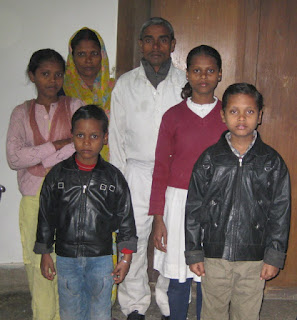
Even the beggar who sleeps under a bridge spend more than the stipulated 32 rs. But let us get serious. If you are a family of 6 and you spend more than rs 5790 then you are not poor. Let me put this sum that may look large to the uninitiated into context. Ram Bachhan the guard at our women centre has four school going children and a wife thus making them a family of six. He used to work for a company but then got severely ill and lost his job. Till quite recently they were considered poor and had a BPL card. But the card was not renewed for reasons known only to the powers that be. They live in a rented room for which they pay 15oo rs, or 50 rs a day. On any given day they buy at least half a liter of milk for their tea at the cost of 16 rs, 2 kilo of rice at 20 rs a kilo, 20 Rs worth of vegetable per meal that is 40 Rs, 20 rs for pulses, 10 rs worth of flour, let us say that their daily cost on tea, spices, oil etc comes to 20 rs, 20 rs for fuel, and 20 rs for toiletries. All this comes to 238 way above the 32×6=192 stipulated to be poor. This is the bare minimum. It does not include illness, education, shoes, clothes etc. And talking of shoes the Planning Commission stipulates 9.9 rs a month for shoes or less than 120 rs a year. We all know the price of shoes and with 4 growing school going children one does need more than a pair per year! As for health, well if you spend more than 39 rs a month you are not poor! A quack in the slums charges 50 to 100 rs a visit and then there is the cost of medicine. We all know how much medicines cost!
You will agree that the figures are ludicrous. In urban India a cup of tea costs 5 rs and a meal at a road side cart 20rs. So if you have 2 cups of tea and one meal then 32 rs does not take you very far. You will agree that the figures are ludicrous and makes us wonder what goes behind the scene. At best it shows that those who make rules and laws are completely divorced from reality. Maybe the members of the commission should try and live on 32rs a day for a month. One should maybe suggest a new TV reality show in this vein. I wonder whether this is our government new way of saying that we are not that poor, or maybe simply on saving on welfare schemes. All I can say with confidence is that this is outrageous.
Ram Bacchan earns 4000 rs and his wife 1500 rs. You can see by just doing some simple maths that the earnings barely cover their expenses. Forget about saving even though they have two girls that will one day need to be married. The BPL scheme enabled people like Ram Bacchan to survive. Today he is struggling to keep life going. Saving is a word that is not in his dictionary. I wonder what will happen to him when prices rise again. Will a child be withdrawn from school to go to work? That would be terrible as all his children are exceptionally bright and doing very well in their studies and could if given a chance aim for a better future.
One never grudges the extra taxes imposed on us for welfare schemes. I suppose no one grudges such schemes as long as they reach the beneficiary but alas that is not the case. For a government that professes to be pro poor such statistics are out of sync. By no means would you call Ram Bacchan and his family ‘rich’. One would not resent it if they received any aid. Actually one would welcome it as it could possibly ensure that his children manage to break the cycle of poverty and maybe become teachers or IT professionals. They have the wherewithal to aspire to this. His daughters often top their classes. But he has lost his BPL card and looking at his expenditure he now does qualify as poor.
There are many like him and I hope that civil society that finds its voice to espouse causes dear to it – we saw it recently during the Hazare campaign – will rise to defend the voiceless poor. We at pwhy intend to take up Ram Bacchan’s case by filing an RTI to find out why he was denied renewal of his BPL card. We plan to do this as a project with the senior children of the women centre so that they can learn to be active and good citizens. Will keep everyone posted.
by Anuradha Bakshi | Sep 20, 2011 | Uncategorized
 Ever since I received a mail about the house of the richest Indian, I have been plagued by the facts and figures of this unthinkable mansion: three helipads, parking space for the owners 200 odd cars, a floor for maintenance of the same, two floor health centre, a movie theater, a ballroom, elevated gardens and 4700 m2 per person. It was built at the whopping cost of one billion dollars, making it one if not the most expensive house in the world! In it will live a family of five who will be cared for by a staff of 600. The monthly electricity bill is a whopping 700 000 Rs. It is all mind boggling and for me it is difficult to begin to understand how a family can call this a home. The building looks ugly and the pictures of the interior remind me of a museum and not a home. It looks more as if its owner is trying to make a statement if one is to beleive McDonald who writes : perhaps he (Mukesh Ambani) has been stung by his portrayal in the media as an introvert. Maybe he is making the point that he is a tycoon in his own right.
I am reminded of a quote by Lisa Edmondson who says : he who is humble is confident and wise. He who brags is insecure and lacking. It seems that the richest are the most insecure. Many of the homes of my richer friends (not in Mr A’s league of course) have always seemed empty and soulless to me, even though they are fit for any home and decor magazine. I have found the true meaning of homes at the other end of the spectrum in the dwellings of people one could name the poorest in India: in Utpal’s home when he had one, in Babli’s home, in Munna’s home, in Manisha’s home and not to forget in the homes of all my Lohar (gypsy) friends before they were bulldozed to make the city beautiful for foreign guests. The one common factor of all these homes is that they have an open door quite literally so. You do not even need to knock. A simple koi hai (anyone there ) is ample. (Try entering Mr A’s home, you will probably land up at the cop station.)
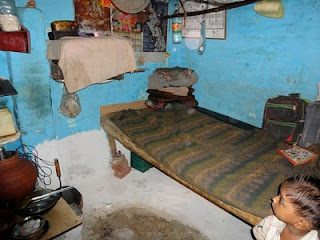
In the homes of the so called poor you are immediately greeted with warm smiles and offered the best place to sit. You are a guest in the true Indian tradition. You are offered the best place to sit, often the sole bed, and before you know it a cool drink or warm cuppa is in your hand. There are smiles on every face and you feel at ease and welcome. You soon forget how dilapidated the surroundings are or how hot or cold it is. True that the first time you encounter such homes you are a little puzzled as they resemble nothing you have seen before, but after some time you get the courage of looking around and you realise the love and care that has gone into making a hole a home. The sole room is a bedroom cum sitting room cum kitchen cum kids room in one and yet you soon see personal touches: a picture hanging, a shelf with some decoration pieces, another one with the few good cups, kitchen ware neatly arranged in one corner and so on and surprisingly in spite of the squalor that surrounds it there is an almost pristine feel around. Once the initial shock over, you realise that the place is filled with warmth and life. And wonders of wonders you feel good and welcome.
What astounded me was the fact that I have never got the feeling that any owner of such homes is embarrassed or ashamed. I remember when I use to visit Utpal in his sordid home, he must have been three at that time, he often walked ahead of me and then climbed on a rickety plastic stool and with is pudgy hands caught hold of two hanging wires and plugged them in a dangling socket to get the sole fan going. At first I was horrified but soon realised that this was the way it was done and like all slum children, Utpal was wise beyond his years. Or can I ever forget how little Ritu the tiny lohar girl use to drag me into her home and make place for me on the bed before she marched on to find her mom and ask her to make me a cup of tea. And believe you me, I never wanted to leave these places as they were filled with all that was good. In learning to survive the poor had mastered the art of living. They were humble true, but confident and wise. They did not need more than the tiny space assigned to them to be who they were.
Entering the intimate world of the poor has been the most uplifting experience of my life. I have learnt many lessons in humility and courage, in fortitude and patience. But what has been the most valuable was the fact that these people were the repository of traditions and mores even though sometimes their tenacious belief in them could be infuriating.
The poor live with dignity and wisdom; maybe there are lessons for all to learn.
by Anuradha Bakshi | Sep 16, 2011 | Uncategorized
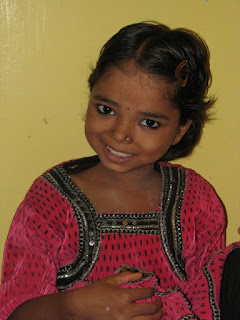
 Every time Radha breaks one of her fragile bones, my heart misses a beat and my blood runs cold. Radha had a fall last week and once again broke her leg. It must have been the evil eye as she was doing so well and on the day the mishap happened had won the prize of best dancer of the class. Today she lies in her dank and dark home and I find myself questioning the heavens.
Osteosis Imperfecta or glass bone disease is hell for anyone but more so for someone born on the wrong side of the fence. In a city like Delhi which has forgotten that the poor also need a roof on their heads, families like Radha’s live in unbelievable conditions. Even if you earn 10 times more than the stipulated 20 Rs a day that qualify you as poor in the books of the State, you can at best afford a jhuggi in one of the umpteen slums that have mushroomed in Delhi. These dwellings are often sunk in, airless and unfit for any living being and come at the whopping price of at least 1000 rs a month. Often the tiny space of barely a couple of square meters is shared by 6 or more people. That is the abject reality of habitat for the poor in our swanky capital city. It is bad enough, but when you suffer from glass bone disease it spells disaster. I am not even mentioning the total lack of facilities in such homes. Our new special educator who comes from a small town was shocked to see Radha’s home. I wonder what he would have said had he seen the one she lived in before!
Yesterday someone forwarded my an email about the home the richest Indian, where each occupant has seven thousand square meters to him or herself. I must admit that seeing the pictures and reading the figures was galling particularly at a time when my mind was teeming with pictures of Radha with her leg in plaster sitting in the flooded hole which she shared with so many. The pictures once again brought to the fore the stark reality of the two Indias that lived side by side but never met. I wondered whether those who had a surplus of space even knew about the plight of the likes of Radha. Imagine one family of five having thirty seven thousand square meters to themselves and the other barely five! Something is wrong and needs to be addressed but when will that day dawn?
Once again the plight of Radha brought to the fore the urgent need for many Planet Whys. Sadly I cannot even get one off the ground.
by Anuradha Bakshi | Sep 15, 2011 | Uncategorized
 When we launched our focus on quality programme in 2010 I did not quite know what results it would yield! But to my mind getting the primary kids to learn spoken English was something I intuitively felt would bear fruits. Quite frankly I was thinking far ahead to times when the spoken English of our kids would help them in getting a better deal in let us say work interviews!
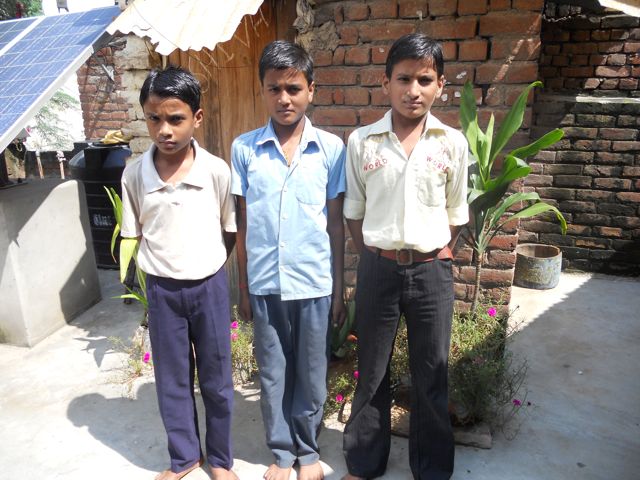
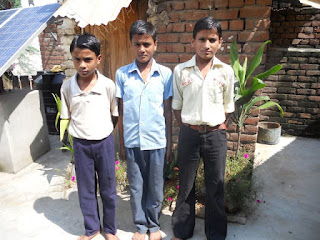
To my utter surprise and delight I did not have to wait that long to see results. Firdos, Suraj and Vikash who are students of our women centre are the first beneficiaries of our programme. They have been admitted to the English medium batch of the secondary government school. It may sound a small feat to those who do not know how things work. To get admitted in the English medium batch, children of class V have to sit for an English exam and pass it. It is often very difficult for children from deprived homes to make the cut but these three boys did. It was another ah ha moment for us and we were thrilled beyond words.
It is heartwarming to know that our decision to introduce spoken English classes for the primary children was a good one. Just wanted to share this bit of good news!
by Anuradha Bakshi | Sep 12, 2011 | Uncategorized
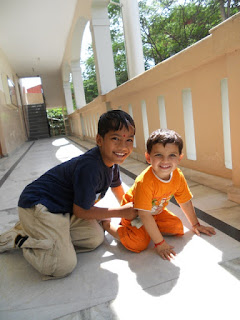
 Yesterday was a blessed day! It was PTM day at the boarding school but a very special one as little Agastya my grandson was with us. Agastya and Utpal share a very special bond. What makes it unique is that in normal circumstances the twain should not have met as they belong to diametrically opposed worlds. Whilst Agastya was born with the proverbial silver spoon, Utpal was barely wanted. It is a miracle conjured by the God of Lesser beings that changed matters. He commissioned the same old biddy to be part of their worlds.
I must sheepishly confess that when Agastya landed in my life I was a little worried about Utpal’s reaction. I needn’t have as he immediately opened his huge heart and took him in. He just became the big brother. Now the two have a great time when they are together and Sunday was just that.
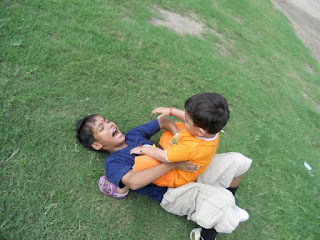 The boys romped around the school, played ball, ate biscuits, had a great time on the slides and swings and rolled in the grass to their hearts content. It was a joy to watch them. But as I looked at them so carefree and happy the moment turned somewhat bittersweet. While the future of one of them was safe and secure the other’s was at tremendous risk as it hung by a flimsy string. It was heart wrenching to think that Utpal who was laughing his heart out had no one in the world to call his own. His mom has not given sign of life for many months. His fate has been decided by a court that stipulated that he spend his time between the boarding school and my home.
To secure Utpal’s future we need to ensure that his school fees are paid till the end and then need to sponsor his further studies. We also need to guide him at every step through his childhood, teens and further. We need to love him, chide him when needed, support him and stand by him. In a word to be his family. It is a huge responsibility and a tad scary. Yet I know that these need to be done with determination and compassion. There is no option available.
Looking at Utpal brought to the fore once again the huge question that hangs around us like the proverbial elephant in the room: pwhy’s future. As age catches up I find my energy dwindling and cannot put the same zeal I once had into day-to-day fund raising, hence the need to find ways to secure pwhy in the short and long term. Planet why seems more and more like a chimera. A sound idea that did not find takers as the costs are high and the returns intangible or of of the kind that do not make sound commercial sense. A child’s future, a life with dignity and so on are not solid enough grounds.
Cynics would say you can only do that much. I know many Cassandras who feel that one should not worry and let things take its course or if needed trim the project to size. Easier said than done. I have been over the past sleepless nights trying to imagine who would be axed: the little children of the creche, the new primary centre, part of the women centre… and each time my blood has run cold. True I could find many logical reasons to let go of any of these but the heart finds none. Little eyes look at me with hope and trust and all my highfalutin thoughts vanish. What remains is the knowledge that I need to find ways and means to protect them all.
I refuse to believe that in this big world there are not enough people to hear my appeal and reach out. I guess I have to try harder at least till I am around.
by Anuradha Bakshi | Sep 9, 2011 | Uncategorized
 In Parliament last week the Minister for Health admitted that 1,74 million children under five die every year in India. I do not know how many of us reacted when the news was aired. I do not know how many of us realised the enormity of the statement. 1,74 million is no small figure! More than half of the deaths were in the first 28 days of life. The causes stated were: pneumonia, diarrhea and of course malnutrition leading to extremely low immunity. Forget the causes; the simple fact that so many children die is unacceptable in a country where according to statistics again some of the richest people live.
I urge you to stop a moment and give some thought to the above numbers. Let me put the statistics into context: the annual number of malnutrition related death in India is more than the total live births in the UK and one-third of newborns in the US. That is huge by any yardstick. 3000 children die every day of malnutrition in a country where food is thrown unabashedly at every wedding or religious feeding frenzy, and in homes; where grains rots with abandon every year for want of storage. All this should shock us out of our lethargy in the same way as corruption did a few days back, but food security is a cause the haves will never espouse. It is something too alien to them. But I ask do such stats not disturb you every time you throw food be it at home, in a party or in a restaurant? It is time it did.
As a state and a society we are guilty of 3000 murders a day! And let me remind you most of these are due to corruption in the so called social programmes heralded each year with great fanfare by the Government in power. A simple and quick look at such programmes show that most address the causes stated above. There are programmes for immunisations, early childhood nutrition, pregnant and lactating mother and of course education that has now become a constitutional right though no one seems to understand the full significance of such a right. If we did then the sight of any child begging on the street or working in a teashop should outrage and revolt us and should make us ask questions of our elected representatives. But it does not, simply because our children are safe and secure.
The Minister made his statement in parliament and so no cynic can state that the figures are cooked up, if anything they err on the low side. What disturbs me is that such scary statistics do not outrage and incense us. Recently we caught a glimpse of an outraged India that stood up against corruption. Will we one day find it in us to stand up against hunger, even if it does not affect us directly. I hope that day will dawn!
by Anuradha Bakshi | Sep 1, 2011 | Uncategorized
 I do not want pwhy to be a tuition centre are words I have oft repeated. From the very outset we had been adept followers of Delors 4 pillars of of Education: – learning to know, to do, to live together and to be – and tried to incorporate them in our programmes. We were always conscious of the fact that education is not simple mugging of text books dutifully regurgitated at exam time and promptly forgotten thereafter. And it was our sincere endeavour to try and remain on track. We set aside time to talk to the children about larger things and make them aware of the world around them. But it was no easy task as there were many impediments along the way. The biggest one being the low level of many children who needed a lot of extra work to catch up with their class. Added to that were the periodic exams that meant extra revision time. Needless to say all extra time needed for studies was taken off time assigned to other pursuits.
In hindsight I think there was also the unexpressed reluctance of the staff to taken on new challenges. One must remember that pwhy staff is all drawn out from the local community and the product of the existing state school system. Teaching the curriculum was their comfort zone and as always they were quick to sink back into known territory. We did run several workshops – RTI, brain gym, teaching methods, civic rights, water etc – and each was attended enthusiastically by one and all. I must admit that for a few weeks post each workshop teachers did apply some of what they learnt but then sunk slowly back into their comfort zones teaching what they new best: the school curriculum! Gentle reminders and even blunt prodding did not bring much results. There were always some excuse available: the forthcoming tests or exams, the shortage of time, the need to bring students to level.
It was then that we decided to set Saturdays aside for what we called creative pursuits. Programmes were chalked out. We suggested that each centre adopt a theme for the month and all creative work be done around the said theme. It worked for some time but then again even creative work sunk into a comfort zone and children were back to drawing mountains and rising suns, the preferred or should I say only drawing subject of children in school in India. Looks grim. Not quite as we blissfully had workshops initiated by friends and volunteers where the children could let their spirit fly free. I remember the one that resulted in the lovely song I wish, that became the pwhy song. The words were written after a workshop entitled what I wish for! The children then recorded the song professionally in a studio. Then we had the letter exchange programmes with children in Germany and France and how can I forget the paintings made by the children for pantomime shows in England. But as I said these experiences were few.
A recent photography workshop once again brought its share of surprises. 8 students were selected for the same and in a matter of days turned into mean lens persons. The workshop culminated in a power point presentation applauded by all and needless to say that today they are the ones who take pictures of the project!
When we decide to celebrate Ram’s centenary project why came alive. For a few weeks studies were forgotten and everyone was busy rehearsing plays, songs and dances. We even got a dance master to come and teach the children and what a wondrous surprise this was as hidden talents slowly emerged and took centre stage. I watched the rehearsals totally dumbfounded and feeling a tad guilty and sad. This is what children should be doing not once in 10 years but regularly. The experience brought out the best in everyone: the children of course but the teachers also as they took on the role of organisers. I wonder how many new lessons were learnt.
What has been a constant in each of the above events is the passion and joy the children demonstrate every time they are faced with a new creative challenge. It is thus time we make some serious course corrections and ensure that creative and awareness raising activities become and intrinsic part of the project why syllabus. We have to shed once for all the tuition centre label that we so easily make ours. It is a foregone conclusion that such activities develop the mind and thought processes and will reflect in the children’s ability to master their school work. So as of today song, dance, debates, newspaper reading and more will be reinstated firmly in our work and no excuse will be accepted. We are not and do not want to be just a tuition centre!
by Anuradha Bakshi | Aug 28, 2011 | Uncategorized
 For the past two weeks a silent revolution has taken place in front of our eyes culminating with a day long debate in Parliament that resulted in a victory for the people of India, the very people who are embodied in the opening sentence of our Constitution. For the first time in our independent history the will of the people was truly heard. For the first time in our independent history the faceless millions found their voice and used it. Democracy was reinterpreted and revisited as the people of India till date only seen once in five years at election booths took centre stage.
These voices were galvanised and aroused by one diminutive man whose main claim to fame was his honesty that he wears as proudly as his cap and who has come to represent the David that could slay the Goliath called corruption. Till date the silent majority suffered the stranglehold of the demon that strangulated all and robbed mercilessly. Till date these battles were fought in intellectual clubs and drawing rooms and ended in remote essays written to satisfy cerebral and not real needs. The very people who have always decried the passive behaviour of our collective mind are now busy writing more essays about the lurking dangers of the over enthusiasm whipped by Anna Hazare!
Today no one is in the mood to hear them. Today India celebrates!
But what are we celebrating. The answer is complex as many firsts happened in the last fifteen days. The obvious is the ending of a 13 day fast by a Anna and of course the resolution adopted by acclamation by our Parliament agreeing to the three points of contention till date. But that is for me just the tip of the iceberg. There is much more to celebrate.
The first step to freedom is the articulation and identification of the cause of repression in clear terms. And this is what happened last fortnight. Corruption an ailment that plagued us all but was often referred to in hushed tones within the four walls of our homes was out in the open. And what that did was bring India together. Here was a cause we could all openly espouse and agree to fight against together. The anger and outrage that we all felt and had repressed for too long had found a way to be released and addressed. The catalyst was a man who wore his honesty with pride and honour and could thus become a rallying force. For the first time India came out on the streets without fear. What we saw in every corner of the land was crowds that had not been paid or intimidated, but who came out of their own sweet will. Strange but true corruption was the great leveller, it affected one and all: the rag picker, the slum dweller, the harried housewife, the aspiring professional, the small businessman, the retired official. No one was safe from its stranglehold. It almost seemed as if we were all waiting for the right moment and it had finally dawned.
And to add fuel to the raging fire, the unbecoming attitude of the government in dealing with a man who simply wished to assert his constitutional right to protest brought to the fore another cause to embrace. It goes without saying that everyone in this land was fed up with arrogance bordering on hubris of the powers that be. Here too India was one. Be it the slum dweller whose daily brush with an arrogant official or the retired professional who needs to renew a passport, everyone had to bear the supercilious and dismissive attitude of officialdom. This reality was amply vindicated as we watched the comings and goings of the government. The impossible conditions laid out for the protest, the arrest, the empty and inane explanations proffered, the carrot and stick and condescending attitude, the arguments on form and practise, and so on. And above all the refusal to accept that the adversary was at par if not greater. We the people had never been a force to contend with. We the people were only meant to appear every five years when the powers that be shed their arrogance for a few weeks and sought a mandate renewal. We the people were those who could be cajoled by empty promises, pouches of hooch and a few coins. This time however we the people said enough is enough: no more corruption, no more arrogance. We will not fall for semantics and dialectics. So let us celebrate our freedom from fear and cynicism.
Another first that happened was the coming together of India in all its diversity. Even the cynics will have to concede that the crowds that gathered spontaneously be it in front of Tihar Jail or in the Ramlila grounds, in Mumbai, Bangalore, Chennai and umpteen other cities had one thing in common: they were all Indians. All barriers were broken be it caste, religion, gender, age or social background. The rich rubbed shoulders with the poor, the literate with the illiterate, the old with the young all shouting in unison: Vande Mataram! So should we not celebrate the coming together of India as one!
For the past days we have been privy to heated debates on the supremacy of Parliament. The cudgels being of course taken up by state representatives and elitist intellectuals trying to smother the vox populi whose role was conveniently cut down to a single act every quinquennial. This being the definition of democracy acceptable to those in power. True one must concede that the chosen ones do also climb down from their mount Olympus a few days prior and put on a real act. I have seen with my own bewildered eyes how the chameleons shed their arrogance and almost grovel in front of their potential electors. Excuse a small aside but this was one of the things that shocked me most when I lived the first municipal elections in a slum. Posses of white clad men, their candidate in the lead, walked the street with their hands folded stopping to caress the cheek of a young child or touch the feet of an elder woman. That in their eyes sufficed to get people to elect them. The parade, for want of a better word, always heralded by the beating of drums to ensure that people come out of their homes, was finely orchestrated. An advance party always came along distributing garlands to some trusted persons with the express directive to place it on the candidate at the appropriate time. I once tried to get the candidate to stop as I wanted to apprise him of some of the problems that the people faced, but needless to say a bunch of acolytes were quick to steer him away. The experience was galling to say the least as the same people become inaccessible once elected. To the people who advocate the supremacy of Parliament and the minute role of its members vis-a-vis the people, the last days should become an eye opener. The people will not accept such a diminished role. Their vote is precious and entails a responsibility that they are now ready to assert. So let us celebrate the true meaning of democracy.
In the smiles and sloganeering of the people one could sense hope. The hope of being finally delivered from the clutches of corruption. True that people felt somewhat naively that the proposed Bill would be a panacea for all ills. Simple people felt they would be rid of greasing palms on day-today basis and they were ready to lend their voice to the cause loud and clear. Yes they were credulous but can one blame them. This seemed the only ray of hope in their otherwise dark world. The Cassandras and doubting Thomas were back to the attack pointing out the flaws but people were too charged to hear. They just wanted to see hope so can we also celebrate the revival of hope.
There has been a lot to celebrate indeed. But there is more. One of the most amazing things to me personally was the vindication of the Gandhian principles of non-violence. It was breathtaking to see so many people protest in a peaceful manner for such an extended period of time, particularly when one is used to seeing violence erupt at the drop of a hat. Critics will again say that many Gandhian principles were subverted, but would not Gandhi himself have adapted his methods to the need of the hour. So we also celebrate the power of non-violence.
As the dust settles and we slowly emerged from our euphoria, it is time to take stock of all that happened and draw the lessons needed. The most important is undoubtedly to define our roles in the fight against corruption. True one man showed us the way. It is now time we learn to walk on it.
by Anuradha Bakshi | Aug 24, 2011 | Uncategorized
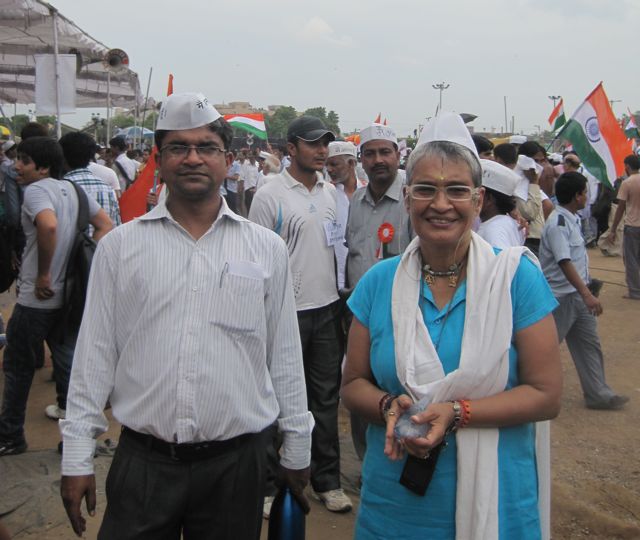
 I went to the Ramlila grounds on Tuesday to be part of the protest against corruption let me Anna Hazare. I have already blogged about my what I felt that day but there are some other aspects of the agitation that I feel need to be highlighted.
I was impressed by the general atmosphere prevailing at the protest which was for want of a better expression a celebration of India. There were people from all walks of life, students and the elderly, rich and poor, urban and rural, people of diverse faiths and origin. But that was not all. There was also a genuine outpour of the legendary generosity of our land. Free packets of water were being handed out with a smile and gentle insistence. The place was surprising clean considering that it had housed tens of thousands of people over the past days. One would have expected it to be littered with garbage but it seemed that people themselves were ensuring its maintenance as one so many picking up the litter.
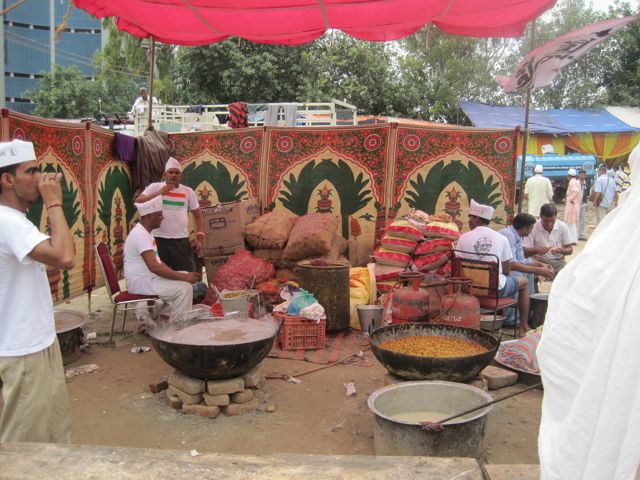
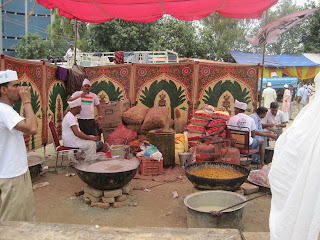
At the back of the grounds was what has been called Anna’s kitchen. Food was being cooked in large vessels and been handed out free to one and all. Hot rice, dal, vegetables, poories in disposable plates. Large bins were available to ensure that no plates were thrown on the ground and surprisingly there were none! A far cry from the morning after a wedding or a religious feeding frenzy in our city. Bags of dry rations and fresh vegetables waited to be turned into the next meal. Everyone was invited. I was told that all the food had been donated by supporters.
We decided to find the donation desk to make a contribution. All the donation posts bore signs saying closed. At first we thought that the people manning them had gone to lunch. But that was not the case. The organisers had decided to stop accepting donations as they felt they had sufficient funds for the present. Chapeau Bas was all one could say. This was really a unique occurrence in our times.
All around us people were singing or shouting slogans with conviction and passion. They had come for a cause they believed in, for a man whose honesty and integrity no one could question and everyone was proving themselves worthy of their ideal. Yes it was a celebration of India, amazing India!
by Anuradha Bakshi | Aug 22, 2011 | Uncategorized
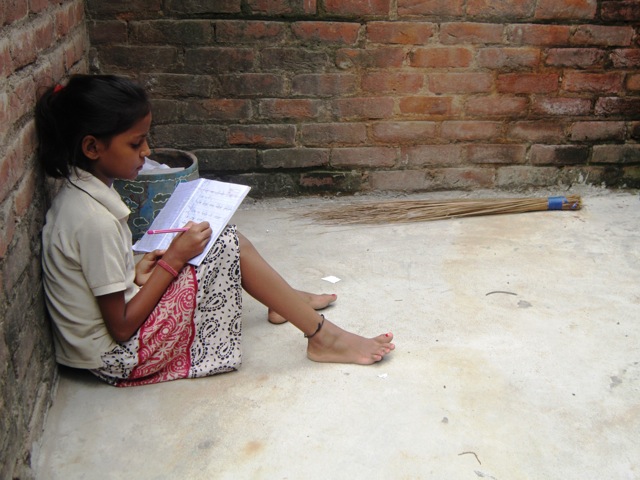
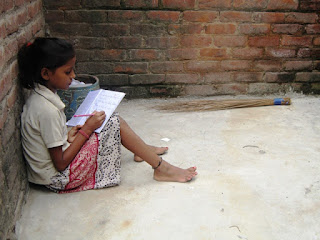
 This picture was taken by one of our students during the recent workshop on photography held at our women centre. The picture speaks for itself: the broom a silent but eloquent reminder of the fate of girls in India.
Let us look at some statistics: India has the largest population of children as 40% of its population is under 18; one out of every six girl child does not live to see her 15th birthday; Every sixth girl child’s death is due to gender discrimination; 35 million children do not go the school, 53% of girls in the age group of 5 to 9 years are illiterate; 60% girls drop out out school before class V. The list is endless and distressing.
In spite of our best efforts we have seen girls drop out of school for a host of reasons, but one of the most shocking one is because many schools do not have toilets for girls! This is something that could be easily remedied if the State had the will to do so. The condition of government run schools in our capital is truly abysmal. Wonder where all the funds go. However that is not the only reason: girls are often made to drop out of school to take on the role of caretakers particularly in urban migrant households where both parents work. Sadly this situation will not change as children under the age of 6 are not covered by the right to education act and the state does not run free preschool facilities. So girls become the obvious and only choice to look after younger siblings. In homes the discrimination continues: girls are less likely to receive immunisation, nutrition or medical treatment compared to a male child. Moreover even if they go to school, girls never get proper support be it books or the much needed tuition that is a must as practically no teaching is done in schools. Even the illiterate have realised the worth of such schools and boys are often send to the ever mushrooming private schools. Girls however are sent to the free Government school if at all.
Let us not forget that in most cases the sole concern of parents is to get the girl married asap and it is often believed that too much education limits the choices of possible grooms. A girl needs to know how to cook, clean and maybe sow. More than that is not considered kosher. And the more educated the groom the larger the dowry. Education is thus viewed as an impediment and not an asset.
The question that comes to mind is how does one change things. Voting laws and Acts is not the answer as often these remain unknown to the beneficiaries. Gender related issues need to be addressed with patience, understanding and perseverance.
by Anuradha Bakshi | Aug 22, 2011 | Uncategorized
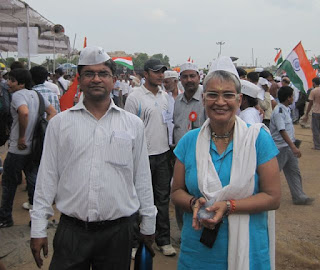
 I went to the Ramlila ground yesterday to be part of the anti corruption agitation led by Anna Hazare. I had of course been watching the agitation on telly and doing my bit by spreading the message but had shied away from actually going there in person. The reasons were many: my hurting knees, my low BP that dips at its own sweet will sending me into unexpected swoons, my agoraphobia and so on. Don’t forget I am a lone wolf. Anyway all this kept me away for a whole week but a little voice kept telling me to get off my high horses and get there.
I guess the little voice had a lot to do with Kamala my mother. As I watched the crowds on the small screen, I found myself going back in time to lessons learnt at mama’s knee, lessons that were often heard and forgotten as they seemed alien to a child growing up in the lap of luxury. Yet they must have struck a chord before being filed in the recesses of my memory as they all came rushing back bringing with them a plethora of emotions. There were stories of want, of patriotism, of sacrifice, of national pride. Was not Kamala the deprived little girl who had to know the extreme humiliation of having to stoop in front of a malicious cousin to get a sweetmeat, or the child whose task was to nurse her father’s and his companions’ lacerated backs when they returned from non violent manifestations having borne the brunt of police beatings, or the young girl who was willing to live life as an old maid rather than give life to a child in a colonised land. You see she was the daughter of a freedom fighter.
I remember fondly the story she once told me of how she and her friends who had decided to emulate their elders and stage their own Satyagraha were bundled up in a truck by the police and deposited miles away from home. The children were frightened and terrified. Thankfully her father had been able to trace them and bring them home in a horse cart. And every story she told me was punctuated with the very slogans that are being heard today: Vande Mataram, Bharat Mata ki Jai! There were also stories of the innumerable hunger fasts my grandfather undertook in jail, stories of force feeding valiantly resisted by consuming red chillies so that their throats were swollen and thus they could resist such attempts. The stories were many and I listened intently more so because of the passion with which they were told. And all the stories had one leit motiv: India’s freedom from British rule. And what is touching is that Kamala carried the same feelings into the initial years of her life as a diplomat’s wife. When she came to know that one of the guests at a dinner party was to be he British Ambassador it took all of my father’s persuasion skill to convincer her to be graceful to her guests!
The Vande Matarams and Bharat Mata ki Jai heard for the past days from every corner of the country resonated deeply in mind as a clarion call urging me to get out of the four walls of my home and lend my voice to the fight against corruption being waged at my doorstep. So yesterday I did set my fears aside and headed for Ramlila grounds. I must admit I was a tad nervous but at the same time filled with a excitement. We got to the group and promptly purchased an Anna Cap reminiscent of the ones worn by my grandfather and by my father at official functions. I donned it proudly and set out for the entry where we joined the queue shouting slogans. Needless to say I joined them enthusiastically and felt my spirits soar. I was transposed to another time.
We finally entered the grounds and though it was not filled to capacity as this was a working day, there were thousands of people around. Some had flags, others banners and yet others just stood watching the stage in the hope of getting a glimpse of their beloved Anna. He finally appeared looking frail bit his spirit soaring to infuse every one of us with renewed commitment as he shouted Vande to which the crowd roared Mataram. The atmosphere was nothing short of magic. The positive energy was palpable and infectious. Everyone exuded cheerfulness and bonhomie. People from all walks of life reached out to you with smiles and greetings. All barriers visible and invisible were forgotten at least for the time being. Everyone was united and it felt incredibly good. I was so glad I had come. I felt the spirit of Kamala right next to me reminding me that I was my mother’s daughter.
by Anuradha Bakshi | Aug 21, 2011 | Uncategorized
 Don’t lose faith in India were the last words of a dying man almost 2o years ago. It was at a time when India was burning over the Babri Masjid issue and everything seemed dark and bleak. Yet the man would not let go and repeated his dying mantra. The man was Ram my father and the words a legacy difficult to accept and yet very real. I was being asked by the one I probably loved and respected most not to lose faith in India. Not an easy task when India was burning and no one seemed to care. Remember it was December 1992!
I often wondered which India he was referring to: the one that lived in his dreams or the one we lived in. With every passing year keeping faith in India became difficult if not impossible, more so because in those days I had not yet discovered the real India. What I saw was the India of my peers and that one was not pretty. It was empty, soulless, arrogant, glittery, vain and obsessively pursuing money. Blissfully it was when I decided to set up project why and was compelled to cross the invisible divide and embrace the other India that I had my first glimpse of an India I could believe in. It was in the slums of Delhi that I finally found the India my father carried in his heart.
The ensuing years were not easy. As I anchored myself in the India I sought, images of the other India became more and more ugly. It was the years of scams, of political arrogance, of corruption in all its shades and hues. That is when I started shutting myself from one India even if it meant becoming a recluse and being the target of the cynicism of my peers. But you see I had to keep faith in India! And the only way I knew was to shut out the one I could not stand by. True I had to make some forays into the India I shunned as therein lay the money we so needed. My brief incursions only vindicated my stand. How can I forget the bags of rubbish that so oft landed on our doorstep as donations! Or the contempt with which my appeals for help were set aside with a curt: all NGOs are corrupt! Or still the more subtler opprobrium voiced when we decided to send some slum children to an English medium boarding school.
I also watched with horror and sadness the dismissive way in which the India of the little people was treated be it the walls created to segregate slums from their upmarket neighbours or the callous destruction of homes to beautify Delhi for an international extravaganza. And as I discovered the sad reality of our land so poignantly conveyed by a set of statistics; 40 % of the world’s starvation-affected people live in India, 76% families (840 million) people do not get their daily required calories, 55 % of India’s women are malnourished, 46% of India’s children are malnourished, more than 320 million people in India are unable to manage three square meals a day and the most startling one: more than 5,000 children die every day from malnourishment. How could the other India remain silent and unmoved. At timed I found it impossible to swallow a morsel of food and still do. And the one and only cause for these terrible statistics is undoubtedly corruption.
As I watched helplessly the astronomical figures of the scams being uncovered and corruption becoming the toast of the day I could not help thinking of its poorer cousin namely the apparently tiny sums doled each day by the invisible ones to be able to survive: the weekly tithe paid by the cart owner, the vegetable vendor, the roadside cobbler and so on. They too were stifling under the same oppressor. Yes Corruption with a big C had become a two headed monster devouring everything in its way. It was this monster that gobbled the funds destined to make schools, hospitals, roads, to provide food to those in need, work to those who had none. Excellent social programmes were hijacked by greed and never fully implemented. Imagine if the simple ICDS scheme launched in 1975 had worked no Indian under the age of 36 would underweight, undernourished or not vaccinated. Isn’t that food for thought. The reality is that the poor are becoming poorer while the rich become richer.
The question was when would India awake from its cynical slumber. When would it find its lost voice.
It took a diminutive elderly soul and a piece of legislation to do the trick. It all began in April when the spirited Gandhian decided to sit on fast to defend his take on a legislation that was meant to rid India of corruption. The cause echoed in the minds of many and for the first time a different breed of people took to the streets. The powers that be were caught unawares as they sprung into damage control by playing to the gallery and inviting the Gandhian to the negotiation table. For them it was a simple delay tactic. They had their own agenda to defend and they did by casting aside the views of civil society and tabling their own legislation. The Gandhian reacted and India responded.
When Anna decided to fast again he would not be alone. India who had sad silent for too many years decided to join the agitation as the cause was one they believed in: corruption had gnawed at them mercilessly for too long and the hubris of the state was getting too much to bear. The state on the other side remained impervious to the pulse of the very people that elected them and unfurled a series of absurd reactions that made the people angrier. The first salvo was of course the favourite weapon in their arsenal: slander! Without a thought a spokesperson decided to call the Gandhian dishonest and brand him and his team as armchair fascists, overground Maoists, closet anarchists. India was outraged and the crowds swelled. As if that was not enough the state decided to act.
Anna was arrested, lodged in the same jail that housed the most corrupt, released all in one day. And as these harebrained actions were taken crowds grew angrier. India took to the streets and Anna remained firm in his resolve. People from all walks of life registered their protest. It was no more a fight for a piece of legislation but for every hurt that had been borne silently and helplessly. Housewives, professionals, students, village folk, retired people, the educated and the illiterate everyone was out to extend support. The media was there to chronicle it all. The powers that be stood exposed. Their arsenal looked strangely inadequate. The bungling lot tried to hide behind a host inane of screens but to no avail. Wonder what they would come up with next.
You may or may not agree with the Anna way. You may or may not agree with his version of the proposed bill but he has managed to stir passions never unleashed before. He has according to the New York Times emerged as the unlikely face of an impassioned people’s movement in India, a public outpouring that has coalesced around fighting corruption but has also tapped into deeper anxieties in a society buffeted by change. He has managed to awake a slumbering India!
We all want to see the monster slain! And we also want to be rid of a government that has lost the pulse of the people. In times where media was non existent, erstwhile rulers disguised themselves as commoners and mingled with the people to gage their mood and opinion. This helped them rule better. It is sad that today when every form of media is blaring the anger of the people our rulers remain aloof and unmoved.
Anna gave us back our voice. Now it is for us to use it in the way we deem right and not let it get once again tinged with cynicism. The ball is undoubtedly in our court. There will be many followers of Antisthenes or Diogenes of Sinope will find many ways to try and deter us, but we need to remain Pollyanna like and believe that the changes we seek with such passion happen soon. There will be enough time for remedies later. And to be a reverse cynic perhaps some form of monster is needed to slay another.
This post is primarily meant to renew faith a lost faith. In the past days I have seen a new face of India, I have seen invisible barriers crossed, I have seen hope. I have seen the India one cannot and should not lose faith in.
by Anuradha Bakshi | Aug 20, 2011 | Uncategorized
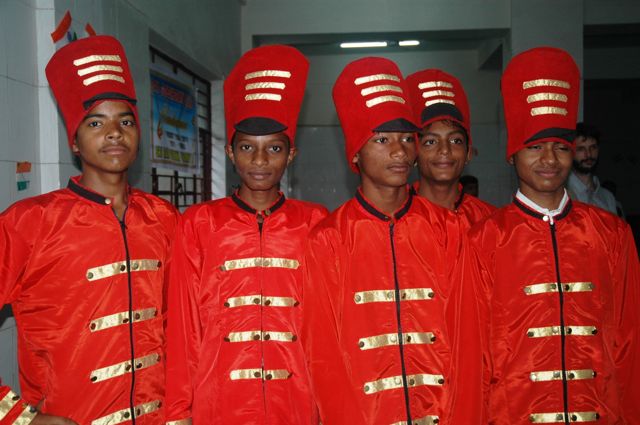
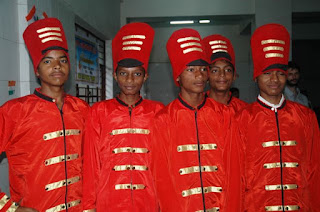
 One of the items of our recent Independence day celebration was a play on Gandhi’s salt march. The play had five British
soldiers cast in it. We needed costumes for them. We thought best to go to one of the costume rental places and asked for British soldier uniforms. The man said he would get them for us in a day or two. We were quite confident that they would be appropriate.
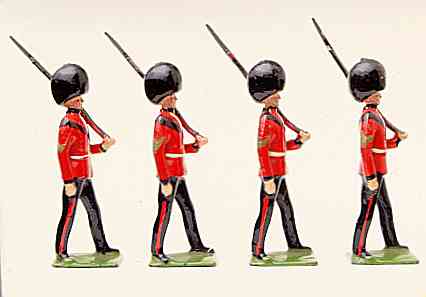
 Imagine my surprise when I saw our four lads all dressed up on D day. They looked like the tin soldiers of my childhood. I wonder which British officer ever wore such an accoutrement! I could barely contain my smile, if not my laugh, as I saw my five boys proudly displaying their regalia. I could not for the life of me understand where this came from! Ottoman soldiers? Prussian ones with the wrong coloured hat or a very strange interpretation of the Royal Guards of Buckingham Palace. Any one’s guess!
As I said to me they looked like the little tin men of my childhood, the ones we kept in tin boxes and took out to play with. Whatever they were, on that morning they looked adorable and won many hearts! God bless them!

 Sometimes life hits you in the head with a brick. Don’t lose faith. I’m convinced that the only thing that kept me going was that I loved what I did. You’ve got to find what you love. And that is as true for your work as it is for your lovers. Your work is going to fill a large part of your life, and the only way to be truly satisfied is to do what you believe is great work. And the only way to do great work is to love what you do. If you haven’t found it yet, keep looking. Don’t settle. As with all matters of the heart, you’ll know when you find it. And, like any great relationship, it just gets better and better as the years roll on. So keep looking until you find it. Don’t settle wrote Steve Jobs.