by Anuradha Bakshi | Jan 17, 2007 | two indias
It is amazing how the micro and the macro level of every occurrence appear almost simultaneously.
In a recent blog, I had recounted the trials and tribulations of our very own Nanhe’s mom who had been told by some hassled medico to go get a kidney if she wanted to save her son! As any desperate mother she heard only what she wanted to and set out on her search. The predator was lurking in the garb of a caring uncle who assessing her worth fixed 17 000 as the price of a kidney made in america.
We were still in the midst of trying to find a solution whereby a mother’s love would be satisfied and a child given the best treatment available, when the tsunami survivors tale hit the press. Now needless to say that the kidney bought from someone belonging to one side of the fence would give life to someone from the other or even to someone from other lands as today medical tourism is here to stay! The tale of two Indias unfolds again. A father steals a hammer to give medical treatment to his aling child and is killed for it; a woman sells her kidney to pay her husband’s medical bill: the stories go and on, each one more desperate, each one urging us to take notice and do something.
The something I agree is elusive and probably still indefinable, but one thing is certain: we have to bridge the gap that is growing by the minute and may soon become an abyss we will unable to come out of.
What we dismiss as the poor are not living on some other planet but standing at our very doorstep. The rising number of urban migrants are a proof of that. They come with their dreams and aspirations, dreams that are fuelled by the same images as ours thanks to the communication revolutions that has put a TV screen in the tiniest of shanties. Set top boxes are being sold faster than anything else in urban slums today.
Half baked education is dangerous as it can lead to dramatic misinterpretations, and as in the case of nanhe’s mom, logic and reasoning are useless weapons to counter that. Third rate education, the kind where 33% get you the coveted certificate only leads to frustration and anger waiting to manifest itself.
We are witness to many micro solutions whereby help pours in when an individual case is reported. But here again we need to retrospect about the reason for such outpour. As long as it stems out of charity, compassion and sympathy it will always fall short.
Something much deeper and radical needs to be done, something that lives beyond the images that splash the screens. Something that actually needs to change us before we attempt to change the world.
by Anuradha Bakshi | Jan 15, 2007 | Uncategorized
A candlelight vigil was held last night for the Nithari children.
It was held at the same place where just a few months back the tout delhi was present in force, led by the urban middle class and the youth fuelled by images of Rang de Basanti, to fight for justice for Jessica and Priyadarshini. The vigil was widely covered by the media in live broadcasts.
Yesterday’s vigil went unnoticed.
Just a handful of people were there: the bereaved families and a few others. It did not even make it to the front page. An article on page 3 stated simply: Public zeal missing from Nihari protest!
A chill went down my back bringing to my mind almost apocalyptic images of the future.. People power had also succumbed to the great divide. We had failed to recognise the writing on the wall. Did we feel that such incidents could never happen to us and hence we did not need to act? Did we just feel safe in our urban middle class reality?
There are many disturbing questions that come to mind, questions we just push away as they would require us to look into ourselves and compel us to take responsibilty. So we simply wash our hands off and look away hoping that some plausible answer will be found soon and allow us to carry on till the next incident.
I am in the game of changing lives. A path I chose to walk because I felt I had a debt to pay. In the last seven years I have had to revise this larger than life attitude and come face to face with reality. Changing lives or crossing the great divide is in no way an act of charity. It is simply investing in your own future, a future where we cannot wish away those who live on the other side.
by Anuradha Bakshi | Jan 12, 2007 | reservations
Bharti Dhondge is a name that rings no bells and yet she will go down in history as the woman who became corporator for a day in the Municipal Corporation of Bombay! It took this woman five years to fight and win a legal battle whereby she challenged the validity of the caste certificate of her opponent. She won a day before new elections were declared, hence the one-day-crown. She now hopes to get a ticket from her party but that is another story.
To may this might seem a irrelevant incident but in fact it is not as it questions the whole matter of caste certificates. In a recent socio economic survey of pwhy we realised that over 80% of our kids belong to some reserved categories or the other. Needless to say not one has the required document to prove it and most of them are actually embarrassed and even aggressive when asked to spell out their caste.
Something is not wrong in a land where the politics of reservation has been heralded as pro poor and held as harbinger of justice for all. It does not take a rocket scientist to conclude that its success depends on ensuring that each and everyone falling within the category should be in possession of the required proof of his or her identity. It would seem logical that the onus of giving id proofs should lie with the law makers and enforcers themselves.
Nothing is farther away from reality as we discovered lately. Obtaining a simple caste certificate is a herculean task. Actually it s an impossible one. The powers that be have ensured that. No simple, unconnected, poor individual can meet the complex prerequisites. Where will the poor should find two class I gazetted officers willing to sign his form?
On the other hand, getting a fake certificate seems to be much easier as is proved by the Bharti Dhonge case. All you need is to know the right person and have sufficient funds to pay the price.
For the policy like the reservation policy to be relevant, the sine qua non condition has to be the issuance of documentary evidence by the state to each and every person falling within that category. Anything short of that is suspect.
One can now understand why our political masters insist upon not excluding the creamy layer. Were that to be, there would be no takers left for the reservations goodies!
Once again this brings to fore the fact that to redress many of the problems that plague our society, it is necessary to take the bull by the horns. In this case rather than demonstrate on the streets and only give more fuel to the politicians to divide society, maybe one should start a campaign to ensure that caste and class identity are issued to each and every one and empower the have nots to stand in line for every benefit doled out.
by Anuradha Bakshi | Jan 11, 2007 | Uncategorized
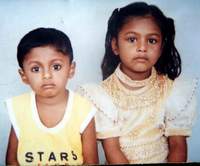
On April 13 the 2003, little Rohan and Puja never went back home. They had gone to the nearby temple as they did every evening. That day some predator was lurking with his diabolical agenda.
Two days later their bodies were found in the sluice gate of the okhla barrage. A little shoe was discovered later next to an open drain in a nearby wooded area, a place no child their age could have reached on their own.
Rohan and Puja were pwhy kids.
I had to move heaven and earth to convince the local police that the children had not just gone off in the dead of the night, crossed dangerous streets and walked in lonely spaces to find the open drain where their death beckoned. I had to use my persuasive skills, my contacts and every ruse in my book to get the FIR lodged under the right IPC sections. I got my share of threats, bullying and intimidating but held on.
The post mortem report not surprisingly did not mention the bruises and cuts but a staid death by drowning. The case was never solved. The family was suitably brow beaten and little Puja and Rohan became simple annoying statistics.
Why were these beautiful children kidnapped and then killed is any one’s guess. Some dark ritual, sexual depravation or personal enmity… no one really cared. Rohan and Puja belonged to the other side of the fence were children are dispensable commodities. For the parents there was never a closure. They just got on with the task of surviving, their grief visible in the few extra grey hair and defeated look of the fathers and the drawn faces and the sad eyes of the mothers. Even the birth of little Nidhi could not bring the required healing.
The last weeks has brought to fore the chilling reality of the number of children that are missing and the fate that many have met. Wonder how many lie dead hidden somewhere yet to be stumbled upon. Wonder also how many could have been saved had the law makers and protectors done their job with a modicum of honesty.
It is time for us to stop and think about what we can do to change things and ensure that tender lives like tat of Rohan and Puja, like that of the children of Nithari or the ones found in the Punjab mill are not in vain.
by Anuradha Bakshi | Jan 9, 2007 | Uncategorized
The mercury has dipped to 2 degrees and delhi is freezing. But our kids turned up as usual in the morning chill.
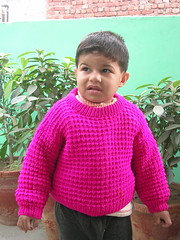
As they filed into the room, we were a little baffled to see little Golu who seemed to have difficulties walking and waddled through arms stretched at an awkward angle. It took a little time and investigation to realise that he was wearing 6 sweaters his mom’s recipe to beat the cold.
One does not know if he warm warm, but one could see he was undoubtedly uncomfortable and unhappy.
We removed some of the layers so that he could play and jump with his buddies but did not forget to put them back on when it was time for mom to come and collect her son.