by Anuradha Bakshi | Jan 26, 2007 | reservations
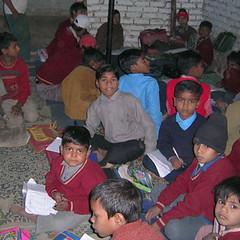
Final exams are just little over a month away and all pwhy kids are busy revising. Government schools held their usual end of term exams in December and we all waited for the results to help us structure our revision programme.
When no result was forthcoming by mid January, we asked the children to find out from their class teachers when these would be available. The next day, little Jyoti from our Govindpuri section came back telling us that she had been slapped by her teacher for having dared ask! We were ready to go and meet the teacher in question but were stopped by the children. Their scared eyes spoke volumes. They knew that our visit would result in more unwarranted abuse.
In another school, children were told that the papers had not been checked as schools had been closed for a few days because of the severe cold. In yet another school, answer sheet lay strewn on the floor at the mercy of rodents.
All in all, we could only gather half of the results.
This is but another example of the state of municipal and government schools. It is a cause of worry as marks of each terminal exam are included in the finals. We were also told that if a child has 75% attendance he automatically passes into the nest class. No wonder than that there are kids in class V who are unable to read or write. They will swell the ranks of drop outs as they reach class VI!
Almost everyday one can find some news item or the other about the abysmal state of government schools in the capital: no toilets, no drinking water, no classrooms, no teachers…One of the reasons for this deplorable situation is undoubtedly the lack of a literate and empowered parents’ group. With the proliferation of shady small teaching shops a.k.a. public schools, only the poorest of the poor land in municipal schools. They simply sit on the benches – or floor – marking time till they exit the school in class V. many will never make it further.
There is something extremely lopsided or insidious about the various policies for the poor. One startling example is the reservation policy in higher education. With the present state of primary education no deserving candidate can ever make it to the portals of an engineering college or medical school. It is only when we clean up the state of primary education that a tangible change can begin to happen.
by Anuradha Bakshi | Jan 26, 2007 | reservations
All over India celebrations are on today. Flag hoisting and parades, people cheering and waving flags everything is on cue to mark the 57th anniversary of our Republic. How many of us are truly aware of the meaning of this day?
Somehow the essence of the constitution got lost along the years and what remained is the pomp and display associated with it.
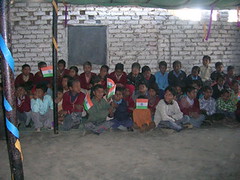
Of all our centre there is one that never fails in its celebrations of our republic our Independence days. Every 26/1 and 15/8 the children of the Okhla centre organise a show. They hoist the flag, sing the national anthem and some patriotic songs and then delight us with the never to be missed bollywood numbers. This year they even had a play and their on gandhiji!
It is with pride and a tinge of sadness that I watch these children. As they remember the day that saw our constitution come into force, I cannot but think about how little of what was promised to them 57 years ago, has actually come their way. It seems as one part of India was conveniently cast aside along the way.
Most of these kids belong to some reserved category or the other but none is aware of what reservation means. They go to poorly run schools from where many drop out. They die for want of medical care. Their morrows are often hijacked by some predator or the other and they soon find themselves on the wrong side of the law. And often they go to sleep hungry.
And yet on these special days all is forgotten as they celebrate being Indians.
This year the President chose to mention crime against children in his R Day address. He was of course referring to cases like Nithari. But there is a more insidious crime tat we are all guilty of, one that is invisible and almost intangible. That of having let down a whole slice of India denying them the basic rights that were meant to be for all Indians.
The children of Okhla did not forget the importance of this day; in their eyes lies a question that needs to be answered: why have they been forgotten them.
by Anuradha Bakshi | Jan 25, 2007 | two indias
50 odd years ago a group of people huddled together to draft a constitution whereby every Indian that had been freed from its colonial master would be protected and given equal opportunities and access to resources. Its preamble resolved to secure for all its citizens:
JUSTICE, social, economic and political;
LIBERTY of thought, expression, belief, faith and worship;
EQUALITY of status and of opportunity;
and to promote among them all
FRATERNITY assuring the dignity of the individual and the unity and integrity of the Nation.
The constitution was to reflect Gandhi’s vision of “…an India in which the poorest shall feel that it is their country in whose making they have an effective voice; …an India in which all communities shall leave I perfect harmony. . Woman will enjoy as the same rights as man.”
On 26th January we will be celebrating our 57th republic day with the usual pomp and parade. And yet a news channel chose to herald the week with a chilling series entitled the Republic 0f Hunger.
Justice, liberty, equality , fraternity seem very empty words in a land where over 30 % of our children go to sleep hungry. And that is not all that has gone awry, every dream and aspiration enshrined in our constitution has been shattered.
If we look at the reality that surrounds us we find none of the four pillars of our constitution. there is no justice, equality, liberty or fraternity, or if there is, it is only for a chosen few. It seems we have ensured that exact opposite.
Justice is denied to the poor who enjoys no liberty, equality and least of all fraternity. They remain voiceless and subservient to a new set of masters who enjoy all the spoils. Events in the recent past have proved this more than once: be it the callous attitude of the police in the Nithari case, or the murder and rape of two poor parents looking to save an ailing child, or a little child losing her fingers for a handful of spinach.
Over the years we have perfected the art of dividing in a way that surpasses Manu. Today’s India is fractured in a million pieces: we have castes within castes, and more. Our political masters ensure we do not forget this. Even children talk that language today.
50 years after our freedom for British rule, the benchmark of success remains how well you speak English and how much money you have! Instead of equality you have two distinct Indias : one that shines, and the other that lives in darkness. The lines that divides the two may look invisible but is impregnable.
60 million children do not get a square meal a day, this after 60 years of freedom. What is frightening is that no one seems to care. They become statistics that fuel new causes to espouse, numbers that will help accede to more international funds and good copy for the media.
As more programmes and projects are set up to tackle these issues, new found ways to siphon funds multiply. It is sad but true: our colonial masters have now been replaced by masters of corruption, the new found mantra that permetaes avery aspect of our existence.
60 years of indepedence and what stares at us is an India divided in two, in every which way possible. Be it education, medicare, housing or any other basic need, things are not the same depending on which side of the fence you were born.
So as we celebrate our 57th republic day, maybe one stop and reflect on the meaning of a Constitution meant for all Indians and ask ourselves what went wrong, and how we can begin to undo the torts.
by Anuradha Bakshi | Jan 20, 2007 | Uncategorized
“Since the day of my birth, my death began its walk.
It is walking toward me, without hurrying.”
Jean Cocteau
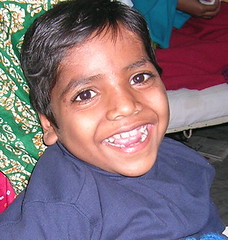
Nanhe lies on a hospital bed, his body wasted, his smile lost forever, his searing pain now borne with a silence more deafening than any cry. The men in white have given up, even his mom’s once indomitable will is now faltering.
There is no talk of elusive kidneys made in america. Even silent petitions to the gods have lost their fervour. And never have Cocteau’s words been so apropos!
But is it not blasphemous to wish that death hastens its pace, particularly when the life at stake is that of a child? Nevertheless I do not feel any sacrilege as I sit hoping that the healing kiss of death brushes Nanhe’s brow and free his exhausted spirit.
Nanhe is what we call a special child. In the game of survival, he was dealt a losing hand. He never learnt to speak, or walk; he never mastered the art of fighting for his rights and hurting others. He just accepted what he was given and rewarded you with his incredible smile. We slowly got addicted to that smile. In it we saw a reflection of everything we seek but never find, and above all the much needed hope to carry on when all seemed to tell us to stop.
Many years back, a friend had told me that special children were god’s special angels sent to earth to help us redeem ourselves. Today I wonder where our redemption lies.
The hospital just gave up and sent him home with a string of empty words: Let him go home, feed him, care for him… and many unsaid ones. So his mom gathered the broken swollen incontinent body in her arms and took him home.
Nanhe’s home is a a tiny airless room where a bed hogs all the place and yet it is where he has lived all his life. It is the place where he has shared with his family and felt safe in. Maybe today it will bring him some peace.
by Anuradha Bakshi | Jan 19, 2007 | Uncategorized
I have been holding to my ‘pen’ for the last few days for fear of being branded the proverbial carper. But doing so longer would be going against my own grain.
For the past few days or more we have been subjected to a string of national news headlines about celebrities ranging from a marriage announcement to a racial debate. The later seems to fall a little flat as the persona in action chose to be part of a reality show known for getting people to put their worst foot forward in public, not to forget that the said actress was paid a huge amount to be part of that show!
Talk shows, parliamentary debates, burnt effigies, political mileage, the reaction cocktail is heady. It is a well known fact that the media plays up what pays and increases TRP ratings. What it means is that an issue like the Shilpa story is one that titillates us and hence sells.
So let us ask ourselves why such a story sells: is it the star gazer in us that is stimulated, or the atavist colonial past that we have not shed. For it is quite obvious that those burning effigies in the remotest part of our land are probably not aware of the Big Brother show. Or was it a too good to let go story that served many unscrupulous masters.
Many questions come to mind. Is such a public outcry a refelection of our society and if so, then are we only sensitive to what happens to stars? Strange that we should be so angry at remarks made on a voyeuristic show when we ourselves live in a fractured society and indulge in divisive remarks on caste, creed and social origin? We have been sadly reminded of his reality in the recent past with the Nithari case where even the lawmakers played the game with impunity.
Sadly even our social conscience seems to follow the pattern and is louder when the cause to defend is glamorous. Come to think about it, what will all this hue and cry lead to: probably more popularity for the show and the lady, till someone comes up with another show and another star.
Racism exists and often it is something that is fuelled by vested interest in search of causes to espouse, and as long as we react in such a violent way, more such causes will be unearthed and nurtured. Here again the ball is in our court and the responsibility ours, but looks like no one is listening.