by Anuradha Bakshi | Apr 15, 2007 | Uncategorized
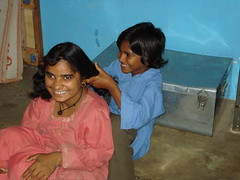
Thursday afternoon is grooming and self-care time in the special section of project why. This is when the students are taught all about looking after themselves and even looking after each other.
Manu gets a vigorous pedicure courtesy Shalini Rinky tries her hand at making up Neha and Shaheeda gives Neetu a hand massage.
Each using her special ability in helping the other feel and look better. This week Ruchi, who suffers from a debilitating nervous condition often leads to uncontrollable tremors decided to style Champa’s unruly tresses.
To many this may seem trivial but to those who know the reality it was an extraordinary moment as for Ruchi to be able to wield a comb was nothing less than a momentous effort. And Champa’s patience was laudable.
These children never fail to move me. They come from different social ad economic backgrounds and would have never met, let alone interacted had they been what we call normal! The common denominator is that they are different in normal parlance. But when you are with them you can feel the bonding that transcends anything one could imagine.
From Manu who was a street beggar a few years ago to Rinky who comes from an educated middle class family, from Himashu barely 5 to Shalini now 31, they form a close knit group that spends a few hours each day laughing, fighting, learning, playing or in a word living!
What a beautiful example they are of how easy it is to forget differences and find a common ground. Maybe we should learn from them.
by Anuradha Bakshi | Apr 15, 2007 | utpal
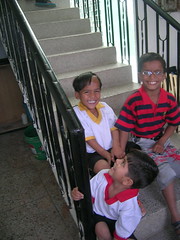
This is a sneak picture.. it was not a PTA day. Dharmendra had gone to Goyla to meet Utpal’s school principal and while he was waiting for him, he managed to get a glimpse of Popples surreptitiously.
This picture will set to rest the minds of all the die hard Mr P fans who may think he is unhappy in school. This snap was taken post lunch on the way to rest time and the huge smiles on our little gang of three say it all.
It speaks volumes for the school as it opened its doors and heart to a child that fitted no mould and enabled him to find his place. Today Utpal has been promoted to the next class. He has his set of pals and is on the way of carving out his future on his own.
Kudos to this little braveheart who has fought many odds in his tiny life.
by Anuradha Bakshi | Apr 13, 2007 | reservations
It took a shocking story to get the Government to look into the matter of burial sites for little children in India’s capital city. Politicians ignore Nithari in the run up to the state elections in Uttar Pradesh, as the families of the dead children are simple migrants and hence do not have votes. The Ghaziabad Girls are lost in administrative and judicial quagmire. Children are beaten in schools. The drop out rates are mind boggling. Child labour is rampant. Orphanages are cramped and unsafe.
Something is terribly wrong…
We are talking about the millions of children in free India, the third or fourth generation after Independence. We are talking about children who see the day of light in a democracy that professes to give them a host of fundamental rights: from education to shelter, from freedom of speech to freedom of faith. And yet a cursory glance and the plight of many of them is enough to prove that each right has been denied, usurped or hijacked.
It is not that we have done things wrong. A passing glance at the multitude of child related programmes is sufficient to see that children have occupied a place of pride in our planning, and on paper many of the proposed projects are excellent.
Let us just talk of the ICDS (Integrated Child Development Scheme) to substantiate our point. This programme was conceived and launched in 1975. Its objectives were as follows:
- to improve the nutritional and health status of pre-school children in the age-group of 0-6 years;
- to lay the foundation of proper psychological development of the child;
- to reduce the incidence of mortality, morbidity, malnutrition and school drop-out;
- to achieve effective coordination of policy and implementation amongst the various departments to promote child development; and
- to enhance the capability of the mother to look after the normal health and nutritional needs of the child through proper nutrition and health education.
What a great programme. Had it worked all other child related programmes should have worked too! But the reality is quite different. In 2007 – 32 years after the programme was launched – an ICDS creche in India’s capital city often runs from a space the rent of which cannot exceed Rs 500! In actual terms this means a tiny airless room devoid of what is deemed essential as per the programme: running water, toilet facilities, open space for children to play.
The state of municipal schools is another reflection of the place children have in free India. After sixty years many schools in our capital still do not have proper buildings, let alone other facilities! There are some exceptions, but these are often dependent on the commitment of a handful of honest individuals.
On the other hand, politicians are busy framing reservation policies to higher institutions of learning and the ensuing debates make us wonder who these places in he sun are for. Certainly not for the potential drop out. Somehow no one seems to be bothered about the state of primary education, though poor parents are slowly seeing the writing on the wall and are now often seen sending their children to private institutions that are now mushrooming in our city and are often of poor quality. Yes in India at sixty we have the private school for the poor with names like SK convent, Mother Sundari English Medium School etc, and they come at a heavy price!
My detractors will be quick to point that it is allright to criticise but what about possible solutions. Many do come to mind but what stands out is the necessity of bridging the gap between the rich and the poor, of striking a balance, of reaching out and doig our ‘bit’! What is needed is to raise awareness. What is needed is to stop for an instant and ask oneself a simple question: where are we going? What is needed is to understand that the plight of the other India will one day affect us in more ways than one.
How can a city not have proper habitat for the poor within it? One cannot just wish them away and hope they will remain invisible. How can a city have schools that do not run, privatising them is again not a solution, they have to be strengthened and improved. The judiciary or the media should not have to intervene each time things go wrong.
Ultimately it all comes down to striking a proper balance between our rights and our duties as citizens, something we seem to have conveniently forgotten.
How many more generations of children will have to be born and become adults before we realise this!
by Anuradha Bakshi | Apr 11, 2007 | girl child, two indias
Bachha ghat is not a play ground for children, it is the only place where children under three can set be to rest after their death. Hinduism does not allow them to be cremated as it is said that their soul is not connected to their body! This was brought to light in a disturbing and shocking news item aired yesterday on national television.
What one forgets is that what is set to rest is not a few pounds of flesh. What is set to rest is a child, nurtured and loved by its mother, held with pride by its father. What is laid to rest is a set of unfulfilled and crashed dreams, what is laid to rest is a life cut short.
I can speak with authority as I lived all my life under the shadow of a dead brother I never knew, one that lived but a few days on earth but lived in my mother’s memory till she breathed her last, a brother who was ever present in my life. I guess my parents were lucky that he was born and died in an alien land. A tombstone marks his brief passage on earth in a Prague cemetery.
I can speak with authority as only a few years ago I scurried around the city with a tiny bundle in my arms looking for a dignified place to lay it to rest. To many it was just a 7 months still born foetus, but for one young mother it was her first child. I had been summoned to Safdurjung hospital by a pwhy staff who was admitted there, as this very young mother had gone in a state of shock when she was told to hand over her child so that it could be thrown in the hospital dustbin. She had refused to let go of her baby and sat in catatonic inertia. When I reached the maternity ward I just held out my shawl and gently asked the girl to give me her child promising her a dignified send off. She did. That was the beginning of an ordeal I cannot forget.
I took my precious bundle which for me was above all a mother’s love and went to the one place I knew: the Lodhi crematorium foolishly believing that there must be an option for young children. As we alighted from the three wheeler I could see a bunch of predators (read funeral rites priest) approach us, gauging our worth and probably thinking we were an advance part to some funeral. When they knew what we had come for, they just walked away in disdain, not even listening to our plea.
I must thank our stars that no one guided us to bachha ghat. Refusing to give up as my promise had to be honoured, I stood my ground. A few minutes later an elderly man approached us and told us that we could bury the child a little further in the empty grounds that lay ahead. He did not reveal that it was the defecating place of the nearby slums. We found a place that seemed clean. No help was forthcoming from the people that had gathered around so we slowly dug a grave with our bare hands, and lay the little child to rest, wrapped in its shawl, and carefully laid stones on the grave and placed the few flowers we had brought with us.
Yesterday’s news item brought back this forgotten day.
We are a city busy building malls, and expressways; we are a city displacing the poor with impunity; we are a city busy dividing the gap between rich and poor and yet this incident shows that at least in death rich children and poor children are treated the same way.
The said TV channel held a discussion of this shocking reality and once again we witnessed the birth of a new polemic with all the necessary ingredients for endless debates for all: politicians, opposition, religious leaders, the judiciary, the newly empowered citizen groups et al..
But as the debate goes on, more children will find their way to the baccha ghat while the city will be busy for 2010 a red later day for many. Today’s world is for the living rich, not for the dead and least of all for the poor.
by Anuradha Bakshi | Apr 9, 2007 | sealing
The verdict is out in the municipal election. The party in power was routed, or almost as most of Delhi, or let us say the 43 odd % who went out to vote seemed to blame the party in power for all their woes ranging from the sealing drive to the lack of civic amenities.
Our municipal ward saw an interesting contest reflecting once again the maturity of the voter. The fight was between two candidates: one the person in power for two terms and the other a rebel of sorts backed financially by the one ‘who did not get the ticket’ or in terms of symbols the fight was between the hand and the engine!
The engine was carefully selected and belonged to Bihar as a vast majority of the slum dwellers – the normal hand vote bank – are from that state. An aggressive campaign ensued where every ploy in the book was used: cajoling, bribing, threatening… you name it, they did it.
Our well seasoned voters excelled themselves in paying lip service and partaking of all goodies offered but never failed to mention that Mr engine had always been against the poor, the slum dweller, the street vendor and had many a time voiced that dislike in no uncertain terms.
On the other hand they remembered Mr hand who in spite of everything was always there for them. Come election day and they excersised their right to vote with intelligence and brought Mr hand back even when most of the city did not. For them it was a municipal election and hence they wanted a person who would help them. It was not a time to back caste, creed or even a larger ideology.
Grapes went sour for Mr engine who fumed, ranted and raved. But to no avail. Many had come to me with a smug smile and shared that they hand voted for Mr hand in spite of what they had been saying, as ultimately it was their decision and their right.