by Anuradha Bakshi | Aug 20, 2007 | Uncategorized
The recent spat between a young athlete’s coach and his mother has led to a child’s future being held to ransom. It is true that in Budhia’s case a solution will be found as he he is a media celebrity but the whole issue opens up a disturbing debate.
In an answer to a recent mail a friend wrote: The thought scares me that by providing support, we may also be creating a social monster which gets used to being fed. He was referring to my concern about the future of the children that transit project why or as a mater of fact the future of all children who acquire a mediocre education as that is what the present system has on offer. In its mission statement the lead India campaign states: our municipal schools are not equipped to impart even basic education but stops short of suggesting an alternative.
Seven years ago, when pwhy began, one lived under the illusion that education would open new avenues for children and hence give them a better future. Today if one were to be honest, experience has proved that it is not quite so. No matter how brilliant a slum kid is, he will never the the 90+% required to go to a good college, nor will he acquire the confidence, communication skills and the oomph required in today’s working world. His marks may help him break some barriers but what about those who just scrape through.
The social monster referred to above is just that child, the one who holds a degree or certificate in hand and thus as arrogated itself the right to dream big. The question one is compelled to ask one’s self is whether it is right to impart such education and feel satisfied? Is not one morally bound to think ahead and look for viable options?
The education for all campaign seems to have gone awry. There are schools without children, children with years of schooling and no knowledge. Budgets allocations increase each year but the situation on the ground worsens. Much needs to be done. Imparting a useless education is worse than no education at all.
Maybe there is a monster lurking, one that needs to be slain not fed
by Anuradha Bakshi | Aug 16, 2007 | two indias
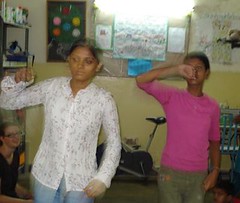
 R and S are hearing impaired. R is 19 and S 14. They are both students of our special section and are real live wires. In the last years they have learnt many things from tailoring to cooking, from paper craft to weaving. R is a talented artist and S can cut and stitch a mean suit. They have evolved their won ways of communicating and have opinions on every and any thing. And yes they can even dance to the latest Bollywood number not missing a beat. R has finished training as a beautician and has a part time job at the local beauty parlour. S will also get the same training soon and join the ranks of the gainfully employed. Both are happy young girls who have taken life’s challenges in their stride.
They both belong to poor families. S’s father is a small time tailor and R’s father keeps poor health and thus does not work much. Like for all girls in India, their parents hope to get them married one day.
A few months ago some visitors from Europe came to pwhy and were touched by these tow vibrant young ladies. They wanted to know whether there was any way in which their hearing could be restored. We had of course explored all ways when they first came to us and had been told that only a cochlear implant could help the, the boggling 1 million rupees that such an implant cost put an end to our efforts.
Last week I got a mail saying that there could be a possibility of sponsoring the implants and seeking added information. True cochlear implants are done In India at the cost of 6 to 9 hundred thousand rupees. there is an added cost of 100 000 Rs for the operation and one has speech therapy for at least two years, regular implant programming and life long annual follow ups. The operation is daunting for any one and more so for simple families who barely survive let alone live. The likelihood of these two young ladies being married in another city or village is real and that would put an end to follow ups and complex programming. The implant could become an impediment rather than an asset.
As we sat with the teachers and special educators wondering what to do, we realised that both R and S were comfortable in their silent world. They had evolved their own ways of dealing with life’s realities. They somehow were far more independent than many other young girls their age who hear but have not been educated. They have various skills and hence many avenues are open to them. A complex surgery may turn out to be a hindrance and destabilise them completely. The whopping amount spent would ultimately bring more trouble than joy.
At times like these, the existence of two Indias becomes painfully real and puts us in a disturbing dilemma. To heart or not to hear, that is the question.
by Anuradha Bakshi | Aug 16, 2007 | Uncategorized
Yesterday India celebrated its 61st independence day amidst much fanfare and media hype. Once again promises were made from the rampart of the historic Red Fort and huge allocations were pledged to education and agriculture. Newspapers dutifully listed all achievements and reading them would have made any one proud. Staggering figures seemed to pervade all sectors of growth as India seemed poised to become a super power.
And yet was it not barely a week ago that a TV channel gave us the startling revelation that over 32 000 primary schools across the country did not have a single student? This sums up much of what is happening in our land. Brave and even laudable programmes and projects get launched but never reach the beneficiary. Somewhere down the line they get hijacked by vested interests.
A leading newspaper has launched a new campaign called LEAD where the operative word is DO! It is a well planned media blitz with all the right ingredients including a string of celebs and will in all probability bring its creators what they aspire for till the next campaign but somehow it seems to have hit the nail on its head.
We seem to have become a nation of non-doers. In response to an email sent on I day, a friend wrote back: Whenever I tell someone to save paper or adopt vegetarian way of life – the response is neutral or negative but hardly enthusiastic.
In a land so deeply divided between the have and have nots, the rich and the poor, the urban and the rural those of us who have the ability to make a difference have lost our enthusiasm and withdrawn ourselves in the comfort of neutrality. We seem to be waiting for the other to do! And this passing on the task goes down the line till there is no other left.
We will become truly independent only when each one of us shakes off this neutrality and acts, when we accept our part of responsibility in each things that is wrong and asks questions; when we finally accept to stand up and leave that mythical armchair. That day India will be truly independent.

by Anuradha Bakshi | Aug 9, 2007 | Uncategorized
Over the past 7 years now, we at project why have been doggedly teaching batch after batch of slum children with a measure of success, if success is to be determined by examinations results. Many have passed out of school and joined the working world, others have selected to pursue academics in some form or the other.
I must confess that for some time we too basked in the glory of our achievement sometimes forgetting to look at the stark realities that stared at us or maybe choosing not to see. But no one can be so inured as to not be outraged when three children open their single lunchbox and find rotten food.
I remember how horrified we were a couple of years back over Preeti’s lunch box, and how it had brought to the fore the plight of disabled children in India. And once again we set out to unravel the mystery of this lunchbox that belonged to three siblings that attend our creche.
A home visit brought to fore the reality of their lives. Eight siblings ranging between the age of 12 and a few months live in a tiny hovel. Their father who own 2 vehicles barely comes home as he spends his money, or most of it, on drink and women, and gives very little to support the family. However he does come home to claim his conjugal right with regularity. The mother manages as best she can and the children are often fed by neighbours. None of the children go to regular school.
This woman typifies many women that live abysmal and lonely lives in Delhi’s slums, away from the comfort and security of their village. They have been brought to practically worship their husbands and defend them with pathetic conviction, as if their lived depended on it. They know nothing of family planning, AIDS let alone women’s rights.
When we asked the mother why she dis not send her elder girls to school the answer was shocking though true to her reality: they only need to learn housework was what she quietly said.
That woman did not have dreams or aspirations, she just had to live or rather survive wondering where the next meal of her children would come from while she clutched the womb that carried her ninth child.
by Anuradha Bakshi | Aug 9, 2007 | girl child
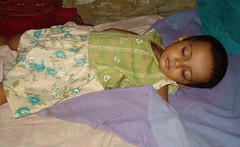
Little mehajabi is back home after a successful open heart surgery. For the first time in her tiny life she sleeps soundly, her breathing normal. Soon she will be returning to where she came from and resume the simple life her parents live in the confines of a madrassa.
What her life will be no one knows but she lives today because two simple and illiterate parents refused to give up on her even though she was a girl and the youngest of 5 siblings. They refused to give up on her even though the costs of her recovery were daunting for a family that earned a pittance. In a country where the girl child is often treated with contempt, the determination of this family to save mehajabi is laudable and needs to be applauded.
One wishes there were more parents like them.