by Anuradha Bakshi | May 1, 2008 | Uncategorized
 A glittering report was aired yesterday about the new home of one of India’s richest man. Quite a home: 27 floors, 400 000 square feet of space, bathrooms as big as flats, private cinema theatre, gyms and juice bars, 4 floors for parking and all for one family! At a whopping two billion dollars it is the world’s most expensive home!
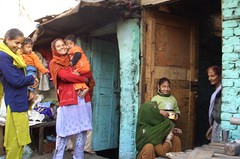
In another part of the same country Jyoti lives with her family and neighbours in a slum. Her home has 80 square feet and no bathroom or kitchen but is her home and she has made the best of what she has: a little shelf displaying some steel crockery- remains of her dowry-, few plastic decoration pieces bought at the local china bazaar, a little TV that brings the world into her home and lots of smiles and giggles as she proudly shows her dog eared photo album.
A few years back when we still were running a centre at the Lohar basti – the gypsy camp – little Ritu a spunky 3 year old whose house was one of the last ones of the camp was often given the task of showing her home to visitors. She lived in a shack covered by a tarpaulin where one corner was filled with rags as her father a ironmonger by trade often picked rags to supplement his income. The dwelling has one large bed piled with clothes, a small rickety cupboard and not much else. It was dark, dingy and humid. I remember a day when I asked her to show her ‘home’ to a friend who had come by. Ritu the ever confident kid, bearing the age old pride of her clan firmly took my friends hand in hers and holding on to her slipping pant with the other marched off. We followed her. As she reached the entrance of her home she said with the confidence of a queen in a loud and clear voice and a regal gesture: Yeh Hai! – This is it-, as if her home was a palace!
And what was heart warming and wrenching at the same time is that it was she felt. This was her home, a place she loved and where she had spent happy moments. The visit was not over. She invited us in, cleared the bed, made us sit and set out to give us a tour of the place. She opened the cupboard and showed off her clothes and those of her parents and then looking for her mom simply said: chai banao – make some tea!
Needless to say we were all moved to tears as millions of questions begging for answers ran through our mind begging for answers. Why were people still living like this in a country that boasted it was shining!
Strange that this incident should come back to my mind today after seeing images of the most expensive home in the world. I simply wonder whether the richest family can ever feel the same pride that the little gypsy girl.
by Anuradha Bakshi | May 1, 2008 | Uncategorized
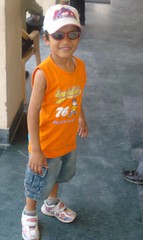
 Had Popples not come into my life, Dear Popples would never have seen the light of day. The young man you see in the picture look nothing like the bundle swathed in bandages, his huge eyes filled in pain who walked into my heart on a March morning in 2002. This one looks more like the pasha – read hero – he wants to be.
Yet Popples changed my life in more ways than one. He taught me hope, love in its purest form, survival no matter how dark the hole you are in is, but above all he became the mirror that showed me who I was, what I had become, and how I could change with time.
Popples makes dreams come true, even very old ones, those you have forgotten or even relegated to some dark recess of your mind as they seem ludicrous and even absurd.
I must have been 15 or or so when I first read Bonjour Tristesse, by Francoise Sagan and as luck would have it I read it sitting on the terrace of a Latin Quarter in Paris. The book not only had the kind of story that would make any young girl swoon, but was written when the author was 17 and has failed her end of school exam. That was the time I think I first dreamt of writing a book!
But books need stories, the kind that wrench your heart and soul, the kind that ring true, the kind that touch others and my life seemed dull and almost jaded. And whatever creativity a young mind could have had, was quickly silenced by the monotony of life.
But dreams do not die. They just wait patiently for the right moment to resurface, even if the right moment is light years ahead. Popples was the catalyst that brought the discarded dream back to life.
My publishers have categorized it as fiction: inspirational and I am deeply grateful for dreams belong to that realm, or do they? I think Abhigyan and Mrinal have put in words as only they can, what I have always felf but never been able to say:
To accept the real is not to accept that it is perfect. Reality is like clay. It is the starting point and not the end of things. At the beginning of the race all runners are at zero. Reality. One goes on to win. He changes reality. Shapes reality. Those who fail – accept that reality and start again on a fresh race. Everyone is back on the starting block. Reality waits to be shaped again. The race is long. And it is continuous. Every moment reality awaits our turn to shape it. To deny it is to escape into wishful inaction. To simply accept it is to stay at the starting block forever. Only way forward is to run.
When our stories become ordinary and the ordinary becomes a virtue; then virtue itself becomes ordinary and the only extraordinary thing left is murder and mayhem. For it is easy to ignore daily goodness like helping someone cross the street but crushing someone on the same street under speeding wheels is bound to generate more interest. At least in these cynical times. Which is why it is the job of stories to exemplify and exaggerate goodness.
Goodness is not sticky when it is mundane. Murder is.
If we want a society of goodness, kindness, compassion, courage and excellence we must tell stories of extraordinary goodness, compassion and excellence. And the extraordinarily good, kind, compassionate and courageous is called a hero.
We are all ordinary but it is the stories of our heroes that inspire us to rise above the ordinary when the moment demands. Without heroes, with the ordinary grey protagonist, all we find are echoes of our own fallible, flawed selves and when the moment calls – the hero within us fails to stir because all he has experienced in life as well as imagination are defeat, despair, fallibility and flaws. When the forces of murder and mayhem confront us in their dark, blacker than Black colour, we are choked in our throats with grey balls of fear and apprehension while the white light of courage and conviction ebbs away from our heart like the blood from our veins.
There are no heroes in life when there are no heroes in our stories.
For life is a story. The story!
Anouradha & Popples’ is an extraordinary story. More so because they have lived it.
Abhigyan and Mrinal Jha

by Anuradha Bakshi | Apr 30, 2008 | Uncategorized
 I must have been quite young when I first heard about dream catchers. As a kid it was comforting to believe that there was something that ensured that only good dreams came your way while bad ones slipped out. Someone had given me a dream catcher and I felt comforted having it hanging above my bed.
I soon grew up and the delicate dream catcher got lost as we moved from continent to continent and I forgot about it. It was only yesterday when I heard that Dear Popples was published that I suddenly remembered the dream catcher of my childhood.
The lore of the dream catcher is beautiful.
Long ago when the word was sound, an old Lakota spiritual leader was on a high mountain and had a vision. In his vision, Iktomi, the great trickster and searcher of wisdom, appeared in the form of a spider. Iktomi spoke to him in a sacred language. As he spoke, Iktomi the spider
took the elder’s willow hoop which had feathers, horse hairs, beads and offerings on it and began to spin a web. He spoke of the cycles of life….how we begin as infants and move on to childhood, and then to adulthood. Finally, we go to old age where we must be taken care of once again as infants, thereby completing the life cycle.
Iktomi said, “In each time of life there are many forces and choices made that can affect the harmony of nature, and interfere with the Great Spirit and all of his wonderful teachings.” Iktomi gave the web to the Lakota elder and said, “See, the web is a perfect circle but there is a hole in the center of the circle. If you believe in the Great Spirit, the web will catch your good dreams and ideas – – and the bad ones will go through the hole.
When I look back at the past few years I am sure that an invisible dream catcher hung over my life helping me make the right choices or how else would all that has come my way happen? But dream catchers are not just about choices and ideas; they are also about dreams. And though I hardly have dreams about myself, one seems to have got caught in some remote corner of the web: that of dear popples being published!
The Great Spirit thought otherwise and set his own wheel in motion and knowing that I would never find the time, the way, the force, the motivation to keep this dream alive, entrusted my dream to someone else. That was Abhigyan a true dream maker!
You do not thank Great Spirits and dream makers. You simply feel blessed that they came your way.

by Anuradha Bakshi | Apr 30, 2008 | Uncategorized
 If two of you agree on earth about anything that they may ask, it shall be done for them by My Father who is in heaven. Matthew 18:19
Thus quotes the Bible and these words were sent to me by the one who made my dream come true. Dear Popples’s genesis began much before Popples himself came into this world. It actually began as a dream of a teenager growing in the sixties a time when everything seemed possible. It began in the head of a girl fed and overfed on books that were the sole form of escape of a lonely child growing up in different lands amidst too many adults. It began in the absurd dreams of a young girl sitting at cafe terraces in Paris imagining herself to be a writer.
Then life took over and decades went by but the dream did not. It sprung back on a summer day when the girl now an ageing woman came across a little child who was to redefine her life and stumble upon who she really was. The dream that had laid in waiting sprung up again and took the shape of a sheaf of haphazard paper where she poured out her heart and soul. But dreams as the Bible says need two people to make it come true as does creation. Where was the other half of the dream.
For many months the sheaf of papers lay in the recess of a drawer; it was sometimes taken out and shared with someone or the other but it quietly slid back into what seemed to have become its resting place. Then one day something impelled her to take it out, clean it up and begin the daunting task of finding the other half.
The rest is history. True that there were the needed string of rejections but those just made her more obstinate till the day someone miles away responded positively; the other half had been unearthed. Dear Popples had emerged from its dark abode into the light and the dream had come true.
I have never met Abhigyan Jha, my publisher, in person but somehow I feel I have known him for a stretch of time that transcends all spatial-temporal laws and defies logic and what I feel is not just gratitude but again something that cannot be expressed in words. I know he understands
Soon dear Popples will be for all to read and I must confess I am terrified.
by Anuradha Bakshi | Apr 30, 2008 | Uncategorized
 I was recently sent a link by a friend about a new library fad: borrow not a book but a person and an interesting link to a comment on this new fad!
A lot of food for thought.
I sent this link to many friends and one of them said the following: we will soon begin to barter ideas and expertise on a peer to peer / person to person basis as that would be the only validation for being human and worthwhile.
you will not need a gardener to do the garden or mow the lawn – you will need him for his insight and creativity – the manual labor ill shift to robots and automatons.
which is all the more reason to educate our children about the conceptual reality if life. that we are nothing if we don’t create products of the mind. it can be values. it can be ideas, processes, products, advice, conscience, friendship, talk, coaching, teaching, storytelling, experience sharing – whatever but it has to come from the mind.
he goes on to add: we are human because we use our mind. period. the sooner we stop talking about the dignity of labor and start making it clear to everyone that there is no option to using our mind to create value which others might want to partake of – the better for everyone. otherwise we are going to see the kind of income inequality that we have never seen before.
Even in the parts of India where there is no food on the table – there is a mobile phone. and it’s almost free to use. Lifetime Free. and what do people do on the mobile phone – they talk. and why would the poorest need a mobile phone. because even for them talking, sharing, communicating is more important than just eating. the hunger of the mind is a bigger necessity than the hunger of the stomach.
His approach seem a little bewildering at first but of you stop a and think, what he says is true and what is alarming is that for once the two Indias’s hearts seem to be beating in unison. They are both spinning unconsciously towards a dystopic view of the world where the power of the mind is losing its importance.
When I was a young girl growing up in the mad sixties I saw Fahrenheit 451, a mind blowing movie by Francois Truffaut: a story about a society where books are banned and have to be burnt! A bunch of old men decide to memorise them so that they are not lost forever. The film end on a bitter sweet optimistic note: the said society is destroyed and a new one is about to be created: their first task is to build mirror factories, a literary allusion, to show people who they are, what they have become, and how they can change with time and knowledge.
Borrowing a person in a library seems akin to the Bradbury’s soft science fiction novella. And are we today slowly but surely moving towards the self destruction of our dystopic society.
On a more optimistic note I would love to borrow the idea and create a library where one could borrow people who still have in the recesses of their memories stories about the past, the traditions, the mores , the of forgotten and never documented anecdotes that threaten to be lost forever. A few years back DV Sridharan the creator of GoodnewsIndia began a series titled memory speaks. I remember having written a few pieces that had been told to me by my mother when I was still a child. Some were amusing others thought provoking and all in need to be preserved before memory failed. The series sadly stopped. Today’s new fad brought it back to me. I guess I too was a person that was once borrowed!