by Anuradha Bakshi | May 11, 2008 | fostercare
For the past few days I have been in a state of postpartum blues, the kind women suffer after the birth of a child. Doctors have their own complex clinical explanations but to me it is simply the feeling of overwhelming emptiness that comes after what you have waited for, desired, expected, prayed for finally comes your way and instead of the feeling of elation should come your way, it is a terrible emptiness that engulfs you and leaves you rudderless.
Last week saw the realisation of two incredible feats came my way: we managed the garner all the funds needed for the land for planet why and are ready to close the deal, and dear popples got published. I should be jumping with joy, planning a holiday or a bash but al I feel is terribly empty and at a complete loss.
What comes to my mind are Oriana Fallaci’s words: To fight is better than to win, to travel much better than to arrive, once you have won or arrived you feel a great emptiness, and to overcome your emptiness you have to set out on our travels again, create new goals..
That is where I stand now. Needing to create new goals, charting new travels, conjuring new dreams as again in the words of Oriana Fallaci: to have realised your dreams makes you feel lost!
And there are many, some small, some huge, some seemingly easy others daunting. Garner the figure with a staggering numbers of zeros needed to build planet why, assemble the much needed money to run pwhy for the next months and then he next one; find the support to ensure that the foster care kids complete their education, find a possible treatment for little Radha, and maybe start writing another book: the project why story!
Yes to fight is much better than to win, to travel much better than to arrive. It is time set out on a new journey…
by Anuradha Bakshi | May 10, 2008 | Uncategorized
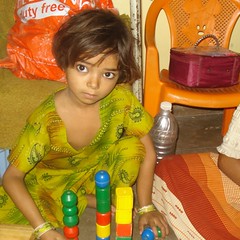
Little Radha is 7. She suffers from ostoegenesis or brittle bone disease has terribly deformed legs and is unable to stand. The slightest fall or hit causes a fracture as her bones have become terribly porous. She has already had more than a dozen in her tiny life.
She came to our office in the arms of her mother clad in a fleece outfit. The ambient temperature of the moment must have been 40 degrees Celsius. When we asked her mother why she was wearing such an outfit, the answer was simple and direct. She had no other decent clothes.
Radha lives in a sunken hovel, the roof of which is lower than a person standing and where not a shred of light enters. Her father lost his job as the factory in which he worked closed. He now sells tea but can barely make both ends meet as they have 4 children. Radha seemed a healthy child till the age of two when she first fell and broke her leg. It was then that she was diagnosed with osteogenesis.
1 in 60 000 children get osteogenesis and little Radha is one of them. Also known as brittle bone disease the ailment has no known cure. Management of the disease includes focusing on preventing or minimizing deformities and maximizing the child’s functional ability at home and in the community. Sound doable but in a home like hers it is close to impossible. Support groups exist but not for someone like our little Radha. The prognosis is scary as it not only affects bones but can result in brittle teeth, loss of hearing and easy bruising. The main cause is little or poor type of collagen.
Wheelchairs or braces are recommended and exercise like swimming is extremely beneficial. But where does a child like Radha go to swim or how does she use a wheelchair in the hole in which she lives. A child with OI needs good nutrition, rich in calcium, leafy vegetables, cereals, milk products all not within reach of a family that barely survives. The doctors had suggested this but for a family that can barely feed 6 mouth this was quasi impossible. And little by little her legs contorted as she suffered one fracture after the other.
New research suggests the use of bisphosphonates that seem to have has excellent results but that still seems at a trial stage. We will of course look into it!
Radha was denied any form of childhood and could not accompany her siblings to school or play. She just lived in her dark hole and dragged herself from one corner to the other. Two of her siblings come to our creche and that is how we came to know about her. Thank heavens her spine of head did not suffer any fracture!
Radha is an intelligent child who could learn like any other seven year old but her ailment closed all doors to her. We hope to be able to help her as best we can. As you know we at project why believe in miracles!
by Anuradha Bakshi | May 8, 2008 | women centre
 The Kamala centre is now more than six months old and much has happened within its walls. It all began as everything does with lofty ideas, impossible dreams and ambitious plans though past experience had proved that these do not get fulfilled no matter how hard you try. We were of course prepared for all course corrections and open to all suggestions and constructive criticism.
It all began when two women needed some breathing space to take stock of their lives and chart out their future at a time where they had been dealt too many blows by an unforgiving and insensitive society. I guess what we did not understand at that moment in time that once you found your feet you had to start looking for your feet and we made the mistake of planning out a long term future for them.
It is true then when things look dark and without hope, people are willing to make adjustments and come to terms with many situations. But as things start looking up and problems resolved, old habits came back to haunt and wings slowly start growing. Often their growth is slowed by a misplaced sense of indebtedness but your heart is not there and you start slipping. Just like with children that is when the wise should let the bird fly out of the coop though many do not understand this.
The last few weeks have been difficult as one of our residents, now healed of all her ailments, started feeling stifled in an environment so different form the one she had known all her life and though it was one that gave the respite she so need a year back, it was not conducive to her needs and desires now that she had found her feet. It was time to let her go.
It was also time to understand that the women centre could only be a refuge and temporary shelter for those who needed to some breathing space. True some may turn up to want to stay for long but we must realise that we cannot and should not try and hold any one back.
On the flip side the Kamala centre has gone beyond our expectations in other ways. We had imagined the children activities to be a small part of the overall project but once again reality stares at us and our education support system now till class X is choker block and even has long waiting lists. Our activities with local women are also on the rise and over and above vocational courses like beauty and stitching, we now have English classes and regular get togethers where women share all their problems and discuss matter of interests to them or us: girl child, banking, legal rights, health and hygiene, government schemes etc.
So slowly we too are finding our feet before looking for our wings!
by Anuradha Bakshi | May 7, 2008 | okhla
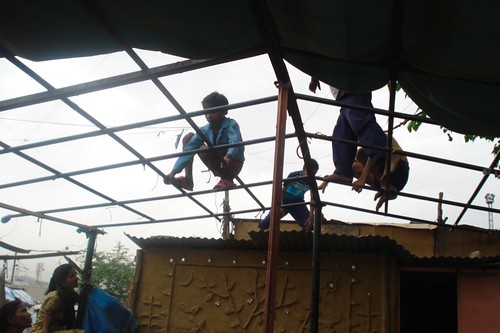
 This is not a picture of a tsunami hit structure. It is simply our very won Okhla centre after the dust storm that blew over Delhi two mights ago. The figures you see eagerly repairing the tent are our very own students. And this is not the first time they have done this, they do it every time the need arises.
The Okhla centre has known more than its share of problems and has dealt with each of them with rare dignity and courage. They are not ones to be deterred and prove beyond doubt the oft quoted and sated dictum: if there is a will…. The almost apocalyptic site was not enough to wipe off their smiles; they just set out to task determined to have their precious school up and running.
Actually they had come out in the night itself during the storm and seeing the damage guarded the place till the teachers turned up in the morning.
As I watched this unique site many thoughts ran in my mind. I felt a sense of immense pride as in spite of belonging to the poorest of the poor, these children showed much more mettle and grit than their colleagues in other centres. Perhaps it is because most of these kids are survivors in the true sense of the word and know that their morrows depend on their own abilities.
My mind wandered on. I realised that this mild storm that did not make a dent in the lives of millions across the city who did not even suffer the customary power cut, had been enough to blow away one of our oldest centres. Was this yet another proof of the extreme fragility of project why itself that could blow away if we did not anchor it on solid moorings.
And I was reminded of these lines wriietn in the XVII century by William Collins
“But tomorrow, dawn will come the way I picture her,
barefoot and disheveled, standing outside my window
in one of the fragile cotton dresses of the poor.
She will look in at me with her thin arms extended,
offering a handful of birdsong and a small cup of light.”
by Anuradha Bakshi | May 6, 2008 | Uncategorized
”We want to preserve their childhood days so that tomorrow if they ever want to see how they were, where they were, they could easily get to see those precious moments. We gift a CD to the parents of the adopted child,” says Madhuri Abhyankar, Director, Sofosh Orphanage.
This is a new initiative launched by an orphanage is an extremely sensitive and a step in the right direction. Adopted children often have the desire to know where they came from, what happened to them, why their natural parents abandoned them and so on.
Childhood needs to be preserved as nothing is worse than not knowing, even the if the truth is harsh. I wonder though how a child would feel of he or she finds out that it was left at a doorstep, in a garbage dump, at a railway station or simply to die. This is the case in India today.
A touching comment on a recent post says: Our 6 year old daughter was a 7 day old foundling left abandoned with a note in the train station at Kattack. Our 12 year old daughter was abandoned after birth at St. Ann’s Hospital in Kumbakonam. I often wonder if their birth mothers ever think of them, wonder about them, worry for them, if they realize what they gave up. I pray that these were the last desperate acts of desperate women hoping that their child might possibly have a better lot in life and not just the disposing of an unwanted commodity.
In a country where life is cheap and the life of a baby girl even more so, where babies are sold for a few farthings for nefarious ends, one wonders how many children do reach orphanages and how many are condemned to lives with no hope of escape? And yet no matter how sordid one’s past, there is a journey everyone has to make at some time of his or her life.
These memories frozen on some digital media will undoubtedly one day heal many hearts