by Anuradha Bakshi | Jul 30, 2008 | sustainability
 Yesterday I was interviewed by the Sari Kids. It was for the film they are making on pwhy and that they plan to show to their friends and peers in business school when they got back. The film is replete with images and cameos of their month long stay with us and they of course, wanted me to give a brief account of what one could call the project why story: its inception and genesis, its achievements and failures and above all its dreams for the future.
I must admit I am always uncomfortable in front of cameras as most of the times one is unclear about the real motivation behind the shoot. But this one was different as we sat comfortably talking about pwhy. The camera just sat unobtrusively on a table and was soon forgotten. And what was intended to be a twenty minutes interview turned out to be an hour long chat with friends, notwithstanding the age difference!
It was easy to share the pwhy journey with these wonderful kids and I found myself talking of the very personal journey that was at the origin of pwhy, not needing to circumvent or colour any event for fear of having them misinterpreted or used without he proper context. The story was much the same as the one too oft recounted, but somehow this time it seemed much truer and heartfelt as they words flew uninterrupted. There was no pressure, no time schedule, no pointed questions, no drama. Facts followed each other, interspersed with personal comments and pointers. And for the first time I saw how almost picture perfect the pwhy story was. We had actually and with a reasonable amount of success met every challenge thrown our way and were in more ways than one ready to face the ultimate one: that of making pwhy sustainable.
The lights went out, the camera was switched off and yet for a long time I sat lost in my thoughts trying to make sense of all that had been said. The disturbing question left unformulated still in my mind: had the journey been worthwhile?
The words of Forest Witcraft came to my mind: “A hundred years from now it will not matter what my bank account was, the sort of house I lived in, or the kind of car I drove…but the world may be different because I was important in the life of a child.”
by Anuradha Bakshi | Jul 25, 2008 | fostercare, okhla
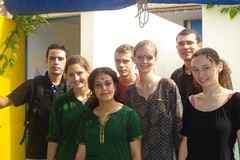
 For almost a month now, project why has been touched a very special brand of love. Almost a month ago seven bright students from a leading business school in Paris landed on our planet brimming with enthusiasm and energy. Sofia, Aude, Anais, Matthieu, Aymeric, Jessica and Carlos are members of SARI, an association aimed at extending support to organisations in India. This year project why was the chosen one!
I must confess that I was a little apprehensive at first as this was the very first time we were hosting not one, not two but seven volunteers at a time. But somehow the warmth of the emails they sent and their deep commitment was enough to bowl us over.
This unique bunch of kids is not your run of the mill business school scholar. They are kids who have learnt to see with their hearts at an age when most of their peers are busy with mundane pursuits. For the past months they have been busy preparing their trip and have spent many a week ends and holidays fund raising for us: baking cakes and Indian pies or taking up sundry chores, they just did everything they could think of.
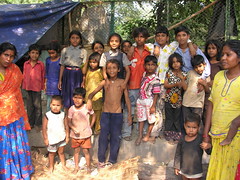
For the past month these incredible kids have been battling the odds that awaited them with grit and determination: the heat an dust, the mosquitoes, the power cuts, the over spiced food, the language problem and above all the cultural shock. And frankly nothing can prepare anyone for slum India! I guess many of our own people would find it difficult of not impossible to spend one or even half a day there. But these brave kids soldiered on and after a difficult first week each one of them found their place in project why. And what was even more remarkable was the fact that they even slept in turns at the foster care where life is rudimentary by all standards, a place where I must confess, I would not find it easy to stay.
In the day they each went their way, some to teach at the women centre, others to play with the kids in the creche and still others to Okhla which is by far our most forbidding centre. Questions abounded in their minds and perhaps we were not able to answer them all. It is much easier to deal with an individual than a group and we realised we too had a lot of learning to do. Many things remained unsaid though they were deeply felt by all of us. We would have liked to be able to reach out and interact much more than we actually could.
By the time they leave, the SARI group as we fondly called them, would have left their indelible mark in our hearts. But that was not enough for them. The last week was spent on a huge shopping spree: school bags for the kids at the women centre who use plastic bags in lieu, oodles of mats to replace the threadbare ones, white boards and even clothes for little GyaniChu. But the biggest gift all is the money given to rebuild our Okhla centre that was literally blown apart. The SARI kids will be fondly remembered by each one of us. They conquered our hearts in their own way.
I have often said that I am busy being grateful. And once again I find myself filled with the same overwhelming sense of gratitude. I realise that I often fall short of saying the two sated words: thank you as they cannot even begin to express the depth of my feelings. Perhaps I should use them more often.
There is another thing that the SARI kids have done and that they not are even aware of. They have vindicated a dream of mine, one that I wish I could see happen with their peers in India. I am convinced that India could change for the better if young people from good homes and leading institutions found the time and the commitment to reach out to the less privileged. I wonder whether that day will dawn while I am still around.
Yes our SARI kids will be in our hearts for a long time. I hope they too will remember us and forgive our shortcomings if any. What they did is something they can truly be proud of. And in a land where the divine rules, we will pray that God grants them all that their heart desires.
You can share some of the special moments of their visit here:
by Anuradha Bakshi | Jul 24, 2008 | Uncategorized
 “The sun illuminates only the eye of the man, but shines into the eye and the heart of the child” wrote Ralph Waldo Emerson. How true he was.
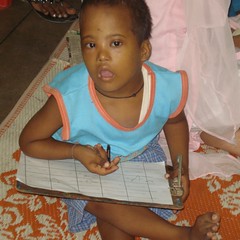
A few days back a little ray of sunshine entered our world. Pooja is 7 year old and has Down syndrome. Since she joined our special section nothing is quite the same. Pooja is an endearing soul and like all kids with trisomy is extremely affectionate and warm. She took no time in making a place for herself in the hearts of each and everyone. She is filled with mischief and a bundle of activity but someone no one seems to mind. Even the most taciturn of the lot cannot help but smile at her antics.
A few days back she commandeered poor Geetu’s lunch box hours before lunch time and decided to eat it. The normally prim and proper Geetu who is a tad possessive about her lunch simply smiled and even fed her. Pooja has still not accepted to follow the time table and the staff too indulges her so she makes her won day and decides who to sit with to what to do. Sometime she is seen practicing writing skills with the more advanced lot, or she decided to butt in puzzle making time of the other group and with a flick of her hand and a mischievous smile destroys the carefully constructed puzzle. What is amazing is that even Anurag who normally would throw a fit, simply smiles at her and sets out to rebuilding his puzzle.
We know that Pooja will soon settle. But what is amazing is the way in which her classmates have accepted her and made her one of them. The motley crew that makes up our special section is normally quite a handful each with their complex behaviour and mood swings. But somehow with this little bundle of joy, they seem to have set all aside. Is it because they intuitively know she needs their support and love. My little special kids never cease to amaze me. Evey day in their own unique way they teach me invaluable lessons to cherish.
by Anuradha Bakshi | Jul 23, 2008 | Uncategorized
 The parliamentary debate on the confidence motion trust was a gloomy moment for all self respecting Indians. I will not delve into the matter as enough has and is being said. I followed bits and pieces of the day long saga with dismay, horror and immense sadness. Less said is better. I simply chose to mention a brave speech, that of Rahul Gandhi and who was heck;ed all the way.
Again I am not one who condones nepotism and dynasties nor am I a sycophant. What got my attention in this speech was the fact that perhaps it was the only one that referred to the other India in a humane and real way. When RG spoke of Kalawati, he gave a voice to the hundred of millions of faceless and voiceless Indians.
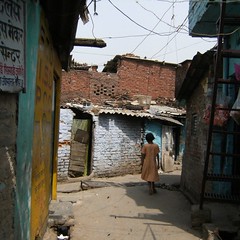
There are Kalawatis everywhere. People who live a hand-to-mouth existence in a land that is becoming more and more indifferent to their needs.They pass by us so quietly that we never see let alone acknowledge them. Yet many are the warp of our very existence. And even if they do not impact us directly they are the lifeline of those who make our lives more comfortable. I am talking about the man who sells hot food to the construction worker, the man who sells handkerchiefs, socks, and cheap ware on road sides, the one who sells plastic toys a father will take back to his child at the end of a long day.
Imagine the plight of such people as they set off every morning, weather notwithstanding, with their bundle, or cart not knowing whether they will be able to bring back sufficient money to feed the family for the next 24 hours. No one buys kerchiefs or head scarves every day! And every day the same amount of rupees buy much less food. Every week we make the appropriate sounds of dismay as we are hear the new inflation figures on our slick TVs in the comfort of our air conditioned room. Yet the size of our weekly basket barely suffers. For the Kalawatis across India the story is different and it is time that we took notice. I guess that is what RG wanted to do. But did we? Or should I say did those that matter notice. We all know the answer. they were too busy playing to the world gallery and bringing shame to each one of us.
I do not know whether the nuclear deal is good or not. I do not know whether RG’s speech was a clever political gimmick or one from the heart. I only know that it brought to the fore the reality of millions of our own country mates. I wonder how many of us can even begin to imagine what such a life means. I must admit that I too was one of those living in absolute denial. Pwhy changed all that.
I see the how inflation and price rise affects the common Indian in the lunch boxes of children everyday. I see it in the eyes of a child burning with fever who was not taken to the doctor for want of money. I see it in the backs that seem more bent and the gaits that have lost their spring. Can you imagine what goes on in the mind of a woman as she waits outside her home late in the evening, her kitchen fire cold, her vessels empty and her children hungry, waiting for her husband to come back with the the handful of rupees that will buy a meal and praying furiously that he does not stop by the watering hole. There are many such women and they live but a few stones throw away from us.
Have we all lost our conscience, or have we simply lost our ability to feel. Are we so lost in hubris that we are unable to see what is happening around us. I do not know. I just feel here is something terribly wrong. In all the hullabaloo of the parliament tamasha I just heard the silent deafeaning voice of Kalawati
by Anuradha Bakshi | Jul 20, 2008 | two indias
 The rise in the crime graph of our city is cause of concern. Delhi today is a megalopolis. With 13 million inhabitants in 2001, we must now be hovering around 18 million, thus being the most populous city. 700 new migrants arrive each day and 600 babies are born every day. By 2015, Delhi is expected to be the second largest agglomeration in the world after Tokyo.
In 2005, (according to the wikipedia)Delhi accounted for the highest percentage (16.2%) of the crimes reported in the 35 cities in India with populations of one million or more. The city also has the highest rate of crime against women (27.6 compared to national average rate of 14.1 per 100,000) and against children (6.5 compared to national average of 1.4 per 100,000) in the country.
Not pretty statistics! And the list goes on: over 8% of Delhi’s population lives below the poverty line and many more barely survive. The galloping inflation rate is just making it worse. The city is bursting at its seams but no one seems to be aware. Quite the contrary. What is visible is a frenzied growth that defeats all logic: new malls, roads, buildings, housing colonies. each requiring its pound of flesh (read electricity, water, hospitals et al).
Whereas for some life is shining (to use a now well known and sated expression) for others it is getting worse by the day and in the wake of this crime is on a spiraling rise. And why not, as hopes and dreams larger than life grow illogically fueled by images and campaigns. The past days has seen the birth of bikers gang and they are on a rampage. The mood is one where everyone wants his place in the sun now and at whatever cost.
The police and authorities are and will remain helpless as they can only intervene after the act. What is needed is to try and comprehend why this is happening. I was recently introduced to the Capability Approach mooted by Amartya Sen and Martha Nussbaum that aims at evaluating social states in terms of well being (welfare) rather than resources (income, assets). Though I am still in the process of understanding this approach, what strikes me is the fact that we often tend to equate poverty simply to absence of money and everyone particularly the deprived is convinced that access to money will resolve all issues.
In the line of such thought the recent access to credit that the poor now have courtesy multinational banks and their financial franchisees, is just adding to the mess. In their frenzied attempt to rope in more and more consumers, such institutions bypass rules for a pocketful of coins. A happy individual gets his loan without understanding the real implications and the seeds of disaster have been sown. Bikes and cars now abound in the narrow lanes of Delhi’s slums. TVs blare in each and every home peddling dreams and false hope. Everything seems possible in this new India which seems to shine for all. What one tends to forget is that for some the sparkle is illusory.
In this almost hubristic environment where even Gods need to be defied, crime proliferates. Reason has been sacrificed at the alter of desires and wants. The shining India beckons all. Education that could have applied a moderating influence has also been hijacked along the way. At one end it reiterates the message of plenty whereas at the other it reinforces the reality of its absence. Moderation, temperance, patience are virtues of another era.
Times are ripe for all kind of short cuts, crime being one of them. Our society is truly sick and it is time we addressed the situation and found the elusive remedy.