by Anuradha Bakshi | Sep 10, 2008 | Uncategorized
 During the recent workshop held in pwhy, a series of qualitative methods were applied to assess the impact of pwhy on children. The methods were applied on a wide section of children: under 12, above 12, kids with special needs, kids not in pwhy. Fun games were organised where questions on specific issues were asked. There was a card game where children were asked to chose pictures and identify those that hey associated to pwhy. But the most revealing game and by far the most exciting for the children was the one called photo mapping. Here a cross section of children were given cameras and asked to shoot pictures of positive and negative aspects of their everyday reality.
The results were stunning and pwhy kids came out winners. Unlike the control group of outside children, our kids had opinions and views, string likes and dislikes and were not shy of expressing what they felt.
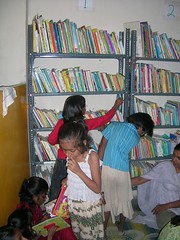
One of the most extraordinary and revealing results was the choice many children of the women centre made when asked to shoot their most favourite thing. It was the library and its books. Each kid shot a picture of it. What makes this even more striking is the fact that the library is a very recent addition to their lives as it was set up just a few months back thanks to our dear friends of the om prakash foundation. And yet in such a short time it has assumed a huge part in the lies of these children. It was on the insistence of the children that Sunday at the women centre is library day where kids come and spend long hours browsing through the shelves. When a couple of books disappeared and the coordinator threatened to shut the library down children made sure that the books were found. Since a lending system has been instituted!
Many conclusions can be drawn from this single result. I will leave the more technical ones to the academics and wait for them, but for me it is undoubtedly a very rewarding outcome. I fell under the spell of books when I was very young and nothing could replace the magic of books till date. It was with extreme sadness that I saw children turning away from them with the advent of TV. As the power of visual media grew, books seemed to loose their charm ans slowly took a back seat. I guess the sheer cost of books and the vanishing of the local library had their role to play. In slum India books became akin to school and hence boring, tedious and unexciting. Slum kids never saw real books. And yet when one was able to set up a colourful and large library in the span of a few days, children not only took to them but placed them on the list of their most favourite possession, one they were willing to protect and care for.
We have thousands of books still packed in boxes waiting to be displayed. We plan to rebuild the small mud room we have in Giri Nagar, the one where pwhy began almost a decade ago. The room will be a library open not only to pwhy children but to all children of the area. Unseasonal and unending rains, and paucity funds have delayed the venture but today the pictures the children took tell us that we cannot wait much longer!
by Anuradha Bakshi | Sep 9, 2008 | Uncategorized
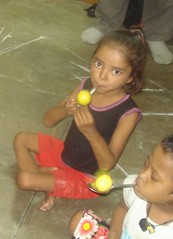
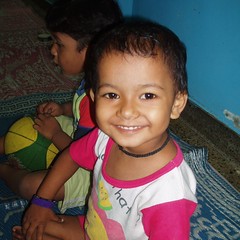
 Little Pooja and Radha are not playing a mindless game! No sir. They are proud participants of an international workshop held under the aegis of the Human Development and Capability Association Thematic group on Participatory Methods a group pf the Human Development Capability Association (HDCA) being held in New Delhi this week.
The workshop was held from 5 to 8 September and had two main objectives: 1 – Strengthen the organizational capacity of Project Why 2 – Explore the impacts of Project Why on beneficiaries of their work with children. The results are awaited and we all, and I in particular, wait with bated breath for the outcome.
But this post is not about whether or not we passed the litmus test, or what measures need to be taken to strengthen our capacities, this blog is about the other side of the workshop, the tiny moments that may have escaped many, the backstage angst, the fleeting moments of pride, the surreptitious phone calls to assert that all is going well, the furtive gestures to ensure that nothing is missed and more.
For 4 whole days project why was on its toes though we did try to put up an equable face. A plethora of different activities were scheduled at different times and places. It was impossible to keep an eye on all as we would have liked to as most of us (teachers and the management team) were part of a SWOT exercise that took a large chunk of time. I must confess that when we were told about having to spend nine hours (3×3) in a room the reactions of everyone were to say the least noteworthy: raised eyebrows, perplexed faces, vigorous shakes of the head and total bewilderment. The motley crew that makes up the extraordinary project team was in a quandary. They all knew that we were to play hosts to a dozen eminent academics from the world over and every one felt diffident. Would we come up to the expectations?
Moreover the past few weeks had been marked by furious preparations with the help of Sara who had come a month earlier to help prepare the workshop. The activities had to be meticulously planned: children identified, parents informed, teachers assigned, transport organised. Props needed to be made, translations done keeping in mind the ground and social reality. Then it was time to explain it all to the team and I guess our own nervousness must have added to theirs in quantum leaps.
D Day dawned after a sleepless might. We all felt like debs on the even of their coming out ball. For the first time we were to be showcased to those that mattered and that would in many ways define our future. We were aware of the fact that in spite of all our careful planning there would be many slips and glitches but decided to put our best foot forward.
The workshop began and we were carried in the whirlwind of activities barely having time to think. We simply moved from one activity to the other and one day to the next. In between we fed our curiosity on the bribes of phrases we heard along the way. As the participants visited some part of the project or finished one particular activity we devoured the “the children are great” ; “what nice answers”; “stunning pictures” ; “interesting debate” that we overheard. It seemed we had come out winners or at least been accepted warts and all!
The frightening SWOT went off like a breeze thanks to the wonderful professor who steered it. We sheepishly recalled how scared we had been and how apprehensive we had felt about the whole matter. Renato was extremely warm and managed to make even the quietest teacher not only speak but share his or her inner most feelings. We discovered things about ourselves and others and above all saw how much we shared in common. It was a priceless experience for all.
We now await the official results but I was made privy to some. The subtle and even anodyne games were powerful tools that helped delve into the children’s mind and bring out their aspirations and hope. It also brought out what project why had taught them and that was a matter of great pride: some children selected the library as their most precious option while others took pictures of places of worship other than theirs to show that they had understood the importance of respecting each other. Many children wanted their friends to also join pwhy and that alone made our hearts swell with pride.
I could have waited for the official results before writing about the workshop, but the excitement was too much and somehow I felt this candid account would better showcase what I felt. It is the moment to express my indebtedness: to all those who made this workshop a reality – Mario, Renato, Nicolo, Sara, Alex, Jean Francois, Jim, Francesco, Sara, Ina – by coming and spending their invaluable time with us, to the pwhy team without which none of this could have been possible but above all to the children of project why who are a living proof of the indubitable reality that every child, no matter how deprived, has a right to dream and we are blessed to be those who are entrusted with the challenging task of making these dreams come true.
by Anuradha Bakshi | Sep 4, 2008 | Uncategorized
 Head fake or indirect learning is a expression I have learnt recently from Randy Pausch’s Last Lecture. In hindsight it is something I have been using, albeit surreptitiously and perhaps sometimes even unconsciously!
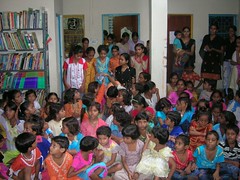
Yesterday I was quietly handed over a CD with pictures of the women centre. They were snapshots of their everyday activities as well as those of the Independence day celebration they had organised. As I browsed through them I was taken aback by the vibrancy and vitality that permeated each of them. And above all I was taken aback by the number of children that smiled at me. I could not believe that a year back this centre was not even in existence.
It is true that the women centre was initially set up as a refuge for women in distress, an answer to the deafening why posed by the plight of Utpal’s mom. But we could have found a tiny place and given her shelter. But that was not to be. Instead we set up the women centre which is not only a refuge for women in distress but a vibrant children centre and community outreach programme.
Herein lies the head fake.
Planet why was on the anvil as the panacea to all problems of pwhy. It looked good on paper, it looked good in words but there lay a unexpressed and unformulated doubt: would it run and survive in spite of the fact that it was miles away? The women centre is its present avatar was the much needed surreptitious testing. Would it be possible to set up and run a complex centre without constant monitoring and hand holding.
Barely 10 months from the day we found the quaint premises that houses the women centre we have a happy place where over 200 children and 50 women are busy changing their morrows. No mean task!
What is truly remarkable is that this centre grew from a few kids to this staggering number without fuss or drama. All decisions were taken in house: staff was identified and selected, time tables made, course corrections made. All crises, and they were many, solved without fuss. Today the women centre has a creche, primary and secondary support classes, tailoring and beauty courses and a weekly women’s meet where a plethora of diverse issues are debated amidst laughter and cups of tea!
I have my answer and my head fake worked. Planet why will not only run and survive, but thrive. This is undoubtedly a huge moment for me personally. When pwhy began I had many dreams, and one of them was to see the local community take on responsibilities and take charge. My dream was to see my teachers and staff spearhead new activities. It has happened and somehow I know pwhy is safe.
Here are some pictures of the women centre, a centre that was set up and is run by those many of us do not trust or even bother to acknowledge, a bunch of remarkable people I am very proud of.
by Anuradha Bakshi | Aug 29, 2008 | Uncategorized
 It was almost 10 days or more ago that Radhey my auto rickshaw driver informed me in a matter fact way that a barrage had breached in Nepal and that floods in his village were imminent. It was just a matter of days. I could not at that time fathom the magnitude of the disaster in waiting. Every morning in a matter of fact way I would enquire about the flood and he would answer that the waters were coming. I must admit I did not see the urgency. How could I. Even the press did not report much. By the time India woke up it was very late: over 3 million people had been rendered homeless, a major river had changes its course, villages had been swept away, lovingly built homes obliterated from the face of the earth.
In a popular TV debate aired a few days back the anchor asked the disturbing and startling question: Does India care about Bihar? And the uncomfortable answer that made us squirm in our chairs was: No! Bihar simply seems to have fallen off the map. We just want to wish it away. The news from the ground gets grimmer by the day and no respite is in the offing. The figures are alarming millions of people have lost their homes and livelihood.
Almost every year Bihar suffers the fury of floods. Some years are worse than the other and lead to large scale migration. It was in 1985 that Radhey fled his village and came to Delhi to build a new life. Like many others he sent money regularly to his village to repair the house, build a new one, buy the much needed farm implement. Today everything is gone. The members of his family have fled the raging waters and taken shelter with relatives. Some have even come all the way to Delhi and will swell the ranks of the staggering migratory population of this choking city. Many pwhy children’s families have similar stories. What is saddening and infuriating is the calm with which they share their plight, as if they too have given up.
It took a long while for India to waken up, or has it really as in spite of the magnitude of the calamity there is no palpable urgency: no dramatic headlines, no continuous coverage… It is as if floods in Bihar are regular occurrences. Bihar once a vibrant state of India, the seat of the Maghadh Empire, of Licchavi the first known republic, of Buddhism the religion of tolerance is today neglected and derided. It is today equated to corruption, hooliganism, gang and caste wars and considered an aberration. Yet it is home to millions of people who bravely fight all odds.
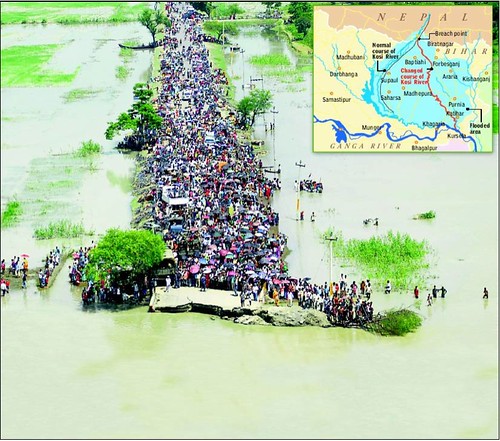
The picture you see dropped in my inbox with an appeal for help.It took me some time to figure out that what looked like a mosaic pattern where actually people left stranded on a washed away road. Imagine the number of children who today instead of setting out for school are living in the open, hungry and wondering where all their dreams have fled. Imagine the number of people deprived of all the facilities we take for granted: water, food. medicine, shelter. Imagine the pain of seeing your life come to naught. Where does one pluck the courage to begin all over again.
Have we given up on Bihar. I do not know. All I know is the contempt with which the word Bihari is used. All I know is the baffled look on people’s faces when I tell them I too am a Bihari. All I know is that today I feel the need to reach out to those in need, casting aside the cliches and commonplace utterances one will be subjected to. Yes we know of the corruption that is rampant during all relief operations but does that absolve us of the duty to do something. Certainly not. As with the tsunami we will wait a little and when the initial wave of help dies down we will try and see how we can help some children reclaim their lost dreams.
by Anuradha Bakshi | Aug 26, 2008 | Uncategorized
 It is fifteen years since the golden summer of 1991 when we lost our innocence wrote Gurcharan Das in a recent article. He was of course referring to our new affair with the the free economy and our expansion as a growing economy. I am no economist and do not understand market forces and the likes of it. I simply see what is around me and draw comparisons with was was an what is.
Last week we celebrated or let us say commemorated 61 years of Independence. All leading magazines had special issues and one must admit no one had anything glorious to share. Even Vinod Mehta who always proffers some light relief on his last page candidly states: I’m looking to offer you some humour. Alas, there’s none to offer. A quick read of the Independence day issue of this or any other magazine does not make happy reading. A leit motiv seems to appear almost with obsessive regularity is the fact that our brave walk on the free economy path has further alienated the poor of the rich. The rich have their schools, their hospitals, their habitat, their markets, their just about everything whereas the infrastructure of the poor is growing from bad to worse.
One of the articles that caught my attention was the one on gated Communities aptly titled Free from India.
The proliferation of gated communities is undoubtedly a world wide phenomena and its Indian avatar larger than life. An article in the New York Times reflects the sad reality of gated communities in our capital region. If one India lives a life of luxury inside the walls, the other survives at its very gates. The raison d’etre of these communities is best defined by a resident himself who states: Everyone understands that there are things outside that you don’t want to expose your children to. The idea is to have the area sealed and sanitised. The apartment costs are huge, but it’s worth it to protect yourself from the violence and crime outside… When I leave these gates I am bang slap in modern India. I can’t say that I don’t like India; it’s my country. But if I can avoid exposing myself to it, why not?‘
The above statement is to say the least perplexing and saddening. Are we simply giving up on India? is creating comfortable and yet visible cocoons the real way out. Did we really lose our innocence when we decided to walk the free trade path and open India’s doors? I cannot say. But if an Indian says that he or she does not want to expose his or her child to things outside, outside being the real India then something is terribly wrong. As citizens of India are we not responsible for that very outside.