by Anuradha Bakshi | May 10, 2009 | Uncategorized
 There’s no tragedy in life like the death of a child. Things never get back to the way they were wrote Dwight Eisenhower.
How true he was.
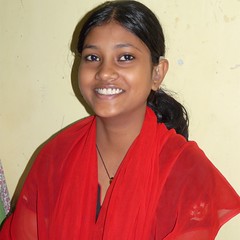
Things will never get back to the way they were at pwhy! I will never be greeted again by Saheeda’s beaming smile as I alight from my scooter in the morning and enter the pwhy building. I will never be asked to scold her when she acts stubborn and refuses to go to her sewing class. I will never watch her dance with gay abandon with her hearing impaired friend Rinky. I will never watch her try and painfully learn new sounds with her speech therapist.
I will never do any of these things because Saheeda is no more. She left our world yesterday. We are all stunned and shocked. I remember the last time I saw her just under a month ago. She was all set to go to her village for a wedding and was all excited. It seems she got very sick at the village and was hospitalised there. As she was not getting better her family brought her back and admitted to Safdarjung hospital last Saturday. She breathed her last the next morning.
Saheeda was one of our first students. She came to us when she was still a child and we have watched her grow and bloom in spite of her impairment. We had hopes and dreams for her and were trying to fulfill them. For the past year or so, she had been attending a beauty course at a parlour and would have graduated in a few months and then got a job just like her best friend Rinky.
I do not know how, in a few hours from now, I am going to face my little special class and tell them the terrible news. They will be devastated. Saheeda was their special didi, one loved by all. I do not how I will explain to the little motley crew of God’s special children that God himself decided to take one of their own away. I myself cannot even begin to understand why such a tragedy happened.
I just know that things will never get back to the way they were.
May Saheeda’s beautiful silent soul rest in peace.
Share some glimpses of her short life
by Anuradha Bakshi | May 7, 2009 | Uncategorized
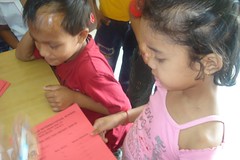
 Yesterday Kiran came to me with three pages of written text: it was her holiday home work. I was taken aback. The homework covered every subject and seemed humongous: read two books and find 3o new words, write five sentences about your daily activities and if you want to get an A in handwriting write a page of cursive writing a day. That was English. There was more of the same for each and every subject: maths, moral science, science and Hindi. And that is not all she also had to make a terrarium, draw a globe on a ball, make an abacus and a bird feeder, take a ride in a mtero and write about it and paste pictures of the places ahe visited during her holidays. Wow! And the holidays are for 6 short weeks. And by the way Kiran is just in class III.
Now the purpose of this post is not to debate about the wisdom of holiday home work. What one is trying to highlight is something quite different. As some of you know Kiran belongs to what we would call a slum and her family took a very conscious and deliberated decision: that of putting Kiran in an English medium school and give her the best possible. Her admission was not an easy affair and her school years have seen many hurdles. Now Kiran has a support system – aka project why- which helps her overcome such hurdles. But what about other children whose family have after great sacrifice get them admission in English medium schools and bravely try to cross to the other side of the invisible fence? How would such families be able to help their children with holiday homework. Even I do not quite know how to make a terrarium!
Lats week we had a visitor who told us about an organisation that was engaged in getting slum children admitted to good public schools. He thought we would appreciate the effort and maybe want to learn to replicate it. He must have been very surprised at our lukewarm reaction. My decision to send Utpal and my foster care kids to boarding school has also raised many eyebrows. Why not just send them to a local public school. The answer is simple: a boarding school gives an inbuilt support system that no slum family can give and without which no child can succeed. I remember an acquaintance telling me how her driver’s son was ostracized in the public school she had got him admitted to. Even if he had good marks he never got invited to a birthday party. A tale of two Indias!
But in a lighter vein how do you expect a mom who has been to a government school and probably dropped out to help her child with her holiday homework. And yet no class III kid could on her own figure out the homework as stated in those three pages. Even though children from the other side have been accepted in upmarket schools, be it because parents pay the fees or because of some illogical government rule, schools are not slum child friendly… maybe it was time we addressed this issue.

by Anuradha Bakshi | May 5, 2009 | Uncategorized
 I watched Radha solve her first puzzle and Conrad Veidt’s quote came to mind: So now it is time to disassemble the parts of the jigsaw puzzle or to piece another one together, for I find that, having come to the end of my story, my life is just beginning. But there is a catch: Radha’s life is slowly and irrevocably ending.
Her life has been a series of unsolved or poorly solved puzzles. When she came to us she had a family, or rather we should say a father. Then one dark evening he passed away. We were certain that we could save the family and have them all come and live at the women centre – was that not what the centre was for – but that to was not to be. Predators and supposed well wishers emerged from the woodwork and put an end to that. The mother was convinced no to come to us, or maybe she herself wanted to remain free of the constraints of a residential programme. One will never know. The end result was that Radha, whose dream is to be able to walk one day, continues to live in what I call a kennel, but what to her is home. And in that home she continues to break her little brittle bones with regularity.
In the best of cases the life expectancy of children with OI is short. There is no known cure to the disease just some therapies that can help reduce pain and complications. Most of these are out of the reach of a slum child.
Radha’s desire to learn is mind blowing. She just wants to catch life with both hands and get whatever she can out of it. She had never been to school before she came to us. Since she has been at pwhy she has learnt many things. She now has a little table which ensures that her legs are safe from hurt. When other children dance or indulge in some physical activity, Radha devours books. Though she cannot read well yet, she flicks through the pages, an intent look on her face and a burning desire in her eyes. She wants to learn with quantum leaps and we try and follow…
When I watch Radha I am filled with sadness and a sense of helplessness. There is so much I would want to do and cannot. Were planet why up and running we would have kept her with us and taken care of her. But planet why is still a dream and little Radha’s life an enigma. One can just hope and pray for miracles. And while we wait and pray, little Radha is busy solving new puzzles.
by Anuradha Bakshi | May 1, 2009 | Uncategorized
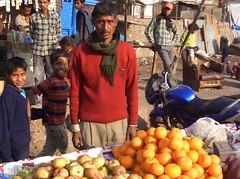
 There is a vegetable vendor in our colony. You can find him at the street corner from the wee hours of the morning to late at night be it the hottest day of the year or the coldest night. Several times during the day he walks the streets of the colony and you can hear his cry as he passes in front of your home hoping against hope that someone will call for him. After each round he goes back to his assigned place at the street corner.
No matter how hot or cold it is, no matter if it is raining or scorching our vegetable vendor does not miss his rounds. His cry is like the comfortable chime of an old clock. When you hear him you somehow know that all is well. Yet each time I hear his cry I feel oddly disturbed. Many of us do not know that to be present on time at his street corner, the vendor has to leave his home in some slum or the other in the dead of night and reach the whole sale market to purchase his ware. He then has to carefully display all the vegetables on his cart and make his way to the place where we find him everyday.
Many of the parents of pwhy children are such vegetable vendors. Most of them left their home because of a flood or a drought that made it impossible for them to feed their families in the village they belong to. Many of them have large families to care for and often have to send money back home to ageing parents that they had to leave behind. Many have huge debts to pay, debts they contracted long ago to marry a kin or fulfill some family commitment. Many have to save for the forthcoming marriage of a daughter. And one must not forget that the family often waits for his return to buy the evening meal.
We often haggle with the vegetable vendor as often his prices are outrageous. It is true that in the recent past we have taken to shop in the air conditioned comfort of the newly built local supermarket or even taken to visit the very wholesale market our vendor buys his vegetables from. But just take a moment and think of all the baggage the vendor carries: a big family to care for and many responsibilities to fulfill then perhaps the price he asks for does not seem that shocking.
There was a time not so long ago that our vegetable vendor did not need to make umpteen rounds of the colony. He was the only option we had. Today he has many unfair competitors and he needs to survive. I guess that is what disturbs me each time I hear him cry: it is a cry for survival.
by Anuradha Bakshi | Apr 30, 2009 | God of lesser beings, manu
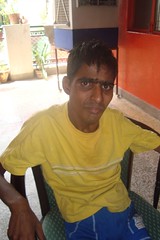
 Manu has been back home for over three weeks. His body is devastated by his terrible ailment but his spirit is intact and soaring. Yesterday we got his latest blood results. His liver and kidneys have not been able to withstand the medication and hence they need to be stopped. In lieu the men in white have prescribed daily shots. Shots in a body that is just a bag of bones is in no way easy. And yet that is the only way out.
A friend who is a healer and who realises my pain has time and again tried to tell me that Manu’s spirit is immortal and cannot be destroyed. I know she is right . I see his spirit every time I go and sit with him. Though he may not be able to walk or move on his own, Manu always reaches out to me and takes my pulse and then looks me deep in my eyes and says: you do not have fever! If I am standing, Manu, the impeccable host, insists I sit down and then looks for Aunty to order my proverbial cup of green tea! He will sit with me at the dining table for as long as I am there, reassuring me that he is well and that I should not worry. Yesterday he even asked me to get him grapes as no one else was getting them for him.
A friend has dropped by a couple of days and we had sat with Manu for some time. What a saintly soul, pure as snow was what she said as we left him. I realised how true her words were. Manu is just that: a pure soul where no ill can dwell. In spite of everything he has suffered over the years, Manu has never shown any resentment or rancor. In many ways he is a blessed soul.
His pain is unbearable. I have spent many nights praying for his well being. I would like to see his body heal and his suffering stop. I cannot begin to understand why the God of Lesser Beings has ordained so much pain for him. When we finally found him a real home with a bed, I really thought we had come full circle. And yet that was not to be. I can only wonder at what lies ahead and hope for the best