by Anuradha Bakshi | Jul 11, 2010 | commonwealth games
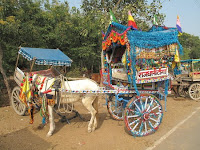
 The Commonwealth games claim one more victim, the tongas! The death knell has sounded for the age old horse drawn carriages that were part of Delhi’s heritage. True only a few remained, 200 or so, but the clack of their hooves and the sound of their bells were an intrinsic part of old Delhi, and added to its old time charm. In a few days they will all be laid to rest. I guess the day had to come but what is terrible is the way in which it all happened and is happening. The past should be allowed to fade out gently and gracefully. But that was not to be. You see the Commonwealth games are coming and someone had decreed that all that is not modern has to be sanitised: smells, sounds and sights: so street food is banned, street vendors are evicted, beggars are hidden, slums raised and tongas taken off the roads. Strangely the common denominator seems to be the poor! They simply have to be wished away.
Yet all that is thought ungainly, ugly and apparently un-modern and thus not worthy of the Game is also part and parcel of this city. They are what gives Delhi its soul and thus need to be handled with care and sensitivity. This so called cosmetic modernisation is unacceptable and yet we watch it helpless and hurting.
I know tongas would have had to go one day. But the way in which it has been done is nothing short of inhuman. The 200 odd tonga owners find their livelihood snatched from them overnight. They were promised a space with hawking rights. They were promised covered stalls, all that is being handed out to them is a pavement along a busy road, miles away from the place they called home. Some have been promised three wheelers or rickshaws but the author ties are still working out the rehabilitation plan! God knows how long it will take! Most of the tonga owners are old and have never done anything else but tend to their animals and drive their carriage. Asking them to become hawkers overnight is nothing short of inhuman. They all plan to sell their horses to a state across the border and then try and reinvent themselves.
Street vendors or horse carriages have never upset any foreign visitor, on the contrary they were part of every picture a tourist took and every memory they carried back. Modernisation does not mean dealing a fatal blow to tradition.
I am sure there were more humane ways of phasing out the 200 odd tongas left in this city. Maybe they could have been spruced up and made a tourist attraction as is the case in many cities the world over. My heart goes out to the tonga drivers today as they set out finding new ways to feed their families.
by Anuradha Bakshi | Jul 10, 2010 | okhla
 PWhy’s blog sometimes makes me sad, sometimes happy. This is a lovely story, so today is a happy day wrote a dear friend after reading Project Why, Namaste. So thought I would write another sunshine tale today, one I must sheepishly admit I should have written long ago! But sometimes there are people who like remaining away from the lime light and Mithu is one such person.
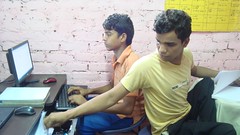
Just like Preeti, Mithu got struck by polio when we was very young and just like her by the time he came to us it was too late for calipers and other such aids! But unlike Preeti, Mithu was a boy and restrictions did not apply at home so Mithu learnt to survive and thrive legs or no legs. He moved at remarkable speed with the help of his hands, climbed trees, played cricket where he bowled a mean ball and lived life to its fullest. When I suggested we get him a wheel chair, the young teenager looked at me with bewilderment and stated: I want to stand on my own feet! Needless to say I felt very small.
Mithu joined as a student in class IX but he had only one fascination and love: computers. Classes were a simple excuse to access our computers. Very soon he became savvy in every aspect of computer learning and we decided to ’employ’ him as a teacher’s aid in our main computer centre. He learnt fast and was soon taking independent classes. When one of our teachers left Mithu quietly walked into his shoes.
When we opened our Okhla computer centre it was a foregone decision that our own Mithu would head it and today he is the ‘in charge’ of that centre. He still walks on his hands, but we would like him to have a motorised tricycle that would enable him to move around with dignity!
by Anuradha Bakshi | Jul 9, 2010 | Uncategorized
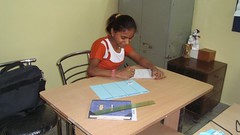
 If you call 9811424877 in the mornings, you will be greeted by a very sweet Project Why, Namaste! Yes we have a new receptionist trainee and it is a very own Preeti from the special section. Preeti is one of our special girls!
Preeti walks on her hand as polio struck her when she was very young and by the time she came to us, her led muscles had become too atrophied for calipers. But that does not stop her from living life to its fullest dance and even be a karate kid!
So when we started dreaming planet why, where we had decided that we would walk the talk and show off our special children to one and all, we knew Preeti would be the one to man the reception desk. So now Preeti is making up for lost time, learning English, computers and training for a few hours a day at the project why office!
I must admit that there are times where my old bones and aching back nudge me to give up the daunting task of setting up planet why, but the soft Project Why, Namaste brought be back to order. Preeti deserves her place in the sun and I just have to see she gets it.
by Anuradha Bakshi | Jul 6, 2010 | Uncategorized
 Yesterday I got my first monthly report from BiharWhy. I sat a long time reading the two neatly typed pages, my eyes moist and a lump in my throat. Was this really happening? Somehow it all seemed to good to be true but true it was. All the years spent trying to empower people and make them believe in themselves had borne fruit. Even the gentle prods on the wisdom of taking the road back home and reversing the migration seemed to have worked. It almost seemed I had come full circle, even if it was in a tiny way.
I was reminded of the umpteen staff meetings where I had urged my proteges to walk the extra mile and fly on their own wings, and where I had despaired at the sullen or at best blank looks I got and yet I had never given up. I guess that is the one thing I personally learnt at pwhy: never to give up!
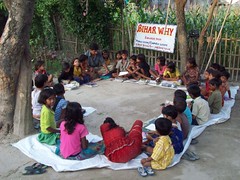
Today I stood vindicated and somewhat liberated. BiharWhy was not some pipe dream of seeing the why spirit soar in the land of my ancestors but a vibrant reality. And Chandan who I must confess never seemed to be the one to take the lead and had made this dream come true. And as I read his report I saw that this quiet and sometimes sullen looking young man had learnt his lessons well. In a month he had managed a parents’ meeting (something we still battle with), filled admission forms, made time tables, held a painting competition and taken a monthly test! What warmed my heart was that he had even convinced 18 parents to come for adult education classes. Soon he will be starting computer classes and even stitching ones. Wow!
His report ended with a simple statement: We are taking the classes in Bihar why project without roof. The words were pregnant with meaning: they need a roof on their little heads and I hope you will help us give them one.
Please take some time and look at these pictures: they speak volumes.

by Anuradha Bakshi | Jul 4, 2010 | Uncategorized
 Got a call yesterday. It was all the way form the USA. The caller was a passionate young Indian who wanted to make a difference. He had been deeply disturbed by the hunger that still prevailed across our land and wanted to help alleviate it. A young professional, he had quit his lucrative job to follow his heart. A young man after my own heart! He had been given my number from another young man who thinks with his heart and I was all ears.
We chatted for a few minutes and then the young man stated: My ambition is to somehow work to appease issues of hunger in Delhi. Wow! That was a stunner. Millions of images zipped through my mind and though some were undoubtedly of hunger per se, most were of the enormous amount of wasted food I have seen over the years I lived in this city: be it the humongous wastage one saw at up market dos – weddings, parties of all hues, religious functions etc – but more than that on the streets and garbage dumps in slums. I remember an instance a few years ago that made me write a blog entitled morning after! It was the site we saw the morning after a wedding that took place in our street and the wise words of a little girl who simply said: why did they not give the food to the cows.
Rewind to 1986. My first visit to an Indian village. It was a godforsaken village in the Jehanabad District of Bihar where I had gone for some developmental work. What surprised the most when I visited the home of one of the poorest family of this village was the pristine cleanliness of this small mud house: no flies, no garbage, no filth. Everything was spotless; it was the perfect example of recycling you could think of. The leftovers ,if there were any, and the vegetable peels were fed to the animals, the dung turned into cakes and used as fuel, the ashes used to clean the few utensils that sat sparkling on a small shelf, next to the Gods. Voila! No need for garbage bins, plastic bags and all the implements essential to urban life.
Forward to 2010 and after. On the sights that greets us each and every day is wasted food lying helter–skelter on the street, in the slum lanes, in garbage dumps, just about everywhere. You see there is always a wedding, a birthday party, a jagran, a religious do, you name it and it is there and at each and every venue there are heaps of plastic and thermacol plates still filled with good and clean food. It is just strewn on the ground till the cleaners sweep it away and carry it to the dump. But food is not only wasted during festivals or special occasions, it is wasted every day in every home as if throwing food was a way of stating that you had reached, that you had graduated from the rural to the urban status. It seemed the be the new mantra of success in the slums. I see it every day. In every home I go if it is meal time every member of a family will leave something on the plate. But come to think about it, this was not the case a few years back. In the same household no food was wasted and children were chided if they did not finish their plate. So what had changed.
The family in question had bettered its plight. More members had jobs now and thus the household income had taken a quantum leap. The advent of credit had enabled the family to buy two TVs, a refrigerator, coolers and many household items. In other words they had arrived. Their rural antecedents were laid to rest, the young adults of the family were all to the city born. The parents ere the only ones who still remembered the ways of village life with nostalgia and no one to listen.
From a people who worshiped food and deified it, we have turned into a nation that wastes with impunity and alacrity as we feel that we have all arrived! But have we? Look around and there are still people rummaging for food in garbage dumps but that is not all and believe it or not every 8.7 minutes a child dies of hunger while mounds of grains rot in the open. But we seem to have got inured to every and any thing. Have we really? I urge you to click on this link and look at the picture of a little three year old from Madhya Pradesh who weighs the same as a three month old healthy baby. It is not trick photography but stark reality in a land where 3000 children a day die of malnutrition. The picture of little Neeraj should be enough to make us think twice before we throw any food in the future. But will it? I do not know. It seems we have put our conscience on hold while we are busy arriving!
In the light of the above I wonder what to answer my young friend when he writes : My ambition is to somehow work to appease issues of hunger in Delhi. True there is hunger in Delhi but there is more wastage and disrespect for food then ever before. Should we mot address those issues, or at least find a way to address them first. I am at a loss.

 The Commonwealth games claim one more victim, the tongas! The death knell has sounded for the age old horse drawn carriages that were part of Delhi’s heritage. True only a few remained, 200 or so, but the clack of their hooves and the sound of their bells were an intrinsic part of old Delhi, and added to its old time charm. In a few days they will all be laid to rest. I guess the day had to come but what is terrible is the way in which it all happened and is happening. The past should be allowed to fade out gently and gracefully. But that was not to be. You see the Commonwealth games are coming and someone had decreed that all that is not modern has to be sanitised: smells, sounds and sights: so street food is banned, street vendors are evicted, beggars are hidden, slums raised and tongas taken off the roads. Strangely the common denominator seems to be the poor! They simply have to be wished away.