by Anuradha Bakshi | Oct 10, 2010 | Uncategorized
 An article entitled no sir slums are not eyesores (the article is at the end of the list) warmed the cockles of my heart! This article written by an eminent economist is an apologia for slums. The author writes: cities must not be elite in a sea of rural despond. They must provide income and social ladders for the poor and unskilled to climb up…. we must have more slums. These are entry points for the poor into urban havens of opportunity…. some see slums as hubs of sub human existence …but you will find an astonishingly wide range of economic activities….if cities are to fulfill their critical function of social mobility we need more slums... Wow an article after my own heart!
And before you start talking of reverse migration by making rural areas prosperous listen to what the author has to say: India has 160 millions hectare of cultivable land for 1250 million people or 1/8 of a hectare per person and even if the urban share of population doubles from todays 30 % to 60 % it will just be 1/3 of a hectare per person! It is not without reason that rural folks migrate to cities. How wretched rural India must be if people see more hope in urban shanties!
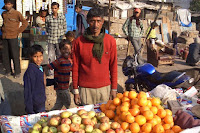
Welcome to the world of what I have always called small entrepreneurs, the ones our satraps are so keen on destroying and obliterating and yet the only ones which can ensure that India prospers. Who are they you ask. Just look around and you will find them: it is you corner samosa seller, your food cart owner, your vegetable vendor, your fruit vendor. It is the young man who walks the streets to repair broken zips, the street corner cobbler or the street tailor always ready to mend your shoes and clothes. It is the enterprising lad who sets up an array of guides and help books in front of an exam centre, or the one who sells all you need for a particular festival. It is the family that makes soft toys in their hovel before selling them at fairs and melas. It is all your pavement vendors who sell the trinkets you need. It is also the plumber, painter, mason, carpenter who sit at road corners hoping to get work for the day. They are the real heart and soul of our land and we need to ensure that they thrive.
Each one feeds a family, educates children and enables them to dream of better morrows. Most of the pwhy children’s parents are just that: small entrepreneurs and it is their blood and sweat that ensures that their children prosper. We have many such kids: the son of our three wheeler driver who today teaches secondary classes at pwhy’s Okhla centre, the vegetable vendor’s daughter who today works in a call centre, the gypsy brothers who after a stint as teachers at pwhy have now got better jobs one at the airport and the other in a bank – the list ins endless and each is an India story. There are so many of them, each endearing and moving.
Life in the city, even in a hovel opens new vistas often thanks to the ever present TV set. I have seen enfold in from of my eyes many times over the last decade. I have seen how a tiny business opportunity brings change into the darkest hovel. This is the social mobility the article highlights, a throbbing and pulsating exercise in hope and belief. There is no other way out, at least for the time being.

by Anuradha Bakshi | Oct 9, 2010 | Uncategorized
A news item brought a bit of cheer. The headline was NGO brings in kids to fill stadia. Yippee! So the poor do come useful in the common wealth games, good that you did not banish or hide them all Madam CEO! Apparently this great idea came after a lot of brainstorming. And it is a double whammy as for the children, watching Indian and international athletes live in action is something that they will cherish throughout their lives but for the OC, giving them these complementary tickets has taken care of their biggest worry — filling up empty seats.
How nice if this had been something the Organising Committee had thought of before. A few seats for the poor children would have been well appreciated. Anyway better late than never. I am sure the children will cherish this moment forever.
And there is more. Seeing all the athletes from small town India winning Gold Medals is heart warming as we all know the odds they have to face. And what about Geeta whose father fought will all village elders to ensure that his daughters follow their dream of wrestling! A real India story!
The Games are on… and one has not forgotten the terrible things that have preceded then. The Games are on … with its share of blunders that happen every day and make our heckles rise. But our athletes do deserve our kudos as they are doing their very best. When then Games are finally over then it will time to ask all the questions that now lie in abeyance. Let us not forget that.
by Anuradha Bakshi | Oct 4, 2010 | Uncategorized
The opening ceremony of the XIX Commonwealth Games was a resounding success. Indi’s pride was restored or so many think. On the same day an investigative weekly ran an article entitled: We who built your games. It is a poignant photo essay of the trails and tribulations of the hundreds of thousands of workers who built the said Games brick by brick. I think that today when the lights are shining and the world is lauding us, they above all need to be saluted or at lest remembered. Please do spend a few minutes and read the article and look at the pictures.
I have often talked of the faceless and voiceless Indian who I have held is the real backbone of our country but few of us are willing to recognise this. So today as a mark of honour to all those who toiled day and night to make the Games are success, to all those who died while doing so I urge you again to spend a few minutes and look at the faces which thanks to this article have a name and listen to what they have to say. They were almost 200 000 labourers who made the Game possible and each was paid a paltry 100 Rs, half the minimum wage and less than what some were paid in the Asian games way back in 1982! They lived in squalor and filth but never complained. They suffered fever and pain but all they got was an innocuous pill doled out by some government doctor. If they did not recover in 5 days they lost their job!
There were no safety belts even if you hung at dizzy heights and no helmets. Over 1000 died though the official figure stands frozen at 42. No laws protected them as most were not registered. You see by not registering them contractors saved 360 crores a year. Once their work finished they have simply been pushed out of the city, back to where they were brought from.
Spend some time on the slide show of the article meet Rajdeb who slept in the open, see how they lived and what they ate. Meet Raj (slide 9) born in a tin box, or Pramod and his family (slide 12) who fled drought and landed in a tin box. This is the real face of the Games but sadly one no one will see or bother about. Today we have a chance to salute them and salute them we must.
Do you have a minute to spare for them.
by Anuradha Bakshi | Oct 4, 2010 | Uncategorized
 It was a strange Sunday. One that I have never experienced before. The city was like a fortress and we felt under siege. A friend who landed from Europe after a few months found the drive from the airport almost eerie. Though the city looked squeaky clean she felt Delhi had lost its soul. The roads were shiny and empty. Gone was the hustle and bustle that are such an intrinsic part of the city. The smell, the colours, the familiar sounds were all absent. Delhi was almost a ghost city. She asked me what was wrong and I could just reply the Commonwealth Games!
Over a much needed cup of tea I tried to fill her in on all that had happened in the last months and about how those in power had decided to rid the city of what they thought was not to be seen: in a nutshell the poor! This was very well articulated by the CEO of the city when she said: We are not trying to hide but you know that you are receiving guests. Yes, Delhi has been decorated – for Commonwealth Games, for celebration…lot of things are there. Don’t you have the right to light up your house on Diwali or whatever festival you may celebrate and are you trying to hide your poverty at that point of time?..But when you get a guest at your house and when the eyes of the world are going to be on this city, would you not like it to look like a nice city? I find it difficult to accept. To me the city today looks alien and soulless. And the decision to close everything just reinforced the feeling. It was one of the most claustrophobic days of my existence.
We cannot and should not forget the reality we live in. We are a poor country as more than 40% of our population lives below the poverty line and there is no way we can conceal that. The honest way would be to accept the reality and take steps to counter it. Wish our leaders did that.
The next cup of tea and there we were discussing the attitude of the rich towards the poor. This is best exemplified in the attitude my peers have had to our boarding school programme. I have yet to find one country mate who has applauded the idea of sending eight of the most deprived children to a ‘good’ school. For them it remains a no no! You see in India you do not mix the rich and the poor, the lines have to remain drawn and cannot be crossed. And if you dare delve further ans ask some disturbing questions pat comes the answer: karma. The poor’s karma is what makes them poor and you do not meddle with that. My answer is a little different: what about our karma, does it not compel us to help those in need. Mine does. And that is simply what I have been doing for the last 10 years and will continue till I breathe my last.
To our CEO who asks candidly : would you not like to look nice, my answer is a loud yes but our ways differ. I would like to look nice by accepting the harsh reality and not looking away; by finding answers and showing to the world that we are aware of our problems and are actively engaged in solving them. I would also like to add that I would like to look nice for ourselves and not just to the eyes of the world. So maybe it is time we addressed the issues of beggars, street children, homeless people. It is time we cleaned up the whole city and got rid of all the pot holes, not just the ones on the roads guests would take. It is time we stop pretending that all is well and addressed real issues. But is anyone really interested?
by Anuradha Bakshi | Sep 30, 2010 | women centre
 India First is the campaign launched by a leading TV channel in the wake of the judgement being pronounced later today on what is known as the oldest property dispute in Independent India. Political parries are urging all to remain calm and young India is exhorting us to look forward and at the real problems that plague our land. I guess all this because the memories of December 1992 are still fresh in many minds. No one is willing to take any chances: schools have been shut incertain states, demonstrations banned, leave of police personnel cancelled and the country is on tenterhooks.
So what is all this about.
There are many ways of looking at the Ram Janam Bhoomi/Babri Masjid issue. I will take the most candid one and borrow the title of an earlier blog I wrote: it is all about ladoos, cake and sewaiyans! In December 2009, when a volunteer decided to celebrate Xmas in our newly opened women centre where the children were predominantly Muslims and Hindus, I had to explain what Xmas was, I did so by telling them that it was a festival where you ate cake and not ladoos or sewaiyans and somehow the children understood. I could have also sung them the Usha Uthup song where she talks of all festivals as being days when you wear new clothes, visit friends and relatives and eat nice food be it Xmas, Eid or Diwali. That is how simple it actually is. You can either see temple or mosques, or if you do with your heart see a house of God.
But sadly religion has been used by power hungry people to justify the worst aberrations possible like the one that happened in December 1992 when a house of one God was brought down in the name of another. On that December day I was ashamed of my religion as I am each time an aberration is committed in the name of religion. I wrote an earlier blog on this and am reproducing some of it below.
I am a Hindu by birth and by choice. I was born to profoundly Hindu parents but grew up in lands of diverse faiths. My parents never imposed their views or beliefs. At home Hindu festivals were celebrated with fervour and some ritualism and the many questions I asked at different moments of my life were answered candidly and without fuss. It is much later in life that I discovered that my mother was not really bent on ritualism but it was her way of introducing me to my faith. I grew up with my set of questions and doubts and each one got cleared with simple honesty.
When I asked one day whether I could go to church and partake of communion as all my school friends did ( I was in a convent school) my parents simply answered that I could if no one had any objection. I guess I had expected a vehement refusal and was a little perplexed by their reaction. I did go to church often and even found a humane priest who allowed me to taste the holy wafer. Some years later while in an Islamic country I wanted to fast in the holy month of Ramadan and once again I got the warm approval of my parents. I celebrated the Sabbath with my Jewish pals too and with every such occurrence my belief got strengthened as I was proud of belonging to a religion that did not close any door in my face but on the other hand allowed me to embrace all faiths. I was proud to be a Hindu. The tales my parents told me only went to reinforce my faith. I was delighted by the pranks of Lord Krishna and by the touching tales of Ram when he ate the fruits proffered by Sabri or rode in Kevat’s boat. I never felt the need to question the sagacity and humanness of the religion I was born in. Till the fateful day in 2002.
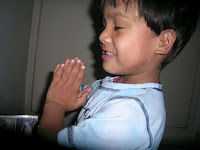
Today as India’s stands waiting for a court decision that will decide which faith a particular piece of land belongs to and hoping against hope that no violence will ensue, my thoughts go back to that fateful day when my headache vanished thanks to the prayer of a little boy to a faceless and nameless God who listens to those who pray with their heart. He is the one I now pray to and hope that once again he will hear.

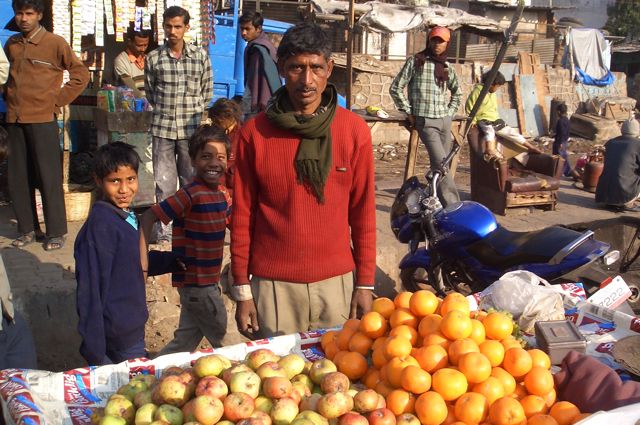 An article entitled no sir slums are not eyesores (the article is at the end of the list) warmed the cockles of my heart! This article written by an eminent economist is an apologia for slums. The author writes: cities must not be elite in a sea of rural despond. They must provide income and social ladders for the poor and unskilled to climb up…. we must have more slums. These are entry points for the poor into urban havens of opportunity…. some see slums as hubs of sub human existence …but you will find an astonishingly wide range of economic activities….if cities are to fulfill their critical function of social mobility we need more slums... Wow an article after my own heart!