by Anuradha Bakshi | Jul 16, 2010 | manu
 We have gone from famous five, to incredible seven and now to exceptional eight. Yes little Manisha will be joining Utpal, Vicky, Nikhil, Aditya, Babli, Yash and Meher. Manisha’s story is heart rendering and I guess once again the God of small things decided to intervene. I must admit that after Yash and Mehar I had decided to put a stop ( at least a temporary one) to the boarding school saga, one that is quite extraordinary to say the least. A simple walk down memory lane brought me to a blog I had written almost 4 years ago, where I had shared what seemed at that time an impossible dream. Like all dreams it was promptly tucked away and almost forgotten. But then the God of small things (GST) decided otherwise. When things looked bleak and almost hopeless, out from the blue came a messenger who revived all dreams, even the wildest ones. It all seemed to good to be true and over and above my cherished dream of planet why, this messenger wanted to change lives of children and we set out to do just that with hope in our hearts. But then the incomprehensible happened. The messenger backed out: the dream seemed too fragile to invest in and I was left holding on to it alone.
In my shaky lap lay not only the future of Manu and his friends, but that of 4 little kids who had been taken away from their homes with the promise of a bright morrow. In hindsight I think the erstwhile messenger was simply God’s way of bringing me back to order. I knew that nothing would ever come easy but come it would! No matter how impossible. And miracles came our way, tiny ones perhaps, but blessed nonetheless. Manu was home safe and happy and soon the little children packed their bags and entered the portals of almost hallowed ground: the boarding school. I heaved a sigh of relief. It has been a long haul but one that was worth it. Who knows one day these very kids would become doctors, engineers, stars! Nothing was impossible. I wondered however whether I would be still around to see them.
Five kids in boarding school was more than enough. We still had 10 long years to go. But my friend the GST had other plans in store. Five soon became seven with Yash and Meher joining the gang of five and of course all my resolutions and resolves went for a six. It is true that when I first laid eyes on little Meher, I knew that this kid had no future. Her little face was scarred making her poor wedding material and her tiny hands maimed making her access to skills very limited and yet her joie de vivre was infectious. When a kind soul offered to repair her body I immediately added a caveat: if we did then we also had to give her a way to break the circle of extreme poverty in which she was imprisoned. Meher belonged to a very poor family where the men lived in the city and worked as house painters, the women stayed in the village and the kids played in the nearby graveyard that was the best playground available. It was a stroke of luck, or rather the GST’s ploy that she had been in the city the day I first met her!
So six it would be, or so I thought. But then what would happen to the little boy who had almost been adopted by some fancy outsiders and then dropped like a hot potato when they found a ‘better’ child! You see six had to become seven. And when a kind gentleman absolutely wanted to sponsor the school of another child, another masterstroke ensured that Manisha would be the chosen one! Seven had become eight!
In a few hours little Manisha will be joining her new friends in boarding school. She spent the night at the foster care so that she could be ready on time. We were a little concerned about how she would feel but to our utter surprise she spent the evening quietly watching TV and telling the housemother about her life. Children like Manisha are born survivors. They sense intuitively what is good for them and hold on to it with their heart and soul. I first saw this in little Utpal long ago.
It is a spirit I for one salute. Chapeau Bas! God bless them all!
by Anuradha Bakshi | May 21, 2010 | manu
The last donation! Sounds ominous but is is not, quite the contrary it is the harbinger of hope, and freedom.
For the past ten years we have been trying to make a difference in the lives of the less privileged and can say with pride that we have succeeded in more ways than one. We launched project why, with the aim of answering all the disturbing ‘why’s that came our way. With limited resources and an abundance of passion and fervor we have helped hundreds of children stay in school and complete their education, have brought smiles on the faces of a bunch of incredible special children and given them reason to live, have rescued a handful of kids who would have otherwise been condemned to join the ranks of child labour but who are now studying in a boarding school and topping their class, sponsored the surgery of a score of children with broken hearts and above all empowered almost fifty adults by giving them employment and dignity.
All this was made possible thanks to donations from people the world over who were good enough to trust and believe in us. Year after year, we shared our success stories with them in the hope that they would once again reach out to us. Whereas this seemed the only doable option in the early years, somewhere down the line came the surreptitious feeling that the pitch was becoming jaded and would not hold forever. Were they not millions the world over engaged in similar work who solicited help via donations and would not donors become satiated sooner or at best later. We needed to find another way, one that would lead us to the last donation.
Many may say, and quite rightly so, that all things must end, and that even a thriving and successful enterprise needs to come to a close. In our case it seemed that the day ‘donations’ would stop falling, the end would happen by force majeure. And more with us as all our fund raising was done by one person with a set of very personal skills. Me!
The unspoken and yet very loud question haunted me. What would happen to project why after I exited. Would it just be a simple swan song with a final curtain call, or would the performance continue. Would project why survive and become sustainable. This I know is the challenge every organisation like ours faces. And this I also know, is not an easy one. I weighed all options, even the one of seeing project why ebb but soon realised that this was not an option we could look at as some of the ‘whys’ we had answered were long term and could not be wished away. There was Manu who had been saved from a life on the streets and who now lived with us along with Anjali and Champa who also has nowhere to go; there were the seven children in school who needed support for many more years. These were the desperate cases but there was also a vibrant and spirited education and empowerment project that deserved to continue. The spirit of project why could not be wished away. Project why had to live on.
Thus began the search for a viable sustainability option, one that could take care of the lost souls as well as ensure continuity. We began to look for success stories to emulate, for organisations that had manage to become sustainable but did not find any. The one way that seemed to work was the one of setting up a corpus fund the interest of which would provide the needed sustenance. But somehow that seemed against the very spirit of project why. We wanted to be freed from the ‘charity’ status and be able to generate funds ourselves. This would keep us on our toes and prevent us from sinking into comfort zones. Project why had to mutate into something greater.
That is perhaps the time when someone mentioned a small project in Cusco, Peru where an organisation had set up guest houses to meet their fund requirements. It was a win win situation and somehow we felt that this was the way to go. We would call it Planet Why.
Planet Why would be a guest house with a difference, a social business generating income to support itself and enable project why to continue its mission, a place where Manu and his disabled friends would live and die with dignity, where project why alumni could be trained in a variety of marketable skills. Planet Why would offer its own brand of hospitality to travelers looking for a different experience. And above all Planet Why would be a green building, the first of its kind in Delhi. We were on cloud nine and felt nothing could stop us.
The first step was to find a find a suitable piece of land at a reasonable price. No mean task in a city like New Delhi where real estate is astronomically priced. We were lucky and located a piece of land not too far from the airport and in a still semi rural area. We shared our vision with our supporters and were fortunate to be able to purchase the land in spite of a few hiccups. It was then time to make plans and find out the costs. Needless to say they were mind boggling and way out of our league. But this did not deter us and we went bravely on the market trying to seek funding. It was not to be, as recession hit the world and all our plans went on to a back burner.
Today after two years in limbo we have decided to revive our dreams and those of the ones who depend on us. Planet Why has to see the light of day as it is the only way we can get out of the charity warp and become truly empowered.
Planet Why will not only enable us to continue our work with the less fortunate but become a real challenge for our team who will need to learn to run a successful business and thus validate all we held as true.
Once again we need you to believe in us.
by Anuradha Bakshi | May 11, 2010 | manu, okhla
 Every year at about this time I sit down to write the annual report of the project. The report begins with a Directors’ message, and till date I have had no problems whatsoever in writing it. There was always something to write about: a special occurrence, a challenge, a success story, a knotty issue well solved etc. As I sat down to write these messages, nine of them till now, I always felt elated and on top of the world. This time however was different.
As I settled down to begin writing the 2009-2010 report, I drew a blank. I could not find the one small spark that would guide me through. I sat for a long time racking my brain but to no avail. I must admit I got a little worried: was age catching up, was I losing my memory? I decided to seek help and asked the girls, the one who run the project, to give me a brief on last year’s happenings. They came back to me a couple of days later and told me quite sheepishly that they too had drawn a blank. The year just seemed to have passed uneventfully and placidly, almost in limbo. I was stunned. Was this ‘good’ or ‘bad’ news?
I sat along time pondering. This was our tenth year on the field and the fact that we had nothing out of the ordinary to write about was cause of worry. Did it mean that we had perfected the model to the point where there was nothing more to add and it could thus run on auto pilot – not a happy thought – or was it that we had sunk into a comfort zone that had made us all forget the spirit of project why itself? I would veer towards the later and thus it was time for some serious soul searching.
Before I carry on I would like to set minds at rest. The year gone by was by all parameters a successful one. All programmes were on course and met their targets. Even the normally challenging issue of funding was well in hand. There must have been some minor irritants, but these were too small to leave an imprint. Then why was I feeling disturbed? What this not what one had wanted: to have pwhy run effortlessly?
I spend a long time wondering why I was feeling troubled. My mind wandered back to early times, when we had just begun, the day I had first set eyes on Manu and the one when I had come across the first child who could barely recognise alphabets though she was studying in class IV. And how can I forget the afternoon when a heartless secondary school principal sneered at a bunch of young boys calling them gutter snipes. I still remember the frozen January morning when a lady walked into our tiny office dragging four challenged children and telling us that they had nowhere to go, or the scorching day when a man hobbling on a stick walked in seeking help to fix his son’s broken heart. And the warm morn when I was told that a child had died of burns. And all this in the span of a short year. These were the deafening whys we had to address with confidence and compassion, the two Cs that defined the spirit of pwhy. We answered each one with success, some taking longer than others and that is how project why grew one challenge at a time. Manu was tended to till the day not so long ago when he moved into a proper home. A primary and secondary after school support was created, a day care for the challenged was set up and our heartfix hotel got its first inmate and the scalded boy is now prancing around in a boarding school!
The next years were spent fine tuning the show. Path breaking decisions were taken like the one to only employ people from within the community or the one to use whatever space we could access be it a pig park, a road side or a reclaimed garbage dump! The project grew and from 40 we became 400 and then 800! There was no stopping us. The results were for all to see: children passed from one class to the other. We had our first batch of class X and then class XII and they too did us proud. We were on a constant high. In hindsight I wonder if we missed something along the way.
I am not beating myself. I guess any project or programme does go through a growth process . It is inevitable. But I also feel that unless it is constantly infused with something new, it runs the risk of declining. Is this what is happening. Am I seeing the first signs of weakening? I hope not. But I know it is time to soul search with honesty. I have talked of the achievements but what about the failures or if not failures what about the downside, the challenges not met. The biggest one I guess has been our inability to achieve any success in our sustainability efforts, be it the small early inroads like candles, chocolates, soaps et al or the now seemingly half hearted attempts at fund raising like the one rupee a day programme or the failed raffles? Or even the apparently win-win option like planet why that today awaits expert validation. The reality is that all our efforts to stand on our own feet have not seen any success whatsoever. Project why has survived thanks to donations of people the world over who believed in our dreams of yore years. And whereas these dreams were once worth defending with zeal and passion, they seem a little jaded today. And the one who till date had sold these dreams effortlessly finds it difficult to repackage them.
I wonder what is missing. Have we really gone in limbo.
If I were to look at pwhy today without knowledge of the past, I would just see an after school education programme like so many others and that is no great achievement, even if our children pass their exams with almost obsessive regularity. True there are some add ons like the special children, the foster home etc. But that is it. There is no movement forward, no challenge waiting to be addressed. I do not have to be a soothsayer to say that come next year we will still look the same unless we break the circle and do something. And that is what I intend to do now.
I admit that the discomfort I write about today has been with me for some time and that is what had prompted me to launch the focus on quality programme early this year. Project why children had to imbibe more than just school knowledge, and we needed to stop our obsession with numbers. It has become imperative to give them an identity of their own. But that is not enough. What is needed is to go a step further and look beyond empowerment, it is time to hand over ownership of the programme to the staff and the community at large.
I have tried to do so over the years but met with stubborn resistance from all quarters. Somehow being an NGO – a word I dislike with passion – gave everyone the license to take things for granted. Parents felt we had funds in abundance and thus were almost outraged at our asking a meagre rupee a day, and most the staff found it easier to stick into comfort zones whereby they did their work and got their monthly pack, they somehow seem to think that fund sources are perennial. Even when one tried hard to get them to participate in any resource gathering activity be it the one rupee programme or selling raffle tickets, there was no enthusiasm leaving me to wonder how to shake them out or their torpor. I did tell them that I for one was not everlasting and that even if I were, we had to contend with something called donor fatigue.
Yes that is what is alarming me.
The recent visit by one of our regular donors was an eye opener. In the course of conversation candidly he admitted that it was easier for him to market – to use his expression – individual stories. He wanted me to ‘find’ more possible candidates for boarding school as he felt that was something donors ‘liked’. I will not go into details here, maybe in another post. What matters at this moment is what was left unsaid. Pwhy in its present avatar may not be easy to market. It was strangely devoid of heart wrenching tales. Even the loudest and most deafening why had finally found a permanent answer: Manu had a home!
So time has come to reinvent one’s self and while we wait for the verdict on planet why – should it not be the one we want we will need to put our thinking caps on again- we need to address the ‘what after me’ issue and thereby infuse a new breath of life in pwhy, one that will allow us to resuscitate the flat line. The way forward is to address the ownership issue head on, notwithstanding the resistance.
I must admit that a few days back I would not know how to do that but yesterday the sullen teacher who had refused to move to Okhla for incomprehensible reasons came to me and informed me that he has set up a Bihar Why in his village in a remote district in Bihar. He proudly handed me a set of pictures showing over 40 children studying in the open. I will write a post about this later. He wanted us to help him. My eyes became moist, my heart swelled with pride and I saw light at the end of the dark tunnel. This was the way to go. Staff had to be empowered to start their own nano projects. It would take time I know but it would validate all we had stood for.
Was this a ah ha moment. Maybe. At least it was a step forward, one that could withstand the test of time. I had found my answer. It was time to move on.
by Anuradha Bakshi | Apr 17, 2010 | manu
 The sight of beggar children is something that has always upset and pained me. It is the perhaps the most deafening and loudest why that came my way, and one that sadly I could never find an answer to. And yet, though many many not know it, it is the very first why project why set out to address way back in 1998. Sadly it is the one we could not find a suitable answer to though in some ways project why came to be, because of an encounter with a beggar who became the spirit and strength of project why our very own Manu!
I still get disturbed by children begging and have often tried and shared my views for anyone to hear. How can I ever forget that one of the first person who told me how important it was to look with you heart was a beggar woman! And it is not surprising that our first valiant and very naive venture into the charity bizmess was to try and do something about children who become beggars. We tried and failed and life moved on. Then why am I writing about beggars today. The answer is simple: in its frenzy to spruce up Delhi for the CW games, our Government has evolved plans to address the situation in its own bizarre ways. (This was brought to my notice in a passionate note of FB.) The first one was a diktat to the states: Take back your beggars! Squads have been formed, and zero tolerance zones identified. You see there are places where beggars just cannot be seen. I guess those are the ones the CWG guests will visit! After the British who criminalised nomadic tribes, it is now our own government who is criminalising beggars. But what we forget is that beggars are either forced into beggary to survive and are often educated and unemployed – entrepreneurs of a special kind – or part of organised mafias – lucrative business-! And yes though we need to rehabilitate them, programmes and projects that aim at feeding them or teaching them some inane trade like basket weaving is not the answer.
It takes two to tango, we all know that. Beggars survive and earn because we give them the coin they seek. And we here is you and me and the whole civil society. The day beggary becomes a non-lucrative business it has to die a natural death and people will find other ways of earning a living. There are very few real beggars like the old lady of my yore years. The majority are part of mafias that kidnap children, maim them and so on.
You must be wondering why this post is entitled a tale of nutritive biscuits. This was our valiant and naive answer to the beggar problem. Way back in 1998 when I was still looking for a cause to defend, I had zeroed in on the beggar child as that was somehow the most visible aberration for all to see. The idea that we came up with was to find a way to stop the giving of money and give nutrition instead. Each time a beggar knocked at your car window just hand two nutritive biscuits. And I must confess, albeit sheepishly, that to me it seemed a Eureka idea so we went at it full swing: stickers on cars and vehicles, biscuits that would be sold in a reusable box that could fit on your car dashboard, and we dreamed on: biscuits that could be bought at petrol stations. We were on cloud nine! But the cloud burst before we knew it. People were not taken in by the idea, or perhaps we were unable to market it well enough. We set sail on another road and the deafening why remained unanswered.
The biscuits will remain forgotten I presume. But what I am trying to say is that unless we as civil society stop giving even if it is so much easier to roll down the window and cast a coin without even looking at the child or woman, beggary will endure, as any lucrative business does. Till then beggars will be hidden by the powers that be each time it is necessary. And my question to you is are WE ready to try and put an end to this evil.
Note: The mafias that control beggars are very powerful and dangerous. I am not thinking of Slumdog Millionaire but of our own brush with them. Some years back we tried to begin a one hour outreach programme for the beggar children under the Nehru Place flyover. In spite of our best efforts we were not allowed to though we were flexible on time. The reason of course was that any such effort would result in the handlers losing control. I know some people have managed to break the mould. More power to them till we all wake up.
by Anuradha Bakshi | Apr 14, 2010 | manu
 What’s on my bucket list? I must admit that till a few days I did not quite know what a bucket list was. Like everyone else I know what a bucket is – don’t we all:) -, had heard the song there is a hole in my bucket and the expression kick the bucket. I actually came across the expression bucket list on FB recently and deciding to do some digging. While doing so I stumbled upon a light hearted website that asks with impunity the bold questions: what is on your bucket list? And then goes on to add that if you have not yet begun one it is because of some serious reasons:
– you’ve probably never taken the time to figure out who you really are, let alone ponder why you’re here.
– you’ve even avoided doing what really matters to you because you didn’t want to admit to everyone that you’ve got a hole in your blessed bucket;
– maybe you’ve just convinced yourself that, by some miracle afforded by the fountain of youth, you’ll never have gray hair or lose it, or ever have to “kick the bucket“.
Or is it just because one has been to busy, to scared to find the list in a waste bucket. The website goes on on a lighter vein and you may enjoy reading it, but I stopped and decided to create that elusive bucket list even if the hair is getting grayer by the day and the years fewer, no matter how ridiculous I would look or how ludicrous the exercise.
As I sat pondering at what I would write on that my bucket list, I realised that I actually have already begun one surreptitiously and that it has one big item looming large and named: Planet Why whose bye line should be: ensure that my work of ten years does not go waste and secure the lives of those God in his wisdom dropped my way. Whether Planet Why will be the green haven that will house my wards, or a cold bank deposit that will pay its monthly deposits, or something still unknown I do not know. All I know is that this is the most important thing on my bucket list. I could expand it in many ways: see that Manu his pals live with dignity till their last breath, see Utpal and his pals graduate with honours and become worthy citizens, ensure that as long as God permits hundred of children are given the skills and education needed to break the circle of poverty they are locked in and so on. Ambitious maybe, but a matter of life and death for me.
I would also have a small personal and somewhat selfish list: see my daughter settled and happy, write at least another book, see my grandson grow, take that long due holiday with my life partner, heal all unnecessary hurts, be healthy and brimming with energy and exit with a smile.
Too much to ask? I leave it to the god of lesser beings to decide. I will just end by quoting a poem by George Bernard Shaw that sums up what I feel:
True Joy of Life
This is the true joy of life.
The being used for a purpose
Recognized by yourself as a mighty one.
The being a force of nature
Instead of a feverish, selfish
Little clod of ailments and grievances
Complaining that the world will not
Devote itself to making you happy.
I am of the opinion that my life
Belongs to the whole community
And as long as I live,
It is my privilege to do for it
Whatever I can.
I want to be thoroughly
Used up when I die,
For the harder I work the more I live.
I rejoice in life for its own sake.
Life is no brief candle to me.
It is a sort of splendid torch
Which I’ve got hold of
For the moment
And I want to make it burn
As brightly as possible before
Handling it on to future generations.
by Anuradha Bakshi | Apr 10, 2010 | manu
 A recent national magazine wrote extensively in its latest issue about the medical boom that India is experiencing these days. Super speciality hospitals with seven star luxuries and helicopter to cart you to and fro! Seems we are now at par with the most developed countries Never mind if all this comes at a whopping price. There are many who have more than required! But that is one side of the coin. Let me tell you the story of Mollika.
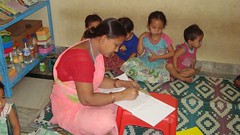
Mollika is one of our creche teacher. She is a quiet and dedicated soul who does her work with utmost diligence. She never misses a day, never complains.. the perfect teacher. Last month she took ten days off as she was unwell. She came back looking pale and tired but git back to work without a whisper. Only her smile seemed to have been lost somewhere. A few days later her sister who works for me told me that Mollika had been diagnosed with a TB infection that was not infectious but required long term medication. Like all Indians she had gone to the Government hospital where all tests had been done and she had been given a long list of medicines she had to take for six months. The tragedy was that for the past four months her husband had lost his seventeen year job and they had finished their meagre savings. Being extremely proud people they had told no one about their plight and hopes against hope that the husband would find a job.
Mollika took her prescription to the chemist to purchase her medicines but came back empty handed. The cost for one month was an astronomical 4200 rs, more than her salary. She just bought a week’s supply. That was all she could afford. Now TB is under a WHO programme that is well advertised and called DOTS or Directly Observed Therapy (DOT) for the Treatment of Tuberculosis. Millions have been spent to promote it. Through DOTS patients can get free medication under supervision. Seems almost miraculous but the ground reality is not quite that. First of all Mollika should have been told by the Safdarjung Hospital to join the programme. Instead she was handed a prescription and asked to purchase the medicines form the open market. She should have been informed about the necessity of taking medication for six months and the consequences if she did not. She was never told anything. She should have been informed about the DOTS programme. She was not.
When Manu got TB and was almost dying we tried to get him into the DOTS programme. But in spite of our explaining to the doctors and health workers that he was in no stage to move, let alone visit a centre four times a week, they were adamant and would not budge from their position. That is maybe why DOTS is not as successful as it should have been. We had no option but to purchase medication from the market. We have bough one month’s supply for Mollika. We will try and get her registered in a DOTS programme but I am a bit skeptical! Let us see how it goes.
For Mollika and the likes of her there are no super speciality hospitals… wonder if that will ever happen. Till then we can only do our little bit.
Mollika has two teenage school going kids. Sghe needs all the help we can give her.