
equal opportunities
 A comment on my latest post reads: A comprehensive solution that caters for reduced population growth, offers equal opportunities to all Indians, offers a fair and just judicial system, and a fair market where people can achieve their goals with no fear is what we need. Wow! Wish one knew how to conjure that, but sadly one does not have the magic wand required. The commentator feels that we cannot limit ourselves to education and perhaps he is right, but to me it seems to be the only logical starting point that may one day open many doors.
One does not have to be a rocket scientist to realise that in today’s day and age, the well educated have a head start in life and maybe the Education for All programme should be renamed as Good Education for All or Fair education for All!
While I was writing this post another comment dropped by. It said pardon me, but i fail to see the social evil of a prestigious educational institution raising its bar. the tougher the goal, the harder one works, the better the ones who qualify and the better the end result. Education is a right, but excellence is a prize one must earn. It is sad indeed that your students will now not be able to enter DU, but surely there are other places they can, and if they are not motivated/empowered to begin with, what magic is an admission in a university going to make? I am saying your students are to be blamed for bad performance, i have worked among high school dropouts and i know at least some of the difficulties and so i suggest you turn this in to an incentive for the rare motivated child, than turn it into an opportunity to complain.
I mean no ill will, this is not a rebuke, please do not take offense, i merely want you to think again.
I must admit that at first it raised my heckles. But with all due respect to the commentator who chose to remain anonymous I did think again as suggested and rather than go into a useless diatribe I chose to answer each point made.
There is certainly no social evil in any education raising its bar provided every bar down the line is also raised. I mean let us raise the pass percentage of school leaving examinations. When I was a student the highest marks veered around 65% with a low of 33. Today we see 99% at one end still 33 at the other. The tougher the goal the higher one strives is again an acceptable maxim but how does one reach that goal if one of the contestant has to run the race with his feet tied up. Let me explain in some government schools – and I have this from the horses’s mouth – the entire curriculum is not even taught as iIwas told by a school Principal: only 40% is needed to pass. And I am not even mentioning minor adavantages like educated parents, access to good books, computers etc.
No Sir, most my students will not access prestigious institutions but not because they do not have the ability to do so, but because they have run a lame race from the beginning. And true there is no magic in an admission to a university, but every child has a right to this access.
Of all that has been written in this comment, the one thing I cannot and will not accept is that my students are to blame for bad performance. How do you blame a kid who has never been taught properly in school. one that goes back to a violent and abusive home, one whose childhood has been hijacked by all. Every child has potential. It is our duty as a society to provide an enabling environment from him or her to grow to its full potential.
If schools did provide that enabling environment then there would be no reason to complain. Schools today simply reflect our society. They are schools for the rich that become richer and school for the poor that seem to become worse by the day. If one has air conditioned facilities the other does not even have toilets or drinking water. School has to be a level playing field, a learning experience, a place to discover that other realities exist, a space to rub shoulders with all and share knowledge. Only then will every child have the possibility to access higher portals and contribute to the change we all seek. And only then will I accept the accusation levelled against my kids.
Yes anonymous friend I have thought again, and it has made my resolve stronger. It is time we offered equal opportunities to all Indians.
musings
 The Delhi University cut off lists are out. A whole 1% higher than last year! You need 90% and more to secure a seat in a prestigious college, and at least 75% to find space in DU (Delhi University). Anything less than that leaves you with few choices: a correspondence course or if you family is endowed, a seat in the new kids on the block: the mushrooming private colleges and institutions that come at a hefty price.
Statistics show that over 100 000 kids passed their class XII Boards. However one wonders where most of them will go as the pass percentage marks remain frozen in time. 35% still gets you your exam and 60% still gives you the 1st division tag.
Something is not right. Or are we mute spectators to a system that pays lip service to education for all while ensuring that the spoils remain the prerogative of a few.
For almost a decade now we have been striving to ensure that children from underprivileged homes do not drop out of school and obtain the much coveted class XII Board. It has been a handicap ridden obstacle race. Practically no teaching in schools, illiterate homes, poor motivation of parents and more. And yet year after year we have ensured that all pwhy get the coveted pot of gold. I must admit that though we have had a handful of 1st divisions (above 60%) and a sprinkling of kids with 70% and above, the majority of pwhy children secure marks between 45 and 52%. This means that the doors of DU are closed to them. And as they all come form poor backgrounds, they cannot accede to private institutions. Somehow for them the journey ends there.
Boys may join some vocational course or the other and maybe a get a job; girls are condemned to stay home waiting to be married off and produce more children who will be destined to teh same fate.
The sad reality is that one cannot see the end of the tunnel. One may wonder where the solution lies or is it that we just accept that we are fighting a losing battle. We all seem to agree that education is the magic potion that would change India. But is it the kind of education that we see around us today?
a unique hour
 How many of us do actually switch off lights when we leave a room, never leave our computers or TVs on stand by, segregate our house waste shut the tap off while we brush our teeth, carry a cloth bag during all our shopping sprees, or travel in a car pool. Not many I guess. But are we not also the many who lecture others on all of the above, nod our heads vigorously during any debate on saving the environment and are the first to sign any petition on the same.
Yesterday someone mentioned a recent article predicting that the North Pole would actually melt this summer. His words brought terrible images to mind, yet before this could truly sink in, the conversation that was threatening to become disturbing moved on, as is too often the case, to a lighter vein. Somehow we always tend to push away what has the potential to rock our boat.
Yet the writing is on the wall: global warming is no more a topic to be debated it lies at our doorstep as we have seen this summer in Delhi. True that there was practically no summer this year, no hot searing heat that sweetens the melons and kills the mosquitoes. True again that the rains came early and the temperature remained low. But this is no cause to rejoice as it is a portent of things to come. Nature has been disturbed and no one knows what lies ahead.
Awareness on environmental issues has been something that we at project why have tried to disseminate, and I say tried, as I must confess our attempts have not been successful or maybe not wholehearted enough. Most of our efforts failed as they clashed with mindsets – our children will never clean streets was the answer to our no plastic programme – or social attitudes.
And yet we know that something needs to be done. It is with this in mind that I approached a friend who walks the talk as far as environment issues go. What I sought was a scintillating project that would look good on the pwhy CV! What my friend suggested was quite the contrary. Have every one follow a zero carbon hour, was his quiet suggestion. I was a tad confused as it made no sense to me. He set out to explain his idea. What he meant was that each one of us, collectively or individually, should once a day or once a week spend one hour where we ensure that our carbon footprint is nil. Translated in other terms it means that for that one hour we use no cellphone, no computers, no iPod, no TV, no cars, no electricity, no fuel of any kind. And further translated in practical terms it means that for one hour you just take a walk or sit in a park or in a room weather permitting.
At first it seemed nothing short of preposterous and yet as I pondered over it, it was a overwhelming. A simple idea and yet one that had immense power as not only was it kind to the environment but also good for us individually. A forced meditation pause that would ensure we get off the spinning wheel and reconnect with ourselves. And there was no excuse as it cost nothing, needed no props or training and could be followed by all.
At this moment of time I do not know how this will be accepted by our team. I do foresee obstacles and hurdles but at the same time I know I am going to use all the power I have to see it happen: maybe not an hour to start with but 30 minutes; maybe not everyday to begin with but once a week but we at project why will adopt a zero carbon hour programme.
To be continued…
Why is God laughing…
 Why is God laughing is the title of Deepak Chopra’s latest book. I have not read it. Yet, just the title filled me with a deep sense of joy.
A review of the book states: it shows us without a doubt that there is always a reason to be grateful, that every possibility holds the promise of abundance, and that obstacles are simply opportunities in disguise. In the end, we really don’t need a reason to be happy.
Why is God Laughing. I guess simply because he sees the big picture and knows that ultimately all falls in place. And I guess wisdom lies in realising just that.
We, humble mortals, have perfected the art of holding on to the tiny bad moment forever, wallowing in it, and refusing not only to let it go but refusing to look beyond. And thus zillions of happy and almost perfect moments pass us by.
I must admit that there was a time when I too did just that. But pwhy changed it all. The past few years have shown me that every moment is worthy of celebration and that nothing is too daunting; one just has to have the ability to wait that little extra moment as even the darkest cloud has a silver lining.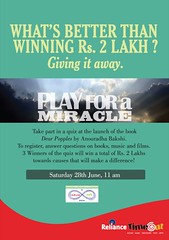
You can think that there will never be a way out of the momentary darkness, and yet there is. And what is amazing is that the way out is often most unexpected. When Basant first came to me, I could not even begin to imagine how we would help this little family as dice seemed loaded against them. And yet God was quietly laughing as he knew the way out. And what is truly wondrous is that the solution would bring together unrelated things. The launch of dear popples, a precious personal dream, would also usher a new dawn for Basant’s family
And this is but one example, the latest in a series of plenty. I never imagined how manu, utpal. babli, neha and many others would come out of their darkness, and yet they did, each one of them in the most unexpected ways.
Yes God is laughing and I am busy being grateful!
farewell class of 2008
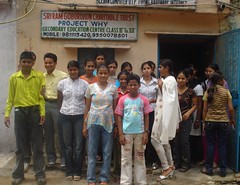
 This is project why’s class of 2008. They have all passed their Boards examinations and are ready to taken their first steps in the outside world with confidence and aplomb.
But yesterday was party time and this picture was taken just a few minutes before they set out for a movie and a treat. I watched them set off with a sense of pride laced with a dash of sadness. This was probably the last time I would see them all together. The morrows belonged to them.
One just hoped that the few years they spend with us would help them in their new ventures. Some are planning to go to college, others are looking for vocational training options. Some may soon be married and others may need to start working to help their families. Some may drop by and see us; others we may never see again. And yet they remain part of us.
farewell class of 2008!

The world is full of wonders..
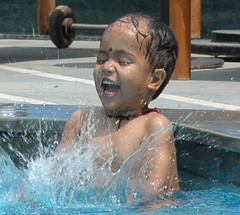
The world is full of wonders and miracles but man takes his little hand and covers his eyes and sees nothing. The words of Israel Baal Shem came to my mind when I saw this picture after a long time. Actually I was putting together a presentation for the launch of dear popples and hence looking through old pictures.
Anyone looking at this child splashing away in a five star pool would never believe that he had once been practically written off by all! And yet today he lives, laughs, goes to a boarding school and is just another little happy boy. He is one of the many miracles that have come our way but that we tend to hide by covering our eyes with our little hand. Or is it that we at project why have simply become inured to the plethora of wonders and miracles that have come our way.
A young girl who tops her school, a handful of kids who are busy making up for lost time now that their hearts are fixed, a young mother fighting a debilitating disease, a disabled beggar who now has a warm bed, a home and a new family, a bunch of kids who would have dropped out of school but who now are assured of a sound education and a small family quietly waiting for a miracle.
I am glad that seeing this lovely snapshot brought Baal Shem’s words to my mind. Far too often in life we tend to glean over tiny problems and minor impediments and forget all the wonders around us. And lost in our limited vision we simply forget to be grateful for the abundance that surround us.
It is time we took away our little hand from our eyes and simply looked around with us with gratitude.
they wait for a miracle
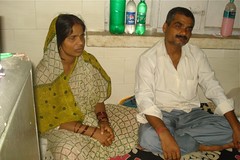
 In a tiny room where barely a bed and a small cupboard fit sit Basant and Rekha. They have been living in this ‘free’ dharamshala (hospice) for almost a month now, but this has not been their first stay here. They are now old hands at living in hospitals across the land.
Their story beats any of the tear jerking celluloid tales so popular in the sixties, the only difference is that it is not a story but real life. The quiet acceptance and the sated dignity are not performances that will beget national awards. The love, tenderness and compassion chiseled on Basant’s face is not for the cameras, it is what he truly feels for his blind wife. He does not even remember how long it has been, or how many hospitals in how many cities he has visited to try and rekindle the light in the eyes of his wife. They have now been at AIIMS for the umpteenth month an were held the last blow a few days back: the cost of medicine that may restore some vision to Rekha’s eyes was so prohibitive that they did not even take the name of the pills that come at 45o rs a piece and of which 2 have to be consumed each day for at least 30 days.
There is no anger, no bitterness, no indignation; at best what one feels is a sense of dignified resignation. Many blows have come in the way of this couple but they have accepted each one of them and tried to move on. It was only a few weeks ago that Basant was told that he needed immediate heart surgery at the mind boggling cost of 100 000 rs. More figures that have far beyond the realm of reality for them. A date was fixed: 7 June 2008. It past as they were unable to pay the money.
For this man who once had a small business and enough money to live an honest life, living on charity must be belittling, yet he stand patiently in queue for the daily packet of milk or ration that is doled out. He knows he has no other option.In a few days they will be thrown out of the hospice as no one is allowed to stay for more than 30 days at a time. They have scant options: to go back to the village beaten, or try and find a way out.
I came to know about them a few weeks back and since have been trying to get the help they so need. But we need in a world where charity has taken strange avatars. It is easy to get help for a child, perhaps a woman but when you seek the same for a man, you are just shunned. Yet in the broken heart of this man lie the morrows of four souls: three little children deprived of the presence of their parents and their mom. It is no wonder that Basant’s heart needs mending. For too long it has carried the weight of a love no one understands in our world.
Away from their children they wait patiently for a miracle to come their way, for now only a miracle can save them. They have exhausted all other resources. Maybe it is time we start looking at ours. We cannot or will not give up. We will ask Basant and rekha to move to our women centre and keep on knocking at doors till we find the one that hides another heart as big as Basant’s.
Is the God of Lesser beings listening.
They can brighten up this world
 When i first thought of planet why as a sustainability option for project why I had never heard of social enterprise and social business. It was simply a gut feeling that propelled me in this direction and with every step I walked, it just felt right.
From day one, it has been I must admit, an arduous journey. And yet I knew it was one that had to be made as the destination held its own pot of gold.
Two unrelated occurrences came my way a few days back : one was the gift of a book and the other a simple line in an email. The book was by Creating a World without Poverty by Nobel Laureate Mohammed Yunus, and the line in the email came from a young professional riled over the injustice she saw around her. It simply said: the other way to look at this is to assume that economic prosperity once established in a quorum population will ignite a string of social entrepreneurship. but that’s a wait and watch game. Strange synchronicity.
Mohammed Yunus’s views echoes what i have always felt and could not express. The world of philantrophy in which I have been always seemed to fall short of something. It was obvious to me that it could not survive the test of time. Business had always been an alien land where I never felt comfortable. The when you get your maximum, everybody will get their maximum often thrown at you by those holding capitalism at hart, was nothing short of galling. There had to be a via media.
The via media solutions that one saw around us also fell short: state run programmes, NGOs depending on donors to survive let alone grow, CSR initiatives that seemed out of place. The common denominator for all of these was that they espoused a state whereby one group remained a donor and the other a recipient. They all celebrated an unequal world.
Mohammed Yunus’s view tilts the balance in order to establish an equal world by redefining capitalism or let us say by adding a new dimension to the words capitalism. Businesses run with the same efficiency not to line deeper and deeper pockets but to change things and make the world a more even playing field.
The idea of Planet Why stemmed form a real need, that of ensuring pwhy lives on. As it slowly took shape it started looking like what is called a social business. A sound investment option in more ways than one. And though the road is still long and the journey far form over somehow I see light at the end of the tunnel.
So I will end by quoting Mohammed Yunus: Lets get serious about social business entrepreneurs. They can brighten up this gloomy world.
they came calling
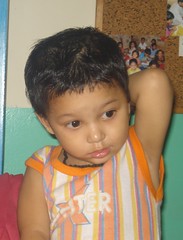
We had two special visitors last week. Little Deepak and Shubhum. For those who may not remember or know them they were both residents of our heartFix Hotel.
Deepak is now a big boy, over two years old and a far cry from the cerulean baby we all feared for. Today he is all set to join our creche and take his firs steps into the big world. A lovely spirited child for whom we know, there is no looking back

Our next visitor was young Shubhum who has come to Delhi from his native village in Bihar for his six monthly check up. An endearing child, Shubhum is keen to study and his dream is to become a doctor. His father a humble tea vendor is doing his utmost to give him a good education in the best school available. Shubhum is already in class V. With young Shubhum came his little brother Rohit.
I often wonder what the God of Lesser beings has in mind when he makes his road maps. Rohit who looks like any normal child suffers from microcephaly. A slow learner with delayed milestones, Rohit is also an aggressive child with poor social skills. Rohit will need specialised care, something not available in his native home.
We have decided to support Shubhum’s studies and are now looking for options for little Rohit.
just like the salt
 To many pwhy is just an education support programme with some forays into community work, a clone of many such organisations that dot the land. I guess it is in some ways quite that, in spite of the many small and big moments we have lived in the past nine years. Yet there is another side of pwhy, one often concealed and veiled and yet one that is as precious.
A heartwarming mail dropped my way this morning. It came from a very special volunteer who had spent a month with us last year. It simply said: The past 2 weeks have been emotionally tolling for me, but somehow Divinity told me to drop by Pwhy blog. True enough, I felt much better after that. At times I ask myself why, till I came across this story yesterday in my friend’s essay:
A little monk liked to complain about everything he does, about life in general. One day, his teacher asked him to go buy some salt. When he returned, the teacher poured half packet of salt into a glass of water. “Drink it”, the teacher commanded. The little monk did, and whined, “Bitter!!” The teacher then brought the monk to a lake, and poured the remaining salt in. “Drink the lake water”, he said. The monk scooped a cup of the lake water, drank it and, with a big grin, exclaimed, “Refreshing!!” Morale of the story? The amount of pain we have in life is the same, just like the salt. Whether we taste it, depends on how large the container – our heart – is.
I guess this is why Project Why always makes a difference. It opens up my heart and lets me realize there is no point in fixing my eyes on the “small” persona.
I read the words many times. They brought a sense of fulfillment laced with a tinge of sadness. In the last nine years I have seen pwhy change not only the lives of the target beneficiaries, but surreptitiously transform the lives of many young people who come from the four corners of the world to spend some time with us. If each volunteer who has come by has left a little of his or her self, they have also taken with them a little of pwhy. Some keep in touch regularly, others time and again. But each in his or her way have shared the fact that the days spent as made a tangible change in their lives. The sadness I mentioned earlier is that most of the young souls have been from other lands or live there. I have not been able to stir the same feelings in those who live round the corner.
I however still believe in miracles, and hope that one day they too will learn to look with their hearts.
are times really changing
 The spiralling and sky rocketing price of petrol in the past few weeks has finally, or so one hopes, brought to fore the need to pause and think about the necessity to change our ways. Till now the pleas of environmentalists fell on deaf years. At best we nodded agreement to all that was said/written/seen while we fans or ACs ran in empty rooms in our own homes.
Words life carbon footprint and emissions made good erudite conversation points, the news of glaciers melting brought the right expression of concern, but nothing got translated into action. It was always felt that others were responsible for all the horrors that befell our planet, our contribution to its slow destruction being oh so negligible: what difference could we make.
Even we at pwhy stand guilty of this as we let our awareness and environment programmes wither away. Somehow it found no takers, or perhaps were we not committed enough. Our only true contribution I guess is our use of green fuelled vehicles , a decision taken I must confess not for environmental reasons but practical and humane ones: the three wheelers have better access in slum areas and are owned by parents. I guess one has also time and again made the politically correct noise but how far have the words been translated into action. Not far at all I must admit. True we have solar energy at our women centre but here again it was a gift from a friend.
Our forays into saving the environment have been too far and few. It is so easy to slip back into comfort zones.
The recent petrol hike has shaken everyone out of ts torpor as it now hits where it hurts most: our pockets. Even the powers that be are talking about reducing carbon footprint: cancelling foreign jaunts and looking at alternative means of transport is the latest mantra being chanted in political circles. Recently a foreign visitor wondered whether the metro when it is completed would change things; his question was simple: would people like you and me adopt it as an alternative means of transport leaving our cars behind. Sadly the answer is in the negative. While we are willing to take metros and tubes on our foreign holidays, I wonder how many of us will take the metro to work or to visit a relative on a weekend. One can here again quote Don Ritter “Trying to save ecosystems has more to do with changing egosystems.” It is all a matter of egosystems and unless we change those nothing will really change.
People are finally seeing their dreams come true: the new Bentley or gleaming bike have just come their way so how can you ask them to park them and take a walk and a metro ride. It would be anathema. Will the new petrol price make a difference? I wonder.
Every price hike is finally taken in one’s stride. Smokers still smoke, and Bentleys and Mercedes still drive around. So one wonders what will truly shake us out of our inertia ad compel us to change? I again wonder.
The recent rains are once again a proof of our blinkered view of life. We urban animals and city dwellers are celebrating the cool clime totally oblivious to the fact that this freak weather may delay the monsoons and hence affect the crops.
Are the times really changing….
the times they are changing
 Once upon a time, not so long ago, an afternoon at the cinema was a treat almost anyone could afford. For less than a hundred rupees two persons could see an afternoon flick and even eat a greasy burger or share a fizzy drink. Cinema was for the masses. Halls were huge and catered to large numbers. The number of movies produced were in accordance with the need of such large audiences. Box office was defined by the number of viewers as well as the number of times one saw the same film. Catching a first day first show was almost a ritual. Cinema was for everyone. It was one of the platform where the two Indias met on almost level field.
Was it too good to be true or did the Gods get jealous? Or was it once again the lure of what lay beyond seven seas or just market forces at play? Who knows. But came the day when the playing ground was redefined and the first multiplex appeared. A new invisible wall was surreptitiously erected. Suddenly what was once open to all, became inaccessible to some. A simple movie ticket was out of reach.
I have never been a movie goer and was quite unaware of the change. Slowly many of the cinema halls that dotted our area started closing for renovation, a renovation that rung the death knell of an era. Yesterday I decided to give a treat to Utpal, Kiran, Chanda and Radhey. The idea was to send them all to the movies, or rather should I say to the multiplex. Two adults and two children. I did not quite know how much money to give them. I handed them 1000 Rs thinking that they would also be able to buy themselves some lunch. I was horrified to learn that almost 800 rs were spent on the tickets alone and the remaining 200 barely got one cold drink and a bag of pop corn. You see in today’s new environment only branded eateries can operate in the swank halls. Gone are the days when you could grab your greasy burger or patty. And of course UtpalKiran being above 5 were treated as adults! And multiplexes have only one rate, even if you are placed in the front row. A great leveller but sadly in the wrong side of the spectrum.
Movies, at least in big cities, are no more for the poor. What was once entertainment for the masses and provided a few hours of much needed escape to many, was now the preserve of a few. You could not more plan a Sunday afternoon family outing. It would cost you a month’s wages. This is today’s reality. The times are indeed changing…

no big deal
 The picture you see may, at first glance, seem innocuous and anodyne. A bunch of smiling young ones chaperoned by an also smiling older one. True that they seem to come from different lands but in today’s shrinking world this is no big deal!
This is what it looks like and no offence to anyone thinking just that. However this snapshot tells an incredible tale. It begins with the meeting of four young persons belonging to different worlds. Janaki is a pwhy alumni, and one we are terribly proud of. She came to us some years back, a spirited bright girl with an insatiable desire to learn. Not only was she a keen student but also one that never shied of anything that came her way. Meeting new people from unknown worlds, participating in any activity proposed, spending more time than necessary at pwhy in the hope of acquiring that little bit more. She completed her class XII last year by obtaining a 11th position in the whole of Delhi. Today she is in college doing not one but two courses.
Willy, Gordon and Lilly are but a few year older than Janaki. They come from the land that conjures success in measures larger than life. When Willy was just about Janaki’s age, an age when kids have glitzy dreams and boundless aspirations, he came to India to volunteer in a school and took a first step in a world that would change lives forever. Deeply moved by the plight of children of a Lesser God, he with some freinds decided to do something. And boy they did. At an age when you are barely considered an adult, they set up a foundation to help organisations engaged in developmental work. And in the span of a few summers thousands of children from the four corners of the world were touched by the magic of these incredible kids.
We at pwhy were privileged to receive an email from them last summer and from that day onwards there was no turning back. They simply walked into our hearts. For almost a year we exchanged mails and were overwhelmed by the unstinted trust and support we got. It was a rare privilege.
A few days back they flew into Delhi and we finally met. But somehow we felt we had known each other for an eternity. Though we knew they were one of a kind, we were overwhelmed by their warmth and kindness. And as we discovered each other, we realised that they were exceptional human beings. It was a meeting of spirits where neither age, nor culture, nor social origin, nor any of the things that normally qualify and often divide human beings mattered. We all spoke the same language.
It is a times like these that I allow myself a few stolen moments to pat myself in the back. As I have often said, pwhy is my swan song and also my magnum opus. I know that it is my last chance to do something I can be proud of. And though I live by stringent canons, moments like the one frozen in this tame picture make my heart swell with pride, till I quickly move on to simply being grateful.
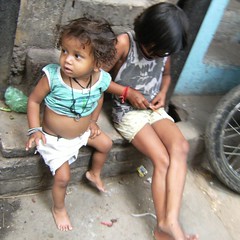
of pink elephants and green skies
There is a time in every child’s life when a cardboard box becomes a house, a stick becomes a sword and a bedsheet becomes a tent, a castle or an entire kingdom.
A child does not need much to create a world.
Give a child a few crayons and a blank sheet of paper and a pink elephant may walk beneath a green sky.
There is nothing wrong with this.
The child is not making a scientific statement. The child is imagining.
And then, sooner or later, an adult says:
“But elephants are not pink.”
“The sky is not green.”
And the child learns that there is a correct way to see the world.
I sometimes wonder whether this is where we begin to lose something.
Every child is born with enormous potential. Education is meant to help that potential unfold. It should teach a child to think, to question, to understand, to imagine and to discover what the mind is capable of doing.
But too often education does something else.
It teaches children to remember the answer rather than ask the question.
It teaches them to reproduce rather than create.
It teaches them that being wrong is worse than being curious.
And slowly, almost imperceptibly, imagination begins to disappear.
Many years ago, when Project Why was still in its infancy, we held a drawing competition. The children came from different backgrounds and were of different ages. We expected to see different worlds emerge from their drawings.
Instead, we saw the same picture again and again.
Mountains.
A river.
A house.
Trees.
A sun rising or setting.
Perhaps a flower or a fish added for variety.
There were differences in colour and technique, of course. Some children drew with greater confidence. Some used brighter colours. But the basic picture remained almost identical.
It was the landscape they had been taught to draw.
That was when we realised how deeply the education system had entered their imaginations.
Later, we held a workshop and asked a group of teenagers to draw a mother and child.
The results were startling.
Many of the drawings returned to the same familiar landscape of mountains, rivers and houses. Very few children were able to draw something they had not been shown before.
Some simply said they could not draw from imagination.
They could copy.
They could reproduce.
But they could not invent.
The problem was not that these children lacked imagination. They had been children once. They had played, invented games and transformed ordinary objects into extraordinary ones.
Somewhere along the way, they had learnt that their own imagination could not be trusted.
I remember another incident from when my daughter was in Class I.
She was asked to write an essay on “My Mother.”
She wrote about her actual mother: a woman with short hair who worked.
She received an F.
The reason was simple. The teacher had given the children a model essay. In that essay, the mother had long hair, wore a sari and stayed at home cooking while the father went to work.
My daughter had written the truth.
The truth, apparently, was the wrong answer.
I remember being furious. I remember arguing with the school. And I remember eventually having to tell my child that sometimes she would have to write what the teacher expected.
I have often wondered what she made of that lesson.
A little later, she was learning the colours of the rainbow. She carefully learnt the spelling of “violet” as it had been written on the blackboard.
When I corrected her, she looked at me and said:
“But that is what the teacher wrote.”
She was right.
The lesson she had learnt was not about spelling.
It was about authority.
The adult is right.
The book is right.
The blackboard is right.
The child is wrong.
And so, little by little, children begin to surrender their own ability to question.
This is not an argument against knowledge.
Children need knowledge. They need facts. They need discipline. They need to learn how the world works.
But knowledge without imagination can become a prison.
A child who learns only to repeat may know the answer to a question.
A child who learns to imagine may one day find an answer to a question no one has asked before.
Imagination is not a luxury reserved for artists, writers or scientists.
It is what allows us to imagine another person’s pain.
It is what allows us to see possibilities where others see only obstacles.
It is what allows us to solve problems, invent, create, adapt and find a way forward when the obvious way has failed.
It is what enables us to imagine a different future.
And perhaps most importantly, imagination allows us to understand that our own way of seeing the world is not the only way.
That may be one of the most important things education can teach us.
A child who can imagine a pink elephant may grow up to understand that the world does not have to remain exactly as it is.
A child who can imagine a green sky may one day have the courage to ask why the sky must always be blue.
And a child who is allowed to ask “Why?” may grow into an adult who is not afraid to challenge what everyone else accepts.
The purpose of education cannot simply be to produce children who can pass examinations.
We should want children who can think.
Children who can question.
Children who can imagine.
Children who can look at a problem and see more than one possible answer.
Children who can understand that a mistake is sometimes not a failure but the beginning of discovery.
We have created an education system that often rewards conformity because conformity is easier to measure.
It is easier to mark an answer right or wrong than to assess curiosity.
It is easier to teach one standard essay than to listen to a child’s individual experience.
It is easier to tell a child that elephants are not pink than to ask:
“Tell me about your elephant.”
But children are not empty vessels waiting to be filled with information.
They are minds waiting to discover the world.
And perhaps our greatest responsibility is not to fill those minds with everything we know, but to ensure that we do not extinguish the questions, dreams and possibilities already burning inside them.
The world needs children who can see what is.
But it needs even more children who can imagine what might be.
So let the elephant be pink.
Let the sky be green.
Let the child draw a world that does not yet exist.
And let us be very careful before we tell that child that the world cannot be so.
Because perhaps, just perhaps, the child is not drawing the world as it is.
Perhaps the child is showing us the world as it could be.
And perhaps that is what education was meant to do all along.
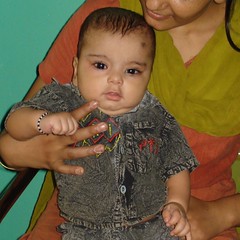
He who was a why to live…
 I have often wondered why pwhy came to be. A rather pointless question many may say as we are now in the 10th year of existence! And yet it is one that comes to my mind many times, always begging for an answer and never quite finding one.
The most obvious answer would of course be to reiterate our mission – arresting drop outs and keeping children in school – an on that account we have done pretty well. But there are innumerable organisations doing just that, and maybe better than of us. And does this explain the very organic manner of our growth, where we seem to take on new responsibilities at the drop of a hat, some a far cry from our stated mission!
Little Prakash once again makes me ask that question. A few months back we were content to see him play and laugh and thought that the story ended there. He was attending our creche and seemed happy. But then a few weeks back we realised that he was losing weight and suddenly he started looking more and more like his sibling. We took him to our doctor and were startled to find out that he be having hydrocephalus. A condition for which there is no cure and where the treatment is complex, expensive and delicate. It requires placing a shunt that needs life long monitoring. Something that a family like Prakash’s can ill afford. And yet untreated it can cause severe retardation and be life threatening.
The past few weeks has been a heady mix of events some thrilling, some just satisfying and some worrisome. The Board results came and went and the 100% result was accepted with a sense of deja vu, our eyes searching for toppers and we were rewarded as it is pwhy kids who topped their respective schools in both classes X and XII. Our land was paid for and though we still have loans to pay back and a whopping amount of money to raise for building planer why, we did feel a step closer to the day when we would be self sustainable. Those were the macro issues, the ones that seem in sync with all our mission statements and vision paper.
However the last few weeks were also replete with micro issues, those that concern individuals of no consequence, souls that no one would ever know exist: a 24 year old widowed mom who is attacked by a vicious disease; a 11 year old post heart surgery girl with a rare ailment, a father in need of help. And yet these almost invisible people did drop our way, almost as if guided by an unseen hand.
It is true that along the way, while we diligently applied ourselves to meeting our goals, mission and objectives, we were faced with many disturbing issues that needed to be addressed. Somehow it seemed impossible to brush them aside with a simple: we are an education based organisation. We simply accepted them and found the best solution we could, hence losing our carefully elaborated mission statements, vision papers and more of the same. To the outside eye we started looking more and more like a haphazard entity that never quite finds the words to describe itself.
We were never disturbed by this. On the contrary we found it to be the natural and obvious way to go happily adding on more whys to the already existing ones! Anything else would have been
unacceptable. And slowly we became who we are bringing to mind Frederic Nietzsche’s words: he who as a why to live can bear almost any how.
So to the question why did pwhy copme to be, the answer is simple: to bear the hows that came its way!
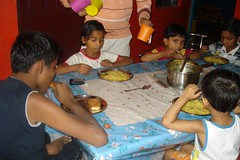
the trick is to finish with flourish
 “A person taking stock in middle age is like an artist or composer looking at an unfinished work; but whereas the composer and the painter can erase some of their past efforts, we cannot. We are stuck with what we have lived through. The trick is to finish it with a sense of design and a flourish rather than to patch up the holes or merely to add new patches to it” wrote Harry S. Broudy. These words came to mind as I sat this morning browsing the pwhy pictures taken last week.
Had someone suggested a few months back that one would soon be seeing Manu around a table sharing a meal with his pals in a proper home, I would have smiled and told the person to stop dreaming, reminding him or her gently that dreams took time to become reality. It would have been akin to fast forwarding a film to reach the end without living through the story. And yet the picture you see is no trick photography, it is reality, one anyone can share each and every day. The foster care was not even an idea in our minds, at best it was a distant and impossible dream.
For the last week or even more I have been avoiding the much needed task of setting out to seek help for pwhy. Strange as I thought I had overcome my almost innate reluctance to ask for money and should and could have picked my virtual begging bowl without fuss, any time needed. But I guess inborn feelings stay longer than one thinks.
But what needs to be done, has to be done. I knew time was of the essence and the task I had to be undertaken. And in order to do so, it was time to take stock of the past. In Broudy’s words I knew that nothing could be erased or painted over and that the work had to be finished with flourish and honesty.
So here I am again seeking support to see pwhy through. Have we reached the middle of the road? I think we have. Much of we set out to do when we began had been achieved in ample measure. The class X results declared yesterday reinforce the point. All the children passed and in in both class X and XII it is a pwhy student that topped his school. Many had made the journey from street to home and many other achievements big and small dot our firmament. We have met every challenge that came our way and have done our best in finding the right solutions. The sustainability issue that had for long been our Achilles heel, has now been addressed as we have bought the land needed for planet why. There is no looking back!
However as I write these words we are in a tricky situation: that of having to raise funds both for the building and the day-to-day running of the project. And our needs have grown as many new whys dropped our way and could not be cast aside as that would have been defeating the very spirit of project why.
We do manage to raise a substantial part of our needs but still fall short. Perhaps the reason for this stems from what I will call the soul of project why. For almost a decade pwhy has been able to survive and thrive because it is infused with goodwill, one that has come from the innumerable kind souls who have answered each and every call for help. Were it to be fuelled by impersonal sources – no matter how regular and steadfast – alone, it would cease to be.
To many this may sound preposterous and even old-fashioned in a world where success is measured by the weight of bank accounts and the size of buildings. But for me that is not so. The mere fact that we have been able to grow and thrive is the direct result the immense love that we have received from people the world over, many of whom we have never seen. Our success is the outcome of the trust and belief that had come with each coin dropped in my begging bowl. We have reached where we are because pwhy has never afforded itself the luxury of sinking into comfort zones that would rob us of our very individuality and make us pallid clones of others. It is but natural and essential that we fall short, as this is what will enable us to always remain who we are. Ours is a work where patches and holes are banished, and each corner of the painting or note of the symphony is part of the whole.
On a personal level it is also essential that I retain the ability to beg humbly and shed any misplaced arrogance no matter how innate it be. Only then will the intangible and indescribable riches that are vital to the very existence of pwhy continue coming our way
It is now time to finish the story with flourish, one that cannot end without the presence of each one of you.
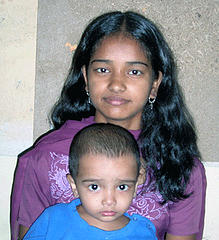
A lot of water has flowed
 This is a picture of Neha and Aditya taken almost three years back in happier times. Since a lot of water has flowed under the bridge. In those times questions were simple and solutions easy. Even mummy learnt to smile as she picked up the pieces of her broken life and wove them bravely into a new one.
Barely a few back just was working and had gladly accepted that Aditya become part of our foster care programme as she knew that this would give him a better future. Everything seemed almost picture perfect as we sat content in what we thought was a befitting conclusion of a journey started many months ago. We had conveniently forgotten about the big picture being busy putting final touches one the tiny one we could see.
Neha had been complaining of back aches, one that even compelled to take a break from the gruelling hours she put in at the beauty parlour where we worked. We advised her to se a doctor and take some rest. Nothing could have prepared us for what was to ensue.
One morning Neha came by asking for help as she had been asked to have an MRI and did not have the money to so. In spite of her smile, we could see the pain and knew that something was wrong. When the results came we were shocked. Neha had advanced tuberculosis of the spine and many of her vertebrae had collapsed. The diagnosis was confirmed by a bone specialist. it was a miracle that Neha was still walking. She needed immediate immobilisation and even then the prognosis was terrible: risk of paralysis, permanent damage to the back and poor chances of recovery, septicemia from the risk of any of her abscesses bursting .
She was advised complete bed rest for at least 3 months as any movement could entail paraplegia. Neha has no one; even her mother has walked away from her life. Her only family is 5 year old Aditya. She needs to get back on her feet; anything short of that is a death knell.
As I write these words she lies in terrible pain in a room at our foster care. In a few days she will be moved to a room on the ground floor of the dame building. A day time nurse will look after her and at night a distant relative will take care of her. Neha weighs a paltry 32 kilos. The ordeal that awaits her is terrible and she knows it.
I have often prayed for miracles but am at a loss as I do not know what to pray for. Even the best case scenario is short of what Neha needs. A deformed back or life in a wheel chair is no life at all for this young single mom. What we need is a real miracle, the kind that is not fabricated by us humans but one that only He can make true.
A miracle for a little boy who plays and learns unaware of the reality that may become his!
So help me God!
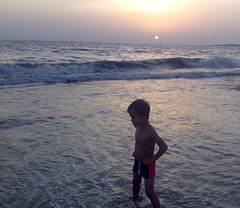
met mrOcean
 One day Popples you will meet mrOcean. Many of your friends live close to it and many have promised that they will take you there one day…
These words were written almost 2 years ago and are now there for all to read as in dear popples. I must confess a little sheepishly that I had then hoped that I would be the one to make the introductions. But that was not part of the larger picture. Mr P met mrOcean last week when he was in Mumbai spending a few days with his new. friends: Abhigyan, Mrinal and Vedika. I wonder what went into his little mind when he saw so much water. I guess we will never know. All I know is that they will be tucked away in his little mind to be recalled at the right moment, when he is in need of reassuring himself.
Utpal has had an ace holiday in Mumbai. One replete with memories of things he never knew existed: a flat on the 22md floor, a shower cubicle, swimming in a pool with goggles, the feel of a real family with a father, mother and grandparents, a train ride over. And to crown a trip in a plane, like the ones he sees flying over his school every day. And of course the huge helicopter balloon he had to give up to enter the plane and that the misses terribly.
I know he was a handful to his impeccable and kind hosts but what a holiday it was. The kind he could not have ever conjured even in his wildest dreams. Here are some stolen moments:
| www.flickr.com
|
never say never
I would have never believed that one day I would be seeking help to fund the surgery of a man! Most of the hearts we have fixed are those of children, barring Nutan who was a mom and her children’s life depended of her survival. She was taken care of and is now back in her village.
Rekha was a young spirited girl when she got married to Basant a kind hearted man. Life was going on well. A few months later she suffered a terrible fever. She survived but the drugs given to her were too strong and led to her losing her sight and hearing. For some months the family took her to a bigger town and yet another. But to no avail. Everyone told them that her eye sight was gone forever though perhaps something could be done for her hearing.
Basant’s family then tried to convince him to send her back and find another bride. But this man was made of another mettle. He stood his ground and told them that she was his wife for the better or the worse and that he would stand by her till the end. The young couple set home and in years to come three children were born. Basant tended to Rekha with affection and tenderness. He looked after her and helped her in all chores, even those considered infradig by his peers. Whenever he could he use to try and seek specialists and even took her to Bangalore in the hope of restoring her sight. Their meagre savings dwindled fast.
A few months back he had brought her to the All India Institute of Medical Sciences as he had been told of a possible next procedure that may restore her sight. One morning he got up with excruciating pain in the chest. he was diagnosed with a heart condition and was told that he may need open heart surgery. An angioplasty was performed and a stent was inserted in the hope that things would settle. But things did not work out and the pain came back. He needed open heart surgery.
The cost was prohibitive: 100 000 rs!
I would have never thought that I would be the one appealing for help for basant. there are many reasons for this. One is that he is the sole support of Rekha and her three children. Were anything to happen to him, she would suffer a fate worse than the darknes she lives in and her children’s future would be jeopardized. But that is not the only basis for my appeal. There is a much deeper one.
Basant is the kind of man one does not see in India, particularly in Bihar where he hails from. No man stands up for his wife, more so a blind one. And to do so with compassion, love and tenderness is unwonted. Were anything to happen to him, Rekha would be derided and shunned as a harbinger of bad times. There is much more at stake than just a life.
I hope we will find the support we need.
wondrous are his ways
 The project why journey has been astounding in more ways than one. At every step, miracles big and small have dotted its path with regularity making one believe that the big picture theory really exists.
When we began the foster care programme, there was a huge debate about how to select the handful of kids that would launch the programme: social profile, performance, home situation.. The options were many. Finally four children were selected. Aditya and Babli being two of them. At that time none of us was aware of the real reason.
A few days back Aditya’s young mother came by our office. We could see the pain written on her face in spite of the smile she bravely put on. We had known that she had left her job as she had been complaining of back ache but nothing prepared us for what was to come. She wanted help to get the expensive CT scan her doctor had asked for. The scan was done and to our utmost dismay she was diagnosed with advanced Pott’s disease or what is knows as bone TB. Many of her vertebrae had collapsed and huge abscesses dotted her spine. The prognosis was not good: she could suffer paraplegia and septicemia.
Aditya’s mom had no support system as after her husband’s death she cut off her links with her own family. She had decided to bring up her child alone and after training as a beautician was working in a parlour earning enough to survive. Two months of sick leave had depleted her of her meagre savings. And to crown it all, her landlord had asked her to vacate the tiny room that was her home.
Aditya’s mom is at the foster care for a few nights. We will take her to hospital and start her treatment. Will she be saved is another part of the big picture cannot see. We will do our best and hope that things go well. We do not even want to think about what could have happened had things not fallen in place. We only know Aditya is safe and his mom in good hands.
When we invested in Babli’s tiny heart, we thought that like in all other cases she would thrive and grow after her surgery and fulfill all the dreams that she had conjured in her head. The script went awry many times and each time, we intervened in the best manner possible, or so we thought. On the way, we did wonder why, unlike other children, Babli was not growing, but felt that it was due to poor nutrition and care.
When we were about to launch our foster care programme, someone suggested Babli as one of the inmates. In spite of her advanced age, we all agreed that it would be a great idea, as the child was intelligent and would benefit from such a programme. A few days after her joining our housemother shared her concern about Babli’s constant bed wetting. Yesterday she was taken to the doctor and diagnosed with hypo parathyroid, a rare condition stunts growth and depletes the body of its calcium retention of the body. It can be treated and reversed with proper life long medication. Babli is now having all tests and investigations required and should soon be on the way to recovery and to leading a normal life.
When we selected Babli and Aditya we were totally unaware of the real reasons that had guided these two children our way. Today we know…
Wondrous are His ways…
It tolls for thee.
 A few days back we got the visit of the representative of a very up market page 3 organisation. This organisation funds various NGOs by organising high profile fund raising events. As we sat chatting in our new foster care building, the lady told me about a new venture of theirs whereby they are sponsoring school fees in up market schools for a handful of very underprivileged children. Actually what she was trying to convey indirectly was her disapproval of the amounts we were spending on the foster care residential programme.
While we were chatting, our children sat quietly finishing their lunch.
I tried to the best of my ability and with as much fervour and passion I could muster to explain to her that a child from a deprived or dysfunctional poor background would never be able to fit and be accepted in an up market English medium school. He or she would feel lost and would not be able to keep up what is required of him or her. Moreover ‘home’ or what goes by the name would not be able to provide him or her the support needed.
My mind went back to a blog where I had shared my feelings about the reactions of people to our foster care programme when it was being launched. Today it is in its third month and though there have been many teething problems, we have never felt that our decision was wrong.
I would not have written this post were it not for a totally unrelated incident. Utpal is in Mumbai spending a few days with Abhigyan and his family. The first few emails were positive ones and then came one where I could feel that Popples was being difficult: tantrums and demands bordering bad behaviour. I must confess that at first I was upset and went into denial and then apologetic mode as any doting parent would. Much later when the heat and embarrassment of the moment has passed, I realised that it had been naive on my part to expect that Utpal would behave like a perfect child in an environment totally new to him. That he accepted to stay in an unknown home without batting an eyelid and with comfort and ease, is in itself huge. He is only 6 and he has had a lot to deal with in the 2000 odd days of his life.
But that does not condone bad behaviour one would we tempted to say, or does it… The urge to balance out his misfortune is not easy to put it in Abhigyan’s words. I cannot but agree. But let us take our thoughts a step further. Till date Utpal was never seen, let alone spent time in what you and I call a family: a papa, a mummy, siblings, maybe grandparents. He has never known a structured home. The only structure he has experienced is that of a boarding school. He has no role models, no examples to emulate, no mentor to walk him through such moments. He survives by instinct and the closest he has been to a home is probably mine, where he knows he gets what he wants courtesy his ever indulging Maam’ji!
We, and here I talk about all those who think they are a cut above the rest being engaged in doing some form of social work or the other and who would like to believe that lives can be transformed by doling out the needed amount of money to pay fees, books and more of the same, have to take a moment to pause and think. If that were so, how easy it would be alter destinies. But the reality is quite different. Education is not just imparted in schools however good they are. Nurturing and building lives start in homes and with parents or guardians. It takes time, patience and above all the will to truly want to do so.
When the idea of what is today our foster care programme was first mooted by a potential donor as part of what we call planet why, these are the words he chose to use: A residential foster care programme for a maximum of 20 bright children where children from deprived backgrounds will be given an enabling and nurturing environment to be able to excel in education and access to employment possibilities. The children ( a maximum of 20) will be kept at planet why for an incubating period of 4 to 5 years and then be sent to boarding school. Emphasis will be on creating an environment close to those found in educated homes, with stress on English and building self-confidence. At that point of time I must admit I was not in a great bargaining position but the immediate reaction that many of us had was that this was far too ambitious if not impossible and that the way it was spelt out reeked of social engineering.
However the die had been cast and even though the initiator of the idea backtracked at a later stage we were left holding the proverbial baby and there was no retracting. The only battle I had won was to begin with a trial with a maximum of 4 to 6 kids. The task was daunting albeit exciting and just the possibility of being able to perhaps change a handful of lives could not be set aside. However one must stress that right from the word go, we knew intuitively and logically that if this was to succeed, we had to keep the kids in residential care at least for part of the week.
Education as I have said time and again is not just imparting the 3 Rs; it goes much further and has to cover life skills. Something that tends to be forgotten. I recall with a smile one of the brainstorming sessions we had early this year about where the foster kids would spend their summer holidays. Our erstwhile donor had suggested that they be sent to homes like yours and mine and wondered if there would people who would accept them. A no comments on this one barring from saying that this person lives outside India and is not aware of the reality that surrounds us.
We will find a solution for Popples, and our fostercare kids are learning to unlearn before they begin learning again.
Life goes on as always.
To quote john Donne: “All mankind is of one author, and is one volume; when one man dies, one chapter is not torn out of the book, but translated into a better language; and every chapter must be so translated…As therefore the bell that rings to a sermon, calls not upon the preacher only, but upon the congregation to come: so this bell calls us all: but how much more me, who am brought so near the door by this sickness….No man is an island, entire of itself…any man’s death diminishes me, because I am involved in mankind; and therefore never send to know for whom the bell tolls; it tolls for thee.”

to sir with love
 The class XII results are out and once again all the pwhy kids have cleared the dreaded Boards! This is now the nth time in a row! There was a time when I remember spending a sleepless night before result day and pacing up and down till I was given the news. In those days results were not on line and one had to wait for the teacher to come back from the school where they were posted.
This year Naresh our secondary teacher just came to the office with his list of roll numbers and a few taps on the keyboard and we knew that all the kids had once again passed. No sleepless night, no angst. Just a feel of deja vu!
Naresh sat with paper and pencil computing the marks to get the percentages, a number essential to chart out the future. Gone were the days that a simple pass was enough for jubilation. Now it all depended on that extra half percent that could make all the difference. As I watched his serious face bent upon his sheet of paper I realised that all this could not have been possible without him. It is Naresh who has almost single handed, year after year, with rare dedication bordering on obsession ensured that pwhy kids have cleared their Boards!
The words of the title song from the movie To Sir with Love came to my mind: But how do you thank someone, who has taken you from crayons to perfume?It isn’t easy, but I’ll try. Every year we congratulate the kids, eat the sweets proffered and organise an outing. But this year kudos need to go where they are due: to sir, with love!
In the winter of 2001, when a deriding remark from a school Principal about the impossibility of a bunch of class X students to clear their Boards had led me to throw the gauntlet and accept the challenge of ensuring their success. That year we simply had a small spoken English class and helped a few primary kids with their studies on an ad-hoc basis. The bunch of boys were students of the spoken English class and the reason for my trip to the school was to find out why one of them had been beaten without apparent reason.
The next day the boys came, huge smiles on their faces and hope in their eyes. We had no classroom, no teacher, no funds. But what we had was the determination to win the challenge. At that time Naresh had just finished his college and was looking for work. I had hear that he use to give tuition to school kids. I asked him if he would help us and he accepted. Classes were held the pavement in front of our single class room, in the biting cold at 7.30 am with many cups of tea! That was how our senior secondary section began.
Naresh is a born teacher and teaches with compassion and unseen commitment. For him it is matter of pride to see his students do well even if that means extra classes early morning or late evenings and even on Sundays. He handles his section almost single handed as no teacher ever meets his expectations. And his students are infused with the same passion, as they often come well before time and wait for him with eagerness. Naresh has turned many failures into toppers and is always there for his students as a teacher, mentor and above all a friend. That is what teachers should be.
So today it is to Naresh that I say: hats off or chapeau bas!
remembering them
 This blog is not meat to be a personal one, nor is it meant to be one for reminiscing the past or delving in nostalgia. Yet today I beg your indulgence as I take a brief pause to remember Ram and Kamala on this day that would have celebrated 59 years of their union.
This blog is meant to share the project why story, but would there have been a pwhy, if Ram and Kamala had not walked this planet. I wonder.
The loss of a parent is always difficult to come to terms with. It digs a deep bottomless pit in your heart and soul, one that is impossible to fill, even with time. A word heard out of context, the whiff of an aroma, the chirping of a particular bird, the sight of an innocuous image are sufficient to trigger a Proustian reaction that is ample to bring back every single memory you had laid to rest.
Yet today it is not with sadness that I remember them, but with a sense of peace and fulfillment. The huge void they had left was not only filled but is now almost overflowing. It has been filled with the smiles of every child at pwhy, with the hearts repaired, with the report cards held out with pride every year, the big and small achievements of children of a lesser God: the first drawing made by one who could not hold a pencil, the first word babbled by one that could not speak, the first step taken by one who was never meant to walk. And they live on in each and every moment of pwhy’s life.
Ram and Kamala gave me the most beautiful gift: that of life itself, and then went on to colour it with muted lessons of hope and courage. I just hope I have been worthy of what they taught me subtly and without fuss.
Pwhy could not have been without them as it is in many ways a reflection of who they were: a spartan erudite humanist and a woman of well beyond her times who wanted to change things and led by example; a reflection reinterpreted by the one who loved them unconditionally.
Today I simply remember them!
a losing battle?
 We work hard to raise money so that we have the opportunity to help people but the more children we educate the more are being born that… so we are tempted to say that education will help our people to overcome poverty but if the resources remain the same and the population continues to grow… it’s a losing battle.
These very frightening words were sent by a dear friend who is a volunteer with an organisation that is deeply involved in education projects all over India. This friend also is a young highly educated Indian the very people on whose shoulders the destiny of India lies. I understand her concern ans perhaps would have shared it had I not been part of project why!
The education scenario in India is abysmal. But it is not only the state of education for the poor or underprivileged but also that of the so called rich and extremely privileged. A strange caste systems now prevails in school and one wonders what schools have become.
The simple definition for the word school in any dictionary is: a place for educating children. The crux of the matter lies in the definition of the word education and the one we at pwhy adopt is the one based on Delors 4 pillars of education: learning to know, to do, to be and to live with others. He says: these four pillars of knowledge cannot be anchored solely in one phase in a person’s life or in a single place. There is a need to re-think when in people’s lives education should be provided, and the fields that such education should cover. The periods and fields should complement each other and be interrelated in such a way that all people can get the most out of their own specific educational environment all through their lives.
To me the most important pillar remains: learning to live with others as therein lies the true success of education and this is sadly what is disappearing from the society we live in. Schools should be a level play field but is now turning into a mirror image of the social strata you belong to and the habitat you live in. Hence the richer you are the fancier looking your school is, and the poorer you are the more pathetic it will be. So any exchange, peer learning, learning to live with others is doomed to fail as you remain within the tiny part of society you belong to.
But I have digressed as the concern voiced here was that of population growth, or have I really? That is the moot point. Education we all agree is a spring board that can enable one to change one’s destiny but is the education we are today giving the children of India the right one to do that? The question raised has within it another element that we may tend to overlook: static resources or we can even say dwindling resources. And I speak with a certain authority as I was spent almost a decade raising these very resources.
Education alone can change the destiny of India and even help arrest population growth and maybe one day reverse it. Sadly it is perhaps not the kind of polarised education we see around us but one that would merge different strata of societies into schools that look like schools and not of seven stars resorts or slum backyards! That in itself would alter the content, change mindsets and bring a transformation that we cannot begin to imagine. All election oriented and fund draining dramatic programmes will lose their relevance as a symbiotic learning will emerge on its own.
Today we have idiosyncrasies like a pass percentage of 33% and a college entry point of 90+%! reservations in higher places of learning when we know the slum kid will never reach. These could slowly vanish on their own without laws and programmes.
But there is also another change that such an approach can bring. It may also address the resource issue as the better off kids may in such a situation become aware of their won responsibility and add to the resource pool. Pay it forward a simple fiction made into a movie launched a movement and a foundation. A child helps another and in return asks him or help to help three others and so on.
When we took on the challenge to give four kids the best education possible we were derided by many, particularly by those belonging to the rich side of the spectrum. And yet everyday these kids shows us that we cannot be wrong. In a pay it forward situation a rich kid could sponsor a poor one who in return would commit to help three or any number when her or she was in a position to do so.
Daydreaming? Perhaps or perhaps not. Change requires bold and seemingly preposterous action. Only one thing remains unchanged education is, cannot and should not be a losing battle!
We have to find the resources both financial and moral to go on!
a deafening why
 A mail about little Radha’s plight dropped by this morning. It asked some stark questions:when you run in to such cases have you been able to get any insight in how the parents intended to support so many children? what were they thinking when they had 4 children in one room? is there some way you have found to communicate that there is no difference between a girl and a boy?
I wish I had answer to these questions. But this is one of whys for which we have sadly not found answers till date and yet it is one of the most deafening ones as therein lies the solution to many of the problems that plague our society. Yet it is almost one of the most inaudible ones too!
Parents like Radha’s produce many children often in the hope of the one or more son that seems to be the touchstone to gage the credibility of women in our land. And this definitely transcends all classes of society and all creeds. As they produce one child after the other they are not aware or thinking about the future of these children or about they would support them. That is often left to God! The paradox of this quest for the elusive son is that they are all aware of the reality that each girl that comes along the way is a burden as she will have to be one day married but that does not stop them.
The flip side is darker as is proved by the terrifying figures of the sex ratio in cities like Delhi where the rich can find ways to abort their unwanted girl child and the poor just abandonned them in garbage dumps or door steps. According to Nobel Laureate Amartya Sen there are 38 millions missing women in India. So in a way Radha’s family should be lauded as at least they did not get rid of the unwanted daughters.
To the question about how they intended to support these kids in a tiny room the answers are again baffling and multiple. Having many children stems out from an atavistic past where many children died in infancy, children were extra hands on the land, where life was self contained and did not need stepping out from the habitat of origin, where families lived in clans and support systems were many. Sons were prized as they ensured continuity and protection of the land. The feudal system ensured protection of farm hands and those who did not own land as their being was a matter of honour.
When society changed and land got divided and could not feed the families it belonged to and as cities grew and were in need of labour, rural exodus started and simple illiterate families came in search of work and a better future. But the urban dream turned into a nightmare and with the total absence of any regulation and above all any housing policy, slums mushroomed helter- skelter and families found themselves living in dark hovels. Radha’s family is still small, sometimes over 10 people live in such places. I remember one case where the father was so tall that he either had to sleep at an angle or keep the door opened for his feet to stick out.
Life is a matter of survival in urban slums. In many cases people are daily wagers and the meal depends on what is brought home each day! It comes to a stage when people stop thinking beyond the day and live life one day at a time. But traditions, mores and atavistic instincts remain. Maybe they become a sort of lifeline in a world too strange to fathom. The yearning for boys is kept alive in spite of the fact that it has lost its meaning, the obsessive need to keep every ritual remains. I was horrified at the money spent for all the death rituals of an old woman who past away recently. The family, simple scooter drivers, fed almost 1000 people for 3 days. On the other hand the poor lady who died was never looked after. I shudder to think at the amount of money that is now owed to the loan shark.
So coming back to the questions asked by my friend and particularly the last one: is there some way you have found to communicate that there is no difference between a girl and a boy? The answer is sadly no, in spite of screaming one’s self hoarse and standing on our heads. There are more than 50 posts on this blog about the girl child and her plight some chilling beyond words. Every day the government announces new programmes for the girl child but rarely do they reach deserving beneficiaries because of complex paperwork, and often do not address the real problem as they are often looked at as simple monetary sops.
If we truly want to find viable solutions in my opinion one needs to be addressed are core issues. One of the main reasons girls are unwanted are that they need to be married and that marriage is a huge money drainer. Boys on the other hand bring money, cars, scooters, fridge, houses etc. Politicians, religious leaders and we the so called educated class should be the ones to set the right example. But sadly the now (ill)famed big fat Indian wedding is turning obese! And what is even more tragic is that in today’s India brides are being killed or forced to commit suicide because they have not brought enough dowry. This happened less than a month ago to young Astha whose parents had given a Mercedes car as part of her dowry. Till weddings mean money girls will not be wanted and boys welcomed.
This of course explains the different ways in which boys and girls are treated in families: education, food, pampering et al!
The other factor that I feel is never talked about let alone highlighted and is the cause of much pain in the lives of women is the fact that the woman is not responsible for the sex of the child. The X Y chromosome story is one that is never told. One cannot begin to imagine the number of women even rich ones who are derided and scorned for not producing that prodigal son. This is even true in rich and educated families. A simple campaign highlighting this could make a world of difference. We are all aware of the hue and cry raised by the so called conservationists and upholders of moral values when sex education was introduced in India. Not only is this essential is a country where AIDS figures are becoming alarming, but could be a way of also explaining how a child sex is determined and who is responsible for it.
There are solutions, but where is the political and social will to seek them, let alone implement them.
A deafening why no one is willing to hear!
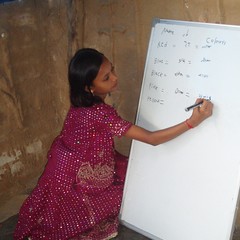
we just assume it is written for someone else
 “Most of us can read the writing on the wall; we just assume it’s addressed to someone else.” wrote Ivern ball. The recent dastardly blasts in Jaipur sadly confirms this saying. While bodies still lay unclaimed, while families are yet to come to terms with the horror that has hit them, while reality is yet to sink in, the now jaded reaction drama is in full swing. Speeches are made about the spirit and resilience of the people of the land; blame game have begun targeting other political parties, and other nations. Sops are promised out to grieving families, wonder how many will actually reach the right hands, and wonder how money can heal loss.
The innumerable intelligence agencies are pointing fingers at each other. VIP’s are planning visits to the maimed city and thus ensuring front page coverage hence displacing all the disturbing and embarrassing issues making us almost wonder about how well timed the blasts seem to be. And international sympathy is surging.
The writing is on the wall but we all look away. Every day in our own city there are rapes of children and vulnerable women, carjacking have become the order of the day, murders for a few pennies abound, neighbours kill neighbours for a handful of coins, road rage is rampant.
The writing is on the wall as walls visible and invisible are built to widen the gap between caste, creed, or social status ; new malls and stores multiply with quantum leaps while tiny businesses are sealed and road vendors banned in the name of aesthetics.
The writing is on the wall but we just assume it is written for someone else as we carry on unabashedly, stopping maybe just for that small instant to mumble a few appropriate but empty words.
And yet everything points at the indubitable and unavoidable reality that all is not well in the world we live in. That sooner than later all of this may just happen to us, that we are not protected by impregnable walls. It is time to read the writing on the wall and accept that it is for each one of us.
post partum blues
For the past few days I have been in a state of postpartum blues, the kind women suffer after the birth of a child. Doctors have their own complex clinical explanations but to me it is simply the feeling of overwhelming emptiness that comes after what you have waited for, desired, expected, prayed for finally comes your way and instead of the feeling of elation should come your way, it is a terrible emptiness that engulfs you and leaves you rudderless.
Last week saw the realisation of two incredible feats came my way: we managed the garner all the funds needed for the land for planet why and are ready to close the deal, and dear popples got published. I should be jumping with joy, planning a holiday or a bash but al I feel is terribly empty and at a complete loss.
What comes to my mind are Oriana Fallaci’s words: To fight is better than to win, to travel much better than to arrive, once you have won or arrived you feel a great emptiness, and to overcome your emptiness you have to set out on our travels again, create new goals..
That is where I stand now. Needing to create new goals, charting new travels, conjuring new dreams as again in the words of Oriana Fallaci: to have realised your dreams makes you feel lost!
And there are many, some small, some huge, some seemingly easy others daunting. Garner the figure with a staggering numbers of zeros needed to build planet why, assemble the much needed money to run pwhy for the next months and then he next one; find the support to ensure that the foster care kids complete their education, find a possible treatment for little Radha, and maybe start writing another book: the project why story!
Yes to fight is much better than to win, to travel much better than to arrive. It is time set out on a new journey…
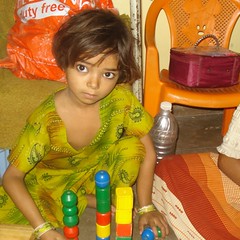
we believe in miracles
Little Radha is 7. She suffers from ostoegenesis or brittle bone disease has terribly deformed legs and is unable to stand. The slightest fall or hit causes a fracture as her bones have become terribly porous. She has already had more than a dozen in her tiny life.
She came to our office in the arms of her mother clad in a fleece outfit. The ambient temperature of the moment must have been 40 degrees Celsius. When we asked her mother why she was wearing such an outfit, the answer was simple and direct. She had no other decent clothes.
Radha lives in a sunken hovel, the roof of which is lower than a person standing and where not a shred of light enters. Her father lost his job as the factory in which he worked closed. He now sells tea but can barely make both ends meet as they have 4 children. Radha seemed a healthy child till the age of two when she first fell and broke her leg. It was then that she was diagnosed with osteogenesis.
1 in 60 000 children get osteogenesis and little Radha is one of them. Also known as brittle bone disease the ailment has no known cure. Management of the disease includes focusing on preventing or minimizing deformities and maximizing the child’s functional ability at home and in the community. Sound doable but in a home like hers it is close to impossible. Support groups exist but not for someone like our little Radha. The prognosis is scary as it not only affects bones but can result in brittle teeth, loss of hearing and easy bruising. The main cause is little or poor type of collagen.
Wheelchairs or braces are recommended and exercise like swimming is extremely beneficial. But where does a child like Radha go to swim or how does she use a wheelchair in the hole in which she lives. A child with OI needs good nutrition, rich in calcium, leafy vegetables, cereals, milk products all not within reach of a family that barely survives. The doctors had suggested this but for a family that can barely feed 6 mouth this was quasi impossible. And little by little her legs contorted as she suffered one fracture after the other.
New research suggests the use of bisphosphonates that seem to have has excellent results but that still seems at a trial stage. We will of course look into it!
Radha was denied any form of childhood and could not accompany her siblings to school or play. She just lived in her dark hole and dragged herself from one corner to the other. Two of her siblings come to our creche and that is how we came to know about her. Thank heavens her spine of head did not suffer any fracture!
Radha is an intelligent child who could learn like any other seven year old but her ailment closed all doors to her. We hope to be able to help her as best we can. As you know we at project why believe in miracles!
making memories
”We want to preserve their childhood days so that tomorrow if they ever want to see how they were, where they were, they could easily get to see those precious moments. We gift a CD to the parents of the adopted child,” says Madhuri Abhyankar, Director, Sofosh Orphanage.
This is a new initiative launched by an orphanage is an extremely sensitive and a step in the right direction. Adopted children often have the desire to know where they came from, what happened to them, why their natural parents abandoned them and so on.
Childhood needs to be preserved as nothing is worse than not knowing, even the if the truth is harsh. I wonder though how a child would feel of he or she finds out that it was left at a doorstep, in a garbage dump, at a railway station or simply to die. This is the case in India today.
A touching comment on a recent post says: Our 6 year old daughter was a 7 day old foundling left abandoned with a note in the train station at Kattack. Our 12 year old daughter was abandoned after birth at St. Ann’s Hospital in Kumbakonam. I often wonder if their birth mothers ever think of them, wonder about them, worry for them, if they realize what they gave up. I pray that these were the last desperate acts of desperate women hoping that their child might possibly have a better lot in life and not just the disposing of an unwanted commodity.
In a country where life is cheap and the life of a baby girl even more so, where babies are sold for a few farthings for nefarious ends, one wonders how many children do reach orphanages and how many are condemned to lives with no hope of escape? And yet no matter how sordid one’s past, there is a journey everyone has to make at some time of his or her life.
These memories frozen on some digital media will undoubtedly one day heal many hearts
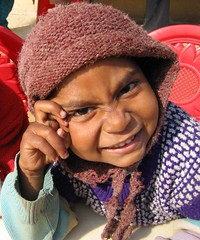
where are you rakhee…
 Rakhee was one of our brightest little sparks. She had first come to us almost 4 years back when she was about 2 year old. Her story is one of total hopelessness and despair. When you hear it you may feel that is a one in a kind but sadly it is the story of many little girls in this land. It is also one that shows that in spite of our best efforts, there are times when we stand helpless.
Rakhee’s father is a construction labourer, one of the millions who flock into India’s capital in search of work. We first met her when her father got work on a site close to our project. They had pitched a small shack on the road and though we passed that way every morning we never saw her.
One day one of our teachers walked into the office quite agitated and told us about a pregnant woman who seemed to have a broken arm and yet carried heavy loads all the time. The woman was Asha; she was not more than 16. She was 8 months pregnant and her arm had been broken by her drunk husband and never attended to. It had just set on its own.
We did take her to the hospital but were told that nothing could be done.We looked after her and fed her emaciated body as best we could. Rakhee joiner our creche. A few weeks later Preeti was born. Asha told us her story: orphaned at a young age she was brought up in an uncle and aunt who married her off to the first man they found. He drank, gambled and beat her with obsessive regularity. He made her work too but there was never enough money to eat.
For some time we helped the family as best we could and even gave Asha a job but nothing truly changed. Preeti grew up in our creche and we got attached to her. But things remained the same in her home and no matter what we tried nothing changed.
One day the little girl stopped coming. We heard that they had shifted to another site. A few months later Asha came back carrying her two kids and told us hat her husband was in jail as he had been caught selling hooch. Once again we helped her and the little girls came back to project why. Rakhee was ready for class I and we were hoping to admit her to regular school. The husband was released and we even gave him some work hoping that it would bring some respite to the family. We were aghast when we heard that Asha was pregnant again but then did we not live in a land where everyone wanted a son. Blissfully the next child was a boy.
But the story did not end there. Once again the family disappeared. Another job on another site. Rakhee was never put in school. She joined the ranks of the thousands of kids that sit on road side while their parents work on the innumerable construction sites that have sprung in our city to make it world class!
Some time back we got news of the family via a surreptitious phone call made by Asha to one of the teachers. She was pregnant again and had been brutally beaten by the police and even kicked in her stomach, as she was caught selling hooch. Her husband made her do that forcibly while he gambled and drank.
We tried to call her to find out where she was but the wily husband had changed his phone number.
Little Rakhee and her siblings are somewhere in this city in state despair and misery and we have no way to reach out to them.
At timea like these I feel totally utterly powerless.
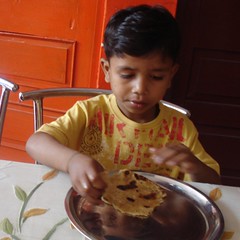
Butter would not melt….
 If you look at Vicky you would think of him as a very quiet and obedient kid. Butter would not melt in his mouth as the saying goes. The reality is quite different as the teachers at the foster care discovered.
Vicky belongs to an extremely poor family and being the youngest boy and the only abled one he has been spoilt silly by a doting but totally illiterate mother. His father a rickshaw puller is barely at home and Vicky was often left to itself playing with older children in the slum, and learning all he wrong things.
It does not take long to change ways in the harsh reality of a slum. We have seen it happen with Babli’s brother Ramu, one of our brightest kids some time back when he was still in primary school. We had a lot of hopes riding on him but they all shattered as Ramu got into the wrong company. Today he barely attends school and has started gambling and other nefarious activities. It does not take long for the slums to take you down.
That is maybe one of the reasons that I held on to the foster care programme in spite of all the criticism and warnings. Maybe, if we took the kids at he right age we would be able to change their lives. Easily said than done.
Vicky the Angel with a halo when we are around turns into a unmanageable brat once our back turned. He has been driving the staff up the walls and also instigating his pals to rebellion. At night when all are meant to sleep, the double life of Mr V begins. Plans are whispered using words that would make a sailor blush. Mostly about what would be done to us once they grow up: I will plant a knife in them whispers Vicky while the others nod. Who do they think they are these ***** and so on. All this heard by he teacher pretending to sleep.
When we confronted Vicky, he just kept quiet, his head bowed, butter would not melt…
Next day we called his father to tell him that if Vicky’s attitude did not change we would be compelled to send him back as he also refused to study. It was heart breaking to see the father’s face as he implored us to keep his son. He simply said that were he to go back to the slums he would become even worse as the environment was not conducive to any child’s proper growth.
We have of course agreed to keep him for the time being. Could we do anything else.
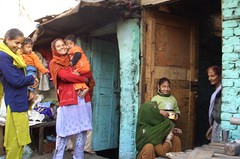
and never the twain shall meet
 A glittering report was aired yesterday about the new home of one of India’s richest man. Quite a home: 27 floors, 400 000 square feet of space, bathrooms as big as flats, private cinema theatre, gyms and juice bars, 4 floors for parking and all for one family! At a whopping two billion dollars it is the world’s most expensive home!
In another part of the same country Jyoti lives with her family and neighbours in a slum. Her home has 80 square feet and no bathroom or kitchen but is her home and she has made the best of what she has: a little shelf displaying some steel crockery- remains of her dowry-, few plastic decoration pieces bought at the local china bazaar, a little TV that brings the world into her home and lots of smiles and giggles as she proudly shows her dog eared photo album.
A few years back when we still were running a centre at the Lohar basti – the gypsy camp – little Ritu a spunky 3 year old whose house was one of the last ones of the camp was often given the task of showing her home to visitors. She lived in a shack covered by a tarpaulin where one corner was filled with rags as her father a ironmonger by trade often picked rags to supplement his income. The dwelling has one large bed piled with clothes, a small rickety cupboard and not much else. It was dark, dingy and humid. I remember a day when I asked her to show her ‘home’ to a friend who had come by. Ritu the ever confident kid, bearing the age old pride of her clan firmly took my friends hand in hers and holding on to her slipping pant with the other marched off. We followed her. As she reached the entrance of her home she said with the confidence of a queen in a loud and clear voice and a regal gesture: Yeh Hai! – This is it-, as if her home was a palace!
And what was heart warming and wrenching at the same time is that it was she felt. This was her home, a place she loved and where she had spent happy moments. The visit was not over. She invited us in, cleared the bed, made us sit and set out to give us a tour of the place. She opened the cupboard and showed off her clothes and those of her parents and then looking for her mom simply said: chai banao – make some tea!
Needless to say we were all moved to tears as millions of questions begging for answers ran through our mind begging for answers. Why were people still living like this in a country that boasted it was shining!
Strange that this incident should come back to my mind today after seeing images of the most expensive home in the world. I simply wonder whether the richest family can ever feel the same pride that the little gypsy girl.
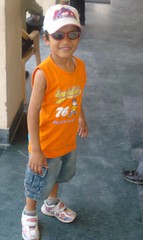
popples a true hero
 Had Popples not come into my life, Dear Popples would never have seen the light of day. The young man you see in the picture look nothing like the bundle swathed in bandages, his huge eyes filled in pain who walked into my heart on a March morning in 2002. This one looks more like the pasha – read hero – he wants to be.
Yet Popples changed my life in more ways than one. He taught me hope, love in its purest form, survival no matter how dark the hole you are in is, but above all he became the mirror that showed me who I was, what I had become, and how I could change with time.
Popples makes dreams come true, even very old ones, those you have forgotten or even relegated to some dark recess of your mind as they seem ludicrous and even absurd.
I must have been 15 or or so when I first read Bonjour Tristesse, by Francoise Sagan and as luck would have it I read it sitting on the terrace of a Latin Quarter in Paris. The book not only had the kind of story that would make any young girl swoon, but was written when the author was 17 and has failed her end of school exam. That was the time I think I first dreamt of writing a book!
But books need stories, the kind that wrench your heart and soul, the kind that ring true, the kind that touch others and my life seemed dull and almost jaded. And whatever creativity a young mind could have had, was quickly silenced by the monotony of life.
But dreams do not die. They just wait patiently for the right moment to resurface, even if the right moment is light years ahead. Popples was the catalyst that brought the discarded dream back to life.
My publishers have categorized it as fiction: inspirational and I am deeply grateful for dreams belong to that realm, or do they? I think Abhigyan and Mrinal have put in words as only they can, what I have always felf but never been able to say:
To accept the real is not to accept that it is perfect. Reality is like clay. It is the starting point and not the end of things. At the beginning of the race all runners are at zero. Reality. One goes on to win. He changes reality. Shapes reality. Those who fail – accept that reality and start again on a fresh race. Everyone is back on the starting block. Reality waits to be shaped again. The race is long. And it is continuous. Every moment reality awaits our turn to shape it. To deny it is to escape into wishful inaction. To simply accept it is to stay at the starting block forever. Only way forward is to run.
When our stories become ordinary and the ordinary becomes a virtue; then virtue itself becomes ordinary and the only extraordinary thing left is murder and mayhem. For it is easy to ignore daily goodness like helping someone cross the street but crushing someone on the same street under speeding wheels is bound to generate more interest. At least in these cynical times. Which is why it is the job of stories to exemplify and exaggerate goodness.
Goodness is not sticky when it is mundane. Murder is.
If we want a society of goodness, kindness, compassion, courage and excellence we must tell stories of extraordinary goodness, compassion and excellence. And the extraordinarily good, kind, compassionate and courageous is called a hero.
We are all ordinary but it is the stories of our heroes that inspire us to rise above the ordinary when the moment demands. Without heroes, with the ordinary grey protagonist, all we find are echoes of our own fallible, flawed selves and when the moment calls – the hero within us fails to stir because all he has experienced in life as well as imagination are defeat, despair, fallibility and flaws. When the forces of murder and mayhem confront us in their dark, blacker than Black colour, we are choked in our throats with grey balls of fear and apprehension while the white light of courage and conviction ebbs away from our heart like the blood from our veins.
There are no heroes in life when there are no heroes in our stories.
For life is a story. The story!
Anouradha & Popples’ is an extraordinary story. More so because they have lived it.
Abhigyan and Mrinal Jha

my dream catcher
 I must have been quite young when I first heard about dream catchers. As a kid it was comforting to believe that there was something that ensured that only good dreams came your way while bad ones slipped out. Someone had given me a dream catcher and I felt comforted having it hanging above my bed.
I soon grew up and the delicate dream catcher got lost as we moved from continent to continent and I forgot about it. It was only yesterday when I heard that Dear Popples was published that I suddenly remembered the dream catcher of my childhood.
The lore of the dream catcher is beautiful.
Long ago when the word was sound, an old Lakota spiritual leader was on a high mountain and had a vision. In his vision, Iktomi, the great trickster and searcher of wisdom, appeared in the form of a spider. Iktomi spoke to him in a sacred language. As he spoke, Iktomi the spider
took the elder’s willow hoop which had feathers, horse hairs, beads and offerings on it and began to spin a web. He spoke of the cycles of life….how we begin as infants and move on to childhood, and then to adulthood. Finally, we go to old age where we must be taken care of once again as infants, thereby completing the life cycle.
Iktomi said, “In each time of life there are many forces and choices made that can affect the harmony of nature, and interfere with the Great Spirit and all of his wonderful teachings.” Iktomi gave the web to the Lakota elder and said, “See, the web is a perfect circle but there is a hole in the center of the circle. If you believe in the Great Spirit, the web will catch your good dreams and ideas – – and the bad ones will go through the hole.
When I look back at the past few years I am sure that an invisible dream catcher hung over my life helping me make the right choices or how else would all that has come my way happen? But dream catchers are not just about choices and ideas; they are also about dreams. And though I hardly have dreams about myself, one seems to have got caught in some remote corner of the web: that of dear popples being published!
The Great Spirit thought otherwise and set his own wheel in motion and knowing that I would never find the time, the way, the force, the motivation to keep this dream alive, entrusted my dream to someone else. That was Abhigyan a true dream maker!
You do not thank Great Spirits and dream makers. You simply feel blessed that they came your way.
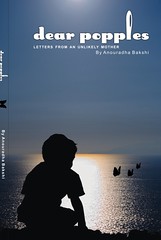
Dear Popples
 If two of you agree on earth about anything that they may ask, it shall be done for them by My Father who is in heaven. Matthew 18:19
Thus quotes the Bible and these words were sent to me by the one who made my dream come true. Dear Popples’s genesis began much before Popples himself came into this world. It actually began as a dream of a teenager growing in the sixties a time when everything seemed possible. It began in the head of a girl fed and overfed on books that were the sole form of escape of a lonely child growing up in different lands amidst too many adults. It began in the absurd dreams of a young girl sitting at cafe terraces in Paris imagining herself to be a writer.
Then life took over and decades went by but the dream did not. It sprung back on a summer day when the girl now an ageing woman came across a little child who was to redefine her life and stumble upon who she really was. The dream that had laid in waiting sprung up again and took the shape of a sheaf of haphazard paper where she poured out her heart and soul. But dreams as the Bible says need two people to make it come true as does creation. Where was the other half of the dream.
For many months the sheaf of papers lay in the recess of a drawer; it was sometimes taken out and shared with someone or the other but it quietly slid back into what seemed to have become its resting place. Then one day something impelled her to take it out, clean it up and begin the daunting task of finding the other half.
The rest is history. True that there were the needed string of rejections but those just made her more obstinate till the day someone miles away responded positively; the other half had been unearthed. Dear Popples had emerged from its dark abode into the light and the dream had come true.
I have never met Abhigyan Jha, my publisher, in person but somehow I feel I have known him for a stretch of time that transcends all spatial-temporal laws and defies logic and what I feel is not just gratitude but again something that cannot be expressed in words. I know he understands
Soon dear Popples will be for all to read and I must confess I am terrified.
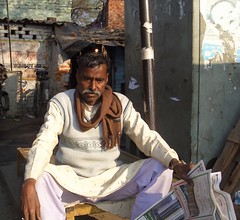
borrow a person
 I was recently sent a link by a friend about a new library fad: borrow not a book but a person and an interesting link to a comment on this new fad!
A lot of food for thought.
I sent this link to many friends and one of them said the following: we will soon begin to barter ideas and expertise on a peer to peer / person to person basis as that would be the only validation for being human and worthwhile.
you will not need a gardener to do the garden or mow the lawn – you will need him for his insight and creativity – the manual labor ill shift to robots and automatons.
which is all the more reason to educate our children about the conceptual reality if life. that we are nothing if we don’t create products of the mind. it can be values. it can be ideas, processes, products, advice, conscience, friendship, talk, coaching, teaching, storytelling, experience sharing – whatever but it has to come from the mind.
he goes on to add: we are human because we use our mind. period. the sooner we stop talking about the dignity of labor and start making it clear to everyone that there is no option to using our mind to create value which others might want to partake of – the better for everyone. otherwise we are going to see the kind of income inequality that we have never seen before.
Even in the parts of India where there is no food on the table – there is a mobile phone. and it’s almost free to use. Lifetime Free. and what do people do on the mobile phone – they talk. and why would the poorest need a mobile phone. because even for them talking, sharing, communicating is more important than just eating. the hunger of the mind is a bigger necessity than the hunger of the stomach.
His approach seem a little bewildering at first but of you stop a and think, what he says is true and what is alarming is that for once the two Indias’s hearts seem to be beating in unison. They are both spinning unconsciously towards a dystopic view of the world where the power of the mind is losing its importance.
When I was a young girl growing up in the mad sixties I saw Fahrenheit 451, a mind blowing movie by Francois Truffaut: a story about a society where books are banned and have to be burnt! A bunch of old men decide to memorise them so that they are not lost forever. The film end on a bitter sweet optimistic note: the said society is destroyed and a new one is about to be created: their first task is to build mirror factories, a literary allusion, to show people who they are, what they have become, and how they can change with time and knowledge.
Borrowing a person in a library seems akin to the Bradbury’s soft science fiction novella. And are we today slowly but surely moving towards the self destruction of our dystopic society.
On a more optimistic note I would love to borrow the idea and create a library where one could borrow people who still have in the recesses of their memories stories about the past, the traditions, the mores , the of forgotten and never documented anecdotes that threaten to be lost forever. A few years back DV Sridharan the creator of GoodnewsIndia began a series titled memory speaks. I remember having written a few pieces that had been told to me by my mother when I was still a child. Some were amusing others thought provoking and all in need to be preserved before memory failed. The series sadly stopped. Today’s new fad brought it back to me. I guess I too was a person that was once borrowed!
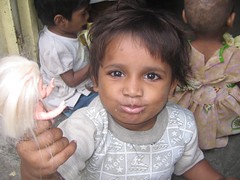
And motherhood dragging a doll by the foot
 If we Indians could take off our minds, eyes and ears from silly slaps by overpaid cricketing heroes and ensuing debates about the quantum of retribution; or stop debating about the appropriateness of the dresses imported and highly paid cheer leaders should or or should not wear – wonder who would pay for the new ones – ; or the inconvenience created by a new transport system, we would be compelled to see the horror that has been and is enfolding around us in the past few days.
Two baby girls are found abandoned in our own city, one barely a few hours old. A 12 year old is raped by a cop, a 5 year old by a so called uncle, a 36 months old by a relative and his friends, a 7 year old by another neighbour. 5 rapes of children and no one bats an eye lid.
Yesterday the prime Minister of India addressed a meeting on “save the girl child”. Time someone did: the latest figures are alarming, the sex ratio is declining: 927 to 1000 is the all India figure, 782 to 1000 is South Delhi’s figure. According to Nobel laureate Amartya Sen, there 100 million missing girls!
The PM made one valid comment: But it is not government alone that can address this problem. Though Government must be active in mobilizing public opinion in this regard. We need active civil society involvement in the national campaign to save the girl child.
This should make us stop and think. The startling figures of South Delhi are ample proof of the fact that we cannot any more brush the problem under the carpet and say that this only affects rural areas or the ‘poor’ as we like calling a large part of our own land. Rest assured we many not be guilty of throwing our new born baby in a dump or leaving her on a doorstep. We have the resources to beat he law and kill her before she is born.
I have often written about the plight of he girl child based on what I have seen around me. I remember a letter written to a child that died in the womb of her mother, or the post written on one of the days when India worships little girls. One must not forget that we are the greatest worshipers of the female form and energy and yet we kill, rape and abuse little girls with impunity. Is it not time to look at ourselves in a mirror with honesty. We all pay lip service to the save the girl child appeals, even make it our cocktail banter of the day and yet we are the ones that surreptitiously ask the name of the local doctor willing to perform a sex determination test for our pregnant daughter in law, whatever the cost!
The poor have another recipe: they keep producing daughters till the male child arrives or the mother stops being able to bear children. I have known of families where there are 11 girls and one boy! I am not going to go into the plight of the girl child, I think we all are aware of it. This post is meant to try and address the problem that is now alarming.
What is it that makes us abandon baby girls? This trend is of course more prevalent with the poor. The question is simple: a girl means marriage that means money in vast quantities. Boys are an investment they can bring all the coveted things; girls a drain because you are the one to pay for the coveted things. All laws banning dowry have failed. The demands are getting larger by the day. Even in slums people talk of cars. One of our teachers who is not very pretty and a bit plum and now 26 remains unmarried as her family cannot afford the Honda Accord that was asked! In states like Bihar it is hard cash. Our rickshaw driver married his daughter to a much older man because the dowry was only 100 000 rupees plus the cost of the wedding where there were 500 guests! The girl is just 18. So the simplistic solution would be rather than give the girls child cash incentives for her marriage as many of the proposed government schemes do, give cash incentives to those who spend little and give no dowry!
But things run much deeper: we are dealing with customs and mores and age long religious diktats and decrees that no politician would want to touch. And let us not forget the law applies to all so who wants to be deprived the right of a lavish wedding for his or her own child. Some of the latest trends are galling: helicopters for the bridegroom, international starts to perform and food imported from the world over and then thrown away as the display itself gives visual indigestion. So I ask are we really serious about saving the girl child.
As for child rape it is something beyond my comprehension in spite of the fact that child abuse is rampant even in he best of homes. Does it come from our so called prudish attitudes a legacy as was aptly said by someone of Victorian England as are we not the land of the Kama Sutra. And the only thing that could protect children – though maybe not 2 years old – would be a healthy sex education programme, but that is rabidly opposed by our politicians! Child abuse, far too often perpetrated within homes is protected by the code of silence and honour, something that has to stop.
Maybe it is time we looked at ourselves with honesty and bluntness and answered some disturbing questions even if it makes each one of us look pathetic and ask ourselves what we can do to save the girl child that leaves every moment of her life amidst unknown yet terrifying fears.
I will end this post with the words of Alan Beck:
Beauty standing on its head,
And motherhood dragging a doll by the foot.”
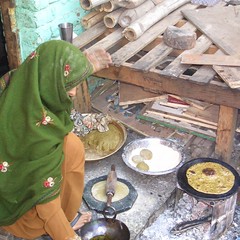
what have they done to the earth
 The world celebrated earth day this week. Wonder why as nothing seems to shake us from the state of catatonic stupor that makes us oblivious to the reality that surrounds us in spite of all media reports, activists’ pleas and terrifying figures thrown at us each day.
In recent days everyone has been harping about escalating food prices and a lot of government bashing has been going on. No one seems to realise that things are going to get worse and that the main culprit in this real life whodunit is each one of us.
A recent news report stated the following
Steady fall in food supply across the world due to stagnation in farm output.Climate change threatens to worsen food insecurity in the world’s poorest regions.
Rising temperatures will affect crop yields in 40 developing countries.
Global warming will increase food prices by 40 per cent.
But we still remain unconcerned and unaware. What is alarming is the quantum of food wasted in our country not only by the rich, but by the poor itself. In villages leftover food is fed to the cattle but in urban slums it is simply thrown on the streets! One of the hallmarks of success or status symbol seem to have become food wastage. Every garbage pile in the poorest of slums is always replete with left over food fit for consumption. People tend to pile up their plates and unabashedly throw what they cannot finish.
When we chided one of the children at the foster care about not finishing his plate, pat came the answer: I never finish it at home! What no one seems to understand is that food shortage is going to hit us sooner than we think. And it is not the government but we ourselves who are to blame. Our total neglect of the environment and hidden economic agendas are the real baddies here.
car. Feeble attempts at promoting common transport seem to go unheeded as it is Land once uses for food is now used for land depleting but pocket filling cash crops. The escalating number of farmer’s suicide in India seems to leave us cold as we are busy increasing our carbon footsteps with misplaced alacrity. Families have not one, not two but cars in double digits. Motorbikes have replaced cycles and will soon be replaced by the much heralded nano believed that almost 1500 cars are added each day on the already choking roads of Delhi!
Trees are felled to make place for these cars, open spaces converted to make way for concrete jungles. The show just goes on. Huge malls that are avid gobblers of energy are replacing smaller shops. India is in the move and the yet inaudible cried of the earth are quietened by the roars of the progress.
Every decision we make affects climate change and this moving documentary urges us to make the right choice.
As I see things around me, I a reminded of the words of Jim Morisson writen in the sixties but that seems so true in our times: